Getting from Velana into Malé and Hulhumalé: A Bridge, a Bus and a Boat
Before August 2018 there was one way from the airport into the capital: a boat. Guides written since still describe the Maldives as a country where you cannot drive anywhere.
The Sinamalé Bridge changed that. It runs 1.39 kilometres from the airport island to Malé, with a link road on to Hulhumalé, and the three-island core is now connected by road. Taxi, public bus or ferry — the right answer depends on your luggage and the hour.
This guide covers all three, what each costs, and the two timing traps — one on Friday, one at the seaplane terminal — that catch people out.
First, are you actually going to the city?
Worth establishing, because most arriving passengers are not.
Resort-bound travellers do not use any of this. Speedboat jetties sit directly opposite the arrivals hall and run around the clock, and seaplane and domestic flight connections leave from their own terminals. Your resort has arranged it, someone is holding a sign, and the bridge is irrelevant to you. Our transfers guide covers that side.
Guesthouse-island travellers may pass through the city to reach a public ferry terminal, in which case this article is your first leg.
Anyone staying a night near the airport — because of a late landing, an early departure or a seaplane window that has closed — needs Hulhumalé, and this article is the whole journey.
Anyone spending a day in the capital on a transit stop needs Malé, covered in our guide to the city itself.
The bridge, and what it replaced
The Sinamalé Bridge opened in August 2018 and connects Hulhulé, the airport island, to Malé across 1.39 kilometres of reef flat and open water. A link road continues in the other direction to Hulhumalé, the reclaimed island covered in our piece on what the country is building.
Before it, every trip between those islands was a boat trip. The ferry ran, it worked, and it was the only option — which is why so much travel writing about the Maldives describes a capital reachable only by sea.
Now the three islands function as one urban area with buses, taxis and a road network, and the ferry has become the scenic budget option rather than the only one.
For arriving travellers the practical change is enormous. A late-night landing no longer means waiting for a boat. Taxis run around the clock and the road is open at any hour.
Taxi: the default
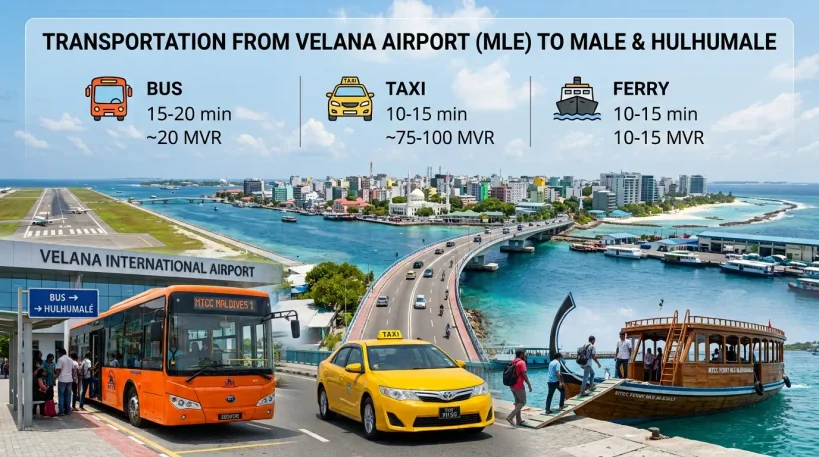
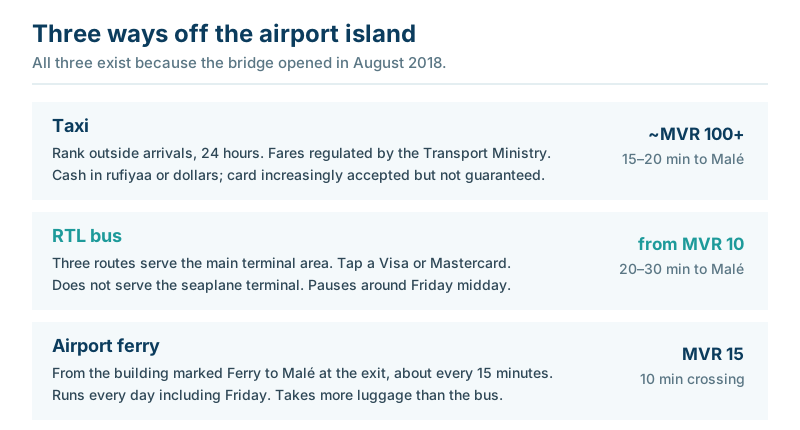
Journey time: 15 to 20 minutes to Malé, 5 to 12 minutes to Hulhumalé.
Where: taxis queue outside the Terminal 1 arrivals hall at all hours. No booking needed, and no app required, though many drivers now accept contactless card payment.
Fares are regulated. This is the single most useful fact in this section. Taxi fares from the airport are set by the Transport Ministry under a regulation in force since May 2024, and drivers are not permitted to charge above the published rates. If a quoted price sounds wrong, referring to the regulation is a legitimate and effective response.
What it actually costs: expect somewhere in the region of MVR 100 or a little more for the crossing into Malé, and comparable for Hulhumalé. Published figures vary widely, and the online fare calculators are algorithmic estimates rather than the regulated schedule — one of them produces a figure well above the rate travellers report paying.
Pay in cash. Rufiyaa or dollars are accepted. Card is increasingly common and not guaranteed, so carry notes — the reasoning is in our guide to money in the Maldives.
Luggage: a normal saloon car with a normal boot. Two large cases and two people is the practical maximum.
Taxis are the right answer if you are tired, carrying dive gear, travelling with children, or arriving at two in the morning.
Bus: the option nobody mentions
Cost: from MVR 10. Roughly seventy cents.
RTL operates three bus routes serving Velana, and almost no English-language travel guide tells visitors they exist.
How to pay: tap your own Visa or Mastercard on the reader inside the bus, or buy through the RTL app. No cash, no ticket office, no local card required. This is unusually painless for a public transport system.
Where they stop: the main terminal area, serving both the international and domestic terminals.
Where they do not stop: the seaplane terminal. If your onward connection is a seaplane, the bus does not take you there.
Route R3 runs to Malé along the southern coast of the city, via the Maafannu bus station and the Villingili wharf, terminating at West Park. Other routes serve Hulhumalé.
The Friday gap. Buses do not run for roughly ninety minutes around midday on Fridays, during the main prayer. It is the same pause that stops the ferry network, and it catches out anyone assuming a service that runs all day.
Luggage on a bus is your problem. Fine with a backpack and a carry-on. Unpleasant with two hard cases and a board bag.
For a solo traveller with light luggage, the bus is roughly a twentieth of the taxi fare for the same journey.
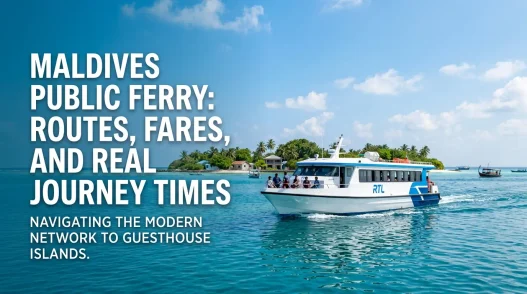
Ferry: the original route
Cost: MVR 15. About a dollar.
Journey time: around 10 minutes across.
Frequency: roughly every fifteen minutes through the day.
Where: the building marked “Ferry to Malé” at the terminal exit.
Two things make it interesting. It typically allows several pieces of luggage per ticket, with a supplement for more — more generous than the bus and cheaper than the taxi. And it runs every day, including Friday, which makes it one of the very few public services in the country that does not stop for the weekend.
That Friday exception matters. If you land on a Friday morning and the buses have paused, the ferry is still crossing.
The ferry lands you at the Malé waterfront rather than at your accommodation, which is fine in a city you can walk across in twenty minutes and less fine with heavy bags in the middle of the day.
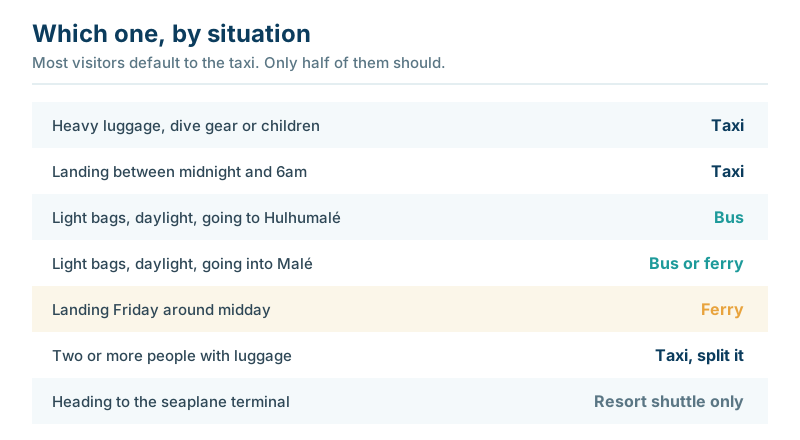
Which one, in practice
| Your situation | Take |
|---|---|
| Heavy luggage, or dive gear, or children | Taxi |
| Arriving between midnight and 6am | Taxi |
| Light bags, daylight, going to Hulhumalé | Bus |
| Light bags, daylight, going into Malé | Bus or ferry |
| Landing Friday around midday | Ferry — the buses have paused |
| Going to the seaplane terminal | Neither: the resort shuttle or the seaplane operator handles it |
| Two or more people with any luggage | Taxi, once you split it |
The last line is the one that changes the arithmetic. A taxi split between two people is a few dollars each, at which point the saving on a bus stops being the point.
Hulhumalé, and why people stay there
Hulhumalé is reclaimed land connected to the airport island by a link road, and it has become the default overnight stop for travellers with awkward flight timings.
Phase 1 is the established district: guesthouses, restaurants, shops and the beach. Most visitor accommodation is here.
Phase 2 is the newer expansion, with additional hotels, residential blocks and the Central Park.
The reason to stay there is proximity. Five to twelve minutes to the terminal by road, at any hour, with none of the water-crossing constraints that shape everything else in this country. If your seaplane window has closed or your departure is at six in the morning, Hulhumalé is the answer, and our guide to hotels in Malé and Hulhumalé covers the choice.
It has a beach, which Malé does not, and a relaxed atmosphere by Maldivian urban standards. It remains an inhabited island, with all that implies for dress and for alcohol.
The first hour, in order
What to do between the aircraft door and the taxi rank.
Immigration. Your IMUGA declaration QR code and passport, and the 30-day visa on arrival stamped in front of you. Allow 75 to 90 minutes at peak times.
Cash. ATMs and exchange counters are in the Terminal 1 arrivals hall. Withdraw rufiyaa here if you intend to use the ferry, the bus or a small shop, because there are no ATMs on resort islands.
A SIM or eSIM. Both operators have stores immediately to the right of the exit, open roughly 08:00 to 23:00 including Fridays. Our guide to mobile data makes the case for buying the eSIM before you fly and walking straight past the queue.
Then choose your transport. Taxi rank outside, bus stop at the main terminal area, ferry building at the terminal exit, speedboat jetties opposite.
One thing not to do in the first hour: buy alcohol at duty free on the way in. It is confiscated or bonded, as our guide to alcohol rules explains.
Malé, and where you actually end up
A short orientation, because arriving in the capital surprises people.
It is dense. Two square kilometres, well over a hundred thousand residents, and buildings to the waterline. There is no beach and no resort atmosphere. What there is: the fish market, the Tsunami Monument, the coral-stone mosque, genuine restaurants and the country’s commercial life.
Addresses are approximate. Streets are narrow, numbering is inconsistent, and a taxi driver will often ask for a landmark rather than an address. Have the name of a nearby building or the ward.
You can walk across it. Twenty minutes from one side to the other, which is why the ferry landing point being distant from your hotel matters less than it sounds.
Ferry terminals for onward island travel are here, not at the airport, and they are not all in the same place. Our ferry guide covers that problem in detail.
Onward from the city: where you actually go next
For most people the city is a connection rather than a destination, and the onward legs leave from four different places.
Public ferry terminals are in Malé, not at the airport, and they are not all in one location. If you are heading to Maafushi or another guesthouse island by ferry, that is a taxi or bus ride from where you land, and our ferry guide explains why the terminal question needs answering the night before.
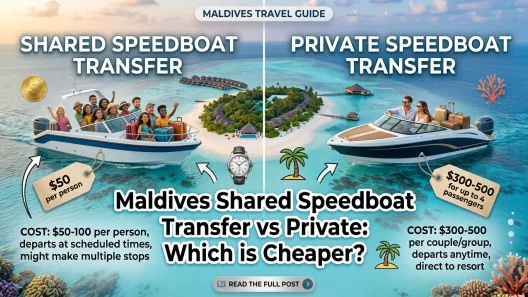
Shared speedboat jetties are at the airport itself, opposite arrivals, running around the clock. For guesthouse islands within speedboat range this is the normal route and it never involves the city at all — the choice between shared and private is covered in our guide to speedboat transfers.
The domestic terminal is a short walk from international arrivals, for flights to the outer atolls. Which atolls have airports at all is in our guides to domestic flights, airports by atoll and how many airports the country has.
The seaplane terminal is a separate building reached by shuttle, arranged by your resort or the operator. No public bus goes there.
Four departure points, and the mistake is assuming they are all in the same place because they are all called “the airport”.
Getting around once you are there
Both islands are small, and neither needs a car.
Malé on foot is genuinely the best way. Twenty minutes across, and the streets are too narrow and too congested for a vehicle to save you time over any distance you would want to walk.
City taxis run short hops at low fixed fares and are useful with luggage or in the midday heat. Tipping is not expected, as our guide to tipping sets out.
RTL city buses run within both Malé and Hulhumalé, paid the same way as the airport routes — tap a card and go.
Hulhumalé is spread out in a way Malé is not, particularly between Phase 1 and Phase 2. Distances that look walkable on a map are longer in equatorial sun, and the bus is worth using.
Scooters are everywhere and are how residents move. Renting one as a visitor is possible and is not something we would recommend in Malé traffic.
Late arrivals and early departures
The two situations that make this whole subject urgent.
Landing after dark. Seaplanes do not fly at night and domestic flights thin out. If your resort is seaplane-served and you land in the evening, you are staying near the airport whether you planned to or not. Taxis run all night, the road is open, and Hulhumalé is minutes away.
Departing before dawn. Check-in for early international flights opens in the small hours, and a Hulhumalé hotel puts you fifteen minutes from the desk. From Malé it is longer and depends on the bridge being clear, which it generally is at 4am.
Allow more than feels necessary. Terminal 1 processes a large volume of passengers into a small number of counters, and the queue at peak departure times is real. Three hours before an international departure is the working figure, and our guide to missed connections covers what happens when the arithmetic fails.
What it all costs
| Option | Cost | Time to Malé | Time to Hulhumalé |
|---|---|---|---|
| Taxi | around MVR 100+ (regulated) | 15–20 min | 5–12 min |
| RTL bus | from MVR 10 | 20–30 min | 10–15 min |
| Ferry | MVR 15 | 10 min crossing | not applicable |
| Resort speedboat | arranged and billed by the property | n/a | n/a |
Two notes on the numbers. Taxi fares are regulated and the online calculators are not authoritative — treat any single figure you read, including the one above, as an indication. And the bus and ferry are priced for residents, which is why they cost what a coffee costs.
Six mistakes people make
Assuming there is no road. The most common, and it comes from guides written before 2018.
Expecting the bus to reach the seaplane terminal. It does not.
Landing Friday midday and waiting for a bus. Take the ferry or a taxi.
Arriving with no rufiyaa. Buses take contactless cards, but the ferry ticket window and many taxi drivers want cash. Our money guide explains why small notes matter here specifically.
Booking a Malé hotel for a 6am flight. Hulhumalé is closer and usually cheaper.
Treating the ferry as the cheap option and the bus as the fallback. It is the other way round: the bus is cheaper, the ferry is more scenic and takes more luggage.
Getting back to the airport
The return leg deserves its own paragraph because the failure mode is expensive.
Build a buffer. Traffic on the bridge is light by international standards and it is not zero, particularly at the Malé end during the working day.
Check the day. Friday midday pauses the buses. The ferry runs.
Confirm your terminal. International and domestic terminals are adjacent; the seaplane terminal is a separate building reached by shuttle, and a taxi driver will need to be told which one.
Do not cut the check-in cutoff fine. If you have been on a resort running an hour ahead of Malé time, departure morning is when that discrepancy bites — see our guide to the time zone.
Why this is one of the few road journeys in the country
Worth a short section, because it is genuinely unusual.
The Maldives has more than a thousand islands and almost no roads between any of them. Three are joined: Malé, Hulhulé and Hulhumalé, linked by the bridge and a causeway, and they contain the airport, the capital, the hospitals and a substantial share of the population.
Everywhere else, movement is by boat or aircraft. There is no road from Kaafu to anywhere else, no ferry you can drive onto, and no vehicle hire that would get you between atolls. The comparison our guide to resort and inhabited islands draws holds here too: what looks like a country is a set of separate places that happen to share a flag.
So the twenty minutes you spend crossing the bridge is, for most visitors, the only overland travel of the entire trip. It is also the only part where taxis, a bus timetable and a road bridge behave the way they would anywhere else. Which is precisely why arriving travellers are unprepared for it.
Questions travellers ask
How do I get from Velana airport to Malé? Three ways. A taxi across the Sinamalé Bridge takes 15 to 20 minutes. An RTL public bus costs from about MVR 10. The airport ferry costs MVR 15 and crosses in about 10 minutes.
Is there a bridge from the airport to Malé? Yes. The Sinamalé Bridge opened in August 2018, runs 1.39 kilometres from the airport island to Malé, and a link road continues to Hulhumalé.
How much is a taxi from Velana airport? Fares are regulated by the Transport Ministry under a May 2024 regulation. Expect roughly MVR 100 or a little more into Malé. Online fare calculators are estimates rather than the regulated schedule.
Is there a bus from the airport? Yes. RTL operates three routes serving the main terminal area, from about MVR 10, paid by tapping a Visa or Mastercard on the reader or through the RTL app. They do not serve the seaplane terminal.
Does the airport ferry run on Fridays? Yes. It is one of very few public services that runs every day, which makes it the reliable option when Friday prayers pause the buses around midday.
Should I stay in Malé or Hulhumalé? Hulhumalé for anything airport-related: it is 5 to 12 minutes away by road, at any hour. Malé if you want the city itself — the market, the mosque and the restaurants.
Can I walk from the airport? No. The bridge carries vehicles, and the distances make it impractical with luggage in equatorial heat.
What if I land at 2am? Take a taxi. They queue outside arrivals around the clock and the road is open at any hour, which is the single biggest thing the bridge changed.
What to take away
- The Sinamalé Bridge opened in August 2018 and ended the ferry-only era. Guides describing the capital as reachable only by boat are out of date.
- Three options: taxi at roughly MVR 100 and regulated by the Transport Ministry, RTL bus from MVR 10 paid by contactless card, and the ferry at MVR 15.
- Buses pause for about ninety minutes around Friday midday. The airport ferry runs every day, including Friday.
- Buses do not serve the seaplane terminal.
- Hulhumalé is five to twelve minutes from the terminal by road and is the right answer for late landings and dawn departures.
Next step: decide before you land whether you are going to the city at all. If you are, and you have light bags, download the RTL app on the plane — the bus is sitting outside arrivals and costs less than the bottle of water you will buy while looking for it.