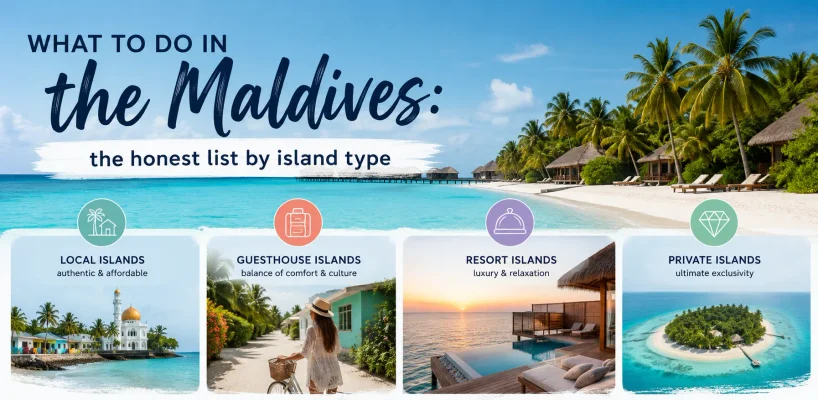
Things to Do in the Maldives: The Honest List, Sorted by Where You Stay
There is no single list of things to do in the Maldives, because the country runs two entirely different holidays and the activities barely overlap.
On a resort island the list is bought from a desk: diving, spa, sunset cruise, private dining, water sports, all priced in dollars and all arranged for you. On an inhabited island the list is negotiated at a shopfront, costs a third as much, and includes a village, a mosque and a football match at six in the evening that nobody sold you a ticket for.
This guide sorts everything by where you will be, what it costs, and which of it is worth the money.
The dividing line
Everything in this article follows from one distinction, set out fully in our comparison of resort and inhabited islands.
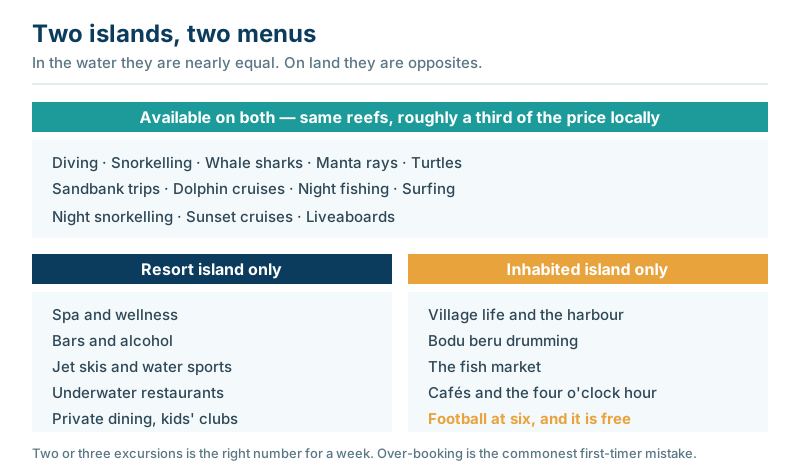
In the water, the two are nearly equal. The same reefs, the same channels, the same mantas and whale sharks. A guesthouse dive centre and a resort dive centre run to the same sites, and the guesthouse charges less.
On land, they are opposites. A resort has a spa, a bar, a gym and privacy. An inhabited island has a community, a harbour, a mosque and no alcohol at all.
The excursions differ in price, not in kind. A sandbank trip from a guesthouse island and the same trip from a resort visit the same sandbank. The difference is a factor of three, as our excursion price reference sets out.
So the honest answer to “what is there to do” is: decide the island type first, then read the relevant column.
In the water: the reason you came
Snorkelling is the default activity of the entire country and the one most people underestimate. House reefs, boat drops, sandbank stops. Free at most resorts if you swim from the beach; USD 30 to 60 for a guided boat trip.
Diving is what the Maldives is famous for among people who do it. Channel dives with current and sharks, submerged pinnacles, night dives. A single dive runs roughly USD 60 to 120 with equipment, and courses from open water upward are available almost everywhere.
Swimming with whale sharks in the South Ari protected area, year-round, on a full-day boat. Snorkel only, no scuba, and the etiquette matters.
Swimming with manta rays, above all at Hanifaru Bay in Baa Atoll between roughly June and November, which is snorkel-only and permit-controlled.
Snorkelling with turtles, which is the most reliable large-animal encounter in the country and the least publicised.
Night snorkelling — lights over the water, plankton drawn in, and whatever comes to feed on it. Available at resorts with a platform and from a handful of guesthouse operators.
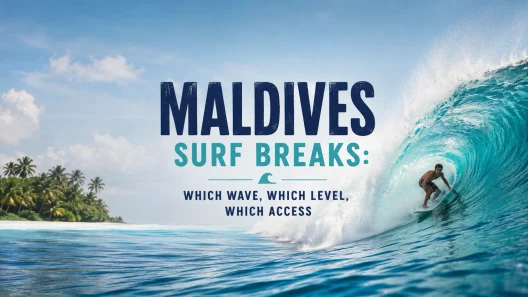
Surfing, mostly reef breaks, mostly March to November, and concentrated in three regions with three different seasons.
Water sports — jet skis, seabobs, paddleboards, catamarans. Resort territory, and expensive.
The seasonal question — which months for which animal — is answered in our diving season calendar and the surf season calendar, and the answer is more interesting than “December to April”.

On a boat: the half-day economy
Excursions are how a Maldives holiday is structured, and four of them account for most bookings.
Sandbank trips. A bare spit of sand in open ocean, an hour of it to yourself, and the photograph everyone came for. USD 35 to 50 per person from a guesthouse island, considerably more as a private resort experience with a picnic attached.
Dolphin cruises. Late afternoon, spinner dolphins, and a reliability rate high enough that most operators will repeat the trip free if you see nothing.
Night fishing and sunset fishing. Hand lines over the side, whatever you catch grilled afterwards, and consistently the excursion guests rate highest — partly because expectations are low and partly because it is the most Maldivian thing on the list.
Sunset cruises. Sold everywhere, included on some packages, and the one that varies most in quality. From a guesthouse island it is a dhoni and a flask of tea. From a resort it is a yacht and champagne.
Add a liveaboard to that list if you dive, which replaces the day-trip economy entirely with a week aboard.

On land: where the two islands diverge
At a resort:
- Spa and wellness — overwater treatment rooms, yoga, and prices that surprise people.
- Underwater restaurants — a handful in the country, each a set-piece with a set-piece price.
- Private dining on a beach, sandbank or jetty, which is the single most photographed resort product.
- Tennis, gyms, kids’ clubs, cooking classes, marine biology talks — the filler that makes a week work.
On an inhabited island:
- Local island excursions — a village walk, bodu beru drumming, a working harbour, and the fish market at the hour the boats come in.
- The football pitch at dusk. Free, unadvertised, and the most reliable window into island life there is.
- Cafés and hedhikaa at four in the afternoon, described in our food guide.
- Malé if you are passing through — the market, the mosque, the Tsunami Monument.
The resort list is bought. The inhabited-island list is mostly free, and this is the clearest argument for spending part of a trip on one.
What a day actually looks like
Two versions, because the shape of the day is the real difference between the two holidays.
On a resort island. Breakfast until ten. A dive or a snorkelling boat at nine, back by one. Then the flat hours between one and four, when the sun is vertical and nobody sensible is outside.
A spa treatment or a sleep. The reef again at five, when the light returns and the fish become active. Sunset somewhere with a drink, and dinner at eight in resort time — an hour ahead of the rest of the country.
On an inhabited island. Mas huni and sweet tea at seven. An excursion at nine — sandbank, snorkelling, fishing — back by two. The island goes quiet in the afternoon heat.
At four the cafés fill for hedhikaa, the most sociable hour of the day. At six there is football on the pitch and the light goes gold. Dinner at eight, and the island is asleep by eleven.
The overlap is the water and the middle of the day. The difference is everything at the edges — who you eat with, whether there is a bar, and whether the island has a life that continues without you.
Neither is better. They are different products, and the mistake is booking one while expecting the other.
The set pieces
Four experiences that people plan a whole trip around.
Weddings and vow renewals. Symbolic ceremonies are a resort standard. Legal marriage in the Maldives is a separate matter with its own requirements, and the distinction catches people out.
Underwater restaurants. Genuinely remarkable and genuinely expensive, and worth knowing which ones deliver.
Underwater photography. The Maldives is one of the better places on earth to learn it, with warm clear water and animals that tolerate you.
A liveaboard week. The serious diver’s version of the whole country, covering several atolls without a single transfer decision.
When it rains
It will, particularly between May and November, and a wet afternoon on a small island is a specific kind of test.
Our guide to what to do when it rains covers it properly. The short version: diving and snorkelling are unaffected by rain, spa bookings fill fast the moment the sky darkens, and the cheapest reliable entertainment on any island is the café you have not tried yet.
The rain rarely lasts. What lasts is wind, which cancels boats, and that is a scheduling problem rather than a boredom one — see our monsoon guide.
What it costs
Rough figures, from a guesthouse island. Resort prices run two to three times higher for the same activity.
| Activity | Typical price per person |
|---|---|
| House reef snorkelling | Free |
| Guided snorkelling trip, half day | USD 30–60 |
| Sandbank excursion | USD 35–50 |
| Dolphin cruise | USD 30–45 |
| Night fishing | USD 30–45 |
| Whale shark day trip | USD 70–120 |
| Single dive with equipment | USD 60–120 |
| Open water certification course | USD 500–800 |
| Spa treatment, 60 minutes | USD 80–250 |
| Jet ski, 30 minutes | USD 80–150 |
| Private sandbank dining | USD 300–800 per couple |
The full reference, including what is negotiable and what is not, is in our guide to excursion prices.
What is available when
Most activities run year-round. Five are seasonal enough to plan around.
| Activity | Best window | Why |
|---|---|---|
| Manta aggregations at Hanifaru | June to November, peak July–September | Plankton pushed east by the southwest monsoon |
| Surfing | March to November, region-dependent | Southern Ocean swell and monsoon wind |
| Maximum diving visibility | December to April | Clear ocean water entering from the east |
| Whale sharks | Year-round, position shifts | They follow plankton, not the calendar |
| Bioluminescence | Year-round, better on dark nights | A moonless night matters more than a month |
The rest — snorkelling, fishing, sandbanks, spa, dolphins, turtles — runs every month of the year. Conditions vary, availability does not.
For the detail, our diving season calendar explains the mechanism behind all of it, the surf calendar covers the three regional seasons, and the month-by-month guides cover weather and prices.
One scheduling note: the public holidays calendar matters only on inhabited islands, where excursion desks close and ferries change during Eid.
What is actually worth it
An opinionated section, because a list without one is useless.
Worth every dollar: whale shark trips, Hanifaru in season, night fishing, a good dive guide, and the sandbank trip on a clear day.
Worth it once: underwater restaurants, private beach dining, a sunset cruise. Set pieces are set pieces — memorable, and not repeatable at the same price.
Frequently oversold: jet skis, expensive and identical to jet skis anywhere; “cultural” excursions that visit a village for forty minutes; and dolphin cruises sold as guaranteed.
Free and underrated: the house reef at seven in the morning before anyone else is in the water, the four o’clock café hour on an inhabited island, and the walk around a small island at dusk.
Overpriced everywhere: water sports as a category, because the equipment has to be shipped to an island and maintained in salt.
By trip type
Honeymooners. One set piece, one excursion, and a great deal of nothing. Our honeymoon guide covers the balance, and the mistake is booking too much.
Divers. Pick the atoll for the diving, not the villa. The atoll decision guide and the complete atolls guide matter more here than the resort brochure.
Families. Shallow lagoons, kids’ clubs, sandbanks and turtles. Skip the long boat days.
Budget travellers. A guesthouse island, the house reef, two excursions and the ferry. That is a complete holiday for a fraction of the resort price, as our cost comparison shows.
Non-swimmers. Honest answer: the Maldives is a harder sell. The spa, the food, the sunsets and a glass-bottom boat are the list, and it is a shorter one.
One week, first visit. Two excursions, one set piece, and the rest unstructured. Almost nobody regrets booking too little.
With children
The activity list narrows and improves.
Shallow lagoons are the whole product for younger children. Most resort lagoons are waist-deep for a long way out and warm all year.
Snorkelling works from about six, with a float and an adult. Turtles are the reliable win, and the turtle guide covers where.
Sandbanks are ideal and short enough not to become a long boat day.
Skip the full-day trips. Whale shark excursions involve hours on a boat and repeated water entries against current, which is a hard day for a small child.
Dive courses start at ten to twelve depending on the agency, and junior certifications are widely available.
Kids’ clubs are a resort feature and a good one. Inhabited islands have none, and have instead other children, a football pitch and a beach.
Night fishing is a surprising success with older children, because something happens every few minutes.
What you cannot do
Worth stating, because the absences shape the holiday.
Nightlife, outside resort bars. There is no scene, no clubs and, on inhabited islands, no alcohol at all.
Hiking or walking of any distance. The largest island in the country is 7.3 square kilometres, as our islands guide explains. There are no hills, no trails and no forests.
Driving. No roads between islands, and nothing to hire.
Wandering between islands. Every movement is a boat, and the ferry network runs on its own schedule.
Historic sightseeing at scale. There are mosques of genuine significance, including the coral-stone architecture in Malé, but this is not an archaeology destination.
Shopping. Souvenirs and a fish market. That is the extent of it.
None of this is a criticism. The Maldives is a water destination that does one thing extraordinarily well, and travellers who arrive expecting a varied land itinerary have chosen the wrong country.
The ethics, briefly and seriously
Most of this list involves animals, and the Maldives has a better record than most destinations. That holds only while visitors behave.
Do not touch anything. Turtles, rays, sharks, coral. Skin oils and sunscreen damage what you touch, and a touched animal stops behaving normally.
Do not chase. Whale sharks and mantas are approached, not pursued. Operators who position a boat ahead of a moving animal are doing it wrong, and the whale shark guide explains what a good approach looks like.
Do not stand on the reef. A fin kick or a foot kills growth that took years, and the reef is under enough pressure already after the 2024 bleaching event described in our reef health guide.
Do not feed fish, however common the practice looks.
Choose operators who brief properly. A dive centre or excursion boat that runs a no-touch briefing is protecting the site it sells. One that lets twenty snorkellers stand on a reef flat is not, and the guided rules at Hanifaru exist precisely because unmanaged access damaged it.
None of this reduces the experience. Every good encounter in the Maldives happens because the animal chose to stay.
Booking: desk, shopfront or in advance
At a resort, book through the guest services desk. Prices are fixed, quality is controlled, and there is no alternative on a private island.
On an inhabited island, walk the main street. Three operators will sell the same sandbank trip at three prices, and the guesthouse will book it for you at a fourth. Compare, and ask what is included — lunch, water, equipment and the service charge are the usual variables.
In advance only for the things that sell out: Hanifaru permits in season, dive courses, and anything on a fixed date such as a wedding ceremony.
Not at all for the good stuff. The house reef, the café hour and the walk at dusk require no booking, and they are where most of the week actually happens.
One practical note: excursion desks quote in resort time on a resort island and Malé time everywhere else, a distinction our time zone guide explains and which has cost more than one traveller a boat.
Safety, briefly
Everything on this list happens in or beside water, and our safety guide covers the real risks properly. Three things belong here:
Currents are the genuine hazard, not sharks. Ask before you swim, and never snorkel alone near a channel.
Reef contact damages the reef and you. Coral cuts infect fast, and the reef is the thing you came to see — the state of it is covered in our guide to coral reef health.
Sun is the most common injury. Rash guards beat sunscreen on a four-hour snorkel.
Two mistakes that shape a whole week
Booking the excursions before the island. The activity list is downstream of the accommodation decision, not the other way round. A traveller who books a remote seaplane resort and then discovers the whale sharks are a full day away in the opposite direction has made an unfixable mistake. Read the atoll first.
Filling the calendar. The Maldives is the one destination where an empty afternoon is the product rather than a failure of planning. Guests who book something every day come home tired, having spent most of the week on boats, and the boat is not the reason anyone chooses this country.
The correction for both is the same and takes ten minutes at the planning stage: pick the region, pick the island type, then choose two or three things to do and leave the rest of the week deliberately unstructured. Every experienced Maldives traveller converges on the same shape eventually, and it takes most of them two trips to get there.
Questions travellers ask
What is there to do in the Maldives besides the beach? Diving, snorkelling, whale shark and manta trips, surfing, fishing, sandbank excursions, dolphin cruises, spa treatments and — on inhabited islands — village life, bodu beru and the fish market. What there is not: nightlife, hiking, driving or shopping.
Do you need to book activities in advance? Only Hanifaru permits in season, dive courses and fixed-date events such as ceremonies. Everything else is bookable on the day at a resort desk or an island shopfront.
Are activities cheaper on a local island? Substantially. The same sandbank trip or dive site typically costs a third to a half of the resort price, because you are buying from an independent operator rather than through a property.
What can you do in the Maldives without swimming? Spa treatments, glass-bottom boats, sunset cruises, dining, island walks and cultural excursions. It is a shorter list, and a non-swimmer should think hard about whether this is the right destination.
Is snorkelling free? At most resorts, yes, from the beach with the property’s equipment. Guided boat trips cost USD 30 to 60. On guesthouse islands, equipment rental is a few dollars a day.
What is the best excursion in the Maldives? By guest satisfaction rather than price, night fishing and whale shark trips consistently rank highest. Sandbank trips deliver the photographs. Dolphin cruises are the most weather-dependent.
What is there to do when it rains? Diving and snorkelling continue in rain. Spas fill quickly. On an inhabited island the café culture is the answer, and the rain rarely lasts more than an hour or two.
How many excursions should I book for a week? Two or three. The most common regret from first-time visitors is over-scheduling a destination whose main product is doing nothing beside very clear water.
What to take away
- There is no single list. A resort island sells activities from a desk; an inhabited island has a community, and most of what is good there is free.
- In the water the two are nearly equal — same reefs, same animals, different prices. On land they are opposites.
- Two or three excursions is the right number for a week. Over-booking is the commonest first-timer mistake.
- Worth the money: whale sharks, Hanifaru in season, night fishing, a good dive guide. Oversold: jet skis, forty-minute village visits, guaranteed dolphins.
- What you cannot do matters as much: no nightlife, no hiking, no driving, no shopping. Arriving expecting a land itinerary is choosing the wrong country.
Next step: pick the island type before the activity list. Everything on this page follows from that one decision, and it is the only one you cannot change after you arrive.