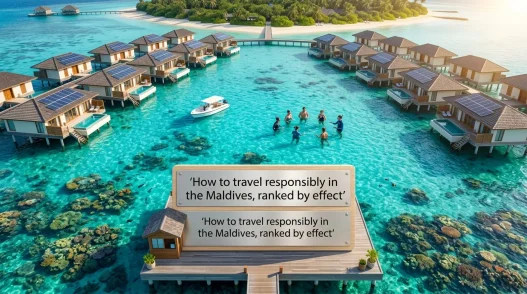


Swimming with Whale Sharks in the Maldives: The Only Place They Never Leave
Almost every guide gives a whale shark season for the Maldives. Most say May to November. They are describing manta rays.
South Ari Atoll holds the only known year-round whale shark aggregation of its kind in the world. The animals do not migrate through; they live there. Researchers have catalogued more than 726 individuals inside the protected area, and operators find sharks on roughly 70 to 90 per cent of trips in every month.
Which month you come is close to irrelevant. What matters is the hour, the tide and whether your operator follows the rules — and those rules changed in 2025 and 2026.

The season myth, corrected
The confusion is easy to trace. Manta rays aggregate seasonally at Hanifaru Bay in Baa Atoll during the southwest monsoon, roughly June to November, when plankton is pushed east across the atoll. That is a genuine season, and it is covered in our manta guide.
Whale sharks in South Ari are a different phenomenon entirely. The protected area functions as a development ground for juvenile males, which patrol the warm, plankton-bearing drop-off along the atoll’s southern outer reef rather than migrating away from it. Sightings hold up in February as reliably as in August.
If a guide gives you a whale shark season, it has confused two animals. The correct answer is: any week of any month, weather permitting.
What SAMPA actually is
The South Ari Marine Protected Area was designated in 2009 and is the largest protected area in the Maldives. It runs the length of the atoll’s southern outer reef, past Maamigili, Dhigurah and Dhidhdhoofinolhu.
The population is unusual. Research within SAMPA has identified more than 726 individual whale sharks through photo-identification of their spot patterns, with over 8,000 recorded encounters. Around 72.5 per cent are juvenile males — a strong sex bias that supports the nursery hypothesis.
They are big but not full grown. Maldivian whale sharks typically run four to eight metres. Adults elsewhere reach eighteen.
They cruise shallow by day. Five to fifteen metres, which is why snorkelling works here. At night they dive to forage, and satellite-tagged animals have been recorded below 1,000 metres.
The Maldives Whale Shark Research Programme, a charity based on Dhigurah, has run the identification catalogue since 2006 and monitors compliance with the code of conduct. It is one of the longest-running resident-population datasets anywhere, and it sits alongside the wider activity list as the country’s best-documented wildlife encounter.
Whale sharks elsewhere in the Maldives
South Ari is the reliable place. It is not the only place.
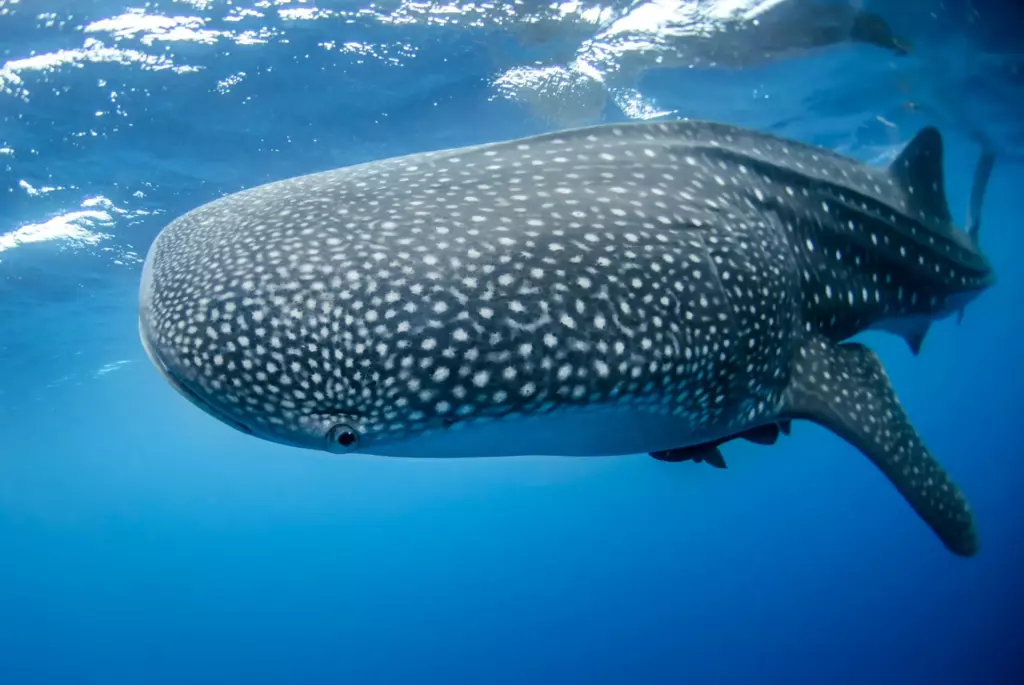
Baa Atoll, during the southwest monsoon from roughly May to November, sees whale sharks drawn in by the same plankton blooms that produce the manta aggregations at Hanifaru Bay. Sightings are opportunistic rather than dependable, and they happen alongside the mantas rather than instead of them — Baa Atoll is worth a trip for the mantas regardless.
Elsewhere, whale sharks turn up occasionally across the archipelago, including in Kaafu and around the outer atolls. These are chance encounters on a dive or a crossing, not something anyone can plan around.
What makes South Ari different is that its animals are residents rather than visitors. A plankton bloom elsewhere attracts sharks passing through; the SAMPA drop-off holds a population that stays. That is why the odds there are quoted at 70 to 90 per cent and nowhere else in the country comes close.
If you want a guaranteed-ish encounter, go to South Ari. If you are already in Baa for the mantas between June and November, keep your eyes open and treat anything that appears as a bonus.
The rules, and what changed in 2026
SAMPA regulations were tightened across 2025 and 2026, and the changes are worth knowing because they distinguish a licensed operator from a cheap one.
For swimmers:
- Three metres from the body, four metres from the tail. The tail is the reason for the second number: a strike from it can knock a person unconscious.
- Never swim in front of the animal or across its path.
- Do not touch, ride or hold on. Ever, for any reason.
- No flash photography.
- Enter the water calmly. No jumping, no splashing, no racing.
For vessels, per the protected area regulation:
- Contact vessels must stay at least 15 metres from the nearest shark. If a shark approaches within that distance, engines go to neutral until it moves away.
- 25 metres between vessels.
- No vessel may pass above a whale shark, under any circumstances.
- Vessels under ten feet may not operate in a contact zone.
New requirements:
- Propeller guards became mandatory on all vessels operating in SAMPA from 30 June 2026.
- Guides must be certified, including rescue certification.
- A maximum of six visitors per guide.
- Vessel speed limits within the protected area.
- Bookings should be made a day in advance.
That six-to-one ratio is the single most useful thing to check when booking. An operator putting twelve people in the water behind one guide is not compliant, and the experience is worse as well as less lawful.
Why the rules exist
A significant proportion of whale sharks in the Maldives carry injuries, and boat strikes are a leading cause. Propeller scars on dorsal fins and tails are visible in the identification catalogue.
That is the direct reason for the propeller guard requirement, the fifteen-metre vessel distance and the prohibition on passing above an animal. It is not bureaucracy; it is a response to documented harm at a site that receives thousands of encounters a year.
What this means for you as a customer: the operator you choose is a conservation decision as much as a comfort one. An operator who crowds an animal produces both a worse encounter and a measurable cost to the population, and our guide to reef and marine health sets out how much pressure the wider system is already under.
Timing: the day matters, the month does not
Three variables, none of them the calendar.
Early morning is best. Calmest sea, best visibility, and the fewest boats on the water. Later trips contend with wind, chop and every other operator who left after breakfast.
The tide window. Operators generally aim to be in the water around three to five hours before high tide, when the plankton-bearing water moves along the drop-off in the pattern the sharks follow.
Sea state decides the day. Visibility and swell affect spotting far more than the month does. A flat morning in September beats a choppy one in February.
One seasonal pattern does apply, and it concerns where the animals sit rather than whether they are there. They shift along the drop-off with the monsoon, through the same mechanism our diving season calendar explains.

Snorkel or scuba
Both are permitted in SAMPA, which distinguishes it from Hanifaru Bay, snorkel-only since 2012.
Snorkelling is the better option for most people. The animals cruise at five to fifteen metres, well within surface viewing range. A snorkeller can also follow a moving shark far longer than a diver on a fixed profile.
Scuba suits a diver already in the water on a South Ari site when a shark passes, and allows longer observation if the animal stays deep.
Neither requires certification for the snorkel version — it needs the ability to swim comfortably in open water with a float if you want one. Our snorkelling guide covers technique and equipment, and the diving guide covers the scuba side.
What to bring, and how to prepare
The encounter is easy. The morning around it is more demanding than people expect.
A mask that fits. The single item worth bringing from home, for the reasons our snorkelling guide sets out. A leaking rental mask on the one morning a whale shark appears is a genuinely bad outcome.
Fins. Provided by every operator, and worth checking they fit before the boat leaves.
A long-sleeved rash guard. Three to five hours on an open boat under equatorial sun, plus repeated entries. It outperforms sunscreen and it does not wash into the water.
A float, if you want one. Nobody will think less of you, and being relaxed matters more than being fast — the animal sets the pace, not you.
Seasickness precautions. The boat sits stationary while spotting, in swell, for long periods. This is the classic recipe, and the southwest monsoon months are the rough ones, as our monsoon guide explains.
Water and a hat. Half-day and full-day trips both run long, and sun is the most common injury on the whole activity list, as our safety guide notes.
Reasonable swimming fitness. You will enter and exit the water several times and swim steadily alongside a moving animal. It is not difficult and it is not nothing.
What the encounter is actually like
Setting expectations, because this is one of the few marine experiences that regularly exceeds them.
A spotter scans the drop-off from the boat’s roof, looking for a shadow rather than a fin. This is a genuine skill and it is the main thing separating operators.
The boat positions ahead of a cruising animal, at the mandated distance, and stops.
You slide in — not jump — and swim parallel while the shark passes.
It lasts longer than you expect. Ten minutes or more alongside a moving animal is common, because a whale shark cruising at walking pace is entirely unbothered by a snorkeller who keeps the rules.
You may get several encounters in a morning, or one, or none.
The animal is the size of a bus and completely indifferent to you. People are frequently surprised by how calm it is, and how much of the experience is about swimming steadily rather than about fear.
Where to go from
Four bases, in ascending order of cost.
Dhigurah. The textbook guesthouse base: a five-kilometre beach, sightings almost daily from the southern reef edge, and guesthouse rates in the region of USD 60 to 120 a night. It is also home to the research programme.
Maamigili. Twenty minutes by boat from Villa International Airport, with more restaurant variety and licensed operators running the same trips. The airport connection is covered in our guide to domestic flights.
South Ari resorts. Several sit inside or immediately adjacent to the protected area and run whale shark excursions as part of their activity programme. Convenient, and priced accordingly. The atoll itself is described in our South Ari guide.
A liveaboard, which can spend a full day in the protected area rather than a half-day window.
The choice between a guesthouse island and a resort is the same choice the whole country presents, and our comparison of the two sets out the trade-offs.
Getting to South Ari
Three routes, and the choice depends on where you are staying.
Domestic flight to Villa International Airport at Maamigili, then a short boat. Twenty minutes from the airport to Maamigili itself, and longer to Dhigurah. Villa Air flies this route as its home network, as our guide to domestic airlines explains.
Speedboat from Malé, roughly ninety minutes to two hours depending on the island and the sea state. The shared and private options are compared in our speedboat guide.
Public ferry, cheapest and slowest, running to the guesthouse islands on fixed days. The network and its Friday gaps are covered in our ferry guide.
Resort transfers are arranged by the property, typically by seaplane or by domestic flight plus boat — the full comparison is in our transfers guide.
If you are deciding between atolls and the whale sharks are the reason for the trip, our atoll decision guide covers what else South Ari offers alongside them.
What it costs
| From | Typical price per person |
|---|---|
| Guesthouse island in South Ari | USD 70–120 for a half or full day |
| Resort inside the protected area | USD 100–200, often part of a programme |
| Resort elsewhere in Ari | Higher, with a longer boat run |
| Liveaboard | Included in the itinerary |
Add the marine park fee, which runs around USD 10 per person in SAMPA and is charged separately by most operators.
Resort prices attract 10% service charge and 17% TGST, compounding to roughly 28.7%, as our guide to money in the Maldives explains. Guesthouse operators are usually quoting a simpler number, and our excursion price reference covers the wider picture.
Booking a day ahead is a regulation, not a courtesy, so leave the arrangement to your accommodation rather than turning up at a jetty.
What the whale sharks are worth
A short section, because the numbers explain why the rules have teeth.
Peer-reviewed work published in 2014 valued whale shark tourism in South Ari Atoll and found it generating substantial annual revenue for the Maldivian economy — the study is one of the most cited pieces of wildlife-tourism economics in the region.
That valuation is the reason a resident population of juvenile sharks became a protected area rather than a curiosity. It is also why the 2025–26 regulations were tightened rather than relaxed when visitor numbers grew: a stressed, scarred population is a depreciating asset as well as an ethical failure.
For a visitor the practical consequence is simple. The money you spend on a licensed operator is the mechanism that keeps the protection funded and enforced. The money spent on an unlicensed one undermines it while producing a worse morning.
That is an unusually clean alignment between doing the right thing and getting what you paid for, and it does not hold in every corner of Maldivian tourism.
Choosing an operator
Six questions. The answers separate a licensed operation from a boat with a spotter.
How many swimmers per guide? The regulation is six. If the answer is more, book elsewhere.
Are your guides certified, including rescue? Required since the 2025–26 regulations.
Does the vessel have propeller guards? Mandatory in SAMPA since 30 June 2026.
What is your policy when another boat is already on a shark? The correct answer involves waiting, not joining.
Do you work with the research programme? Operators who contribute identification photographs are the ones taking it seriously.
What time do we leave? Anything after mid-morning is buying you worse conditions and more company.
An operator who answers all six without hesitation is worth paying more for, and the difference between the best and the worst trip on the same water is largely this.
The crowding problem, honestly
South Ari on a good morning can hold a lot of boats, and the code of conduct exists precisely because it does.
Twenty-five metres between vessels is the rule, and on a busy day the water does not always look like it. If your boat joins a scrum around a single animal, that is the trip going wrong, and it is worth saying so to the guide.
A good operator will leave and look for a second shark rather than compete for the first one. That decision costs them time and improves your morning.
The animal decides. A crowded shark dives, and the encounter ends. A respected one cruises on the surface for ten minutes, and everybody gets what they came for. The rules and the good experience point in the same direction, which is not always true in wildlife tourism.
What else the trip includes
Whale shark excursions are usually half or full days, and rarely contain only whale sharks.
A reef snorkel stop at a nearby site, which is often excellent in its own right.
Turtles, common along the same stretch of reef and covered in our turtle guide.
Manta rays, occasionally, since South Ari has cleaning stations of its own on the western rim during the dry season.
Dolphins, frequently, on the boat run — the dedicated trips are covered in our dolphin cruise guide.
Lunch on a sandbank on full-day versions, which our sandbank guide covers.
If nothing is found, many operators will repeat the trip at reduced cost or free. Ask before you book rather than after.
Photography, briefly
No flash. It is in the code of conduct and it is enforced.
Get the whole animal or get the detail — the half-frame shot of a four-metre shark is the picture everyone comes home with and nobody keeps.
Shoot upward or level rather than down, and stay wide.
Do not chase a shot. Every rule above overrides every photograph, and a swimmer manoeuvring for an angle is the commonest breach of the three-metre rule.
A phone in a case works at these distances in good light. Our guide to underwater photography covers the rest.
Questions travellers ask
When is whale shark season in the Maldives? There is no season in South Ari. It is the only known year-round aggregation of its kind in the world, and operators report sightings on roughly 70 to 90 per cent of trips in every month. Guides quoting May to November are describing manta rays at Hanifaru.
Where do you swim with whale sharks? The South Ari Marine Protected Area, along the southern outer reef past Maamigili, Dhigurah and Dhidhdhoofinolhu. It was designated in 2009 and is the largest protected area in the Maldives.
How close can you get? Three metres from the body and four metres from the tail. Vessels must stay 15 metres away and 25 metres from each other, and may never pass above an animal.
Do I need to dive? No. Snorkelling is permitted and is the better option for most people, since the sharks cruise at five to fifteen metres. Scuba is also allowed in SAMPA, unlike at Hanifaru Bay.
How much does it cost? Roughly USD 70 to 120 per person from a guesthouse island, and USD 100 to 200 from a resort, plus a marine park fee of about USD 10.
How likely am I to see one? Operators report finding sharks on about 70 to 90 per cent of trips. Sea state and the time of day affect the odds more than the month does.
Are they dangerous? No. Whale sharks are filter feeders and entirely indifferent to swimmers. The only real hazard is the tail, which is why the code specifies four metres behind the animal.
How do I choose an operator? Ask how many swimmers per guide — the regulation is six — whether guides are rescue certified, and whether the vessel has propeller guards, mandatory in SAMPA since 30 June 2026.
What to take away
- South Ari holds the only year-round whale shark aggregation of its kind on earth. Guides quoting a season have confused whale sharks with mantas.
- More than 726 individuals have been identified inside the protected area, around 72.5% of them juvenile males, with over 8,000 recorded encounters.
- Three metres from the body, four from the tail, no touching and no flash. Vessels stay 15 metres off and 25 metres apart.
- The 2025–26 regulations added certified guides, a six-swimmer limit per guide, speed limits and mandatory propeller guards from 30 June 2026.
- Book the earliest trip of the day, from Dhigurah or Maamigili if budget matters, and ask the six operator questions before paying.
Next step: stop looking for the right month and start looking for the right operator. The animals are there every week of the year, and the difference between a superb morning and a scrum around a stressed shark is entirely the boat you booked.


