Most visitors planning a Maldives trip search for manta rays and land on Hanifaru Bay — the UNESCO-protected inlet in Baa Atoll that holds the world’s single largest known manta feeding aggregation. That framing is not wrong. Hanifaru Bay is genuinely unmissable. But it tells only part of the story.
The Maldivian archipelago spans nearly 900 kilometres from north to south, and reef manta rays (Mobula alfredi) move through it in a predictable arc, following plankton blooms that shift with the monsoon winds twice a year. The best atoll for manta encounters on any given week is not necessarily Baa — it depends entirely on which monsoon is active and where the plankton is concentrated. Miss that logic, and you can spend a week on the wrong atoll at the wrong time of year.
This guide breaks down the full picture: the monsoon mechanics that drive manta movement, a deep dive into Hanifaru Bay’s access rules (which most articles skip over), an atoll-by-atoll seasonal matrix, and what it takes to witness cyclone feeding — the rarest spectacle in manta behaviour and the visual reason Hanifaru Bay became famous in the first place.
How Monsoon Seasons Drive Manta Movement
The Maldives operates on a two-monsoon calendar with a brief transition window at each end.
The northeast monsoon (Iruvai in Dhivehi) runs roughly from December to April. It brings drier skies, calmer seas, and exceptional visibility — sometimes exceeding 30 metres. During this period, the prevailing winds push nutrient-rich water toward the western sides of the atolls, and manta rays follow the plankton accordingly. This is the season when resorts fill, prices peak, and most travellers assume it’s also the best time for marine life. For mantas, it is not — at least not in the northern atolls.
The southwest monsoon (Hulhangu) runs from May to October, with November acting as a gradual wind-down. It brings stronger currents, slightly reduced visibility (typically 15–25 metres), and an explosion of biological productivity. Plankton blooms surge through the channels between atolls, concentrating on the eastern sides as the prevailing winds drive nutrient-rich deep water up through the reef passages. Manta rays gather in numbers that are simply not possible during the northeast monsoon.
The key insight is that manta rays follow plankton, not the calendar most tourists follow. The southwest monsoon that brings grey afternoons and choppy afternoon seas also delivers the conditions responsible for aggregations of 200+ mantas in a bay the size of a football pitch. Water temperature remains 27–29°C throughout both seasons, so thermal comfort is not a variable. The trade-off is predictable weather versus peak wildlife density.
April and November are transitional months. Conditions at those times are genuinely unpredictable and best avoided for manta-specific itineraries unless your dates are fixed.
Hanifaru Bay: The World’s Largest Manta Feeding Station
Hanifaru Bay sits on the southeastern edge of Baa Atoll, separated from the inhabited island of Dharavandhoo by a deep-water channel. It measures roughly 700 metres in length and 200 metres at its widest point. The maximum depth at the centre reaches 24 metres, but most of the feeding action happens in the shallower inner funnel, which is why snorkellers — floating above — often get the better view.

Why Mantas Gather Here
The bay’s physical geometry is the engine behind its extraordinary aggregations. Its reef is twice as wide at the mouth as it is towards the lagoon, forming a shape closer to a keyhole than a simple inlet. During the southwest monsoon, this funnel structure intercepts the prevailing current, which carries dense zooplankton from the open ocean outside the atoll into the shallow lagoon.
The third factor is the lunar tide. When a strong incoming tide pushes against the southwest monsoonal current, a counter-current — or back eddy — forms at the mouth of the channel adjacent to the bay. This back eddy traps and concentrates zooplankton inside the shallow water rather than allowing it to disperse. On the days when monsoon current, incoming tide, and moon phase align precisely, the result is what researchers from the Manta Trust have described as “plankton soup” — zooplankton concentrations dense enough to trigger coordinated mass feeding.
Scientific research published in peer-reviewed literature confirms that Mobula alfredi at Hanifaru Bay switch from non-feeding to feeding behaviour at a prey density threshold of approximately 53.7 mg dry mass per cubic metre — more than double what they theoretically need to meet metabolic requirements. The feeding events are tidally driven, predictable in timing, and most reliably triggered on full and new moon tides during peak season.
The official season runs from May to December. The largest aggregations typically occur between July and October. Whale sharks share the bay during the same plankton blooms, with juvenile whale sharks appearing regularly alongside the mantas in peak conditions.
The Rules: What Visitors Actually Need to Know
Hanifaru Bay is a Marine Protected Area managed under strict regulations by the Maldivian Environmental Protection Agency, enforced daily by park rangers. Access is not independent — every visitor must be part of an organised excursion with a licensed guide. Attempting to enter the bay unguided is a fineable offence.
Key regulations in force:
- Scuba diving is completely banned inside the bay. This applies to all visitors without exception, regardless of certification level. The ban protects the feeding mantas from bubble noise and diver movement disruption.
- Snorkelling is permitted and is, in fact, the only way to experience the aggregations.
- A permit is required, currently priced at approximately USD 20–30 per person. Most resorts and liveaboards include this in their Hanifaru excursion packages.
- The visitor cap is 45 snorkellers in the water at any one time, accompanied by licensed guides.
- Maximum five boats are permitted at the site simultaneously.
- Sessions run on a rotation system — approximately 45 minutes per group — with resort boats and liveaboards allocated on a scheduled, alternating basis. This prevents the type of overcrowding that made the site unsustainable before protection.
- A strict speed limit applies throughout the bay area, enforced by rangers on patrol.
- Fishing, touching marine life, littering, and anchor dropping on the reef all carry significant fines.
Guides receive their licence through a formal certification process and are the primary point of compliance enforcement in the water. No solo dives of any kind are permitted.
Getting to Hanifaru Bay
From Malé International Airport, the two practical options are a 30-minute seaplane to Dharavandhoo Domestic Airport followed by a 15–20-minute speedboat transfer, or a domestic flight to Dharavandhoo combined with the same speedboat leg. From resorts within Baa Atoll itself — Soneva Fushi, Four Seasons Landaa Giraavaru, Amilla Fushi, and others — the boat transfer to the bay takes 10–20 minutes depending on position within the atoll.
Liveaboards operating Baa Atoll routes typically anchor overnight in the atoll during peak season, enabling early-morning departures to catch the best tidal windows.
Booking early matters. During peak season (July–September), the daily permit allocation for the bay fills weeks in advance. Resorts in Baa Atoll prioritise their own guests; liveaboards book their slots through the EPA before departing Malé.
Cyclone Feeding: The Rarest Spectacle in Manta Behaviour
Standard manta ray feeding involves a solitary animal performing barrel rolls near the surface, using its cephalic fins — the distinctive wing-like lobes flanking its mouth — to funnel zooplankton toward its open jaw. It is graceful, efficient, and quiet.
When plankton density inside Hanifaru Bay reaches its absolute peak, that individual behaviour breaks down entirely.
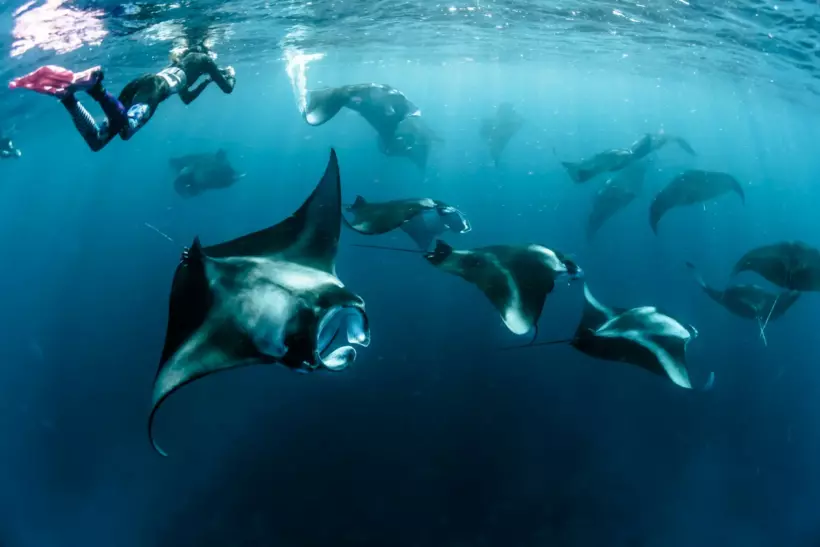
It begins with chain feeding. One manta follows another in single file, each using the slipstream of the ray ahead to increase feeding efficiency. As more animals join and the plankton concentration intensifies, the chain begins to loop. The leader catches the tail. The formation starts to spiral. Within minutes, what began as an orderly line becomes a rotating column of manta rays turning in an anti-clockwise direction — a living vortex that forces zooplankton to concentrate at its centre, where the feeding pressure is highest.
This is cyclone feeding. Cyclones at Hanifaru Bay have been documented at up to 20 metres in width and 15 metres deep in the water column, involving more than 100 individual rays, lasting as long as 60 minutes. The rotating motion itself is not random — it is a cooperative foraging strategy that amplifies the concentration of prey beyond what any individual animal could achieve alone.
From a snorkeller floating at the surface, the effect is extraordinary. The mantas circle below and around you, wingtips occasionally breaking the surface, the entire column visible in the clear water beneath.
Cyclone feeding has been documented in only two places in the world: Hanifaru Bay in the Maldives and isolated reef sites in Fiji. At Hanifaru, it is relatively common during peak season — but only on the days when all variables align simultaneously. The conditions required are: peak southwest monsoon (July–September is most reliable), incoming tide, and a full or new moon providing sufficient tidal pressure to create the back eddy that concentrates plankton inside the bay.
No amount of planning can guarantee a cyclone feeding event. What planning can do is put you at the site on the highest-probability days — which means timing your trip around neap tides during August or September and staying close enough to the bay to move quickly when conditions develop.
Atoll-by-Atoll Seasonal Matrix
The table below summarises peak windows across the four most productive manta atolls. “Peak” means the period when large aggregations or highly reliable cleaning station encounters are most likely. Encounters outside these windows are possible but less consistent.
| Atoll | Peak Window | Monsoon | Best Sites | Encounter Style |
|---|---|---|---|---|
| Baa Atoll | July – October | SW (Hulhangu) | Hanifaru Bay, Horubadhoo Thila, Dhonfanu Thila | Mass feeding aggregations; cyclone feeding possible |
| South Malé Atoll | May – November | SW | Lankan Manta Point (Lankan Reef), Embudhoo Express | Cleaning station; drift encounters; smaller numbers |
| Ari Atoll (South) | February – April (peak); Sept – May overall | NE (Iruvai) | Mahibadhoo Manta Point (eastern), Rangali Madivaru (western), Dhigurah Etere | Year-round cleaning station mantas; largest numbers in NE monsoon |
| Meemu Atoll | May – July | SW (early) | Mantas and More, Muli Corner, Mulaku Kandu | Cleaning stations; channel encounters; less crowded |
Baa Atoll
The aggregations at Hanifaru Bay are on a different scale than anything elsewhere in the Maldives. Outside of Hanifaru, the atoll’s thilas — isolated reef pinnacles — host manta cleaning stations that are accessible by scuba and active year-round. Horubadhoo Thila and Dhonfanu Thila are the most cited among local dive guides.
South Malé Atoll
Lankan Manta Point (Lankan Reef) is the most accessible major manta site in the entire country — a 30-minute speedboat transfer from Malé, requiring no seaplane or domestic flight. During the southwest monsoon, mantas arrive to be cleaned at this reef in numbers that regularly reach 20–30 individuals per session. It is a dive site rather than a snorkel site, and the experience is quite different from Hanifaru — quieter, slower, individual rays hovering at cleaning stations while small cleaner wrasse work over their bodies.
Embudhoo Express is a fast-drift channel dive on the northeast coast of the atoll — one of the few sites where mantas are reliably found on the upwind side during the northeast monsoon. Numbers are smaller here, but the site offers an alternative for visitors in Malé Atoll between December and April.
Ari Atoll (North and South)
South Ari hosts what is arguably the most underrated manta population in the Maldives. A resident group of reef manta rays circulates between cleaning stations on the eastern and western sides of the atoll, shifting position with the monsoons. Between September and May (the northeast monsoon and its build-up), the eastern stations at Mahibadhoo come alive; between January and August, the western stations near Rangali Madivaru are more productive.
The extraordinary thing about South Ari is that this is also the world’s most consistent whale shark aggregation site. A well-timed itinerary in February or March can deliver both species on the same day.
North Ari offers a genuinely unusual experience at Fesdhoo Lagoon — manta encounters after dark, where divers position themselves on the sand floor while artificial lights attract plankton to the surface. Mantas arrive to feed in the lit column and sometimes exhibit cyclone-like feeding behaviour under the lights. This is a scuba experience and requires Open Water certification minimum.
Meemu Atoll
Meemu is the correct answer for visitors who want reliable manta encounters without the crowds that peak Hanifaru season brings. Two of its sites — Mantas and More and Muli Corner — function as dedicated cleaning stations during the southwest monsoon (May–July most reliably), with regular sightings at the channel site of Mulaku Kandu. The atoll has minimal tourist infrastructure compared to Baa or Ari, which means smaller groups and less competition for space in the water. Most productive access is by liveaboard.
Snorkelling vs Scuba: Which Gives the Better Manta Encounter?
For Hanifaru Bay specifically, there is no choice — scuba diving is banned, and the answer is snorkelling only.
Beyond that constraint, the honest assessment is more nuanced than most dive-focused content acknowledges.
The case for snorkelling is strongest at feeding aggregation sites. Mantas feeding near the surface — particularly in cyclone formation — are visible in their entirety from above. The bird’s-eye perspective lets you see the full geometry of a cyclone formation in a way that a diver positioned inside or below the spiral cannot. Snorkellers also produce no exhaled bubbles, which means less acoustic disturbance to feeding mantas. Many experienced observers note that feeding mantas are noticeably more relaxed around snorkellers than around scuba divers. No certification is required, sessions can be extended, and the experience is accessible to anyone comfortable swimming in open water.
The case for scuba is strongest at cleaning stations. When a manta hangs motionless at a cleaning station — wings splayed, eyes open, cleaner fish working over its underside — the encounter at depth is a different quality to a surface view. Eye-level proximity, longer bottom time, and access to deeper sites (some cleaning stations operate at 15–25 metres) are genuine advantages. Scuba also opens up the night manta dives at Fesdhoo Lagoon and similar sites.
The most practical guidance: if your primary objective is Hanifaru Bay or any large feeding aggregation, snorkel. If you are combining a manta trip with broader reef diving and want cleaning station encounters, scuba adds value but does not replace snorkelling at feeding sites.
Responsible Encounters: Rules That Actually Matter
Manta rays are wild animals. Feeding aggregations are functional biological events, not wildlife performances. Responsible encounter guidelines exist because intrusive behaviour genuinely causes mantas to abort feeding sessions and leave, eliminating the experience for everyone else in the water.

The core rules:
- Maintain a minimum 3-metre distance from all manta rays at all times. At Hanifaru Bay, licensed guides enforce this actively.
- No touching. Physical contact removes the protective mucus layer from a manta’s skin, which creates entry points for infection. A single touch from a diver’s hand does measurable harm.
- No flash photography. The sudden light burst causes startle responses that interrupt feeding and cleaning behaviour. Reef mantas are wide-angle subjects best captured in natural light with a wide dome port.
- Do not chase or position yourself in front of a feeding manta. Block a manta’s path and it will simply stop feeding and move away.
- Stay horizontal in the water. Vertical body positions are read by mantas as predator posture. Horizontal drift is neutral.
- No sunscreen (oxybenzone-containing formulas) in the water at any site. Reef-safe mineral sunscreen is the minimum standard.
The Manta Trust has documented that sites with consistent enforcement of these guidelines show significantly higher manta residency rates. The link between responsible tourism and manta abundance is not theoretical.
Conservation: How the Maldives Protected Its Mantas
The Maldives has one of the most consequential manta ray conservation records of any country, and the timeline matters for understanding why the aggregations still exist.
Before the 1990s, Hanifaru Bay was known locally as a whale shark hunting ground. As dive operators began visiting in the early 1990s, the combination of overfishing pressure and uncontrolled tourist access put the site under acute stress.
The export of all ray products from the Maldives was banned in 1995 — an early and under-publicised protection that predated the global wave of manta legislation. On 8 June 2009 (World Oceans Day), the Maldivian government declared Hanifaru Bay a Marine Protected Area, a decision driven in part by data from the Manta Trust’s Maldives Manta Conservation Programme, which had identified the site’s global significance. Two additional MPAs — Anga Faru in Baa Atoll and Maamigili in South Ari Atoll — were declared simultaneously.
In 2011, the entire Baa Atoll was designated a UNESCO World Biosphere Reserve, placing Hanifaru Bay’s management under the international framework that restricted visitor numbers and formalised the licensing system for guides.
In 2014, all ray species — including both reef manta (Mobula alfredi) and oceanic manta (Mobula birostris) — were added to the Maldivian National Protected Species List, making it illegal to capture, keep, or harm any ray species anywhere in Maldivian waters.
In 2013, manta rays were listed on CITES Appendix II, restricting international trade. The Manta Trust has identified over 6,000 individual reef manta rays across the Maldives from more than 80,000 sightings — a photo-identification database that forms the basis for population health monitoring.
The primary threats remaining are fishing gear entanglement (manta rays cannot reverse through netting and drown), unsustainable tourist growth at aggregation sites, and the longer-term pressure of climate change reducing zooplankton biomass. Research from the University of the Sunshine Coast estimates that zooplankton biomass could decline by up to 50% in some tropical regions under high-emissions scenarios — a direct threat to the filter-feeding ecology that makes Hanifaru Bay possible.
Best Resorts and Liveaboards for Manta Season
Baa Atoll Resorts
Four Seasons Landaa Giraavaru operates one of the most substantive marine biology programmes in the Maldives — a fully staffed research centre with Manta Trust collaboration, a coral restoration programme, and a dedicated manta excursion system called “Manta-on-Call” that alerts guests via speedboat the moment manta rays are detected in the area. The best option for serious manta photography and research-adjacent experiences.
Soneva Fushi is the longest-established luxury resort in Baa Atoll, 15–20 minutes from Hanifaru Bay by boat. Its sustainability infrastructure is genuine (the resort runs a glass-blowing studio from recycled waste and a waste-to-energy programme), and its dive centre runs daily Hanifaru excursions during season.
Amilla Fushi and Milaidhoo are both positioned in the southern part of Baa Atoll with short boat transfers to the bay. Milaidhoo’s smaller scale (45 villas) means fewer competing groups for bay access slots.
Vakkaru Maldives and Anantara Kihavah fill the gap between those ultra-premium properties and the budget end of the market.
For a budget-conscious option that still delivers Hanifaru Bay access, Kihaa Resort and the local island guesthouses on Dharavandhoo both run licensed guide excursions during season at a fraction of the overwater bungalow price.
Ari Atoll Resorts
LUX South Ari Atoll and Constance Moofushi offer the most direct access to South Ari’s manta cleaning stations. For the dual manta-and-whale-shark itinerary, base yourself in South Ari between February and April.
Meemu Atoll
Madifushi Private Island is the only notable resort currently operating in Meemu, with a marine centre focused on the atoll’s cleaning stations. Six Senses Laamu (in the adjacent Laamu Atoll) is a worthwhile alternative that combines strong manta programming with an exceptional house reef.
Liveaboards
Liveaboards are the correct choice for anyone who wants to combine multiple atolls — typically Baa with Ari and/or the far south — in a single trip. The best vessels plan their itineraries around the monsoon calendar and have established relationships with the EPA for Hanifaru Bay slot allocation.
The Nautilus Maldives is the most cited option for serious divers on Baa Atoll-centred routes. Blue Force Fleet offers combined itineraries covering Baa plus the central atolls. Scubaspa Yang departs from Malé and includes South Ari on most central atoll routes.
The practical advantage of a liveaboard over a resort for Hanifaru Bay is response time. Liveaboards anchor within the atoll overnight, enabling departures timed precisely to the incoming tidal window that triggers the best feeding events — often a pre-dawn departure to be in position at first light.
FAQ
Is scuba diving allowed at Hanifaru Bay? No. Scuba diving is completely banned inside Hanifaru Bay Marine Protected Area. Snorkelling is permitted with a licensed guide.
What is the best month to see manta rays at Hanifaru Bay? August and September offer the highest probability of large aggregations and cyclone feeding events, as they fall at the peak of the southwest monsoon when lunar tides are strongest. July and October are also productive.
Can I go to Hanifaru Bay without staying in Baa Atoll? Technically yes — day trips from Malé via domestic flight to Dharavandhoo are possible — but logistics are complex and seat availability on the domestic route is limited. Staying in Baa Atoll is significantly easier.
Do manta rays visit the Maldives year-round? Yes, but their location within the archipelago shifts with the monsoons. Some atolls (particularly South Ari) have a resident population present year-round. Hanifaru Bay is seasonal: May to December, with peak activity in July–October.
Are there manta rays in the Maldives outside of Baa Atoll? Yes. South Malé Atoll’s Lankan Manta Point, South Ari Atoll’s cleaning stations, Meemu Atoll’s Mantas and More site, and Raa Atoll’s Sola Corner are all productive manta sites with different seasonal windows.
How do I know if cyclone feeding will happen during my visit? You cannot predict it with certainty. Highest probability conditions are: August–September, incoming tide on full or new moon days, peak southwest monsoon activity. Being present at Hanifaru Bay on multiple high-tide mornings across a 5–7 day stay gives reasonable odds.
Is manta ray photography allowed? Yes, but without flash. Video and natural-light photography are both practised extensively at Hanifaru Bay and at cleaning stations across the archipelago.