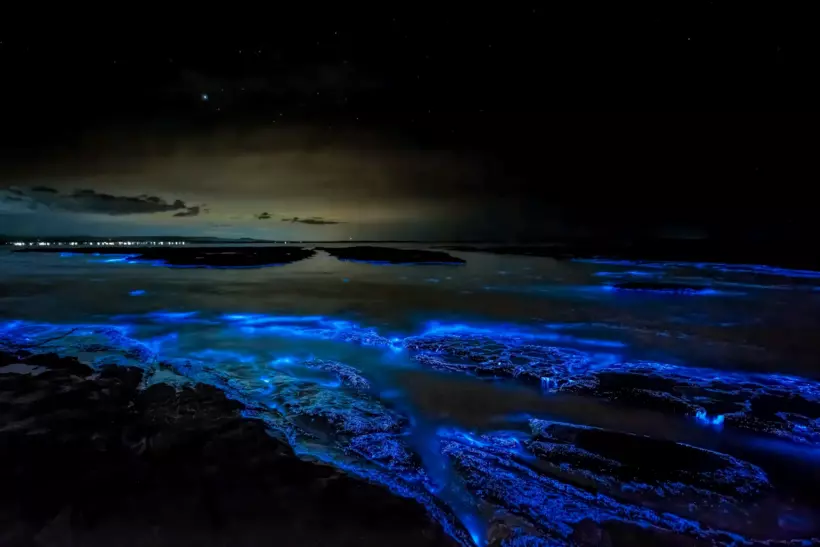
The photograph has gone viral dozens of times: a beach washed in electric blue, the shoreline pulsing like a circuit board, every wave leaving a trail of cold fire on the sand. It looks fabricated. It looks like a long-exposure trick, a post-processing flourish, a camera lying beautifully.
The truth is both more complicated and more worth knowing. The glow is absolutely real. It is also nothing like the Instagram version — and that gap between expectation and reality is precisely why so many visitors to the Maldives leave the beach disappointed while another group, standing on the same sand, consider the experience one of the most remarkable of their lives.
This guide closes that gap. It explains the biology behind the glow, the precise conditions that make it intense or invisible, which islands offer the best odds, when to stay indoors entirely, and how to photograph the phenomenon with any camera you own. It also tells you what most travel articles do not: on any given night, even at the most famous locations, there is a real chance you will see nothing at all.
What Actually Causes the Blue Glow
The light comes from a single-celled organism called Noctiluca scintillans, whose Latin name translates, with satisfying directness, as “glowing bright by night.” It is classified as a heterotrophic dinoflagellate — a microscopic predator that feeds on algae, bacteria, and fish eggs rather than photosynthesising — and it is responsible for the majority of bioluminescent blooms in the Indian Ocean and Arabian Sea.
Inside each Noctiluca cell are thousands of tiny spherical organelles called scintillons. These act as self-contained light factories. When the organism is mechanically disturbed — by a wave, a fish, a hand dragged through the water — ion channels on the cell membrane shift the internal pH. This triggers a reaction between two chemicals stored inside the scintillons: luciferin, a light-emitting molecule, and luciferase, an enzyme that catalyses the reaction. Oxygen completes the chemistry, and the result is a photon released at a wavelength of 474 to 476 nanometres. That is the blue end of the visible spectrum, which is why the glow is always blue and never green or yellow.
The entire flash lasts approximately 80 milliseconds.
What makes Noctiluca particularly interesting — and relevant to planning a visit — is that this response follows a circadian rhythm. The organism is significantly more bioluminescent at night than during the day, even in laboratory conditions with no external cues. The light-producing system is internally regulated, which means that seeing the glow requires darkness not just to make it visible but because the plankton itself is less capable of producing light in daylight hours.
Biologists also understand the evolutionary purpose: the flash acts as a defence. When a copepod or small fish begins feeding on a Noctiluca bloom, the sudden burst of light startles the predator and, crucially, attracts larger predators — a mechanism sometimes called the burglar alarm effect. The plankton is not glowing for your benefit. It is trying to get something eaten by something else.
In the Maldives, this phenomenon has a local name: Redhan lun, which translates roughly as “the sea sparkle.” Maldivian fishermen have observed and named it for generations, long before it became a subject of viral travel photography.
The Conditions That Create — or Kill — the Glow
Understanding why the glow varies so dramatically from one night to the next requires understanding what Noctiluca needs to thrive, and what triggers the bioluminescent response at maximum intensity.
Moon phase is the single most controllable factor you can plan around. Moonlight overwhelms the glow. Even a half-moon produces enough ambient light to render a modest bloom almost invisible. Planning a visit around the new moon — the three to four nights on either side when the sky is darkest — can be the difference between seeing blue sparks in the surf and seeing nothing but black water. This is non-negotiable for reliable sightings.
Water temperature influences bloom density. Noctiluca concentrates most visibly in warmer tropical water, and research on the Indian Ocean population shows that higher salinities also produce more intense flash output. The Maldives’ shallow lagoons, which warm quickly, create ideal conditions during the right months.
Calm versus rough water creates a paradox that confuses most visitors. Calm water concentrates the plankton in visible densities, especially in sheltered lagoons and along beach margins where gentle breezes push organisms toward shore. But bioluminescence only activates when the water is disturbed. The ideal night involves a calm sea with occasional gentle surf, or a visitor wading slowly through shallow water. A violent storm disperses blooms and reduces visible density even if millions of organisms are present.
Your own eyes are a factor most articles miss entirely. Noctiluca bioluminescence is genuinely faint to the naked eye — far fainter than any photograph suggests. Human vision requires roughly 20 minutes of full darkness to fully adapt. Visitors who check their phones, use flashlights, or stand near resort lighting frequently cannot see a bloom that a dark-adapted observer standing ten metres away finds unmistakable. Give your eyes the time they need, and protect that adaptation fiercely.
Nutrient levels matter for bloom formation over longer timescales. The southwest monsoon (May through October) drives upwelling that brings nutrients to Maldivian surface waters, fuelling phytoplankton growth. Noctiluca feeds on that phytoplankton, so bloom densities tend to be highest in the months following peak nutrient availability.
Best Time to Visit — and Why the Window Is Narrower Than You Think
Most guides say “June to October” and leave it there. That range is broadly accurate but misses important nuance.
The southwest monsoon season runs from approximately May through October, bringing the nutrient-rich conditions that build dense Noctiluca populations. June through December is therefore the period when plankton concentrations are highest and blooms most probable. Peak probability falls between July and October.
However, peak monsoon months (June through August) also bring rougher seas, cloud cover, and reduced water clarity in some areas. The inter-monsoon transition periods — April through May, and September through October — often offer an underappreciated combination: elevated plankton levels from recent monsoon nutrients, calmer waters that concentrate organisms in visible patches, and clearer skies for darker nights. Experienced guides and liveaboard operators in Raa Atoll consistently describe September and October as some of the most reliably productive nights.
December and January are considered off-peak by most sources, but the northeast monsoon brings its own calmer conditions, and experienced observers at Kuredu resort (Lhaviyani Atoll) have reported vivid sightings as late as November. Bioluminescence has been observed in every month of the Maldivian calendar, which is why the honest answer about timing is always probabilistic rather than definitive.
Plan your new moon nights to fall within the July–October window for the best combination of bloom density and dark skies. Use a lunar calendar app before booking — the dates shift by roughly one day each month, and two weeks of full moon during peak season can turn an otherwise promising trip into a series of moonlit disappointments.
Which Islands and Atolls Offer the Best Conditions
Vaadhoo Island (Raa Atoll) is the name every article mentions first, and with reason. A small, inhabited local island roughly 200 kilometres north of Malé, it was photographed for the now-iconic “Sea of Stars” shots that circulated internationally around 2014. Its eastern shoreline, facing open ocean, receives current-driven plankton accumulations regularly during peak season. The island has guesthouses, though reaching it requires a domestic flight to Dharavandhoo Airport followed by a speedboat transfer, or a seaplane from Velana International Airport at considerably higher cost.
One important caveat about Vaadhoo that most guides omit: the famous photographs were taken with long exposures of 15–30 seconds. The naked-eye experience on even a good night is more subtle — blue sparks in the surf, trails of cold light following your footsteps, the water faintly luminous where you disturb it. It is beautiful. It is not the electric ocean of viral photography, and understanding that distinction before arrival will allow you to appreciate what you actually see.
Rangali Island (South Ari Atoll) — home to the Conrad Maldives Rangali Island resort, famous for its underwater restaurant — sits in an atoll system with consistently warm water and good plankton concentration during season. Guests report bioluminescence from private beach areas and from overwater villa decks. The resort’s darker northern beaches, away from the main lit areas, are the most productive spots.
Dharavandhoo (Baa Atoll) sits within the Baa Atoll UNESCO Biosphere Reserve, where nutrient-rich waters support exceptional marine biodiversity. The same upwelling that attracts manta rays to Hanifaru Bay also feeds phytoplankton populations that sustain Noctiluca blooms. Several resorts in Baa Atoll arrange guided nighttime beach walks, and the Dusit Thani Maldives property has a well-documented track record of sightings on its darker beach sections.
Hulhumalé — the reclaimed island adjacent to the capital — is rarely mentioned in luxury travel guides but is worth knowing about for travellers who arrive in Malé without the budget or time to travel far. Sightings have been documented there, particularly along the quieter northern coast during late evening after resort lighting diminishes. It is not the most dramatic location, but it is accessible without a seaplane.
The most important geographical truth is that bioluminescence in the Maldives is not island-specific. Noctiluca blooms move with currents and concentrate based on local conditions. Experienced Tripadvisor contributors who have visited more than 20 Maldivian resorts report seeing the glow at various different islands on an unpredictable basis. Choosing a resort in Raa or Baa Atoll improves your odds due to those atolls’ consistently nutrient-rich waters — but there is no island that guarantees a display, and no island that categorically cannot produce one.
When NOT to Expect It
This section is the one most travel content ignores, and it is probably the most useful.
Full moon and bright moon nights are the single most reliable predictor of a failed sighting. Lunar light is surprisingly powerful; a full moon reflecting off calm tropical water produces enough ambient illumination to render modest Noctiluca concentrations essentially invisible. Do not book a beach-specific trip for bioluminescence during the week centred on a full moon unless you are comfortable with the likelihood of disappointment.
During or immediately after heavy rain, bioluminescence intensity drops. Freshwater runoff reduces surface salinity, and research on Noctiluca confirms that lower salinities produce weaker bioluminescent flash intensity. The nights following heavy monsoon rain are often poor viewing conditions even if the cloud cover clears.
Resort-adjacent beaches with significant artificial lighting suppress visible bioluminescence. The glow requires complete or near-complete darkness to be visible to dark-adapted eyes, and the ambient light spill from overwater villa walkways, restaurant terraces, and illuminated swimming pools can render an adjacent beach essentially useless for viewing. Resorts that offer guided bioluminescence excursions typically walk guests to the darker, less-developed perimeter of the island specifically to escape this problem.
Outside the main season (December through April), plankton concentrations are lower and the odds of a significant display drop substantially. December through early January can still produce sightings in some atolls, particularly during the northeast monsoon’s calmer conditions, but February through April are widely regarded as the lowest-probability months by local guides.
One experienced TripAdvisor contributor who visited around 20 Maldivian resorts across multiple years stated plainly: “I have seen bioluminescence on two occasions just splashing around in the shallows.” This is not a failure of locations — it is an honest reflection of what Noctiluca blooms are. They are natural, dynamic, and governed by conditions no resort can control.
If bioluminescence is the primary reason you are visiting the Maldives and you are not willing to accept the possibility of not seeing it, consider also looking at Mosquito Bay in Vieques, Puerto Rico, which holds a Guinness World Record for the world’s brightest bioluminescent bay and offers a far higher baseline certainty, or the dinoflagellate bays in Jamaica. These are enclosed ecosystems with trapped populations; the Maldives’ open-ocean blooms simply cannot be reliably predicted on a night-by-night basis.
How to Photograph the Glow — With Any Camera You Own
The photographs you have seen were almost certainly captured with a DSLR or mirrorless camera on a tripod, with a long exposure between 15 and 30 seconds. That method produces images that look significantly brighter than what the human eye perceives. This is not deceptive — it is how long-exposure photography works — but it is important to understand the gap between camera output and naked-eye experience before you set up your shot.

For DSLR or mirrorless cameras:
Begin with ISO 3200, aperture f/2.8, and a 15-second shutter speed. Adjust from there: if the glow is faint, extend the shutter to 25–30 seconds or raise ISO to 6400. A wide-angle lens (17–35mm) captures more of the shoreline in a single frame and is generally preferable to telephoto for beach work. A tripod is not optional — any hand movement during a 15-second exposure destroys the image. Use a remote shutter release or your camera’s two-second self-timer to eliminate button-press vibration. Manual focus is necessary because autofocus typically fails in near-total darkness; focus on a distant lit object before moving to the dark beach, then switch to manual to lock the setting.
For iPhone and modern Android phones:
Recent iPhone models (iPhone 11 and later) can capture genuine bioluminescence using Night Mode. Activate it by tapping the crescent moon icon, then slide the exposure timer to “Max” for the longest possible exposure (typically 10–30 seconds depending on ambient light detected). Prop the phone against a beach bag, camera case, or mound of sand — even a small amount of movement during the exposure will blur the image. Enable the countdown timer to give yourself time to remove your hand from the phone before the exposure begins. Android users on Pixel devices can use the Astrophotography mode within Night Sight, which stacks multiple exposures to produce similar results.
Critical tip for any camera: your night-adapted eyes will show you something the camera preview obscures. Spend 20 minutes away from all screens and lights before trying to see the glow. Use your camera as a detection tool first — a 15-second exposure reveals whether a bloom is present even when your eyes cannot quite confirm it — and then trust your dark-adapted vision for the actual experience.
Avoid camera flash entirely. Flash photography within a Noctiluca bloom disrupts the organisms and eliminates your own night vision, making the experience worse for you and potentially stressful for the plankton community. White lights of any kind pointed at the water are similarly counterproductive.
How to See It Without Harming It
Bioluminescence tourism in the Maldives is generally low-impact compared to enclosed bay ecosystems like Puerto Rico’s Bioluminescent Bays, where swimming is actually prohibited in some areas specifically to protect the plankton from sunscreen chemicals. Maldivian open-ocean blooms are more dispersed and less fragile, but responsible behaviour still matters.
Do not apply conventional sunscreen or insect repellent before wading into an active bloom. Chemical UV filters — particularly oxybenzone and octinoxate, which are already documented as damaging to coral reefs — can harm the delicate cell membranes of dinoflagellates and reduce bioluminescent intensity. If you want to enter the water where bioluminescence is active, either apply reef-safe mineral sunscreen hours before nighttime, or go in without it during the evening visit. Insect repellent with DEET should similarly be kept away from the water’s edge.
Disturbance is both necessary and capable of being overdone. Gentle movement through shallow water — walking slowly, trailing your hand — is what triggers the flash. Violent churning, splashing, or aggressive disturbance does not increase the glow; it can disperse the bloom and reduce visibility. Treat the water the way you would approach a sleeping animal you want to observe without frightening.
Do not attempt to collect bioluminescent water in bottles or cups as a souvenir. The plankton dies rapidly when removed from its ecosystem — Noctiluca requires specific salinity, temperature, and access to prey that a bottle cannot provide. The glow will typically fade within hours.
Resort Experience vs. Independent Exploration
Luxury resorts in Raa and Baa Atolls offer structured bioluminescence experiences ranging from guided nighttime beach walks to speciality excursions by dhoni (traditional Maldivian wooden boat) to known bloom locations. The advantages are access to staff who know their island’s micro-geography — which beaches face the current, which sections are darkest, which nights recent guests have reported activity. Resorts like The Nautilus Maldives have built bioluminescence visibility into their guest satisfaction metrics and coordinate experiences accordingly.
The disadvantages are genuine. Most luxury resorts are lit extensively, and walking guests through lit areas to a designated beach diminishes night vision. The experience can feel managed in a way that conflicts with the inherent wildness of the phenomenon. Guided group tours, however well-intentioned, typically involve phone screens, conversation, and the collective ambient light of eight people trying to take photographs simultaneously.
Guesthouses on local islands — particularly Vaadhoo and Dharavandhoo — offer a different dynamic. The infrastructure is simpler, the beaches are darker, and the access is less mediated. A guesthouse host who has watched the sea sparkle his entire life can walk you to the beach, point you toward the right water, and leave you alone. This option requires more planning (getting to remote atolls independently involves navigating domestic flights and ferry schedules) but produces encounters with bioluminescence that feel genuinely unscripted.
Liveaboard safari boats represent the best-kept secret for bioluminescence in the Maldives. Anchored away from resort lighting, often in open-atoll locations chosen by experienced captains for conditions rather than infrastructure, liveaboard vessels position guests in exactly the dark, calm-water environments where blooms are most visible. The captain’s knowledge of seasonal plankton movement is often far more granular than anything available to a resort concierge. Night snorkelling from a liveaboard during an active bloom — surrounded by bioluminescence in every direction — is a different order of experience from standing on a beach.
What to Actually Expect When You Arrive
Here is the honest version: if you go to the right atoll, in the right season, around the new moon, allow your eyes 20 minutes to adapt, and find a genuinely dark stretch of beach, there is a reasonable chance you will see something. It may be a faint shimmer at the waterline. It may be distinct blue sparks tracking your footsteps in the wet sand. On a strong night, wading knee-deep into a dense bloom produces trails of cool blue light following every movement — something the brain processes as deeply strange, like moving through liquid starlight.
That experience is not the neon ocean of viral photography. The camera, with its 25-second exposure and f/2.8 aperture, sees more light than you do. Your photograph will look better than what your eyes see, and that is fine — knowing this beforehand lets you appreciate the subtle reality rather than comparing it unfavourably to a long-exposure image.
What genuinely surprises most visitors who go in with honest expectations is how quiet the experience is. There is no sound from the bioluminescence itself, no obvious marker that something extraordinary is happening until your dark-adapted eyes register it. It rewards patience and stillness in a way that very few natural phenomena do. People who give it twenty minutes and genuine darkness typically leave transformed. People who check their phones every five minutes and leave after eight minutes typically leave underwhelmed, even when a bloom is present.
Plan it as a bonus — a potential reward for a trip you would want to take anyway for the reefs, the marine life, and the above-water beauty of the Maldives. Treat it as your primary reason for a significant investment of money and travel time, and you are setting yourself up for the kind of disappointment that no guide, however honest, can protect you from entirely.
If the sea glows blue on the night you stand at the waterline — and it may — you will know precisely why it happens, what you are looking at, and why a creature smaller than a grain of rice has been producing this light for reasons that have nothing to do with you. That knowledge makes it better.
Quick-Reference Planning Checklist
Best months: July through October, with September and October particularly recommended for the combination of plankton density and calmer seas
Moon phase: Plan around the new moon; avoid the five nights centred on a full moon
Best atolls: Raa, Baa, South Ari — but sightings are possible anywhere with the right conditions
Dark adaptation: 20 minutes minimum before expecting to see anything; leave your phone in your pocket
Camera settings (DSLR): ISO 3200–6400 / f/2.8 / 15–30 seconds / manual focus / tripod
Camera settings (iPhone): Night Mode at Max / prop phone on stable surface / countdown timer
Before entering water: Remove conventional sunscreen and DEET repellent
Disturbance: Gentle wading and trailing hands; avoid violent splashing
Expectation: Subtle, beautiful, and real — not the electric ocean of Instagram