Surfing in the Maldives: Forty Named Breaks, Eight You Can Reach
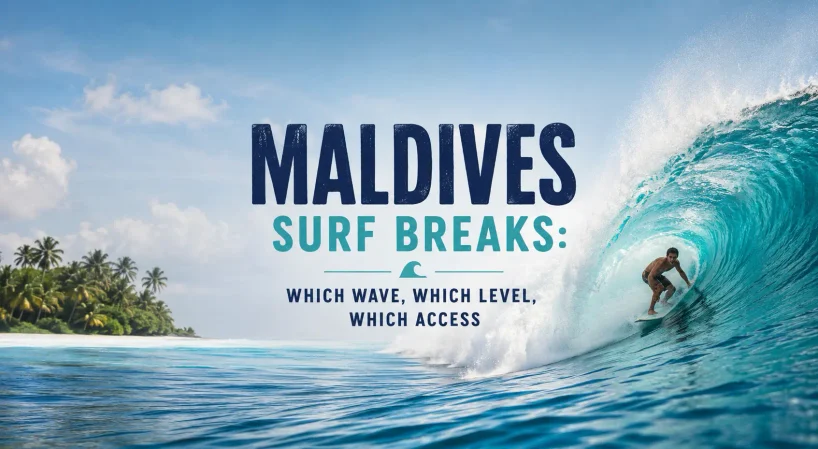
The Maldives has around forty named surf breaks. From any single base you can reach about eight, two of those are private, and the rest need a boat you have not chartered.
Access, not swell, is the problem this country presents to a surfer. The waves are consistent, warm and world class. Whether you can paddle out at the one you flew for depends on which island you booked, and in two cases on which resort.
This guide is a break-by-break reference with the access rules attached. For which region works in which month, our surf season calendar answers with one mechanism.
How access actually works
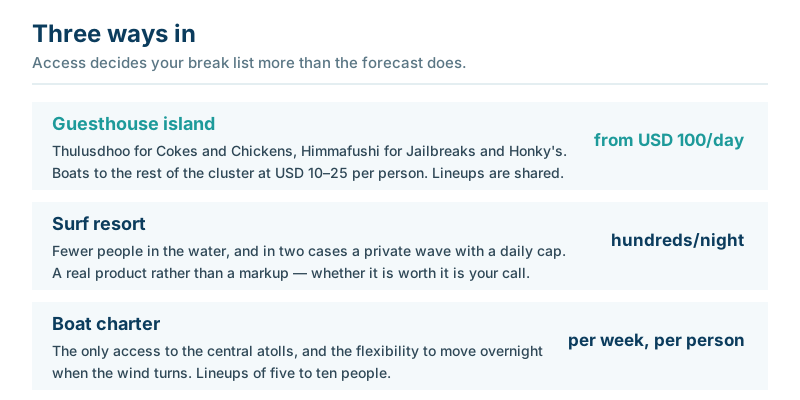
Three models, and the one you choose determines your entire break list.
Guesthouse island. Base on Thulusdhoo, Himmafushi or a neighbour and paddle out to your home break for nothing. Boats to the surrounding breaks run USD 10 to 25 per person, ten to twenty minutes each way. Cheapest by a distance, and the lineups are shared with everyone else doing the same thing.
Surf resort. A fixed base with a house break and a boat programme. Two properties control access to specific waves, which is the country’s most unusual arrangement and is covered below.
Boat charter. The only way to reach the central atolls, and the most flexible everywhere. When the wind turns, the boat moves.
Access shapes the trip more than the surf forecast does, which is why this article leads with it.
The two private waves
Nowhere else in surfing works quite like this at scale.
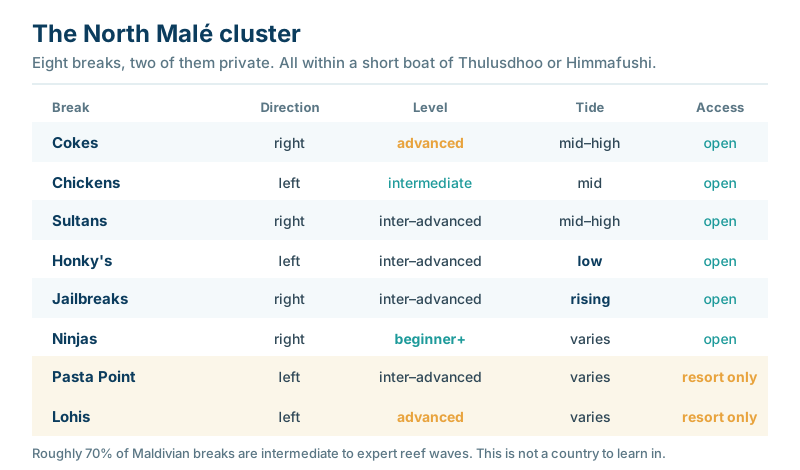
Pasta Point, at Cinnamon Dhonveli in North Malé, is a left-hand point that peels over shallow reef and is surfed only by guests of the resort. The water is technically public; the resort enforces access and priority. That keeps the lineup at around ten people on a perfect day, which is the entire proposition.
Lohis, off Lohifushi at Adaaran Select Hudhuranfushi, is the same arrangement applied to a long, consistent left. The property caps surfer numbers, which is why the wave stays rideable when it is working.
Both are effectively bought rather than found. If a specific wave is the reason for the trip, the accommodation decision and the surf decision are the same decision — a point our season calendar makes about the history behind the arrangement.
North Malé Atoll, break by break
The core cluster, and where most first trips happen. All of it is reachable by short boat from Thulusdhoo or Himmafushi.
Cokes. Right-hander off the southern reef of Thulusdhoo, named for the Coca-Cola plant on the island. Fast, hollow, steep take-off over reef that is rarely more than a metre under your fins. Advanced only when there is size. Works best on a southeast swell of five feet and up, mid to high tide. The most famous wave in the country and the least forgiving of the cluster.
Chickens. Left-hander directly across the channel from Cokes, and its opposite in temperament. Long, with sections for both tubes and turns, and intermediate-friendly at three to eight feet. A ten-minute boat from Thulusdhoo for around USD 10. This is the wave to step up on before Cokes.
Sultans. Long right off Thamburudhoo, rides of 150 to 300 metres, a mellow first peak leading into a faster second. Works from four to ten feet, intermediate to advanced, best on mid to high tide with offshore wind. Less crowded than Cokes, and the venue for the Four Seasons Surfing Champions Trophy.
Honky’s. The left on the same reef as Sultans, roughly a hundred metres along, and its mirror. Long wrapping wall with an inside section that stands up bigger than the take-off. Best at low tide and in north to northeast winds — which is to say, when it is blowing onshore at Sultans. Intermediate to advanced, and on its day one of the best waves in the country.
Jailbreaks. Long, fast right off the eastern tip of Himmafushi, named for the prison that used to face it. Three distinct sections on a small swell that connect into one long wall at two metres and above. Best on a mid to rising tide with southwest wind. Intermediate to advanced, and a five-minute walk plus a short paddle from the island.
Ninjas, also called Piddlies. Mellow right-hand wall, the closest thing in the cluster to a forgiving wave, popular with longboarders. Beginner-friendly when it is working, and inconsistent.
Pasta Point. Left-hand point, 100 to 250 metre rides, works from three to ten feet. Intermediate to advanced. Resort guests only.
Lohis. Long left, best on a south or southeast swell with northeast wind, at its most consistent from May to October. Resort guests only, with a daily cap.
South Malé, the central atolls and the far south
South Malé. Generally smaller than the north by a couple of feet and shadowed enough to shorten the season. Worth surfing when a bigger swell arrives, quiet otherwise, and more often surfed in passing on a charter heading south than as a destination in itself. Islands like Gulhi sit within reach of it, and the atoll is described in our guide to South Malé.
The central atolls — Meemu, Thaa and Laamu. Open to every southerly swell, empty because nothing here is reachable from a resort jetty, and the reason surf charters exist. Mushrooms, Yin Yang, Finnimas, Veyvah and Muli are the names that recur. Mostly intermediate and above, some of it expert-only, and all of it uncrowded.
The southern atolls. Gaafu Dhaalu is the heart of it, with Addu further south again through Gan. Beacons, Blue Bowls, Castaways, Love Charms and Tiger Stripes are the headline waves: full swell exposure, reefs facing straight into it, and the most powerful surf in the country. One resort in the region, very few charters, and lineups that are quiet in a way North Malé has not been for twenty years.
The catch in the far south is wind rather than swell, and the timing that follows from it is the subject of our season calendar.
Matching the break to your level
The honest distribution, from operators who assess it for a living: roughly 70% of Maldivian breaks are intermediate to expert reef waves, about 20% are intermediate-friendly, and around 10% are expert only.
| Level | Where you can surf | Notes |
|---|---|---|
| Beginner | Very limited. Protected lagoons, Ninjas on a small day | The Maldives is not a beginner destination |
| Improving intermediate | Chickens, Honky’s on a mid tide, Pasta Point when small | The step-up cluster |
| Solid intermediate | Sultans, Jailbreaks, most central atoll breaks | Where the country opens up |
| Advanced | Cokes with size, Jailbreaks at two metres, the far south | Shallow, fast, consequential |
| Expert | Big Cokes, the heaviest southern reefs | Consequence rather than difficulty |
The country is not a place to learn. There is no beach break, no sand bottom and no forgiving whitewater. Learning here means a protected lagoon and an instructor, which is possible and is not what anyone means by a Maldives surf trip. If it is your first ever surf holiday, somewhere with a sand bottom is the better first choice — and our activities overview covers what else the country offers if you are travelling with a surfer rather than as one.
What a surf day looks like
Predictable enough to plan around, and different from a surf trip almost anywhere else.
06:00. First light, and the best conditions of the day. Wind is lightest in the morning and the cluster is at its emptiest before the day boats arrive.
06:15. Paddle out from the island if your break is the home one, or load the dhoni if it is not. Boats to the nearby breaks take ten to twenty minutes.
08:30. Back for breakfast, or straight to a second break if the guide reads the tide as improving elsewhere.
Midday. Flat light, vertical sun, and the least pleasant three hours to be on the water. Most people are not.
16:00. The second session, with the light returning and the wind usually dropping again.
18:15. Dark, quickly. Equatorial dusk lasts about twenty minutes and there is no evening surf.
Two sessions a day is the normal rhythm, and it is dictated by wind and light rather than by swell. On a guesthouse island the boat schedule is built around exactly this, and on a charter the boat simply moves overnight to wherever the morning is better.
Reading the tide, break by break
Maldivian reef waves are more tide-sensitive than almost anywhere, and the difference between a mid tide and a low one can turn a rideable wall into a closeout.
Mid to high suits Cokes, Sultans and most of the shallow reefs, where more water over the coral means a safer take-off and a fuller wave.
Low tide suits Honky’s, which gets punchier and better defined as the water drains.
A rising tide suits Jailbreaks, which is when its three sections have the best chance of connecting.
The practical routine: check the tide table alongside the swell forecast, and expect the local guide to move the session by two hours rather than change the break. Tide tables are published and exact, unlike wind, which is the variable nobody can call reliably at atoll scale.
If you are basing on a guesthouse island, the boat schedule will already be built around this. If you are surfing your home break on foot, it is on you.
The reef, and what it does to people
The bottom is live coral and dead coral, and neither is forgiving.
Take-off zones are shallow. At several breaks the reef sits a metre or less below the surface at the critical section. A fall in the wrong place is a reef contact, not a wipeout.
Booties divide opinion. They cost feel and they prevent the specific injury of stepping onto reef while paddling out or getting in. On the shallower breaks, most regulars wear them.
Coral cuts infect fast in warm water. Clean immediately and properly, and watch for redness — our guide to health and medical care covers what the medical system can and cannot do, including how far a hospital is from an outer atoll.
There are no lifeguards. Anywhere. The nearest help is the boat you arrived on.
The reef is also the wave. Standing on it, anchoring on it and breaking it damages the thing that makes the break work. It is under enough pressure already, as our guide to coral reef health sets out.
Boards for these waves
Bring your own. Rental exists at surf resorts and is limited everywhere else. Quivers on charter boats are for emergencies rather than for choice.
Two boards cover the range. A standard shortboard for the four-to-six-foot days, and something with more volume — a step-up or a mid-length — for both the bigger swells and the mellow ones. The same week can serve four-foot Chickens and eight-foot Sultans.
Longboards work at Ninjas and on small days generally, and are harder to justify on a baggage allowance — the numbers are in our guide to seaplane baggage, and the same constraint applies in reverse on domestic flights.
A repair kit is not optional. Reef and dings arrive together, and there is no surf shop on a charter boat.
Board bags on a seaplane need advance approval and may travel on a later flight than you do. Most surf destinations here are reached by boat or domestic flight instead, which removes the problem — the mechanics are in our transfers guide.
What to bring
Short, because the constraints are specific.
Boards and a repair kit, as above.
Reef booties, at least for the shallower breaks.
A rash vest or wetsuit top. Water sits at 26 to 30°C year-round, so nobody needs neoprene for warmth. Sun and reef are the reasons to cover up, and three hours of equatorial UV on a back is a genuine injury.
Zinc, and more than you think.
A proper first aid kit with antiseptic. Coral cuts infect quickly and the nearest pharmacy may be an atoll away.
Cash in small notes for boat fares, crew tips and island purchases — the mechanics are in our guides to money and tipping.
Nothing warm. There is no cold water in this country and no cold evening.
Crowds, and the etiquette of a small lineup
North Malé is busy and the rest of the country is not, which produces two different sets of manners.
In the North Malé cluster, on a small day, the crowd is the limiting factor rather than the wave. Cokes and Sultans draw day boats from several islands plus resort guests plus guesthouse surfers. Ten to twenty in the water is normal at Sultans; more at Cokes when it is good.
Priority rules apply as anywhere, and the local crew are generally welcoming to visitors who observe them. Maldivian surfing has grown enormously, and the lineups that were once entirely foreign now have a strong domestic contingent — the Dhivehi Surf League is where that scene is visible.
In the central and southern atolls, five to ten people is a crowd. The etiquette that matters there is different: you are sharing a wave with one boat, and everyone on it will be surfing with you all week.
The genuinely useful advice: surf the second-best break. On any given morning the cluster is not uniformly crowded, and a guide who moves you to Honky’s when Sultans is full is worth the boat fare on his own.
What a surf trip costs
| Model | Typical cost |
|---|---|
| Guesthouse island, all-in | From about USD 100 per day |
| Boat to a nearby break, per person | USD 10–25 |
| Surf resort, per night | Several hundred upward, before flights |
| Surf charter, per person per week | Substantially higher, and covers several atolls |
What the guesthouse figure includes is a room, meals and boat access to the cluster. It is the reason the North Malé lineups filled: a wave that used to require a resort booking now costs a fraction of that, and the water is the same water.
What a resort buys is a break with fewer people on it, and in two cases a private one. That is a real product rather than a markup, and whether it is worth the difference is a question only you can answer.
What a charter buys is the central atolls, flexibility when the wind turns, and lineups with nobody in them.
The wider cost picture — transfers, taxes and what else a week absorbs — is in our guides to money in the Maldives and excursion prices.
A note on conflicting information
Worth stating, because surf-travel content about this country is unusually unreliable.
While researching this article we found published guides that describe Pasta Point as a right-hander — it is a left — and that place Lohis in the central atolls, when it breaks off Lohifushi in North Malé. Both errors appear on sites that look authoritative.
The pattern is familiar: one source makes an error, several aggregate it, and the mistake outlives the correction. If a guide has the direction of a wave wrong, assume it has the tide and the skill level wrong too.
How to check anything in this article: the local operators and the surf-forecast services agree with each other on wave direction and tide preference, and they are the sources to trust. Where our description differs from something you read elsewhere, ask the guide on the boat — they surf it daily and they will tell you plainly.
Getting there
North Malé is a speedboat transfer of thirty to ninety minutes from Velana. The easiest surf trip in the Indian Ocean to organise.
The central atolls mean a charter from Malé or a domestic flight to meet a boat. Allow a full travel day at each end.
The southern atolls mean a domestic flight to Kooddoo or Gan and a boat onward, which is two travel days out of a week.
Board bags fly as sports equipment and airline policies vary, so check the allowance before booking the international leg. If your dates fall around Eid, book internal transport early — Maldivians travel between islands and flights fill, as our public holidays calendar explains.
Non-surfing days
Every surf trip has them, and the Maldives handles them better than most surf destinations.
Diving and snorkelling on a flat day is the obvious answer, and the country is world class at both — see our guides to diving and snorkelling.
Fishing trips from a guesthouse island cost little and fill an evening.
A non-surfing partner is better served on an inhabited island than at a surf resort, where the entire programme is built around the water. Our comparison of resort and inhabited islands sets out what each offers.
And the flat spell may not last. Swell arrives on a four-to-seven-day cycle from the Southern Ocean, so a two-day lull inside a ten-day trip is normal rather than a wasted week.
Questions surfers ask
Is the Maldives good for beginners? Not really. Around 70% of breaks are intermediate to expert reef waves over shallow coral, and there is no sand-bottom beach break to learn on. Lessons in protected lagoons exist, but a first surf trip is better spent elsewhere.
Which is the best break in the Maldives? Sultans and Pasta Point are the two most consistently named, for different reasons — Sultans for long rippable right-hand walls, Pasta Point for a private left that rarely holds more than ten surfers. Cokes is the most famous and the least forgiving.
Can I surf Pasta Point or Lohis without staying there? No. Both are controlled by the resorts that built their proposition around them, and access is enforced. Lohis also operates a daily cap on surfer numbers.
Where should I base myself for the North Malé breaks? Thulusdhoo for Cokes and Chickens, Himmafushi for Jailbreaks and Honky’s. Boats to the rest of the cluster run USD 10 to 25 per person.
Do I need reef booties? On the shallower breaks, most regulars wear them. They cost some feel and prevent the specific injury of stepping onto reef.
How crowded is it? North Malé can be genuinely crowded on small days, with ten to twenty in the water at Sultans and more at Cokes. The central and southern atolls are quiet because access requires a boat.
What boards should I bring? A shortboard and something with more volume. The same week can serve four-foot Chickens and eight-foot Sultans, and rental is limited outside surf resorts.
Does tide matter? Considerably. Mid to high suits Cokes and Sultans, low suits Honky’s, and a rising tide suits Jailbreaks. Check the tide table alongside the swell forecast.
What to take away
- Access is the constraint, not swell. From any single base you can reach about eight breaks, and two of the best are private.
- Pasta Point and Lohis are surfed only by guests of the resorts controlling them, so the accommodation choice is the surf choice.
- The North Malé cluster is the accessible core: Cokes and Sultans for the experienced, Chickens and Honky’s to step up on, Ninjas when it works.
- Roughly 70% of Maldivian breaks are intermediate to expert reef waves. This is not a country to learn in.
- Tide changes the wave more than it does elsewhere: mid to high for Cokes and Sultans, low for Honky’s, rising for Jailbreaks.
Next step: pick the base before the break, because the base determines the list. Thulusdhoo and Himmafushi buy you the cluster for a hundred dollars a day; a charter buys you the central atolls and nobody else in the water; and two waves in this country cannot be bought at all except with a room key.