What to Do on a Wet Day in the Maldives: Rain Is Not the Problem
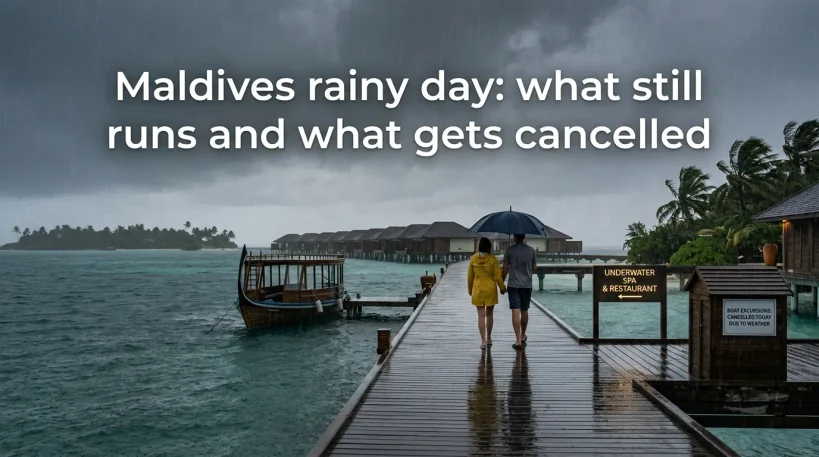
A rainy day in the Maldives is rarely a rainy day. It is a squall that arrives, empties itself over the island for forty minutes, and moves on, leaving everything steaming and the reef exactly as it was.
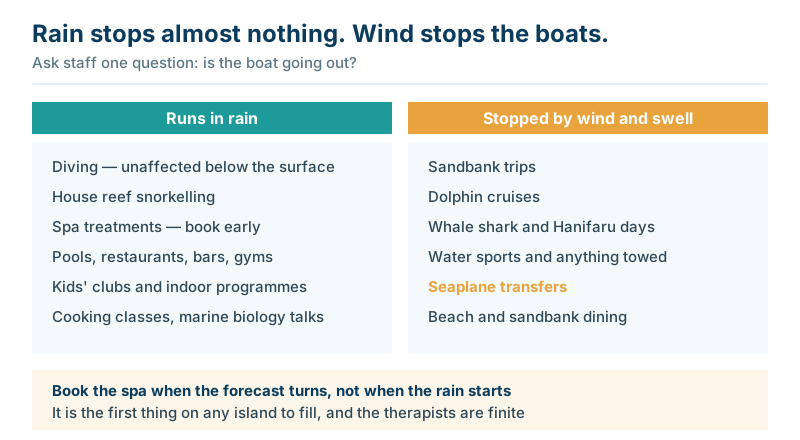
What actually ruins a day here is wind. Rain does not cancel a dive, a snorkel or a spa treatment. Wind cancels boats, and boats are how you reach almost everything.
That distinction is the difference between a lost day and a rearranged one. This guide covers what Maldivian rain actually is, what keeps running through it, what gets cancelled, and what to do with the hours in between.
What Maldivian rain is actually like
Not what northern European visitors expect, and worth setting out.
It arrives in squalls. A dark line on the horizon, twenty minutes of warning, then heavy rain for anywhere between fifteen minutes and two hours. Then it passes.
It is warm. Air and water both sit at 26 to 30°C year-round, so being rained on is a novelty rather than a hardship. Nobody gets cold.
It is heavier than you think and shorter than you fear. Tropical rain falls hard. A squall that would count as a serious event in a temperate country is a normal Tuesday afternoon here.
Whole grey days happen in the southwest monsoon, and they are the exception rather than the rule. The pattern is covered properly in our monsoon guide.
The wet season runs roughly May to November, with the wettest weeks generally in the middle of it. The dry season from December to April sees rain too, just less of it and usually briefer.
The light afterwards is the best of the trip. A post-squall late afternoon, with broken cloud and a wet beach reflecting it, is what photographers hope for.
Rain versus wind: the distinction that matters
Rain cancels almost nothing. You are getting wet either way if the plan involved the ocean.
Wind cancels boats. Excursion dhonis, sandbank trips, dolphin cruises, dive boats and speedboat transfers all depend on a workable sea, and the decision is the operator’s.
Wind also cancels seaplanes, which fly under visual rules in daylight only. A weather cancellation on transfer day is a different problem entirely, and our guide to missed connections covers who pays for the resulting night.
Swell is the third variable. A sandbank trip in a metre of swell is unpleasant regardless of what the sky is doing.
So the useful question is not “will it rain?” It is: is the boat going out? That answer determines your day, and staff give it honestly, because a cancelled trip suits nobody.
What keeps running
More than most visitors assume.
Diving. You are already wet. Visibility drops slightly with heavy surface rain and the dive itself is unaffected. Dive centres run in rain and stop only for wind and swell — the seasonal picture is in our diving season calendar.
House reef snorkelling. Same logic. Surface chop matters more than rainfall, and a sheltered lagoon side is usually calm even when the exposed side is not — our snorkelling guide explains why island geometry decides this.
Spa treatments. Which is why they fill within minutes of the sky darkening. Book ahead if rain is forecast, not after it starts.
Restaurants, bars, gyms, kids’ clubs and everything under a roof.
Pools. Warm rain, warm pool, nobody else in it — and the activities list is longer than most guests realise on a wet day.
Cooking classes, marine biology talks, craft sessions and the rest of a resort’s indoor programme, which exists precisely for these hours.
The public ferry network in ordinary rain, though it suspends for genuinely bad weather.
What stops
Sandbank trips, which need a workable sea and produce nothing in grey light — our sandbank guide covers why this excursion is the most weather-dependent of all.
Dolphin cruises, where swell makes spotting difficult and the sunset is the point.
Long boat excursions — whale shark days, Hanifaru trips, anything with an hour of open water each way.
Water sports. Jet skis, parasailing and anything towed.
Seaplane transfers, in poor visibility.
Private dining on a beach or sandbank, which resorts move indoors rather than cancel.
Ceremonies on a sandbank, which is why our weddings guide recommends a backup plan for that particular setting.
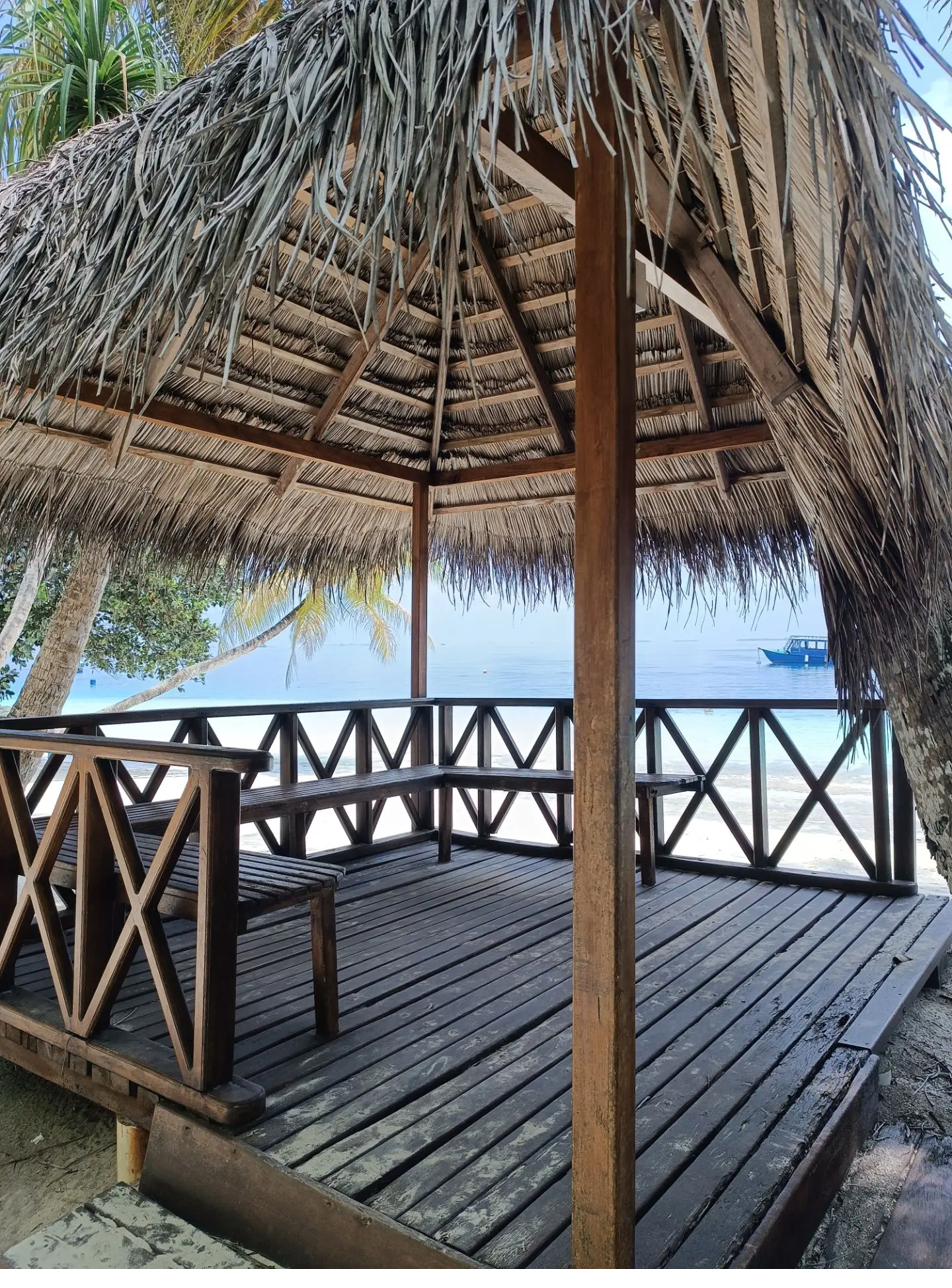
On a resort island
The resort’s answer to weather is its indoor programme, and the quality of it varies enormously by property.
Book the spa immediately. Not when the rain starts — when the forecast turns. Everybody else has the same idea and the therapists are finite.
Ask what is scheduled. Most resorts run something: a cooking class, a cocktail masterclass, a marine biology presentation, a fish-feeding session off the jetty. It rarely appears in the daily programme until somebody asks.
Use the house reef anyway. A wet afternoon snorkel with nobody else in the water is one of the better hours of a Maldives week.
The library, the cinema, the games room. Larger properties have all three and most guests never find them.
In-villa is not a defeat. A private pool in warm rain, a long lunch, and a book is a legitimate use of an expensive villa. Several guests report it as the most relaxing afternoon of the trip.
What to avoid: sitting in reception refreshing a weather app. The squall will pass before the app updates.
On a guesthouse island
A different set of options, and in some ways a better one.
The café hour. Four o’clock, hedhikaa on the counter, sweet tea, and an island’s worth of people doing the same thing. Rain makes this better rather than worse, and it is described properly in our food guide.
Walk the island anyway. Twenty minutes end to end, warm rain, empty streets. This is how a small island looks when it is not performing for anyone.
The guesthouse common area. Most have a covered terrace, and a wet afternoon there with the owner is how visitors learn more about the country than any excursion delivers.
Shops and the harbour. Small, functional, and interesting in the way ordinary places are.
Talk to the excursion desk about tomorrow. A cancelled trip today usually becomes a free reschedule, and the desk will be quieter than usual.
What a guesthouse island has that a resort does not is a functioning community that continues in bad weather. What it lacks is a spa, a cinema and a bar — a trade-off our comparison of the two island types sets out in full.

In Malé
If the weather has caught you in the capital — a transit day, a flight connection, a cancelled transfer — the city is the one place in the country with genuine indoor options.
The National Museum, in Sultan Park, covering the pre-Islamic and Islamic periods.
The Grand Friday Mosque and the historic coral-stone mosque, with access for non-Muslims managed and worth checking locally.
The fish market and the produce market, both covered and both busiest in the afternoon.
Cafés and restaurants, which the capital has in quantity and quality that no resort island matches for the price.
Shops, in the only place in the Maldives where that word means anything.
Our guide to Malé covers the walkable version of all this, and the guide to getting into the city covers how to reach it from the airport in twenty minutes.
With children
Rain and small children on a small island is the specific scenario people worry about.
Kids’ clubs run regardless, and at family resorts they are the whole answer — one factor in the atoll and property decision if you are travelling with children.
Warm rain is a novelty. Children who would never be allowed out in rain at home find being outside in it delightful, and there is nothing to catch cold from.
Pool in the rain is the reliable winner.
Board games, films and the resort library exist, and staff will produce them if asked.
On a guesthouse island, other children, a covered terrace and a football under a shelter cover most afternoons.
What not to do: book a long boat excursion with young children on a marginal weather day. A rough crossing turns a family holiday sour faster than any amount of rain.
For divers, the rain is an opportunity
The one group who benefit.
Dive sites are emptier. Casual divers and snorkellers stay in when it rains, which means fewer boats on the same reef.
The diving is unaffected. Below three metres it makes no difference at all.
Visibility drops slightly with heavy surface rain and runoff, and this matters less than people assume in a country with almost no land to run off.
Dive centres reschedule generously on wind days, and a diver with a package rather than a single dive loses nothing.
The rain-day discount does not exist — nobody drops prices for weather. What you get instead is a quieter boat.
On a liveaboard, and in transit
Two situations the standard advice does not cover.
On a liveaboard, weather changes the itinerary rather than the day. The boat moves overnight to the sheltered side of an atoll, the dive schedule continues, and the crew simply picks different sites. This is the single strongest argument for a liveaboard over a fixed resort in the monsoon months, and it is covered in our diving guide.
In transit, weather is a scheduling problem rather than a boredom one. A cancelled seaplane means a night near the airport, and our guide to a late arrival in Malé covers where to spend it.
On departure day, wind is the risk worth taking seriously. Build the buffer described in our transfers guide, and in the monsoon make it four hours rather than three.
On a domestic flight, weather delays happen and cancellations are rarer, because regional airports have instrument approaches and lighting — the comparison is in our guide to domestic airlines.
Photography in bad weather
Counter-intuitively, the best conditions of the trip.
Post-squall light is the finest of the day: broken cloud, low sun, a wet beach acting as a mirror.
Storm approach over open water is genuinely dramatic and nobody photographs it because everybody is inside.
Flat grey is the enemy, not rain. A uniformly overcast sky produces nothing.
Protect the gear. Salt spray plus rain is worse for a camera than either alone, and there is no repair shop.
Underwater is unaffected and is where the photography guide applies — our underwater photography guide covers it.
What to pack for the wet season
Six items, and none of them is a raincoat.
A dry bag. The single most useful thing you can carry in the monsoon months. Phone, camera, passport, and it doubles for boat transfers when spray comes over the bow.
A light long-sleeved layer. Not for warmth — for the wind on an open boat after a squall, when a wet swimsuit stops being pleasant.
Quick-dry everything. Cotton takes a day to dry in this humidity. Synthetic takes an hour.
A waterproof phone case, which costs nothing and prevents the commonest equipment loss of a Maldives trip.
Reef shoes. Wet jetties and boat decks are slippery, and a fall on a wet gunwale is the most likely injury of a rainy week.
Not an umbrella. It will be useless in wind, every property has them, and rain here arrives horizontally as often as vertically.
What genuinely helps, and costs nothing, is checking the forecast the evening before rather than the morning of. Squalls are visible on satellite imagery hours ahead, and an evening look tells you whether to book the spa or the boat.
Planning around it
Five rules that turn weather from a risk into a scheduling detail.
Build a spare day. If a sandbank trip or a whale shark day matters, do not schedule it for your last full day.
Book weather-independent things for the wet season. Diving, spa, house reef, dining.
Ask about cancellation policy before paying. Refunds are standard when the operator cancels; partial refunds for a shortened trip are not. Our excursion price guide covers the mechanics.
Choose a speedboat resort if your dates are in the monsoon, because seaplane transfers are the leg most exposed to weather.
Read the season honestly. The wet months are cheaper for a reason, and the reason is not that it rains all day — it is that some days the boat does not go out. Our guide to high and low season sets out the trade.
How many wet days to expect
Honestly, and without pretending to a precision the climate does not offer.
In the dry season, December to April, expect occasional short squalls and mostly clear days.
In the wet season, May to November, expect rain on a meaningful proportion of days, usually in bursts rather than continuously, with a smaller number of genuinely grey days.
Cancellations are the better metric than rainfall. A week in August might lose one boat excursion to wind and nothing else.
Nobody can forecast an individual week more than a few days out, and any month-by-month promise of sunshine is marketing. Our month guides give the pattern rather than a prediction.
What resorts owe you
Operator cancellation: a refund or a reschedule, and this is standard.
Your cancellation: usually nothing, inside 24 hours.
A shortened trip: rarely a partial refund.
A cancelled transfer: an overnight, and who pays varies by property — the detail is in our missed connections guide.
Nothing at all for rain. A wet week is not a service failure and no property compensates for weather, which is worth knowing before the conversation starts.
What good properties do voluntarily is reschedule generously, produce an indoor programme and stop selling excursions they know will be uncomfortable. That behaviour, more than any facility, is what distinguishes them in bad weather.
The honest version: when a wet day is genuinely bad
Most of this article argues that weather is manageable. Three situations where it is not, and pretending otherwise would be useless.
A short trip in a bad week. Four nights with three days of wind is a real loss, because there is no spare day to move anything into. Longer trips absorb weather; short ones do not.
A one-thing trip. If you flew specifically for Hanifaru or a whale shark day and the boats do not go out, no spa treatment fixes that. Build in two attempts rather than one.
A small resort with a thin programme. Some properties have a spa, a bar and nothing else. On a wet afternoon that is a long time on a small island, and it is worth asking what the indoor offering is before booking if your dates fall in the monsoon.
What does not help: treating it as a service failure. Nobody sold you the weather, and staff who are being blamed for wind stop being helpful.
What does help: deciding early that the day is a rest day rather than spending it waiting for the sky to change. The people who enjoy wet days here are the ones who commit to them by ten in the morning.
One more thing worth knowing
The wet season is when the reef is most alive.
The same plankton that reduces visibility feeds the animals people fly here to see. Manta aggregations, whale shark activity and the general density of life in the water all rise during the months with the most rain — the mechanism is set out in our diving season calendar.
So a wet week is not a worse week in the water. It is a week with less visibility and more biology, which is a trade many divers make deliberately.
And prices reflect the rain rather than the diving. Low-season rates are set by the number of people willing to risk a grey afternoon, not by what is happening on the reef — which is the quiet argument for travelling in the monsoon that our guide to high and low season makes in full.
Questions travellers ask
Does it rain all day in the Maldives? Rarely. Rain typically arrives in squalls lasting fifteen minutes to two hours and then passes. Whole grey days happen in the southwest monsoon and are the exception.
Can you still dive and snorkel in the rain? Yes. Rain has almost no effect below the surface, and dive centres run through it. What stops diving is wind and swell, not rainfall.
What gets cancelled when the weather turns? Boat-dependent activities: sandbank trips, dolphin cruises, long excursions, water sports and seaplane transfers. Anything on the island continues.
What is there to do at a resort when it rains? Spa, pool, house reef, gym, cooking classes, marine biology talks, library and cinema at larger properties. Book the spa when the forecast turns rather than when the rain starts.
Is the wet season worth avoiding? Not necessarily. Prices are substantially lower, the rain is usually brief, and the main cost is the occasional cancelled boat trip. It is a genuine trade rather than a compromise.
Do resorts compensate for bad weather? No property compensates for rain. Operators refund or reschedule excursions they cancel themselves, and that is the extent of it.
What can you do in Malé on a wet day? The National Museum, the mosques, the fish and produce markets, and the cafés. The capital has more indoor options than any resort island.
Does rain affect visibility for snorkelling? Slightly, through surface disturbance rather than through the water itself. A sheltered lagoon side is usually calm even when the exposed side is choppy.
What to take away
- Rain in the Maldives arrives in squalls and passes. Wind is what actually cancels things, because wind cancels boats.
- Diving, snorkelling, spa, pool and everything on the island continue regardless of rainfall.
- Book the spa when the forecast turns, not when the rain starts. It is the first thing to fill.
- Build a spare day if a specific excursion matters, and never schedule it for your last full day.
- No property compensates for weather. Operators refund or reschedule trips they cancel, and that is the whole entitlement.
Next step: stop asking whether it will rain and start asking whether the boat is going out. The first question has no useful answer and the second decides your day.