Water Sports in the Maldives: Half of It Is Free and Nobody Uses It
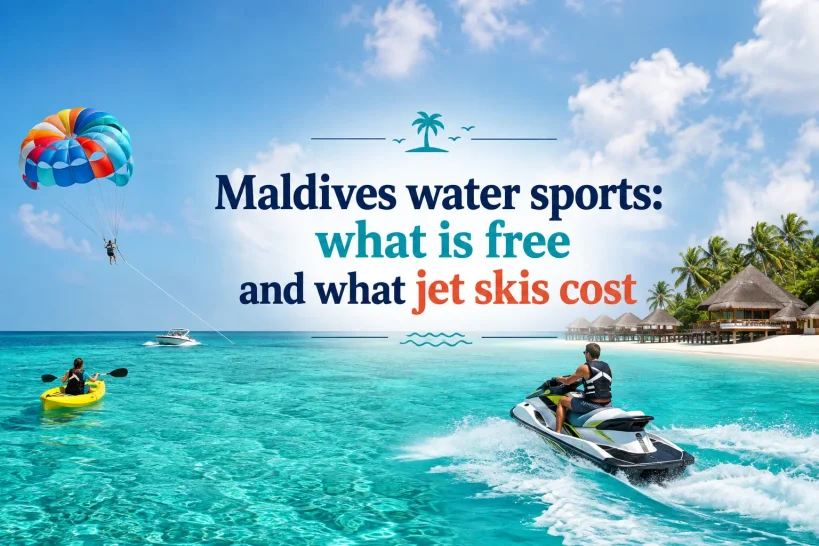
Every resort in the Maldives has a water sports centre, and Maldivian water sports come in two entirely different halves.
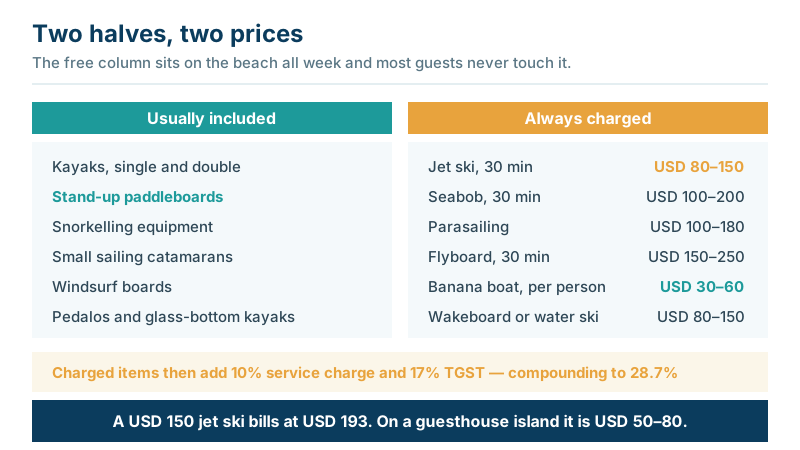
The first half is usually included in your rate: kayaks, paddleboards, sometimes a small sailing catamaran, and the snorkelling gear you already have. It sits on the beach all week and most guests never touch it.
The second half is the most expensive water sports on earth. A thirty-minute jet ski runs USD 80 to 150 before tax and service charge compounding to nearly 29 per cent. The machine is identical to one you could rent for a quarter of the price almost anywhere else.
This guide covers which is which, what the paid items actually cost, when the wind works for kitesurfing, and why several resorts have quietly stopped offering jet skis at all.
What is usually included
Non-motorised equipment is complimentary at most mid-range and luxury resorts, and it is the single most underused facility on any island.
Kayaks, single and double, available from the beach without booking.
Stand-up paddleboards, the same.
Snorkelling equipment, at almost every property — the reason our snorkelling guide argues that the house reef is the whole product.
Small sailing catamarans at many resorts, sometimes free and sometimes chargeable, usually with an instructor available.
Windsurf boards at properties with a sailing programme, often free for basic use.
Pedalos and glass-bottom kayaks at family-oriented resorts.
What is never included in the free water sports list: anything with an engine.
On a guesthouse island, none of this is free. Kayak and paddleboard rental runs a few dollars an hour from a beach operator — less than the tax alone on a resort jet ski, as our comparison of the two island types would predict.
What the paid items cost
| Activity | Typical price |
|---|---|
| Jet ski, 30 minutes | USD 80–150 |
| Seabob, 30 minutes | USD 100–200 |
| Parasailing, per person | USD 100–180 |
| Flyboard, 30 minutes | USD 150–250 |
| Banana boat or fun tube, per person | USD 30–60 |
| Wakeboarding or water skiing, 15–20 min | USD 80–150 |
| Windsurf or kitesurf lesson, per hour | USD 60–120 |
| Kitesurf equipment hire, per day | USD 70–140 |
| Catamaran with skipper, per hour | USD 80–150 |
Then add the tax. A 10% service charge followed by 17% TGST compounds to roughly 28.7%, so a USD 150 jet ski session bills at USD 193. The arithmetic is in our guide to money in the Maldives.
On a guesthouse island the same machines run considerably less — a jet ski at USD 50 to 80 for thirty minutes is normal on the established tourism islands. The multiplier is the same three-times pattern our excursion price guide documents across every activity in the country.
Jet skis, honestly
The most requested of all Maldivian water sports, and the one that deserves the most scrutiny.
It costs more here than anywhere in the world, and the machine is the same machine. You are paying for fuel shipped to an island, maintenance in salt air, and a captive market.
Several resorts do not offer them at all. Not because they cannot, but because a jet ski at speed in a shallow lagoon is loud, disruptive to guests who came for silence, and damaging to the reef and its animals. Properties that have built their proposition on tranquillity have made a deliberate choice.
Where they are offered, they are restricted. Designated areas away from the house reef, away from swimmers and away from moorings, with a briefing and often a guide riding alongside.
The environmental case against them is real. Noise disturbs turtles, rays and resting animals; propeller strikes injure them; and shallow-water operation over reef causes direct damage. Maldivian reefs lost a great deal of live coral in the 2024 bleaching event, as our guide to reef health documents, and they are not helped by this.
Our honest position: if you want to ride a jet ski, do it somewhere it does not sit above a coral reef. It is the one item on this list where the money and the ethics point the same way, which is toward not booking it.
The rest of the motorised list
Seabob. An underwater scooter you hold onto, which pulls you along at snorkelling depth. Genuinely fun, quiet, and the least environmentally objectionable motorised option — though a poorly ridden one still contacts reef.
Parasailing. Towed behind a boat under a canopy, two to three hundred feet up, for eight to twelve minutes. The view over an atoll from that height is the actual product — the same geometry our islands guide describes from the ground. Weather-dependent.
Flyboard. A water-jet board that lifts you above the surface. Difficult, brief, expensive, and most people spend the session falling.
Banana boat and fun tube. Towed inflatables, sold by the person, and the best value in the motorised column by a distance. Popular with families and teenagers.
Wakeboarding and water skiing. Short sessions behind a boat, requiring calm water and therefore usually a morning slot.
No water sports here require a licence, and everything requires a briefing. Take the briefing seriously — there are no lifeguards anywhere in the country.
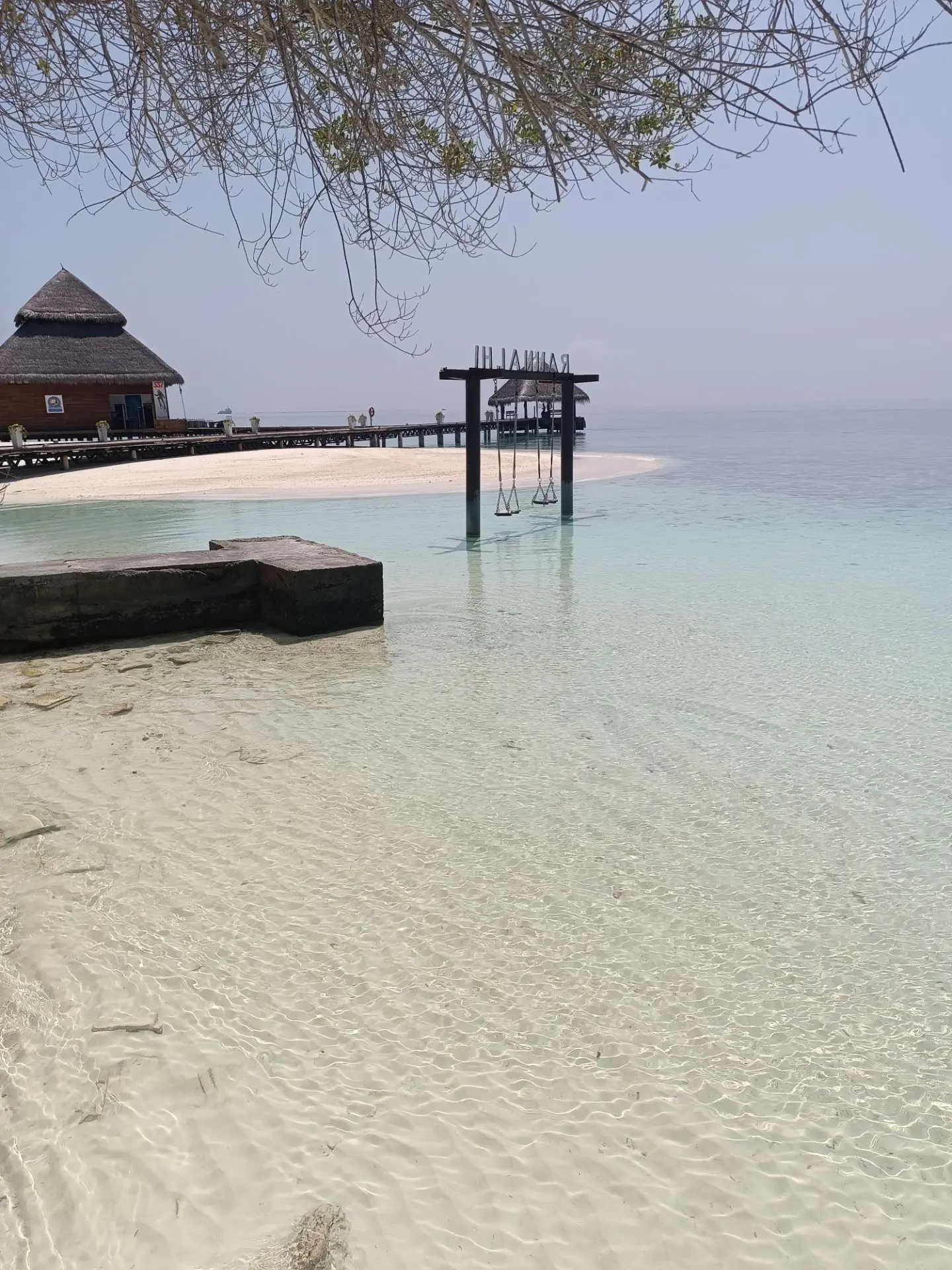
Kitesurfing and windsurfing: the wind seasons
The one water sport in the Maldives with a genuine season, and it has two of them.
The northeast monsoon, December to April, brings steadier, cleaner wind and flatter water. Better for learning and for flat-water riding.
The southwest monsoon, June to August, brings stronger, gustier wind and more chop. Better for experienced riders wanting power.
The transition months — May, and October into November — are the unreliable ones, with light and variable wind.
Where. Resorts with dedicated kite centres run across several atolls, and the sport needs space: a wide lagoon, a launch area clear of coral heads, and a downwind escape that does not end at a reef.
Lessons run USD 60 to 120 an hour with equipment, and a beginner needs several hours before riding independently.
Equipment hire requires certification or an assessment, and centres will refuse riders who cannot demonstrate control. That is correct and you should want it.
The reef is the hazard. A lagoon that looks empty from the beach has coral heads in it, and a crash onto one at speed causes the injuries our safety guide describes.
Surfers, note: the wind seasons and the surf seasons do not align neatly, because surf wants offshore wind and kiting wants side-onshore. A trip built for one is rarely optimal for the other.
Paddleboarding and kayaking: the underrated pair
The free water sports nobody uses, available all week, and consistently the thing people say afterwards they wish they had done more of.
Sunrise is the window. Flat water, no wind, no heat, and the best light of the day. A paddleboard at six in the morning on a mirror lagoon is the single best free hour on any Maldivian island.
Circumnavigate the island. Most resort islands take twenty to forty minutes to paddle around, and the view of the reef from above at low tide is remarkable — better, on a calm morning, than most of what is on the paid activities list.
A glass-bottom kayak or a clear paddleboard turns the same trip into a snorkelling substitute for non-swimmers.
The current warning is real. A lagoon is calm; the channel at its edge is not. Wind that pushes you out is easy and the return is not, and this is the commonest way a free activity becomes an incident.
Tell someone where you are going, stay inside the lagoon, and turn back earlier than feels necessary. Resorts often ask you to sign out equipment for exactly this reason.
On a guesthouse island, rental is cheap and the same rules apply with less supervision.
Sailing
Underrated and available at more resorts than guests realise.
Small catamarans — Hobie Cats and similar — are free or low-cost at many properties, with an instructor available for a first session.
Lessons are usually chargeable and short, and a competent sailor can take a boat out unaccompanied after an assessment.
Sunset sails with a skipper are sold as a private excursion, and are a calmer alternative to the dolphin cruise or a sandbank trip on a busy island.
Conditions are gentle in the lagoon and considerably less so outside it.
Booking and practicalities
How the water sports centre actually operates, which is not obvious from the beach.
Non-motorised equipment is walk-up. Sign it out, take it, bring it back. Some resorts ask for a room number and a signature, which exists so somebody notices if a kayak does not return.
Motorised activities are booked, usually at the centre itself or through guest services, and usually the day before for popular slots.
Morning is calmer. Wind builds through the day in most conditions, which is why water skiing and wakeboarding are morning products and kitesurfing is not.
Minimum numbers apply to towed activities. A banana boat needs four or five people, and a solo traveller may be asked to wait for others or pay the difference.
Weather cancels more than rain does. Wind and swell stop towed sports and parasailing while rain does not, the same distinction our rainy day guide draws for the whole activity list.
Refunds follow the same pattern as excursions: full when the centre cancels, none when you do inside the notice period. Our excursion price guide covers the mechanics.
On a guesthouse island, water sports operators sell from a shopfront and prices are negotiable for multiple sessions.
What to bring
Six items, and none of them is equipment.
A long-sleeved rash guard. Three hours of water sports at the equator burns worse than three hours on a beach, because the water reflects and the wind hides the heat.
Reef shoes. Launching and landing happens on sand and coral rubble, and the entry to a lagoon is rarely all sand.
A dry bag, for the walk back with wet everything.
A strap for sunglasses, which is the item most commonly lost in a Maldivian lagoon.
A waterproof phone case. Cheap, and it prevents the commonest equipment loss of any trip.
A camera mount if you want footage. Most water sports centres will not lend one, and a handheld phone on a jet ski or a paddleboard ends in the lagoon.
Not a wetsuit. Water sits at 26 to 30°C year-round and nobody needs neoprene for warmth — the same advice our snorkelling guide gives.
Safety, and why it matters more here
Six safety points for water sports here, and the first is the one people do not expect.
There are no lifeguards. Anywhere in the Maldives, at any resort, on any beach. The responder is whoever is nearest.
Current is the real hazard, not equipment. It runs at channel edges and around the ends of islands, and it is invisible from the beach.
Reef contact injures you and the reef. Coral cuts infect quickly in warm water.
Sun is the commonest injury on the whole list. Two hours on a paddleboard at the equator burns severely, and the water reflects — see the sun advice in our safety guide and the monsoon guide for when conditions are calmest.
Check your insurance. Some travel policies exclude motorised water sports entirely, and others cap them. Read the wording before booking a jet ski, not after — the same advice our guide to missed connections and cover gives about the rest of a Maldives policy.
Alcohol and water sports do not mix, and resorts will refuse a guest who has been drinking. Our guide to alcohol rules covers where drinking is possible in the first place.
Fitting water sports around diving
A scheduling point that catches divers out.
Most water sports are fine after a dive. Paddleboarding, kayaking, sailing and towed inflatables involve no meaningful physical stress or altitude.
Parasailing is the exception worth thinking about. It lifts you two to three hundred feet. That is well below the altitude thresholds dive tables concern themselves with, and the sensible order is still to parasail before a dive day rather than after one. If you dived that morning, ask both teams.
Strenuous water sports immediately after diving are discouraged for the same reason that vigorous massage is, as our spa guide explains: exertion affects off-gassing.
And the reverse: a day of wakeboarding leaves shoulders that make a dive less comfortable the next morning.
The practical structure of a week is dive days and water sports days, rather than both in one afternoon — the scheduling logic our diving guide sets out for the rest of the trip.
Age limits and children
Motorised activities generally require a minimum age of twelve to sixteen for the rider, with younger children permitted as passengers on some.
Parasailing is often available from around eight with an adult, subject to weight limits.
Banana boats and fun tubes are the family option, and the one children remember.
Kayaks and paddleboards work from about six with an adult and a buoyancy aid.
Kitesurfing typically starts at twelve to fourteen depending on the school.
Check with the property, because these limits are set per resort rather than nationally, and a family activity plan built on assumptions is a plan that fails at the beach.
On a guesthouse island
A shorter water sports list, cheaper, and with a different feel.
Motorised water sports exist on the established tourism islands, run by independent operators, at roughly half to a third of resort prices.
Non-motorised is rented rather than free, at a few dollars an hour.
Kitesurfing schools operate on a small number of guesthouse islands — around Maafushi and its neighbours among them — and are considerably cheaper than the resort equivalent.
Modesty applies on the beach. Bikinis are for the designated tourist beach only, as our guide to dress codes explains, and that shapes where water sports are based.
Supervision is lighter. Fewer staff, less briefing, and more responsibility on you — a trade-off our comparison of the two island types sets out across every activity.
Where the conditions are best
Water sports conditions follow geography rather than atoll brand.
Wide, shallow lagoons suit paddleboarding, kayaking, kitesurfing and learning to sail. Many resorts across Kaafu, North Malé and South Malé sit in exactly this.
Narrow lagoons with close reef edges suit snorkelling and diving and are poor for anything towed, because there is nowhere safe to run.
Channel-adjacent islands have current and are the ones where the free-equipment warning matters most — the geography our atolls guide explains.
For kitesurfing specifically, the requirement is a wide lagoon with a clean launch and a downwind escape, which is a property-level question rather than a regional one.
The practical approach: choose the island for the diving, the transfers or the budget, and ask what the lagoon supports. Our atoll decision guide covers the factors that genuinely differ between regions, and water sports is not among them.
Is it worth it?
The free half: unambiguously. Paddleboard at sunrise, kayak around the island, take the catamaran out. It costs nothing, it is available every day, and almost nobody does it.
Banana boats and fun tubes: yes, at USD 30 to 60, particularly with children.
Parasailing: once. The aerial view of an atoll is genuinely worth having and cannot be got any other way short of a seaplane transfer, which gives you the same view for free on arrival day.
Seabob: if you like the idea. Expensive, fun, and quiet enough not to be objectionable.
Kitesurfing: yes, if you kite. The conditions are good, the seasons are workable and the lagoons are the right shape.
Jet skis: no. Most expensive in the world, identical to jet skis anywhere, and sitting on top of a reef that has had a bad decade. This is the clearest “spend it elsewhere” in the whole activities list.
And the free version that beats all of it: the house reef at seven in the morning, which costs nothing and is the reason most people booked.
Questions travellers ask
Are water sports included at Maldives resorts? Non-motorised equipment usually is — kayaks, paddleboards, snorkelling gear and often a small catamaran. Anything with an engine is charged separately, and most guests never use the free equipment.
How much does a jet ski cost in the Maldives? USD 80 to 150 for thirty minutes at a resort, before a service charge and tax compounding to about 28.7%, so a USD 150 session bills at USD 193. On a guesthouse island the same machine runs USD 50 to 80.
Why do some resorts not offer jet skis? Noise, disruption to other guests and damage to reef and marine life. Properties built around tranquillity have made a deliberate choice not to run them.
When is the best time for kitesurfing in the Maldives? December to April for steadier, cleaner wind and flatter water, and June to August for stronger, gustier conditions. May and the October–November transition are unreliable.
Do I need a licence for water sports? No, but every activity requires a briefing, and kitesurf equipment hire requires certification or an on-site assessment. There are no lifeguards anywhere in the country.
Are water sports covered by travel insurance? Not always. Some policies exclude motorised water sports and others cap them. Check the wording before booking rather than afterwards.
What is the best free activity? A paddleboard at sunrise on a flat lagoon. It is free at most resorts, available every day, and the single most underused facility on any island.
Can children do water sports? Motorised activities typically require riders to be twelve to sixteen, parasailing is often available from around eight with an adult, and kayaks and paddleboards work from about six. Limits are set per resort.
What to take away
- Non-motorised equipment is free at most resorts and sits unused all week. Kayaks, paddleboards and often a catamaran.
- Motorised water sports are the most expensive in the world here. A USD 150 jet ski bills at USD 193 after tax, for the same machine you could rent anywhere.
- Several resorts have stopped offering jet skis because of noise and reef damage, and that is a defensible position.
- Kitesurfing has two seasons: December to April for clean flat conditions, June to August for power.
- The current at a lagoon edge is the real hazard, and there are no lifeguards anywhere in the Maldives.
Next step: before booking anything with an engine, take a paddleboard out at six in the morning. If that is not enough, the jet ski will still be there at nine — and you will have a better sense of what the lagoon is actually like before you go fast across it.