Local Island Excursions in the Maldives: Forty Minutes and a Souvenir Shop
The standard resort excursion to an inhabited island runs like this. A boat at nine, a walk past a mosque, a school and a harbour, twenty minutes in a shop selling the same sarongs the resort sells, and back on the boat by half past eleven.
Guests come away saying it was interesting. Almost nobody says it was the best day of the trip, because forty minutes is not enough to see anything, on any island, anywhere.
The islands are genuinely worth visiting. This guide covers what is there, the rules that apply the moment you step off the boat, and how to make the visit more than a walk past somebody’s front door.

What an inhabited island actually contains
Not a museum. A functioning community of a few hundred to a few thousand people, most of whom are working.
A harbour, which is the busiest place on the island and the most interesting. Boats unloading, fish being landed, cargo arriving. Everything on the island came through here.
A mosque, often the oldest building, sometimes built of coral stone. Non-Muslims generally do not enter, and the exterior and the ablution tank are worth looking at.
A school, a health post and a council office. The infrastructure of a small state.
Cafés, which fill at four in the afternoon for hedhikaa — short eats with sweet tea — and which are the single most sociable hour on any island. Our food guide covers what to order.
Shops. Small, functional, and selling groceries rather than souvenirs on the islands with fewer visitors.
A football pitch, in use every evening around six, and the closest thing to a free spectacle in the country.
A tourist beach, on islands with guesthouses — a designated stretch where swimwear is permitted, described below.
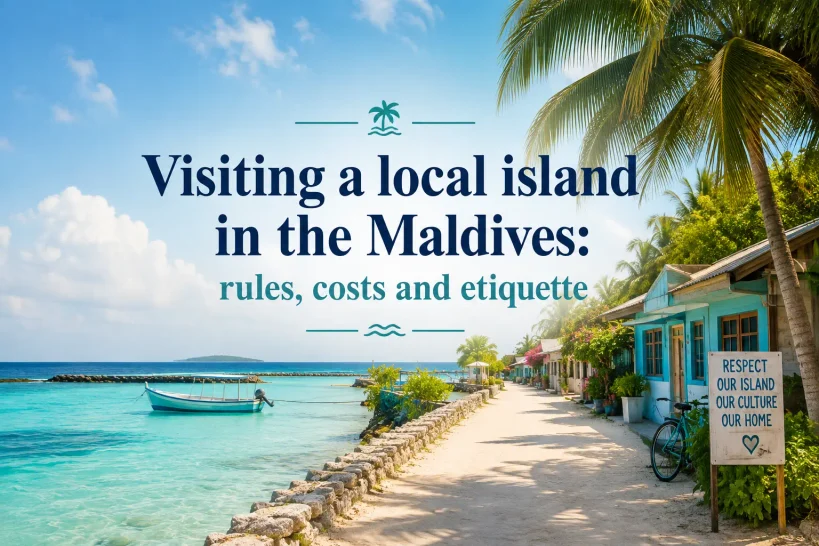
Sandy lanes, bougainvillea, cats and bicycles. The texture of the place, and what people photograph.
What it does not contain: a bar, a nightclub, a shopping district or an attraction. Our comparison of resort and inhabited islands sets out the full trade.
Why these islands are open to visitors at all
A short piece of context that explains everything about the current situation.
Until 2009, tourists could not stay on inhabited islands. The Maldivian model separated visitors onto uninhabited resort islands entirely — one island, one resort — and the population lived elsewhere. It was deliberate, and it was designed to keep tourism and Maldivian life apart.
Guesthouses on inhabited islands were legalised in 2009, and the effect has been substantial: a domestic tourism industry owned by Maldivians rather than by international operators, on islands that previously saw no visitor money at all.
That is why a local island excursion feels new, because it is. The infrastructure, the bikini beaches and the guesthouse scene are barely fifteen years old.
It is also why the rules feel improvised in places. Communities are still working out what they want from visitors, and the answer differs by island.
The practical consequence for a visitor: you are early, in historical terms, and the behaviour of visitors now shapes how open these islands remain. That is not a burden — it is an argument for the dress code, the photography consent and the lunch bought locally.
The history of how the country got here is in our guide to the Maldives and Islam, and the economics in our guide to what the country runs on.
The rules, from the moment you step off the boat
Four things, and they are not optional.
Dress modestly. Shoulders and knees covered for both men and women anywhere except the designated tourist beach. This is not a legal requirement enforced against visitors so much as a social one, and it is the clearest signal you can send about whether you understood where you are. Our guide to dress codes covers the detail.
Swimwear only on the bikini beach. Islands with tourism have a designated stretch, often screened, where swimwear is fine. Everywhere else — including the walk between your guesthouse and the beach — it is not.
No alcohol. Inhabited islands are dry. There is none for sale, none permitted, and bringing it is a customs matter, as our guide to alcohol rules explains.
Public displays of affection are out of place, and this catches honeymooners off guard.
One more that is not a rule but should be: greet people. Assalaam alaikum works, and the response is warm. Our Dhivehi guide has the rest.
Photography, and the thing nobody tells you
The most common way visitors give offence, and it is entirely avoidable.
Ask before photographing people. Always, and particularly women and children. A camera raised at a stranger in their own street is intrusive anywhere, and here it also crosses a cultural line.
Children are not scenery. Photographing other people’s children without a parent’s consent is not acceptable, and a group of visitors doing it on a small island is remembered.
Do not photograph inside mosques, and ask before photographing the exterior if people are present.
Harbour work is fair game in general terms, and asking the fisherman still costs nothing and usually produces a better photograph and a conversation.
Drones need permission and are restricted, and flying one over an inhabited island without asking is the single fastest way to become the story.
The reliable test: would you photograph this on your own street, of your own neighbours, without asking? If not, ask first.
Friday, and the timing nobody plans for
Friday is the Maldivian weekend and the island changes shape.
Shops and offices close for the main prayer, roughly 11:30 to 13:30, and the island goes quiet.
Ferries and some transport pause across the same window — the pattern our ferry guide documents in detail.
Afternoon is the busiest social time of the week, with families out and the football pitch full.
A resort tour scheduled for Friday morning arrives at the quietest possible moment and sees the least.
During Ramadan, cafés close during daylight, the rhythm of the island inverts, and visiting requires more care and delivers more if you do it thoughtfully. Our public holidays calendar covers the dates.

Doing it properly
Five versions, in ascending order of how much you will get out of it.
The standard resort tour. Two to three hours, guided, scheduled, and the least you can do. Fine as an introduction and it will not tell you much.
The extended half day. Ask the resort whether a longer visit is possible, or book with an operator who allows free time rather than leading a column. Three to four hours, with an hour unstructured, is a different experience entirely.
The self-directed day. Take a public ferry or a scheduled speedboat, spend the day, eat lunch in a café, and come back in the afternoon. Cheap, unguided and considerably better — logistics permitting, which they often do not from a resort.
A night. One night in a guesthouse converts a tour into a stay: you see the evening, the football, the morning, and the island when no boat of visitors is on it.
Two or three nights, which is the version this site recommends and our Maafushi guide describes in full. Split-stay trips — a few nights on an inhabited island and a few at a resort — are the single best structural decision available to a first-time visitor.
The general principle: the island is not a stop on an itinerary. It is where the country actually lives, and the amount you take from it scales almost linearly with the hours you spend.
What to actually do with the time
If you have three or four hours rather than two, this is the order that works.
Start at the harbour, early if possible, when boats are unloading.
Walk the residential lanes rather than the shopfront street. Twenty minutes, no destination.
Sit in a café at four for hedhikaa and tea. This is the single highest-value hour on any inhabited island and it costs two dollars.
Find the football pitch around six. Nothing is organised for you, which is the point.
Swim at the bikini beach, which on most islands is genuinely good and empty compared with a resort beach.
Buy something from a shop rather than a souvenir stand.
Talk to your guide about their island rather than about the mosque. Guides on these islands live there, and the questions worth asking are ordinary ones.
What to skip: the souvenir shop stop, which is on every itinerary and sells what the resort boutique sells.
What it costs
| Version | Typical price |
|---|---|
| Resort guided tour, 2–3 hours | USD 80–150 per person |
| Guesthouse-island operator, half day to a neighbouring island | USD 25–40 per person |
| Public ferry, each way | About USD 1.50–3 |
| Scheduled speedboat, each way | USD 25–50 per person |
| Guesthouse room, per night | From about USD 60 |
Resort prices carry the usual 28.7% in service charge and tax, as our guide to money in the Maldives explains, and the multiplier against the local operator is the same three-to-five times documented in our excursion price guide.
The stark comparison: a resort tour for two costs more than a night in a guesthouse on the island you are visiting.
Where the money goes
Worth thinking about for thirty seconds, because it changes what you do while you are there.
A resort-run tour keeps most of the fee in the resort economy. The island sees the souvenir purchases and little else.
A locally-run trip pays a local boat, a local guide and a local business directly.
What you spend on the island stays there. A meal in a café, a coffee, a sarong bought from the shop rather than the resort boutique, and a tip to the guide who walked you round.
Eat lunch there. The highest-value thing a day visitor can do, at USD 5 to 13. Our food guide covers what to look for.
Do not haggle hard over small sums with people whose margin is small. The saving is a dollar and the impression lasts.
From a guesthouse island
The reverse direction, and an underrated excursion in its own right.
Island-hopping trips run from the established guesthouse islands to their neighbours, usually as a half day combined with a sandbank stop or snorkelling.
They cost USD 25 to 40 and visit islands with fewer visitors than your base.
The quieter island is usually the better one. Fewer guesthouses, fewer souvenir shops, and a community that is not accustomed to visitors — which cuts both ways, and requires more care with dress and photography rather than less.
The public ferry is the cheapest version, at a dollar or two, and it is also how residents travel. It runs on a schedule built for them rather than for you, and it does not run on Fridays.
Combine with a dolphin cruise or a turtle snorkel for a full day that is not all village.
Getting there yourself
The logistics that decide whether a self-directed visit is possible at all.
From a guesthouse island, trivially. Neighbouring islands are a short boat away and operators run daily.
From a resort, harder. Most properties will not release guests onto a scheduled ferry, transfers are chargeable, and the resort’s own tour is often the only offered route. Ask anyway — some will arrange a private boat.
From Malé or Hulhumalé, easy and cheap. Scheduled speedboats and public ferries run to the nearer islands daily, and the airport area is the natural launching point — the practicalities are in our guide to getting into the city.
On a transit day, this is the best use of an awkward layover: a ferry out, a few hours, a ferry back, for a few dollars.
Check the return before you go. The failure mode is a delightful afternoon followed by the discovery that the last boat left at three — the scheduling problem our ferry guide exists to solve, and one that gets worse on Fridays.
Never make a ferry your last connection before a flight. That rule applies here as everywhere, and our guide to missed connections explains what it costs when it fails.
Which islands
By accessibility rather than by ranking, since they are communities rather than attractions.
Near Malé, in Kaafu: Maafushi is the largest and most developed for tourism, with Gulhi, Guraidhoo, Himmafushi, Thulusdhoo and Dhiffushi nearby and progressively quieter. All are within reach of South Malé and North Malé resorts by boat.
In Ari: Dhigurah and Ukulhas, both with strong guesthouse scenes and — in Ukulhas’s case — a reputation for waste management that is genuinely unusual in the region.
In Baa: Dharavandhoo, the gateway to Hanifaru.
Further out, in Vaavu, Lhaviyani and the southern atolls, islands see very few visitors and the experience is correspondingly less packaged.
The pattern: the more guesthouses an island has, the easier the visit and the more it resembles a tourist environment. The fewer it has, the more interesting and the more responsibility falls on you.
With children
Genuinely good, and better than most of the paid alternatives.
Other children. A football pitch at six in the evening is an international language, and Maldivian islands are safe in a way that surprises visiting parents.
The harbour holds a child’s attention longer than any village walk.
Short is fine. Two hours is a reasonable maximum for a young child in equatorial heat with no air conditioning.
Dress rules apply to children too, in practice more loosely for small ones, and it costs nothing to comply.
Bring water. Tap water is not drinkable, cafés sell bottles cheaply, and there is no resort dispensing free water at every corner.
Is it worth it?
The two-hour resort tour: marginally. It is an introduction rather than an experience, and at USD 80 to 150 per person it is poor value for what it delivers.
A locally-booked half day: yes, at USD 25 to 40, particularly if it includes free time and a meal.
A night or more: unequivocally. This is the version that changes how people understand the country, and it costs less than the tour.
The split stay is the recommendation. Three nights on an inhabited island and four at a resort gives you both halves of the country. Our activities overview and island comparison reach the same conclusion from different directions.
Not worth it as a photo opportunity, a curiosity or a way to fill a morning. If that is the intent, the money is better spent on a sandbank trip, and the island loses nothing by your not coming.
One thing the tours get right
Fair is fair, and there are two.
The guide. A local guide walking you round their own island answers questions no article can, and the good ones are genuinely proud of the place. The forty-minute format is the problem, not the person delivering it.
The transport. Getting from a resort island to an inhabited one is a boat, a schedule and a licence, and the resort has all three. For guests on a seaplane-served island in an outer atoll, the resort tour is not the worst version of this visit — it is the only version.
Which is worth saying plainly, because the rest of this article argues for the independent alternative and that alternative is not always available. If your resort is two hours from the nearest inhabited island, take the tour, ask for the longest one offered, and spend money in the cafés while you are there.
And if the tour is the only option, the way to improve it is to opt out of the group for the last half hour. Most guides will agree to a meeting point and time. That thirty minutes alone on a lane is worth the other two hours combined.
Questions travellers ask
What is a local island excursion in the Maldives? A visit to an inhabited island, usually sold by resorts as a two- to three-hour guided tour of a village, mosque, harbour and souvenir shops. Independent versions are longer, cheaper and considerably better.
What should I wear on a local island? Shoulders and knees covered for both men and women, everywhere except the designated tourist beach where swimwear is permitted. This applies on the walk to and from the beach as well.
Can I drink alcohol on an inhabited island? No. Inhabited islands are dry, alcohol is not sold and bringing it in is a customs matter.
Can I take photographs? Of places, yes. Of people, ask first — particularly women and children. Do not photograph inside mosques, and drones require permission.
How much does it cost? USD 80 to 150 per person for a resort tour, USD 25 to 40 for a locally-booked half day, and a dollar or two for the public ferry. A guesthouse room starts around USD 60 a night.
What happens on Friday? Shops and offices close for the main prayer, roughly 11:30 to 13:30, and much transport pauses. The afternoon is the busiest social period of the week.
Which local island should I visit? Maafushi is the most developed for tourism and the easiest. Gulhi, Guraidhoo, Himmafushi, Thulusdhoo, Dhigurah and Ukulhas are progressively quieter. The fewer guesthouses, the more interesting and the more care required.
Is a day trip enough? Not really. Two hours shows you a village; a night shows you an island. The best structure is a split stay of a few nights on an inhabited island and a few at a resort.
What to take away
- The standard resort tour is two to three hours and shows you very little. The island is a community rather than an attraction.
- Cover shoulders and knees everywhere except the designated tourist beach, and remember the rule applies on the walk there.
- Ask before photographing people, always, and particularly women and children.
- Friday closes the island from roughly 11:30 to 13:30, which is exactly when most morning tours arrive.
- A resort tour for two costs more than a night in a guesthouse on the same island. The night is the better purchase.
Next step: if a local island is on your list, look at whether you can spend a night rather than a morning. It costs less than the excursion and it is the only way to see the island when no boat of visitors is on it. It is also the single change that turns an interesting two hours into the part of the trip people talk about afterwards.