
Maldives or Fiji: One of Them Gets Cyclones
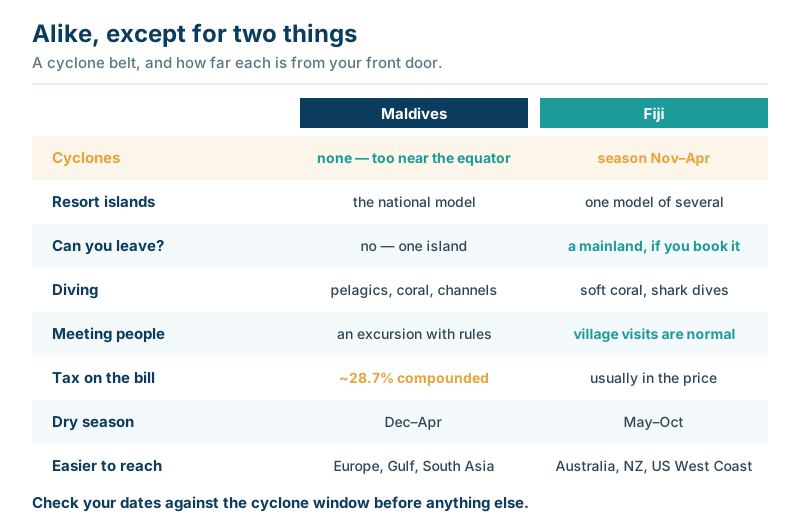
The Maldives sits almost on the equator, and tropical cyclones do not form there. Fiji sits well south of it, in a cyclone belt, with a season that runs roughly November to April.
That is the single structural difference between these two destinations that no amount of money, planning or property choice can work around. Everything else — the reefs, the resorts on small islands, the boat transfers, the overwater villas — the two have in common to a degree that surprises people who assume the Pacific and the Indian Ocean are unrelated products.
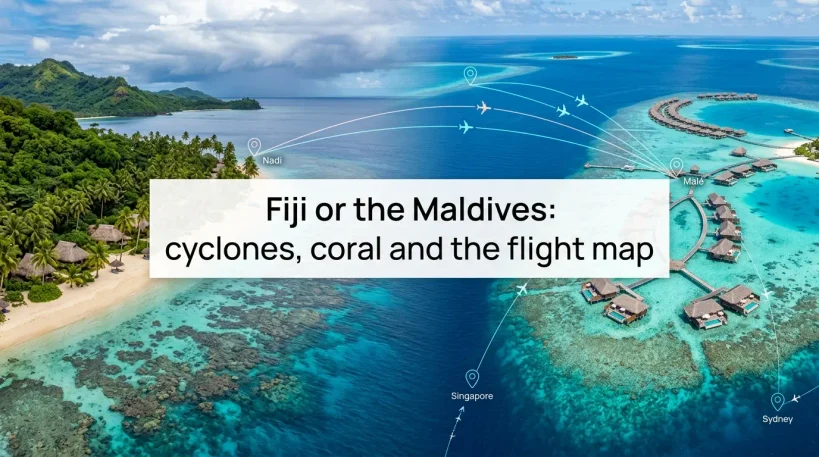
The rest of the decision is made by a flight map, and it makes it decisively.
1. What they have in common
More than most comparisons in this set, and it is worth establishing before the differences.
Resort islands. Fiji’s Mamanuca and Yasawa groups contain small islands with a single property on each — the same model the Maldives runs nationally, reached the same way, by boat.
Overwater villas, at a premium over a beach room, with the same trade our villa comparison describes.
Boat and seaplane transfers, priced per person, with a catamaran service through the island groups and air options for the further properties.
Reef everywhere, and a diving industry built around it.
And a wide price range, from backpacker accommodation to properties at the top of the market — a spread the Maldives also has, though the two spreads are constructed very differently.
Which means this comparison is not about kind but about detail, unlike Bali or Thailand, where the two destinations offer fundamentally different holidays.
2. The cyclones
The difference that is not negotiable, and the reason this article opens with it.
Fiji lies in the South Pacific cyclone belt. The season runs roughly November to April, which coincides with the wet season, and severe storms do reach the islands.
Resorts are built for it and the country manages it, but a traveller booking in that window is accepting a risk that does not exist in the other destination.
The Maldives is too close to the equator for tropical cyclones to form. Within a few degrees of the equator the Coriolis effect is too weak to spin one up. The country’s weather problem is monsoon wind and rain rather than storms, as our monsoon guide explains.
Which does not make the Maldives weatherproof. The southwest monsoon cancels boats, reduces visibility and produces genuinely wet weeks, as our guide to rainy days sets out.
But the failure mode differs. A bad Maldivian week is grey and windy. A bad Fijian week in cyclone season can involve an evacuation and a cancelled holiday.
For anyone travelling in the southern summer, that difference is the most important line on this page, and travel insurance that covers weather disruption is worth reading closely — a point our guide to insurance makes generally.
3. The flight map, which decides it for most people
The second decisive factor, and it works exactly as it does in our Bora Bora comparison.
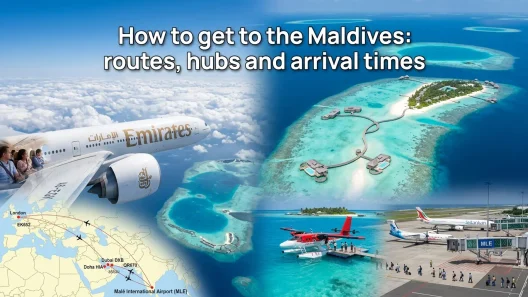
From Europe, the Maldives is straightforward — one connection through the Gulf or Istanbul. Fiji from Europe is among the longest journeys available, usually via Asia or North America, and it consumes days at each end.
From Australia and New Zealand the position reverses completely. Fiji is a short-haul flight, and the Maldives is a long one with a connection.
From the US West Coast, Fiji is directly served and the Maldives is very far east.
From the Gulf, India and South Asia, the Maldives is close and Fiji is not.
Which means where you live decides this more often than preference does, and it is worth establishing before you compare a single property.
The practical instruction is the same as in the Bora Bora piece: price both routes from your own airport first. The flight difference frequently exceeds the accommodation difference and determines how much of the holiday is spent travelling.
4. What is in the water
Where the comparison gets interesting, because Fiji is not the weaker diving destination people assume.
Fiji is known for soft coral. The Somosomo Strait and the Rainbow Reef carry a reputation for soft-coral density that the Maldives does not compete with, and it is a visually different kind of reef.
Beqa Lagoon runs a shark dive with multiple species, including large ones, which is a specific product with no Maldivian equivalent. Maldivian shark encounters are reef sharks on a wall, not a baited aggregation.
The Maldives has the pelagics and the coral cover. Manta rays at cleaning stations, the year-round whale shark aggregation in South Ari, and channel diving driven by monsoon current, which our diving guide describes.
Fiji has mantas too, seasonally, in the Yasawas.
Which produces an honest summary: the Maldives for pelagics, coral cover and channel diving; Fiji for soft coral and shark diving. A diver who has done one will find the other genuinely different rather than a lesser version.
And the same caution applies to both. “House reef” is not a standard term, and the water outside a villa is frequently sand. The satellite check in our guide to reading a house reef works identically in either country.
5. Can you leave?
Both offer two models, which is unusual in this set.
Fiji has a mainland. Viti Levu is roughly 10,400 square kilometres, with roads, towns, mountains, rivers and most of the population. Staying on the Coral Coast or near Nadi gives you a country to move around in.
And it has resort islands in the Mamanucas and Yasawas that work exactly like Maldivian ones: one property, one island, no leaving.
So the answer depends on which Fiji you book, and a traveller who wants mobility should look at Viti Levu rather than at the island groups.
The Maldives offers one model plus a village. A resort island cannot be left; a guesthouse island is a village you can cross in twenty minutes, and our comparison of resort and inhabited islands sets out the difference.
Which is a genuine flexibility advantage for Fiji. It is easy to miss, because the photographs come from the island groups where the answer is the same as the Maldives.
The private island question
Worth a short section, because both countries sell it and the two versions differ.
In the Maldives, one island one resort is the national rule. It is not a luxury product but the legal and commercial structure of the whole industry, applied at every price point from about USD 350 a night upward.
In Fiji it is a choice among several models. Some properties occupy their island; others sit on a coastline shared with villages, farms and roads.
Which changes what “private island” means as a marketing phrase. In one country it describes the default. In the other it describes a deliberate and more expensive arrangement.
And it changes the density calculation. Our guide to island size sets out how to divide villa count by usable land, and the method applies to any resort island anywhere — it simply matters more where the entire market is built that way.
The practical upshot: in the Maldives, check the density because you cannot leave. In Fiji, check whether you would want to.
6. Culture, and where a visitor meets it
A real asymmetry, and it favours Fiji.
Fijian villages are visitable, and village visits with the associated etiquette — a gift of kava, covered shoulders, removing hats — are a normal part of a trip rather than an unusual excursion.
The population is mixed, with indigenous iTaukei and Indo-Fijian communities, which produces two food traditions and two sets of festivals on one island group.
The Maldives keeps tourism and population physically separate, which is the country’s founding structural decision. A visitor meets Maldivian culture either as a resort’s presentation of it or on an inhabited island excursion with dress rules attached.
Which is not a criticism of either arrangement. One country decided to keep visitors apart from residents and the other did not, and both decisions have defensible reasons behind them.
But if meeting people is part of what you want from a holiday, Fiji offers it structurally and the Maldives does not. The closest that country comes is the split stay described in our comparison of resort and inhabited islands.
7. What it costs
Two wide ranges, differently built.
Fiji has a genuine budget tier. The Yasawa islands carry backpacker accommodation and dormitory-style properties served by the same catamaran that reaches the resorts, which means a very cheap island week is possible.
The Maldives has no equivalent on a resort island — but it does have the guesthouse islands, at around USD 60 a night with meals at USD 5 to 13. That is the Maldivian budget answer, and it competes.
At the top both are expensive, with overwater villas and private-island properties in the same bracket.
The Maldivian bill compounds. A 10% service charge and 17% goods and services tax reach roughly 28.7% on nearly every resort line, as our guide to money in the Maldives explains.
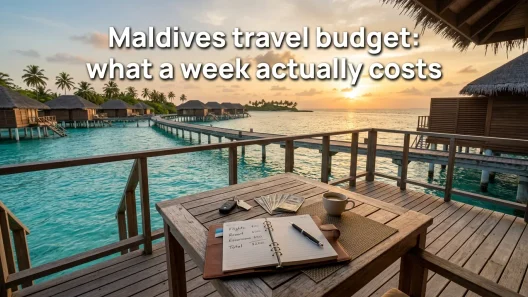
A week for two, excluding international flights. Maldivian figures from our own budget work; Fiji as orientation.
| Maldives | Fiji | |
|---|---|---|
| Budget | USD 1,100–1,900 guesthouse island | Yasawa backpacker properties, comparable or lower |
| Mid-range | USD 4,500–8,000 resort | Below it |
| Luxury | USD 12,000+ | Comparable |
| Transfer to the hotel | USD 200–1,640 for two | Catamaran, boat or light aircraft |
| Tax on the bill | ~28.7% compounded | Local taxes, usually in the price |
Which makes the price comparison closer than most in this set — both countries have a cheap answer and an expensive one, and the difference is in what the cheap answer looks like.
8. Season
Offset, and one of them carries a risk the other does not.
The Maldives runs on the monsoon: December to April is dry, clear and expensive; May to November is wetter, cheaper and better for large animals. The pricing is in our guide to high and low season.
Fiji’s dry season runs roughly May to October, which is the southern winter — cooler, less humid, and outside the cyclone window.
Its wet season, roughly November to April, is warmer, more humid and carries the cyclone risk described above.
Which means the two are broadly out of phase. The European summer is Fiji’s dry season and the Maldivian wet one; the European winter is the reverse.
And for anyone tied to school holidays, that offset is a real argument in whichever direction their calendar points.
9. Surf
Worth its own short section, because both countries are serious about it and the arrangements differ.
Fiji has world-class waves, including breaks off the Mamanucas that appear on professional tours.
Access there was historically restricted to particular resorts and was liberalised by legislation, which opened the breaks more widely than before.
The Maldives has the opposite trajectory in miniature. Two of its best-known waves remain access-controlled by the resorts in front of them. Our guide to choosing a resort for surfing explains it, and names the two properties because the fact is structural.
Both are reef breaks with no sand bottom, which decides who should be there — the caution our surfing guide makes.
Seasons differ. Maldivian surf runs March to November on the southwest monsoon; Fijian swell is at its most consistent in the southern winter.
10. Who each one suits
Choose the Maldives if: the reef and the pelagics are the point, you are travelling from Europe, the Gulf or South Asia, or you want a destination with no cyclone risk at any time of year.
Choose Fiji if: you are travelling from Australia, New Zealand or the US West Coast, or you want soft coral and shark diving. Also if you want a mainland as well as islands.
Divers: genuinely split. The Maldives for pelagics and channels; Fiji for soft coral and Beqa.
Families: Fiji has more variety and a mainland; the Maldives has contained shallow lagoons and no traffic. Our guide to choosing a resort for a family covers the Maldivian side.
Honeymooners: both work, and the flight map usually settles it. Our honeymoon guide covers the Maldivian case.
Budget travellers: both have an answer — Yasawa backpacker properties on one side, guesthouse islands on the other.
Anyone travelling in the southern summer: the Maldives, on the cyclone point alone.
And anyone who has done one: the other is more different than it looks, particularly underwater.
What a week looks like in each
Concrete, because the daily shape differs more than the brochures suggest.
A Maldivian resort week is one place. Breakfast, the reef, lunch, the reef again, dinner, and a boat trip on two or three of the days. The absence of decisions is the product, and our activities overview argues that two or three excursions is the right number.
A Fijian island week is similar if you book the island groups, with the addition of village visits and a dive schedule.
A Fijian mainland week is entirely different — a base on the coast, a car or a driver, and days that involve highlands, rivers and towns.
Which means “a week in Fiji” is not one thing, and comparing it to a Maldivian week requires knowing which version you mean.
And it means the island-hopping option exists there and largely does not here. The catamaran through the island groups makes a two- or three-island week straightforward; the Maldivian equivalent is a split stay arranged deliberately, with a paid transfer at each move.
For a first visit to either, one base is usually right. The moving version rewards a second trip, when you already know which parts you want more of.
And the transfer arithmetic differs accordingly. A Fijian catamaran ticket between islands is a modest published fare; a Maldivian move between resorts is a fresh per-person boat or seaplane charge, which our transfers guide prices.
11. Can you do both?
No, and the reason is not preference.
They are on opposite sides of the world, and combining them means circumnavigating.
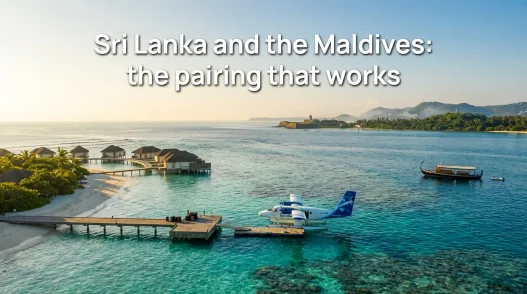
Each sits inside a region that rewards moving. Fiji pairs with the rest of the South Pacific, or with a stop in Australia or New Zealand on the way. The Maldives pairs with Sri Lanka. Our Sri Lanka comparison sets that out as the best fortnight in that part of the world.
Which is the useful reframing for a two-week trip. You are choosing between two regions rather than two islands, and regions differ far more than beaches do — as our comparison hub argues for the whole set.
What we know first-hand, and what we do not
We have been to the Maldives — to Maafushi, an inhabited island, with a day visit to one resort. We have not stayed overnight at a Maldivian resort, which is why nothing on this site ranks them.
We have not been to Fiji. This comparison is structural: geography, meteorology, transport, cost mechanics and season — facts that are checkable rather than felt.
Which is why this article says nothing about Fijian food, service or hospitality. Fiji has a strong reputation for the last of those and we are not in a position to assess it, so we do not.
The Maldivian figures are ours, from published work on this site. The Fiji figures are bands, labelled as orientation.
Three of the ten comparisons in this set were written after visiting both countries — Mauritius, Zanzibar and Thailand. This is not one of them, and the difference is stated on purpose.
Questions travellers ask
Which is better, the Maldives or Fiji? More alike than most people expect — both have resort islands, overwater villas and boat transfers. The Maldives has the pelagics and no cyclone risk; Fiji has soft coral, shark diving and a mainland. Where you live usually decides it.
Does the Maldives get cyclones? No. It lies too close to the equator for tropical cyclones to form. Its weather problem is monsoon wind and rain rather than storms.
When is cyclone season in Fiji? Roughly November to April, coinciding with the wet season. Travellers booking in that window should read their insurance terms on weather disruption closely.
Which has better diving? Split. The Maldives for pelagics, coral cover and channel diving including year-round whale sharks. Fiji for soft coral and the Beqa Lagoon shark dive, which has no Maldivian equivalent.
Which is cheaper? Closer than most comparisons. Both have a budget answer — Yasawa backpacker properties on one side, Maldivian guesthouse islands at around USD 60 a night on the other — and both are expensive at the top.
Which is easier to reach? Entirely dependent on where you start. From Europe, the Gulf or South Asia, the Maldives. From Australia, New Zealand or the US West Coast, Fiji.
When should I go to each? The Maldives is best December to April. Fiji’s dry season runs roughly May to October, outside the cyclone window — so the two are broadly out of phase.
Can I combine them? No sensible itinerary does; they are on opposite sides of the world. Fiji pairs with the South Pacific or an Australasian stop; the Maldives pairs with Sri Lanka.
What to take away
- The Maldives lies too close to the equator for tropical cyclones. Fiji is in a cyclone belt with a season running roughly November to April. That difference cannot be planned around.
- These two are more alike than most pairs in this set — resort islands, overwater villas, boat transfers and reef.
- Diving is genuinely split: pelagics and channels in one, soft coral and shark diving in the other.
- Fiji has a mainland you can move around as well as islands you cannot leave. The Maldives has one model plus a village.
- Where you live decides it more often than preference does. Price both routes before comparing a single property.
Next step: check two things before anything else. Your travel dates against the Fijian cyclone window, and the flight time from your own airport to each destination. Between them those two checks resolve this comparison for the large majority of travellers, and everything else on this page is confirmation rather than decision.