Maldives or Sri Lanka: The One That Is Not a Rival
Every other comparison on this site asks you to choose between the Maldives and somewhere else. This one, on Sri Lanka, mostly does not.
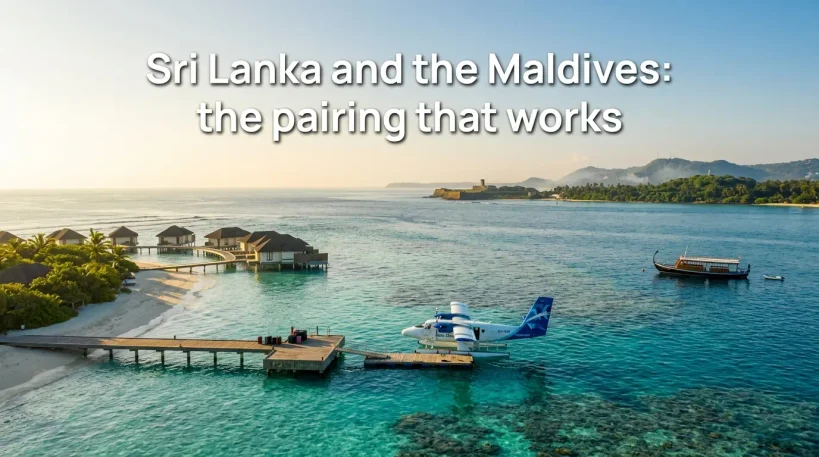
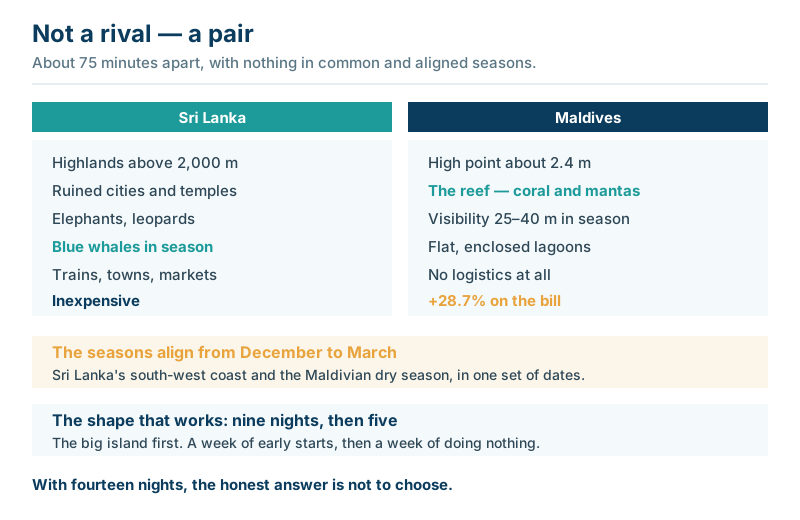
Sri Lanka is about seventy-five minutes from Malé by air. The two countries offer nothing in common — one is a large island with mountains, tea, elephants, ruined cities and twenty-two million people, the other is a scattering of coral islands with a reef and no land. And their good seasons line up.
Which makes them the best fortnight available in that part of the world. This article therefore spends as much time on combining the two as on choosing between them, because for most travellers with two weeks the combination is simply the better answer.
1. Why they pair so well
Four reasons, and together they are unusual.
The flight is short. Roughly an hour and a quarter between Malé and Colombo, on a route served regularly. That is a domestic-length hop between two entirely different holidays.
The trips have nothing in common. One is highlands, wildlife, temples, trains and food. The other is water. A fortnight split between them is two distinct experiences rather than fourteen days of the same one.
The seasons align. The south-west coast is at its best roughly December to March, which is exactly the Maldivian dry season — so a single set of dates works well for both. That is not true of most pairings.
And the order is natural. The big island first, the atolls second, because a week of driving, walking and early starts is better followed by a week of doing nothing.
One caution on the sequence. If you are diving in the Maldives, the no-fly interval — 18 to 24 hours between the last dive and altitude — sits at the end of the trip, which is where you want it. Our diving guide covers the rule.
2. What one has and the other has none of
The list is long, and it is the whole reason for the pairing.
Mountains and tea country. Highlands rising above 2,000 metres, plantations, cool nights, and a train through them that is one of the better railway journeys anywhere.
Ruined cities. Sigiriya, Anuradhapura and Polonnaruwa are archaeological sites of a scale nothing in the Maldives approaches, because the Maldives has no such history above ground.
Large land animals. Wild elephants and leopards, in national parks, at densities that make sightings realistic rather than lucky.
Blue whales. Off the southern coast in season — the largest animal that has ever lived, and a genuine complement to the Maldivian whale shark aggregation rather than a competitor to it.
A food culture. Rice and curry, hoppers, kottu, and a spice tradition that predates the tourism industry by centuries.
And ordinary life. Towns, buses, markets, trains and people going about their day — the thing our comparison of resort and inhabited islands explains is almost entirely absent from a Maldivian resort week.
3. And what the atoll side has instead
Shorter, and it is the reason the second week exists.
The reef. More coral, more species, and reliable encounters with manta rays, reef sharks and turtles. There is diving on the other side — Pigeon Island, some wrecks — and it is not in the same category.
Water clarity. Maldivian visibility runs to twenty-five or forty metres in the dry season. Sri Lankan coastal water is more variable and frequently less clear.
Calm lagoons. Those beaches face open ocean, and much of the south coast has surf and undertow. The Maldivian lagoon is flat and enclosed.
Complete isolation. One island, one property, nothing else — which our where to stay pillar describes as both the appeal and the constraint.
And doing nothing, properly. After a week of ruins, parks and early mornings, that is not a small thing.
4. If you are choosing rather than combining
Some people have one week, and the comparison is then real.
Choose the big island if: you want to see a country. It is one of the more varied places on earth for its size — coast, highlands, wildlife and antiquity within a few hours of each other.
Choose the Maldives if: you want the water and nothing else, and you would rather not be in a vehicle at any point.
On price it wins comfortably. Inexpensive across the range, and a week there costs a fraction of a Maldivian resort week.
On effort, the Maldives wins. A week there involves drivers, distances, early starts and planning. A Maldivian week involves one boat and then nothing.
And on a first long-haul trip, the honest answer is that most people get more from the big island, and most people picture the atolls.
Which is why the pairing exists. It resolves the tension rather than forcing a choice, and for a fortnight it is the right answer far more often than not.
5. The seasons, which is the part that makes it work
The technical detail that decides whether a combined trip is a good idea in your dates.
There are two monsoons. The south-west monsoon runs roughly May to September, wetting the south and west coasts. The north-east monsoon runs roughly October to January, wetting the north and east.
Which means the beach season flips by coast. The south-west coast — Galle, Mirissa, Unawatuna, Tangalle — is at its best roughly December to March. The east coast — Arugam Bay, Trincomalee, Pasikuda — is at its best roughly May to September.
The Maldives has one system. December to April is dry, clear and expensive; May to November is wetter and cheaper, with better large-animal activity — the mechanism is in our monsoon guide and the pricing in our guide to high and low season.
So the pairing works cleanly from December to March, with Sri Lanka’s south-west coast and the Maldivian dry season in the same window.
And it works differently in the European summer. The east coast is good from May to September while the Maldives is in its wet season — which is still a viable combination, at lower prices, with more rain risk on the atoll side.
What does not work: planning a Sri Lankan south-coast beach week in July, or an east-coast one in January. The country is not seasonally uniform and treating it as one is the commonest scheduling mistake.
6. How to structure a fortnight
The practical version, and it is simpler than most two-country itineraries.
Nine nights Sri Lanka, five Maldives is the shape that works for most people. Long enough to see the highlands and a park; long enough at the end to stop moving.
Sri Lanka first. Arrive in Colombo, do the country, then fly to Malé.
Do not try to see all of it. A common mistake is a nine-night itinerary with six bases. Three is better: the cultural triangle, the hill country, and a coast — or drop one and go slower.
Book the Maldivian half against your outbound flight home, not against your arrival from Colombo. The transfer is the constraint: seaplanes stop between about 15:30 and 16:00, and a late arrival costs a day, as our guide to missed connections explains.
Choose a Maldivian property close to the airport for a five-night stay. The arithmetic is in our guide to staying near the airport, and on a short second leg it matters more than the villa.
And consider a guesthouse island rather than a resort for the Maldivian half. After a week in Sri Lanka, an island village at USD 60 a night is a natural continuation rather than a downgrade — and it keeps the whole fortnight inside a sane budget.
Getting between them
The logistics, because a two-country trip lives or dies on the connection.
The flight is short and regularly served, and it is an international sector — so you clear immigration twice, with all that implies for timing.
The Maldivian entry requirements are light. A free visa is granted on arrival to almost all nationalities, and the IMUGA declaration must be submitted within 96 hours of travel, in each direction. Our guide to the visa on arrival covers the process.
Baggage is the constraint people forget. If your property is reached by seaplane, the allowance is 20 kg checked and 5 kg cabin. It is set by the smallest aircraft in the chain, not by whatever you flew in on.
Which argues for a speedboat-served property on the second leg, and for leaving anything bulky in storage — most airport-area hotels will hold bags, as our guide to hotels in Malé and Hulhumalé notes.
And build a buffer at the join. A connection that assumes both flights run on time is a connection that has not read our guide to missed transfers. A night in the airport area between the two legs costs very little and removes the whole risk.
7. What it costs
Two very different price structures, which is another reason they combine well.
It is inexpensive. Accommodation across the range, food at local prices, drivers and trains that cost very little.
The Maldives is not. A resort week for two runs USD 4,500 to 8,000, and the bill compounds. A 10% service charge and 17% goods and services tax reach roughly 28.7% on nearly every line, as our guide to money sets out.
Which is why a fortnight split between them costs far less than fourteen Maldivian nights — and contains more.
A rough shape for two people, excluding international flights. Maldivian figures from our own budget work; Sri Lankan figures as orientation.
| Maldives | Sri Lanka | |
|---|---|---|
| Budget week | USD 1,100–1,900 guesthouse island | Well below |
| Mid-range week | USD 4,500–8,000 resort | A fraction of it |
| Transfer to the hotel | USD 200–1,640 for two | A car and a driver |
| Eating outside the hotel | Impossible at a resort | The normal way to eat |
| Tax on the bill | ~28.7% compounded | Local taxes, usually in the price |
And the internal flight between them is short and modestly priced, which is what makes the whole arrangement viable.
8. The rules you live under
Different, and there is one Sri Lankan detail that catches visitors out.
It is a Buddhist-majority country with Hindu, Muslim and Christian communities. Alcohol is sold normally, dress is a matter of courtesy, and temples ask for covered shoulders and knees and removed shoes.
But alcohol is not sold on poya days — the full-moon public holidays, one a month, when shops and bars do not serve it. Hotels sometimes make private arrangements for guests; supermarkets do not. It is a small thing and it surprises people who arrive on the wrong date.
The Maldives operates two legal regimes. Alcohol is served on resort islands under licence and is unavailable on every inhabited island; swimwear is for resorts and designated tourist beaches only. Our guides to alcohol and dress codes set out the detail.
Which produces a symmetry worth noticing. Both countries ask visitors to cover up at religious sites and both have dry days or dry places. The difference is that in the Maldives the restriction is geographic and permanent, and in Sri Lanka it is occasional and calendar-based.
9. Who each one suits
Choose Sri Lanka if: you want variety, history, wildlife and value, and you do not mind being in a vehicle.
Choose the Maldives if: you want the water, the isolation and no logistics at all.
Divers: the Maldives, and it is not close. Our guide to choosing a resort for diving covers how to pick a base.
Wildlife travellers: the big island, comfortably — elephants, leopards and blue whales in one country.
Surfers: the mainland for accessibility and price; the Maldives for the waves themselves, with the access complication our guide to choosing a resort for surfing explains.
Families: one has more to do and more to see; the other has a shallow lagoon and no traffic. The considerations are in our guide to choosing a resort for a family.
Honeymooners: the classic answer is the pair — Sri Lanka then the Maldives — and it is the classic answer because it works. Our honeymoon guide covers the Maldivian half.
Anyone with one week and no strong preference: the big island, on value and variety.
And anyone who has already had that week: the Maldives is what to do afterwards, which is the point of this whole article.
The one-week version of the pairing
For anyone who cannot give it a fortnight, because a compressed version does exist.
Four nights and three is possible and it is tight. It buys the cultural triangle or the hill country, not both, plus a short atoll stay near the airport.
What to cut on the mainland side: the long drives. Pick one region and stay in it, rather than moving every night to see more.
What to cut on the atoll side: the distant property. On a three-night leg the transfer eats a disproportionate share, which our guide to staying near the airport quantifies.
What not to cut: the buffer at the join, and the day before your flight home.
And the honest assessment. A seven-night split is a taste of two countries rather than a proper visit to either, and plenty of people would be happier giving the whole week to one. If you are undecided, that is a signal.
10. The Maldivian half, done well
Since most readers of this page will be planning the second week rather than the first.
Five nights is enough if the property is close to the airport and the point is to stop moving.
Check the water before the villa. “House reef” covers four different arrangements, one of which is a sandy lagoon with the reef four hundred metres out — the satellite check is in our guide to reading a house reef and it takes thirty seconds.
Check the density too. Villa count divided by island area predicts how busy a property feels, and the method is in our guide to island size.
Take half board rather than all-inclusive on a short stay, unless you drink daily. The break-even is in our guide to budget and all-inclusive.
And book two or three excursions at most. After Sri Lanka you will have had enough organised activity, and the best hour of a Maldivian week is the house reef at seven in the morning, which costs nothing.
What we know first-hand, and what we do not
We have been to the Maldives — to Maafushi, an inhabited island, with a day visit to one resort. We have not stayed overnight at a Maldivian resort, which is why nothing on this site ranks them.
We have not been to Sri Lanka. This comparison is structural: geography, transport, season patterns, cost mechanics and legal environment — facts that are checkable rather than felt.
Which is why this article says nothing about Sri Lankan food, service, hotels or people beyond noting that a distinct food culture exists. We are not in a position to, and neither is most of the comparison content that claims otherwise.
The Maldivian figures are ours, from published work on this site. The Sri Lankan figures are bands, labelled as orientation.
Three of the ten comparisons in this set were written after visiting both countries — Mauritius, Zanzibar and Thailand. This is not one of them, and the difference is stated on purpose.
Questions travellers ask
Should I choose the Maldives or Sri Lanka? For a fortnight, neither — do both. They are about seventy-five minutes apart by air, they have nothing in common, and their good seasons align from December to March. For a single week, Sri Lanka gives more variety and value; the Maldives gives water and rest.
How far apart are they? Roughly an hour and a quarter by air between Colombo and Malé, on a regularly served route.
Which order should I do them in? Sri Lanka first, the Maldives second. A week of driving and early starts is better followed by a week of doing nothing, and the no-fly interval after diving falls at the end where it belongs.
How long should I give each? Nine nights in Sri Lanka and five in the Maldives works for most people. Do not attempt more than three bases in Sri Lanka.
Do the seasons match? From December to March, yes — Sri Lanka’s south-west coast and the Maldivian dry season overlap. From May to September, Sri Lanka’s east coast is good while the Maldives is in its wet season.
Which is cheaper? Sri Lanka, substantially, across the whole range. A fortnight split between the two costs far less than fourteen Maldivian resort nights.
Which has better diving? The Maldives, clearly. Sri Lanka has diving, including Pigeon Island and some wrecks, but it is not in the same category.
Is alcohol available in both? In Sri Lanka, normally — except on poya full-moon days, when it is not sold. In the Maldives, only on resort islands; every inhabited island is dry.
What to take away
- This is the one comparison in the set where the answer is usually “both”. They are seventy-five minutes apart and share nothing.
- The seasons align from December to March — Sri Lanka’s south-west coast and the Maldivian dry season in the same window.
- Sri Lanka first, the Maldives second. Nine nights and five is the shape that works.
- Sri Lanka has mountains, ruined cities, elephants, leopards and blue whales. The Maldives has the reef and no logistics at all.
- Sri Lanka is not seasonally uniform. Its beach season flips coast, and treating the country as one climate is the commonest scheduling error.
Next step: if you have fourteen nights and you were choosing between these two, stop choosing. Book nine on the big island and five in the Maldives, in that order, in the December to March window. Then spend the money you save against a full Maldivian fortnight on a property with a house reef you can actually swim to — which is the single upgrade that changes a short atoll stay more than any villa category will.