
Choosing a Resort by Its House Reef: Read the Colour of the Water
Every resort in the Maldives says it has a house reef. The phrase is never defined and covers four completely different situations, one of which is a sandy lagoon with the water you came for four hundred metres away.
Nobody will tell you which one you are booking. But you can find out in about thirty seconds, before you pay, from a satellite image and two emailed questions.
This guide is the booking version of that check: what makes one good, how to read it from above, and what to ask. Our snorkelling guide covers the swimming; this covers the choosing.
What “house reef” is hiding
Four geometries, one phrase, and the difference decides the week.
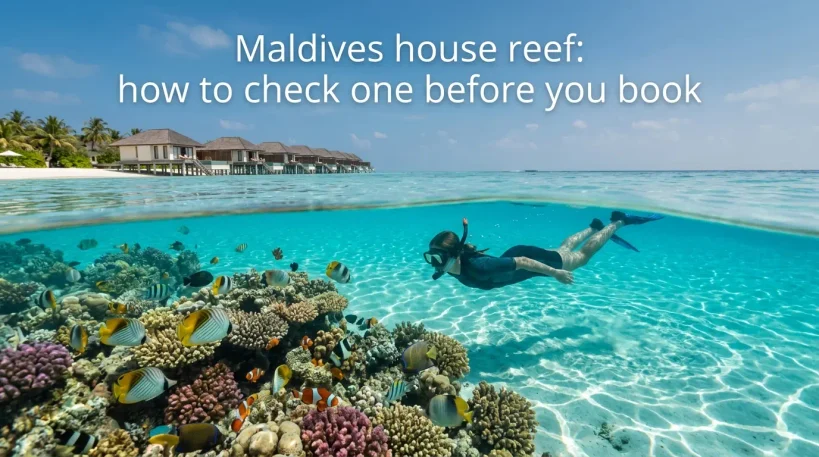
A close drop-off. The reef edge sits ten to fifty metres from the beach and the wall falls from two metres to twenty. You walk in and you are there. This is the arrangement that makes a property.
A reef flat with a distant edge. A hundred metres or more of shallow rubble before the drop. Swimmable, tide-dependent, and at low water you may not be able to cross without touching — which you must not do.
A wide sandy lagoon. Beautiful, warm, empty. The reef is a four-hundred-metre swim or a boat ride, and many of the most photographed islands in the country are exactly this.
A channel edge. Current, big animals and genuine hazard. Superb for confident swimmers on the right tide and unsuitable otherwise.
The description says “house reef” for all four. Our snorkelling guide sets out what each is like to swim; this article is about telling them apart before you have paid.
The satellite method
The single most useful pre-booking check available, and it costs nothing.
Open the island in any satellite map view. Search the property name; the island will be centred.
Read the colours.
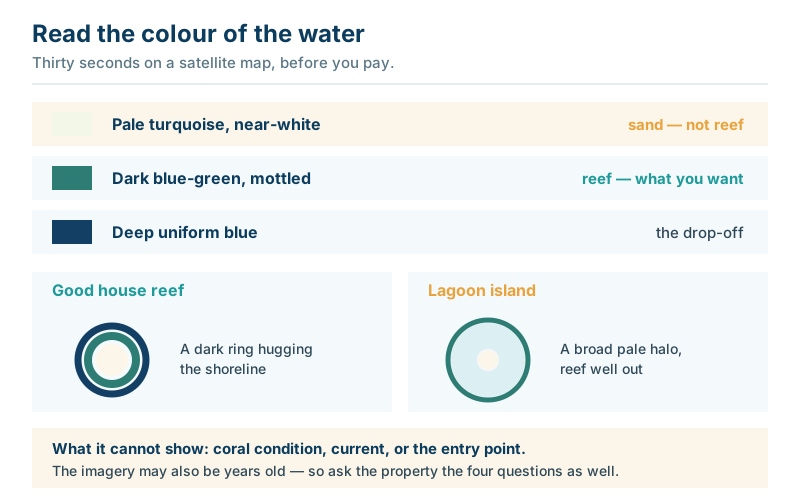
- Pale turquoise or near-white is shallow sand. Pretty, empty, and not a reef.
- Dark blue-green, mottled, textured is reef. This is what you are looking for.
- Deep uniform blue is the drop-off and the water beyond it.
What a good house reef looks like from above: a dark ring or crescent hugging the shoreline, close enough that you could pace it, with deep blue immediately outside it.
What a lagoon island looks like: a broad pale halo, with the dark line sitting well out. Sometimes further from the beach than the island is wide.
Check both sides. Many islands have a close reef on one side and a lagoon on the other. Which side your villa is on then matters, and so does the season — see below.
Look at where the jetty runs. Overwater villas are built over shallow calm water, which means pale, which means sand. Our villa comparison covers what that means for the room decision.
What the method cannot tell you
Stated honestly, because a technique presented without its limits is a bad technique.
It cannot tell you the reef’s condition. Dark colour means structure, not living coral. After the 2024 bleaching event, a healthy-looking outline can be dead rubble — the picture is in our guide to reef health.
It cannot tell you about current. A channel edge and a sheltered reef look similar from a satellite.
The imagery may be old. Reclamation, dredging and jetty construction change islands, and the image you are looking at may be two or three years out of date.
It cannot show you the entry. A close reef with no safe way into the water from the beach is not a usable house reef.
Which is why the method is step one and the questions below are step two. Together they give you a real answer; alone, either is a guess.
The questions to ask the property
Four, by email, before you book. A property with a good reef answers all four immediately and specifically.
1. How many metres from the beach is the drop-off, and where is the entry point? This is the question. Not “is there a house reef” — the answer to that is always yes.
2. Can you snorkel from the beach at all states of the tide, or only at high water? A reef flat that is uncrossable at low tide halves the usable hours.
3. Is there current on the house reef, and where should guests not swim? A property that names the hazard is a property that supervises the water.
4. What condition is the coral in, and do you have a marine biologist or a restoration programme? The first half tells you about the water. The second tells you about the property.
What a vague answer means. “We have a beautiful house reef with lots of colourful fish” is not an answer to any of those questions, and a property with a close drop-off has no reason to be vague.
And one more, if you dive: which sites are within twenty minutes, and does the dive centre visit the house reef?
Reading reviews for reef signals
Reviews are more useful than descriptions here, if you search them rather than read them.
Search for “lagoon”. Guests use the word when they mean “no reef”, usually in a sentence beginning “beautiful but”.
Search for “walk out”, “far” and “swim out”. All three describe distance.
Search for “current” and “channel”. Both describe the opposite problem.
Search for “bleached”, “dead” and “rubble”. These are the post-2024 condition words, and our guide to what happened covers the wider pressure on these islands.
Search the phrase itself and read what follows. Enthusiasts describe a close drop-off in detail and are vague about a distant one.
Weight recent reviews heavily. Conditions changed materially in 2024, and a five-year-old review describes something else.
And weight diver reviews most of all. A diver saying it is good is applying a standard; a first-time snorkeller who saw a parrotfish in a lagoon is not.
What actually makes a house reef good
Five characteristics, in order of how much they matter.
Distance to the drop-off. Ten to fifty metres is excellent. A hundred is workable. Four hundred is a boat trip.
A safe, marked entry. Steps, a channel through the reef flat, or a sandy path in. The best house reefs on paper are unusable if the only way in is over sharp rubble at low tide.
Depth at the edge. A drop from two metres to twenty gives you structure, fish and light. A gradual slope over sand does not.
Fish life, which follows structure. Older, more complex formations hold more, which is why a mature site beats a young one even when both are alive.
Current that is manageable. Some water movement brings fish; a channel’s flow takes you away from the island. The distinction is the property’s to explain and yours to ask about.
What does not matter as much as people think: the colour of the sand, the size of the lagoon, and whether the villa is overwater.
Where the geography favours you
Not a resort list, and the underlying pattern is worth knowing.
Islands on an atoll’s outer rim tend to have the reef edge close on the ocean side, because that is where the atoll wall is. Islands sitting inside a lagoon frequently do not.
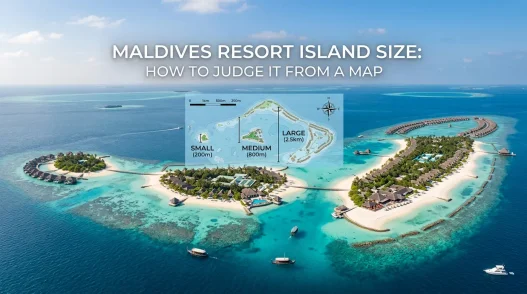
Small islands are more likely to have close water on at least one side, simply because there is less island between you and the edge — the point our guide to island size makes about the rest of the stay.
Channel-adjacent islands have current and the fish that come with it, which is superb for divers and a caution for casual swimmers. Vaavu is channel country; our atolls guide explains the geometry.
Heavily reclaimed islands frequently have engineered lagoons, which is what reclamation produces.
By region, there is no atoll that reliably has better house reefs than another — Kaafu, Ari, Baa and the rest all contain both kinds of island. Choose the region for the transfer, the diving or the budget, and check the water per property.
Which is the point of this whole article: this is a property-level question, not a regional one, and it is answerable in thirty seconds.
The seasonal side, which swaps twice a year
The variable that makes a good house reef temporarily unusable.
The monsoon reverses. Roughly December to April the wind comes from the northeast; roughly May to November from the southwest — the mechanism is in our monsoon guide.
One side of the island is sheltered and the other is not, and which is which changes with the season.
On the exposed side, surface chop makes snorkelling unpleasant and reduces visibility, even when the reef itself is excellent.
Which means a property with reef on both sides is more robust than one with a single good side, and it is worth asking which side the reef is on and pairing that with your travel month.
It also means the reviews contradict each other, and both are right. A guest in January and a guest in July on the same island can describe different experiences of the same reef.
Reef condition after 2024
The context that changes what “good” means, and it needs stating plainly.
Maldivian reefs lost a great deal of live hard coral in the 2024 bleaching event, with the central atolls worst affected. Our guide to reef health covers what happened and where recovery stands.
Fish life recovers faster than coral. A reef with damaged coral and intact structure still holds fish, and the snorkelling can be very good — it simply looks different from a photograph taken in 2014.
Which means two things for booking. Recent reviews matter more than they used to. And a property’s honesty about its reef is now a signal in itself: the ones describing conditions accurately are the ones paying attention.
Ask directly. “What condition is the coral on your house reef in?” is a fair question, and the answer separates properties that monitor their reef from those that do not.
Restoration programmes exist at a number of resorts — coral nurseries, transplanting frames, resident marine biologists. They are a genuine signal, and they are also the property’s own account of itself, so weight them accordingly.
Entry points, which nobody photographs
The practical detail that turns a good reef into a usable one.
A sandy channel through the reef flat is the ideal: you walk in over sand and swim out to the edge without touching anything.
Steps or a ladder from a jetty works, and puts you in deeper water immediately.
Straight off the beach over rubble is the worst version, and at low tide it can be impassable without standing on the reef.
Tide changes everything. A reef flat with fifty centimetres over it at high water has ten at low water, and the difference between a swim and a scrape.
Marked exits matter as much as entries. Current runs parallel to shore at many islands, and coming out where you went in is a plan rather than an assumption.
Ask where the entry is, and how many entries there are. A property with three marked entry points has thought about this.
On a guesthouse island
The comparison worth making, because the answer is not what people expect.
Several inhabited islands have excellent house reefs reachable from the designated tourist beach, and several have none at all — the same lottery as at resorts, at a fifth of the price.
The bikini beach is the constraint. Swimwear is permitted on one stretch only, so good water on the wrong side of the island is not accessible to you.
Which makes the satellite check even more useful there, since guesthouse listings say less about reefs than resort pages do. Our guide to choosing a local island lists reef-from-the-shore as one of the five characteristics that differ.
And boat snorkelling is cheap. USD 30 to 60 for a guided trip from a guesthouse island, against USD 90 to 160 at a resort — the comparison is in our excursion price guide. On a guesthouse island a poor house reef is an inconvenience; at a resort it is an expensive one.
Using it without damaging it
A close house reef is swum several times a day for a week, by everybody staying on the island. That volume is the reason the rules matter here more than on a boat trip.
Never stand on it. Not to rest, not to adjust a mask, not for a photograph. One foot kills growth that took years, and this is by far the most common damage visitors do.
Keep fins up over a shallow flat. If the water is too shallow to fin without contact, it is too shallow.
Use the marked entry. It exists to keep a hundred pairs of feet off the same section of reef.
Reef-safe sunscreen, or better, a rash guard — the reasoning is in our snorkelling guide.
Do not feed anything, and do not touch turtles or anything else that lives there.
Take nothing. Shells, coral and sand are covered by export restrictions, as our guide to restricted items explains.
And the self-interested version: the house reef you are protecting is the one you are swimming on tomorrow morning. Properties whose guests behave have better reefs, and it shows within a few seasons.
If you have already booked a lagoon island
Not a disaster, and there are four things to do about it.
Take the boat trips. Guided snorkelling at USD 90 to 160 per person at a resort, and the sites are usually better than any house reef — the price comparison is in our excursion guide.
Ask about the other side. Many islands have a reef edge somewhere, even if not off the main beach, and the dive centre knows where.
Book the dive centre’s snorkel drops, which are cheaper than the excursion desk’s guided trips at some properties and go to the same places — including, in season, the manta and whale shark sites.
Use the lagoon for what it is good at. Shallow warm water suits paddleboarding and kayaking, which are free at most resorts. It also suits families better than a drop-off does, as our comparison of resort and inhabited islands notes.
And know for next time. The satellite check takes thirty seconds and it is the difference between a week of free snorkelling and a week of paying for it.
What a good reef is worth, in money
Worth quantifying, because it changes the property comparison.
A close house reef gives you unlimited free snorkelling — twice a day, every day, for nothing, which is the best hour of most weeks according to our activities overview.
A lagoon island costs you USD 90 to 160 per person per guided trip. Two trips each for a couple across a week is USD 360 to 640, plus the 28.7% service charge and tax explained in our guide to money in the Maldives.
Which means a property with a good reef is effectively USD 400 to 800 cheaper across a week for two who want to be in the water. A boat trip also has a schedule; swimming from the beach does not.
That is frequently more than the price difference between the two properties, and it is invisible on a booking page.
Divers, briefly
The house reef matters differently if you dive.
A house reef you can shore-dive is unusual, valuable, and worth asking about specifically: unlimited dives without a boat, at whatever hour suits.
Night dives from the beach are the clearest benefit, and our diving guide covers what they show — the snorkelling version is in our night snorkelling guide.
But the dive sites matter more. A resort with a modest house reef and twenty channel sites within half an hour beats one with a superb house reef in an empty corner of an atoll — the geography our atoll decision guide sets out.
Ask the dive centre, not the reservations desk. They answer differently, and the dive centre answers accurately — the same principle our where to stay pillar applies to every property question.
Questions travellers ask
What is a house reef in the Maldives? The reef belonging to a resort island, reachable from the shore. The phrase covers four different geometries — a close drop-off, a distant reef flat, a wide sandy lagoon or a channel edge — and property descriptions use it for all of them.
How do I check a house reef before booking? Open the island on a satellite map. Pale turquoise is sand, dark blue-green is reef, deep blue is the drop-off. A dark ring hugging the shoreline means a close reef; a broad pale halo means a long swim.
What should I ask the resort? How many metres from the beach the drop-off sits, where the entry point is, whether it is swimmable at all tides, and whether there is current. A property with a good reef answers all four specifically.
Is the coral dead after the 2024 bleaching? Damaged in many places, particularly the central atolls, and not uniformly. Fish life recovers faster than coral, so the snorkelling can still be excellent — but recent reviews matter more than older ones.
Does the side of the island matter? Yes. The monsoon reverses twice a year, one side is sheltered and the other is not, and a reef that is superb in January can be choppy and cloudy in July.
Do guesthouse islands have house reefs? Some do and some do not, exactly as at resorts. The constraint is that you can only swim from the designated tourist beach, so the reef has to be on that side.
What if my island has no reef? Take boat trips at USD 90 to 160 per person, ask the dive centre where the reef edge is, and use the lagoon for paddleboarding. It is an expense rather than a disaster.
Is a good house reef worth paying more for? Frequently yes. It saves USD 400 to 800 across a week for two who want to snorkel daily, which is often more than the price difference between the properties.
What to take away
- “House reef” covers four different geometries and every property uses the phrase. One of them is a sandy lagoon with the reef four hundred metres away.
- Read the satellite image: pale turquoise is sand, dark blue-green is reef, deep blue is the drop-off. A dark ring against the shoreline is what you want.
- Then ask four questions by email. How many metres to the drop-off, where is the entry, is it swimmable at all tides, and is there current.
- Check which side the reef is on and pair it with your travel month, because the sheltered side swaps twice a year.
- A good house reef is worth USD 400 to 800 across a week for two, which is frequently more than the difference in room rate.
Next step: open the satellite view of the property you are considering and look at the colour of the water against the beach. If it is pale all the way out to the horizon line of the shallows, you are booking a lagoon island. That may still be the right choice for your trip — plenty of excellent resorts sit in lagoons — but you should know it before you pay rather than discovering it on the second morning with a mask in your hand and a long swim ahead.