
Where to Stay in the Maldives: You Are Choosing an Island, Not a Hotel
Everywhere else, if the hotel disappoints you, you walk out and eat somewhere else. Here you cannot. A Maldivian resort occupies its entire island, and the property you booked is the only restaurant, the only bar and the only company for the length of your stay.
That is the fact that should drive the decision, and almost every guide treats it as a detail.
There are four things you can book: a resort island, a guesthouse on an inhabited island, a liveaboard, or a hotel near the airport. Four different holidays rather than four price points. This guide covers what each involves, what a week costs, and who each suits.

The four options
A resort island. One property, one island, entire. Overwater villas, a house reef, a spa, bars, several restaurants and a dive centre. Isolation is the product.
A guesthouse on an inhabited island. A small hotel in a village of a few hundred to a few thousand Maldivians. Cafés, shops, a harbour, a designated tourist beach, and no alcohol anywhere on the island.
A liveaboard. A boat that is also your hotel, moving between dive or surf sites, usually for a week. You wake up somewhere different every day, which nothing on land here offers.
A hotel in Malé or Hulhumalé. The capital area, near the airport, used mostly for a night either side of a flight — and occasionally as a base in its own right.
What every stay here shares: you are on an island, you are dependent on a boat, and the reef is the reason you came.
Resort islands
The stay most people picture, and the one that costs the most for reasons that are not all margin.
What the stay gets you. A private island, staff who outnumber guests, a house reef you can swim from the beach, and complete separation from everyday Maldivian life. Alcohol is served, swimwear is normal, and the rules that govern the rest of the country are suspended by licence.
What it costs. From roughly USD 350 a night at the accessible end to several thousand at the top, before transfers. Then a 10% service charge and 17% TGST, which compound to about 28.7% on almost everything you sign for — the arithmetic is in our guide to money in the Maldives.
The transfer is not included and is frequently the largest single line after the room: USD 100 to 400 per person by speedboat, USD 400 to 820 by seaplane.
Who it suits. Honeymooners, anyone who wants to be left alone, families who need a kids’ club, and travellers for whom the point of a holiday is that nothing is required of them.
Who it does not. Anyone who gets restless, anyone who wants to see the country, and anyone whose budget will not survive USD 30 cocktails for seven days.
Guesthouses on inhabited islands
Guesthouse stays became legal only in 2009, and they are the fastest-growing part of Maldivian tourism.
What you get. A room in a village. Local cafés at a fifth of resort prices, a designated bikini beach, excursions at a third of resort rates, and an island that has a life of its own whether you are there or not.
What it costs. From about USD 60 a night, with meals at USD 5 to 13 and excursions at USD 25 to 60. A week for two, all in, can land under USD 1,500 including transfers.
What you give up. Alcohol, which is unavailable on inhabited islands under the national rules. Swimwear outside the tourist beach. Room service, a spa on site at most properties, and the sense of occasion.
What you gain. The country. Our guide to local island excursions argues that a two-hour resort tour shows a visitor almost nothing, and a night shows them an island — that argument applies to the whole holiday.
Who it suits. Divers on a budget, independent travellers, anyone curious about where they are, and families who would rather their children met other children than a kids’ club.
Which islands. Maafushi is the largest and most developed, with Thoddoo, Ukulhas and Dhigurah among the quieter alternatives — covered in our guide to choosing a local island.
Liveaboards
The option that solves a problem the other three cannot.
What you get. A cabin on a boat that moves. Three or four dives a day, sites chosen for the conditions that morning, and access to atolls no resort can reach.
What it costs. From roughly USD 150 per person per day, including cabin, all meals and the diving. Tax, nitrox and park fees sit on top, as our diving guide sets out.
Why it is the best value for divers. Twelve to eighteen dives a week at a price a resort charges for six, with no transfer decisions and no boat ride back to an island each afternoon.
The other advantage, underrated: weather. When the wind turns, the boat moves to the sheltered side of an atoll and the week continues. A fixed resort cannot do that, which matters most in the monsoon months.
Who it does not suit. Non-divers, anyone prone to seasickness, and couples where only one person dives — a week aboard is a long time for the one who does not.
Surf charters work on the same model and are the only realistic access to the central atoll breaks, as our surfing guide sets out.
Hotels in Malé and Hulhumalé
The stay everybody ignores and roughly half of visitors end up needing.
Why you need one. Seaplanes fly in daylight only and stop between about 15:30 and 16:00. An international arrival after roughly 14:00 misses the last flight of the day, which means a night near the airport whether you planned it or not — the arithmetic is in our guide to missed connections.
What it costs. A fraction of a resort night, with the city’s restaurants at ordinary prices.
Hulhumalé over Malé for anything airport-related: five to twelve minutes by road at any hour, a beach, and a calmer atmosphere — our guide to getting into the city covers the journey.
Malé itself if you want the capital: the fish market, the mosques and the only genuine urban life in the country, described in our city guide.
Both are dry, like every inhabited island, with one long-standing exception near the airport.
Book it deliberately. A planned night in Hulhumalé costs a hundred dollars and removes an entire category of risk. The same night booked in an arrivals hall at seven in the evening costs three times that and starts the trip badly — the full list of properties and their trade-offs is in our guide to hotels in Malé and Hulhumalé.

Where we have actually stayed
Worth stating plainly, because most accommodation content does not.
We have stayed on Maafushi, an inhabited island in South Malé Atoll, and the photographs in this article and across this site are our own. What we know about guesthouse islands — the four o’clock café hour, the walk to the bikini beach, the difference between an operator’s price and a guesthouse’s price for the same excursion — we know because we were there.
We have day-visited Adaaran Club Rannalhi, a resort island in the same atoll. That is enough to describe the arrival jetty, the overwater architecture and the shape of a resort day. It is not enough to review a resort, and we do not.
We have not stayed overnight at a Maldivian resort. So this site does not publish ranked lists of the best resorts for families, for divers or for anyone else. Where we write about resorts, we write about the things that are structural and checkable — what the tiers include, what the transfer costs, how to read a house reef from a satellite image, what a service charge does to a bill — and we say where the figure came from.
That is a narrower promise than most sites make. It is one we can keep.
The thing that decides everything: you cannot leave
Say it once more, because it is the difference between the Maldives and every other beach destination.
On a resort island the property is the whole world for the length of the stay. If the food is mediocre, it is mediocre for seven days. If the other guests are wrong for you, they are wrong for seven days. If the house reef is a sandy lagoon, there is no second beach.
On an inhabited island you can walk out, eat somewhere else, and change operator. That freedom is worth more than most people expect and it is the guesthouse model’s real advantage over its price.
On a liveaboard you cannot leave at all, which is either the point or the problem depending on who you are.
Practical consequence: research the property harder than you would anywhere else, and weight the things you cannot change — the reef, the island size, the transfer, the board basis — above the things you can.
The transfer is part of the accommodation decision
The mistake almost everyone makes is booking the room and then discovering the transfer.
The atoll sets the transfer, and the transfer sets a large share of the budget. A property in Kaafu is a speedboat at USD 100 to 400 per person. One in Baa or Noonu is a seaplane at USD 400 to 820. For a family of four that difference is over a thousand dollars before anybody has eaten anything.
The transfer also sets your arrival day. A seaplane resort commits you to daylight arrival and departure. A speedboat resort does not.
And it sets what you can reach. Whale sharks are resident in South Ari; manta aggregations happen in Baa; channel diving is Vaavu. Our atoll decision guide matches regions to travellers, and our transfers guide covers the modes.
Do this before you shortlist properties, not after.
What a week actually costs
Seven nights for two people, excluding international flights. Indicative, and the structure matters more than the numbers.
| Guesthouse island | Mid-range resort | Luxury resort | Liveaboard | |
|---|---|---|---|---|
| Accommodation | USD 420–700 | USD 2,450–4,900 | USD 7,000+ | included |
| Food | USD 220–360 | usually included | included | included |
| Transfers, both ways | USD 100–200 | USD 400–1,600 | USD 800–3,300 | included |
| Excursions or diving | USD 300–600 | USD 800–1,600 | USD 1,200–3,000 | included |
| Service charge and tax | minimal | ~28.7% on most of it | ~28.7% on most of it | on the fare |
| Rough total | USD 1,100–1,900 | USD 4,500–8,000 | USD 12,000+ | from USD 2,100 |
Two things to notice. The guesthouse column has no tax line worth mentioning, because most of what you buy there is outside the resort tax regime. And the liveaboard column is the only one where the diving is not extra — which is why it beats a resort for anyone whose week is built around it.
Room type, briefly
The decision people spend most time on and which matters less than the island.
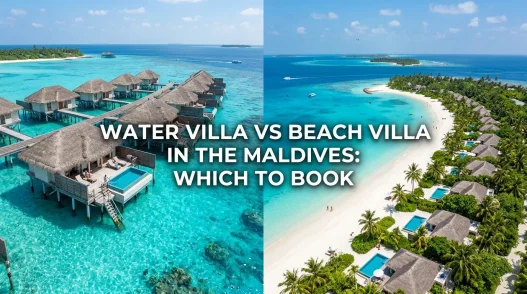
An overwater villa is the photograph. Steps into the lagoon, glass floor panels at some properties, and a premium of roughly 40 to 100 per cent over a beach villa.
A beach villa is cooler, quieter, better for families, and closer to the reef at most properties — because the reef edge is reached from the beach, not from the overwater jetty, which usually sits over sand.
Our comparison of overwater and beach villas sets out the full trade, and our guide to private pool premiums covers the tier above.
The short version: book the overwater villa for a few nights of a longer stay if the budget allows, and put the difference into a longer trip or better diving.
Board basis, and what it excludes
The line that produces most of the unpleasant surprises.
Bed and breakfast on an island with no alternative restaurant means two meals a day at resort prices. Do the arithmetic before choosing it as the cheap option.
Half board covers breakfast and dinner and leaves lunch, which is fine for anyone diving through the middle of the day.
Full board covers three meals, usually at a single buffet restaurant, with the speciality restaurants charged.
All-inclusive varies enormously between properties. What it typically excludes: premium spirits and wines, speciality restaurants, anything described as a signature experience, excursions, diving and the spa. Our guide to budget and all-inclusive covers what the packages actually contain.
And the tax applies on top of most of it, which is why an all-inclusive rate that looks like a saving frequently is not.

The house reef question
More consequential than the villa type, and knowable before you book.
“House reef” means four different things. A drop-off ten to fifty metres from the beach; a shallow flat with the edge a hundred metres out; a wide sandy lagoon with the reef four hundred metres away; or a channel edge with current. Every property description uses the same phrase.
Check the satellite image. Pale turquoise is sand, dark blue-green is reef, deep blue is the drop-off. If a dark ring hugs the shoreline, the reef is close. Thirty seconds, and no property description will tell you this.
Ask the specific question. Not “is there a house reef”, because the answer is always yes. Ask how many metres from the beach the drop-off sits, and where the entry point is.
Our snorkelling guide explains the method in full, and our guide to reading a house reef before booking applies it to choosing a property.
Island size
An underrated variable that changes the character of a stay.
A small island — walkable in ten minutes — feels intimate, has fewer guests and fewer restaurants, and can feel confining by day five.
A large island has variety, several restaurants, more space and more people, and loses the sense that you have the place to yourself.
Neither is better. Our guide to island size covers how to judge it from a map before booking, which is the only way to judge it.
The split stay
The stay pattern this site keeps arriving at from every direction.
Three or four nights on an inhabited island, three or four at a resort. You get the country and the villa, the café hour and the spa, at a total cost below a full week at the resort alone.
It works logistically because the guesthouse islands with the best transport are in Kaafu, and so are a large share of the speedboat resorts. A transfer between them is an hour and a few dollars.
Do the inhabited island first. Arriving into a village and then moving to a resort reads as an upgrade; the reverse reads as a downgrade, however unfair that is to the island.
One practical note: you will need to repack, and the seaplane baggage allowance applies if the resort leg is a flight.
When to book, and where
Peak season, December to April, needs three to six months for the popular properties and longer over Christmas and New Year. The high and low season comparison covers the price difference, which is substantial.
Low season can be booked weeks ahead, and the discounts are real rather than cosmetic.
Direct versus an agency. Resorts frequently match or beat online rates when contacted directly, and they control the room allocation. Agencies package the transfer, which is worth something when the transfer is a seaplane.
Guesthouses are booked directly or through the standard platforms, and the price difference between the two is smaller than at resorts.
Liveaboards book furthest ahead, particularly for the manta and whale shark seasons, and the good boats fill a year out.
Reading a listing critically
Five things that mean less than they appear.
“House reef” — four different geometries, as above.
“All-inclusive” — check the exclusions list before the inclusions list.
“Luxury” — unregulated, and used across a very wide range.
“Beachfront villa” — every villa on a small island is beachfront. It tells you nothing about the reef.
“Steps into the lagoon” — into sand, in most cases, at a depth that varies with the tide.
And two things that mean a great deal: the distance to the drop-off in metres, and the transfer mode and price. Both are answerable by email before you book, and a property that answers vaguely has told you something.
Which one should you book?
Honeymoon or a milestone: a resort, and put the money into the island rather than the villa category. One overwater night in a longer stay beats seven if the budget is finite — our honeymoon guide covers the rest.
Diving-led week: a liveaboard if you dive daily, a guesthouse island if you want the diving and the country, a resort only if the dive centre and the sites are genuinely good.
Family: a resort with a kids’ club and a shallow lagoon. Or a guesthouse island, if the children are old enough to entertain themselves and you would rather they met the place.
Budget under USD 2,000 for two: a guesthouse island, without hesitation. It is not a compromise version of the Maldives; it is the same water.
First visit, no strong preference: the split stay.
Awkward flight times: a speedboat-served property, or a deliberate night in Hulhumalé.
Surfers: the surf access rules decide it, and two of the best waves are surfable only by guests of the resorts controlling them.
Questions travellers ask
Where should I stay in the Maldives? There are four options: a resort island, a guesthouse on an inhabited island, a liveaboard, or a hotel in the capital area. They are different holidays rather than price points. A first visit with no strong preference is usually best served by splitting the week between an inhabited island and a resort.
How much does a week in the Maldives cost? Roughly USD 1,100 to 1,900 for two on a guesthouse island, USD 4,500 to 8,000 at a mid-range resort, USD 12,000 upward at a luxury one, and from about USD 2,100 on a liveaboard — excluding international flights.
Is a guesthouse island a compromise? No. It is the same water, the same reefs and the same excursions at a third of the price. What you give up is alcohol, the sense of occasion and swimwear outside the designated beach.
Do I need an overwater villa? No, and beach villas are cooler, quieter and often closer to the reef. If the photograph matters, book the overwater villa for part of a longer stay rather than all of it.
What does all-inclusive exclude? Typically premium drinks, speciality restaurants, excursions, diving and the spa — with service charge and tax on top of most of them. Read the exclusions before the inclusions.
How far in advance should I book? Three to six months for peak season from December to April, longer over Christmas and New Year. Weeks rather than months in low season. Liveaboards book furthest ahead.
Should I stay near the airport? For a night, if your international arrival lands after about 14:00 and your resort needs a seaplane. Booking that night deliberately costs a fraction of arranging it at seven in the evening in an arrivals hall.
What matters most when choosing a resort? The things you cannot change once you arrive: the house reef, the island size, the transfer mode and the board basis. The villa category is the thing people research most and change least.
What to take away
- You are booking an island, not a hotel. On a resort you cannot walk out, so weight what you cannot change — reef, island size, transfer, board — above the villa category.
- Four different holidays: resort island, guesthouse island, liveaboard, city hotel. A week for two runs from about USD 1,100 to USD 12,000 depending on which.
- The atoll sets the transfer and the transfer sets a large share of the budget. Decide it before you shortlist properties.
- “House reef” means four different things. Check the satellite image and ask for the distance to the drop-off in metres.
- The split stay — a few nights on an inhabited island, a few at a resort — gives most first-time visitors both halves of the country for less than a full week at the resort alone.
Next step: open a satellite view of any property you are considering and look at the colour of the water around it. Then email and ask two questions — how many metres to the drop-off, and what the transfer costs per person each way. Those three minutes tell you more than every photograph on the booking page.