
Weddings in the Maldives: Beautiful, Witnessed, and Not a Marriage
You cannot legally get married in the Maldives. Not at a resort, not on a sandbank, not underwater, not at any price.
The Maldives is an Islamic republic and civil marriage registration is restricted to Muslims. Every wedding sold to a foreign couple here — at every resort, without exception — is symbolic. The certificate is beautiful, framed, and has no legal weight anywhere.
That is not a problem, and almost nobody who marries here treats it as one. It does mean the registry appointment at home is not optional. This guide covers the legal position, what a ceremony costs once tax is added, and the one question to ask before you sign.

The legal position, precisely
Maldivian civil law recognises only Islamic marriage. The 2008 constitution defines the country as a Muslim state, and marriage registration through the Family Court is available to Muslims.
Foreign non-Muslim couples cannot register a marriage here. This is national law rather than resort policy, so no property can arrange an exception and none claims to.
Every resort wedding is symbolic. The celebrant is real, the vows are yours, the witnesses are present, the photographs are the photographs. The paperwork is decorative.
Some resorts ask you to sign an acknowledgement that the ceremony is non-binding. That is a sign of a property being straightforward with you rather than a red flag.
Nothing else about the day changes. Couples describe these ceremonies as emotionally indistinguishable from a legal wedding, which is why the industry exists at all.
Muslim couples: the exception
The restriction described above applies to non-Muslim foreign couples. The position for Muslim couples is different and should be checked directly rather than through a resort.
Maldivian civil law provides for Islamic marriage, registered through the Family Court, with documentary requirements that vary by circumstance and nationality.
Resorts are not the right source. Wedding coordinators sell symbolic ceremonies; they are not registrars and they do not process legal marriages.
The correct route is to contact the Family Court, and your own embassy or high commission, well in advance of travel. Requirements around documentation, witnesses and residency are specific and are not something to establish on arrival.
The wider context of why the country’s law is structured this way is covered in our piece on how the Maldives embraced Islam, and the practical implications for visitors generally are in our guides to dress and customs and Ramadan.
This article covers the symbolic ceremony, which is what the overwhelming majority of couples travelling here are buying.
The three ways couples handle it
Legal at home first, wedding here. By far the most common. A registry office appointment weeks before departure — fifteen minutes, two witnesses, done — then the Maldives wedding as the celebration with family and friends. Legally married on the day; the Maldivian ceremony is the wedding everybody remembers.
Vow renewal framing. Couples who married quietly at home sometimes book a vow renewal package instead of a wedding package. Same setting, same wedding, different name, and occasionally a different price.
Legal at home afterwards. Also fine. The Maldivian ceremony has no legal standing regardless of when the paperwork happens, so the order is entirely up to you.
What none of them requires is documentation. Symbolic ceremonies need no birth certificates, no affidavits of single status, no apostilles and no residency period. Bring your passports for check-in and your vows if you have written them.
That absence of bureaucracy is the underrated advantage of the whole arrangement. A legal destination wedding elsewhere can mean weeks of paperwork; here there is none.
What a ceremony actually includes
Wedding packages vary, and the common inclusions are consistent enough to list.
The standard wedding package: a celebrant, a setting decorated for the occasion, a bouquet and buttonhole, a symbolic certificate, sparkling wine and a cake, and often a traditional bodu beru drumming performance.
A traditional Maldivian wedding is offered at many resorts, officiated by an island headman, incorporating readings, an exchange of rings and the signing of the symbolic certificate.
Commonly added: photography, a private dinner, a dhoni transfer to the ceremony site, room decoration, a couples spa treatment and a coconut-palm planting.
Rarely included: guest accommodation, transfers, alcohol beyond the toast, and a professional planner if your guest list is large.
Vows are yours. Every reputable property works from a framework you can rewrite, and this matters more than it sounds — see the section below.
What it costs
Three wedding tiers, per couple, before tax.
| Tier | Ceremony package |
|---|---|
| Budget resort | from about USD 820 |
| Mid-range to upper-mid | USD 1,500–5,000 |
| Ultra-luxury, venue and ceremony only | USD 7,000–18,000 |
Then add the tax. A 10% service charge and 17% TGST compound to roughly 28.7%, so a USD 5,000 ceremony bills near USD 6,400. Our guide to money in the Maldives explains the mechanism, and it applies to every line of a wedding invoice.
Then add everything else. This is where the real number lives:
- Accommodation for the couple: USD 4,000–15,000 for seven nights, depending on the property
- Guest accommodation, at the same rates
- Transfers: USD 100–400 per person by speedboat, USD 400–820 by seaplane
- Photography beyond the package hours
- Private dining, decoration and anything described as “bespoke”
Realistic totals. A complete intimate wedding trip for two runs roughly USD 8,000 to 15,000. A wedding with 10 to 40 guests runs USD 25,000 to 60,000 all in.
The ceremony, in other words, is rarely the expensive part. Accommodation and transfers are.

Where the ceremony happens
Five wedding settings, each with a catch worth knowing.
The beach. The default wedding setting, the cheapest and the most weather-resilient. Bare feet, a canopy, the lagoon behind you.
A sandbank. A bare spit of sand in open ocean, reached by boat, with nothing in any direction. The most photogenic option and the most fragile — it depends on the tide, the swell and the day, and a sandbank ceremony has no wet-weather backup.
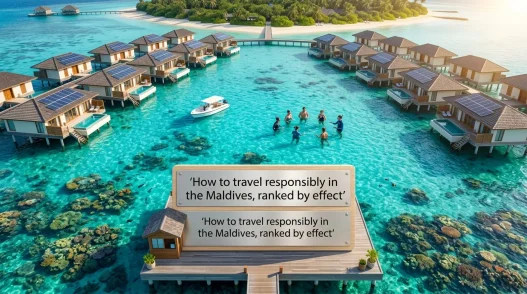
Overwater. On a jetty or a deck above the lagoon. Reliable, dramatic and constrained on guest numbers by the structure.
Underwater. Available at a handful of resorts, in an undersea restaurant or, at some properties, as an actual dive ceremony for certified divers only. Extraordinary and logistically demanding.
On a dhoni. A traditional boat at sunset, with the ceremony on deck.
Practical note on all of them. Sunset is the light everybody wants and the slot everybody books, and equatorial dusk lasts about twenty minutes — as our guide to the time zone and daylight explains. A ceremony scheduled at sunset must start on time or the photographs happen in the dark.
The question to ask before you sign
Ask for the wedding script, in English, in writing, before you book.
The reason is a specific one. In 2010, a European couple’s vow renewal at a Maldivian resort was conducted in Dhivehi by staff who used the occasion to insult them; video of the ceremony leaked and became an international story. The government apologised, arrests followed, and the industry was badly embarrassed.
What changed afterwards is that reputable properties now work from written, translated scripts and are entirely willing to share them. A resort that will not produce the text of what will be said at your ceremony is telling you something.
Three things to confirm:
- The full script in English, including anything spoken in Dhivehi and its translation
- Who officiates, and whether they have done it before
- Whether you may write your own vows, which every good property permits
None of this is adversarial, and wedding coordinators are used to being asked. It takes one email and it removes the only genuinely avoidable way this can go wrong.
Choosing the resort
Guest count is the binding constraint on a Maldives wedding, not budget. A Maldivian resort is a small island with a fixed number of rooms, and a wedding party of forty needs forty rooms on one island on one week.
Under ten guests: almost any wedding resort works, and the intimate luxury properties are in play.
Ten to thirty: a property with a dedicated wedding team and enough room categories to absorb the group.
Thirty to fifty or more: the larger resorts, and considerably more lead time, because group accommodation is what runs out first.
Adults-only resorts exclude children entirely, which decides itself if your guest list includes families.
Alcohol matters. A wedding on an inhabited island is possible and dramatically cheaper, and it is dry — as our guide to alcohol rules sets out. That single fact rules it out for most parties and makes it perfect for some.
Location drives cost. Properties in Kaafu reached by speedboat cost every guest USD 100–400 in transfers; a seaplane resort in Baa or Noonu costs USD 400–820 each. Across thirty guests that difference is a car. Our atoll decision guide and the transfers guide cover the geography.
Do you need a planner?
Three models, and most couples need less than they expect.
The resort wedding coordinator is included, does this every week, and handles the ceremony, the decoration, the celebrant, the cake and the photographer. For a wedding of two to ten people, this is usually all you need.
A Maldives-based specialist agency bundles the ceremony with villas, transfers and coordination, and quotes all-in with tax included. Useful when you are comparing several resorts at once, or when the guest list passes twenty and the accommodation puzzle becomes the job.
An external planner from home adds cost and rarely adds capability, since they will be coordinating with the same resort team by email. The exception is a large, complex wedding with multiple events, where having someone who answers to you rather than to the property is worth the fee.
What to insist on regardless: a written schedule for the day, a named contact on the island, the ceremony script, and a wet-weather plan for anything on a sandbank.
One thing a planner cannot fix: room availability. If the resort has thirty rooms and your party needs thirty-five, no coordinator solves that — which is why the guest count question comes before every other decision.
When to hold it
The dry season, December to April, gives the most reliable weather, the calmest sea and the best light. It is also high season with the highest prices.
The shoulder months — April and November — offer calm conditions at lower rates and slightly less certainty.
The wet season, May to November, is cheaper by a wide margin and carries genuine weather risk. Rain rarely lasts, wind is the real problem, and a sandbank ceremony in August needs a backup plan.
Book six to twelve months ahead for peak season, three to six for shoulder and low. Larger weddings need longer, because rooms run out before ceremony slots do.
Check the dates against Ramadan if any of your party is Muslim, and against the public holidays calendar for domestic transport around Eid.
Guests, and what you are asking of them
The honest conversation, because a Maldives wedding is expensive for everyone invited to it.
Each guest pays for a long-haul flight, a villa at Maldivian rates and a transfer of USD 100 to 820. A week costs a guest several thousand dollars.
The guest list shrinks accordingly, and most Maldives weddings run to ten people or fewer for exactly this reason.
Children are excluded at adults-only properties, which decides who can come.
Non-swimming guests have a shorter list of things to do, and our activities overview is worth sharing with anyone deciding.
Some couples solve it by inverting the problem: a full celebration at home for everyone, and the Maldives for two. That is a honeymoon rather than a wedding, and our honeymoon guide covers it.
The rest of the week
A wedding here is one afternoon inside a holiday, and the holiday is the reason most couples chose the country.
Give the day a clear run. Nothing scheduled the morning of, nothing demanding the day after.
Guests need something to do. Two or three excursions across a week is the right number — the price picture is in our excursion guide, and a group booking is usually negotiable.
The reliable group activities are a sandbank trip, a dolphin cruise and a guided snorkelling session. All three work for mixed ability and mixed ages.
Divers will want their own programme, and our diving guide covers what a week costs.
A spa booking the morning before is the single most common pre-wedding item, and it books out.
Dinner arrangements for a group need setting weeks ahead, not on arrival. Private dining, a beach barbecue or an undersea restaurant all have capacity limits.
Photography
The wedding line item people underestimate, and the one that outlives everything else.
Wedding package photography is usually one to two hours, covering the ceremony and immediately after. Extended coverage costs more.
Resort wedding photographers vary enormously. Ask to see a full gallery from one wedding rather than a portfolio of highlights.
External photographers are permitted at most properties, sometimes with a fee, and they need their own accommodation and transfer. That adds several thousand dollars for a couple travelling with their own.
Light is the constraint. Golden hour is roughly forty minutes here, twice a day, and dusk collapses fast.
Underwater and drone work need arranging in advance. Drones are restricted, as our guide to banned and restricted items notes, and resorts have their own policies.
Vow renewals specifically
Usually the same product with a different name, and occasionally a better deal.
The ceremony is identical at most properties: same celebrant, same settings, same certificate.
Pricing sometimes differs, and it is worth asking for both quotes.
The framing suits couples who married at home years ago, who married quietly during a period when a celebration was not possible, or who are marking an anniversary.
Anniversary packages at many resorts include a renewal ceremony as one element alongside dining and spa treatments, which can be better value than booking the ceremony alone.
Some resorts price a renewal at the same figure as a wedding — Meeru, for instance, publishes both at USD 820 per couple — which tells you these are the same event with two labels.
What to bring
Short, because the requirements are minimal.
Passports, for check-in rather than for the ceremony.
Your vows, if you have written them.
Rings. Obviously, and hand-carry them.
A dress that survives a suitcase and humidity. Structured gowns and equatorial heat are not friends, and everything on a beach happens barefoot.
Nothing legal. No affidavits, no certificates, no translations. There is no legal process to feed.
Something for the heat. Ceremonies at midday are uncomfortable for everyone; late afternoon is standard for good reason.
Is it worth it?
An opinion, since the alternative is a brochure.
A Maldives wedding is worth it for the setting, unambiguously. Nowhere else offers this particular combination of water, light and privacy, and a small ceremony on a sandbank is genuinely extraordinary.
Worth it for the simplicity. No paperwork, no residency requirement, no legal process, and a resort team that does this weekly.
Not worth it if the legal ceremony matters emotionally. If signing the register is the moment, have that moment at home with the people who matter and treat the Maldives as the celebration — or the honeymoon.
Not worth it for a large guest list. Forty people at Maldivian rates is a six-figure event, and most of that money buys accommodation rather than wedding.
The best-value version, and the one many couples land on: marry legally at home in front of parents, fly two people to the Maldives, and spend the wedding budget on a fortnight instead of an afternoon.
Questions couples ask
Can foreigners legally marry in the Maldives? No. Maldivian civil law recognises only Islamic marriage, and registration is not available to foreign non-Muslim couples. Every resort wedding is a symbolic ceremony with no legal standing here or at home.
Is the certificate worth anything? Only as a keepsake. Resort certificates are personalised and often framed, and they are not proof of marriage anywhere.
What documents do we need? None for the ceremony itself. Bring passports for resort check-in. There are no affidavits, apostilles or residency requirements, because there is no legal process.
How much does a Maldives wedding cost? Ceremony packages run from about USD 820 at budget resorts to USD 1,500–5,000 typically, and USD 7,000–18,000 at ultra-luxury properties, all before a tax and service charge compounding to about 28.7%. A complete trip for two is USD 8,000–15,000; with 10 to 40 guests, USD 25,000–60,000.
How far ahead should we book? Six to twelve months for the December to April peak, three to six months for shoulder and low season. Larger weddings need more, because guest accommodation runs out before ceremony slots.
Can we get married underwater? At a handful of resorts, yes — either in an undersea restaurant or, for certified divers, as an actual dive ceremony. Both need arranging well in advance.
Is a vow renewal different from a wedding ceremony? Usually not. Same celebrant, same settings, same certificate, and at some resorts the same price. Ask for both quotes.
Can we have a wedding on a local island? Yes, and it is far cheaper, but inhabited islands are dry and more conservative in dress. That suits some parties and rules it out for others.
What to take away
- Foreign couples cannot legally marry in the Maldives. Every resort wedding is symbolic, and the certificate has no legal weight anywhere.
- The fix is a fifteen-minute registry appointment at home before or after. Most couples do it before and treat the Maldives as the wedding.
- Ceremony packages run from USD 820 to USD 18,000, before a tax and service charge compounding to about 28.7%. A complete trip for two is USD 8,000–15,000.
- Ask for the ceremony script in English, in writing, before booking. A resort that will not provide it is telling you something.
- Guest count is the binding constraint. Rooms on a small island run out long before ceremony dates do.
Next step: book the registry office at home first, then choose the island. Doing it in that order takes the only legal question off the table and leaves you choosing between a beach, a sandbank and six metres of water — which is the decision you actually came for.


