
Spas and Wellness in the Maldives: The Glass Floor Problem
The photograph shows a treatment room with a glass floor over the lagoon, fish moving beneath it. What it cannot show is that you spend most of a massage face down, looking at a hole in a table.
That is not a complaint. Maldivian spas are good, the pavilions are beautiful, and a massage with the sound of water underneath is a real thing. It is worth knowing what you are buying before you pay USD 250 — which becomes USD 322 once service charge and tax are added.
This guide covers what a resort spa costs, what the same hour costs on an inhabited island, the safety rule about massage after diving, and how to book.

What a Maldives spa physically is
Consistent enough across properties to describe.
The spa is an overwater pavilion, usually thatched, at the end of a jetty, separated from the rest of the resort. The isolation is deliberate and it works.
Treatment rooms with a glass panel in the floor, looking down into shallow lagoon water. At better properties the panel is large and the water beneath it is clear.
Open sides or shutters, so the room is naturally ventilated with the sound of water underneath.
A relaxation area, usually with tea, and often a sauna, steam room or plunge pool at larger properties.
Two to eight treatment rooms. Maldivian resort spas are small, which is why the spa fills so quickly.
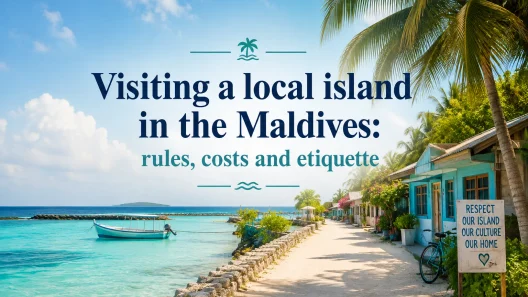
On a guesthouse island, none of the above: a small treatment room in a building on the main street or inside the guesthouse, air-conditioned, functional, and a fraction of the price.

What it costs
| Treatment | Guesthouse island | Resort |
|---|---|---|
| 60-minute massage | USD 25–50 | USD 120–250 |
| 90-minute massage | USD 40–70 | USD 180–350 |
| Facial | USD 30–60 | USD 130–280 |
| Couples treatment, 60 min | USD 60–100 | USD 300–500 |
| Signature ritual, 2 hours | rarely offered | USD 350–600 |
| Day package | rarely offered | USD 400–900 |
Then add the tax. A 10% service charge followed by 17% TGST compounds to roughly 28.7%, so a USD 250 treatment bills at USD 322. Our guide to money in the Maldives explains the arithmetic, and it applies to every line on a spa bill.
The multiplier is the same three-to-five times that runs through every activity in the country — the pattern documented in our excursion price guide.
What the resort premium genuinely buys: the pavilion, the setting, trained therapists, better products and an hour of complete privacy. What it does not buy is a fundamentally different massage.
The guesthouse alternative is real. A sixty-minute massage on Maafushi or a comparable island costs USD 25 to 50, and the therapists are frequently trained to the same standards. What you lose is the overwater room, and that is genuinely most of what you are paying for at a resort.
The rule about diving
The most important paragraph in this article, and one that many visitors are never told.
Do not book a deep-tissue or vigorous massage immediately after diving. Reputable spas ask whether you have dived that day, and there is a reason. Strong manipulation increases circulation and can complicate the off-gassing that follows a dive, and post-massage soreness can mask symptoms that need attention.
What good spas do: ask the question, and steer divers toward a gentle relaxation massage rather than deep tissue, or ask them to leave a gap.
What to do yourself: tell the therapist you have dived, before the treatment rather than during it. Nobody will refuse you; they will adjust.
The reverse also applies. A deep-tissue massage the evening before an early dive is not ideal either.
If in doubt, book the spa on a non-diving day. Our diving guide covers the wider safety picture, including the four decompression chambers and where they are, and our safety guide covers the rest.
Other things to declare
Short list, and therapists ask about most of them.
Sunburn. No massage on burnt skin. This rules out more treatments than anything else on a Maldives trip, and it is entirely self-inflicted — see the sun advice in our snorkelling guide.
Pregnancy. Most spas offer prenatal treatments and will decline certain others. Declare it at booking rather than on arrival.
Alcohol. Not immediately before, for obvious reasons.
Recent injury, high blood pressure, heart conditions. Standard declarations, and the intake form asks.
Allergies, particularly to nut oils, which are widely used here — coconut above all, for reasons our food guide explains.
Jellyfish stings or coral cuts. Nothing goes on broken skin, and coral cuts infect quickly in this climate.
The spa menu is more consistent across the country than resort marketing suggests.
Massage, in the usual styles: Balinese, Swedish, deep tissue, hot stone, aromatherapy, Thai. Therapists are frequently from Indonesia, Thailand, India or Sri Lanka, and the style follows the therapist.
Signature rituals, which are typically a scrub, a wrap and a massage bundled into two hours with a coconut or sand theme. Expensive and pleasant, and a scrub is a scrub.
Facials, with international product lines.
Couples treatments, in a double room, which are the most-booked item at every resort and the reason to reserve early.
Ayurveda, at properties with resident practitioners, usually from India or Sri Lanka — a tradition with deeper roots in the region than the Maldivian food culture most visitors meet. This is a genuine tradition rather than a marketing label at the resorts that invest in it, and a fifteen-minute head massage at one of them is not the same product as a spa menu item with the word attached.
Yoga, most often free or low-cost at resorts, usually at sunrise on a deck or a sandbank.
Wellness programmes at a small number of properties: multi-day structured retreats combining consultation, treatments, diet and movement, priced in the thousands.
Booking, and when to do it
Spa booking matters more than any other resort facility, because the supply is tiny.
Two to eight treatment rooms serve an entire resort island. Do the arithmetic.
Book the spa on arrival day, for the whole stay. Not on the day you want the treatment.
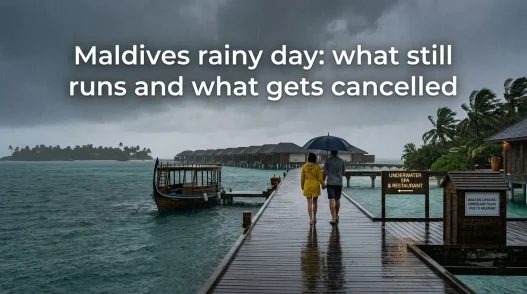
Book on the forecast, not on the rain. The moment the sky darkens, every guest on the island has the same idea and the spa is full within minutes — a point our guide to rainy days makes at length.
Sunset slots fill first, then late afternoon — and sunset here is a hard twenty-minute window, as our guide to the time zone explains.
Couples rooms are the scarcest resource of all.
Ask about packages. Multiple treatments booked together frequently carry a discount that is not advertised.
On a guesthouse island, same-day spa booking is usually fine, and walking in works.
Couples, families and who else uses the spa
Four situations worth planning for.
Couples treatments are the most-booked item at every resort, and the double room is the scarcest thing in the building. Book it on arrival day or accept two separate rooms.
Honeymooners frequently have a spa credit or a couples treatment included in the package, and it is worth checking what you already hold before booking anything — our honeymoon guide covers what these packages typically contain.
Children. Most resort spas set a minimum age of twelve to sixteen for standard treatments, with shorter children’s massages offered at family properties. Ask rather than assume, particularly if you are travelling as a family.
Solo travellers get the best of it: single rooms are the ones with availability, and a spa is one of the few resort facilities that works exactly as well alone.
Groups and wedding parties should book as a block weeks ahead. A wedding morning with five people wanting treatments in a two-room spa does not work, and our weddings guide flags it among the things to arrange early.
What is included, and what is not
Included: use of the relaxation area, tea, and the sauna or steam room where one exists.
Included by law: the 10% service charge, which is distributed to staff. Our guide to tipping explains the mechanism and why an additional tip is still meaningful.
Not included: the tax, which is added.
Not included: products to take home, which are sold at resort prices.
Not included at some properties: the transfer to the spa, if it sits on a separate jetty or islet. Rare, and worth asking about at the very top end.
Check what a “package” contains. Day packages sometimes include lunch and sometimes do not, and the difference is a hundred dollars.
Etiquette and practicalities
Arrive at the spa fifteen minutes early. There is a form, a foot ritual and a consultation, and arriving on time means losing treatment minutes.
Say what you want. Pressure, areas to avoid, whether you want conversation. Therapists here are used to being told and will not be offended.
Undressing is your choice. Disposable underwear is provided, draping is standard and professional, and nobody expects anything you are uncomfortable with.
Therapist gender can be requested. Ask at booking; it is a normal request and staffing usually allows it.
Phones off. The room is the product.
Shower after, not before, if there is oil involved.
Hydrate. Massage plus equatorial heat plus a day in salt water is a dehydration combination. Tap water is not drinkable on inhabited islands, and our guide to money and daily costs covers what bottled water adds up to.
Modesty on a guesthouse island. The spa is a private room and the walk there is a public street, so the ordinary dress rules apply — our guide to dress codes covers them.
The glass floor, honestly
Worth a section, because it is the thing that sells the treatment.
You will look at it for about four minutes. Arriving, lying down, and turning over. The rest of the time your face is in a hole in the table.
It is better in a couples room, where one of you can watch while the other is face down, and better still during a facial, when you are face up throughout.
The water beneath varies. A pavilion over a sandy lagoon shows sand. A pavilion over reef shows fish. Ask which you are getting if it matters.
Time of day decides what you see. Bright midday light through shallow water is when the glass floor works; after dark it shows nothing at all, and evening treatments are about sound rather than sight.
The sound is the underrated part. Water moving directly beneath a wooden floor, with the sides open, is better than the photograph suggests. It is also available at every price point, including guesthouse islands where an open window does the same job.
Yoga, fitness and wellness programmes
The category resorts have expanded fastest into, and the one with the widest quality spread beyond the spa itself.
Sunrise yoga is standard at mid-range and luxury resorts, often free, usually on a deck or a sandbank. Turn up.
Group classes — pilates, aqua fitness, meditation — appear on daily programmes and are frequently under-attended, alongside the other activities a resort sells.
Personal training and private yoga are chargeable and priced like spa treatments, and they compete for the same hours as a dive schedule.
Structured wellness retreats run at a handful of properties: multi-day programmes with consultations, prescribed treatments, diet plans and movement. They cost thousands and they are a different product from a spa menu.
What to check before booking a retreat: who runs it, what qualifications they hold, whether the diet plan is compatible with the resort’s dining, and what happens on the days you would rather dive.
The honest observation: a Maldives resort is already a wellness environment — no traffic, no noise, warm water, early nights. A large share of what a retreat delivers, an ordinary week delivers free.
On a guesthouse island
The overlooked option, and the value pick.
Small spas and salons operate on the established guesthouse islands across North Malé and South Malé, offering massage, facials and basic treatments at USD 25 to 50 an hour.
Therapists are frequently from the same countries as those at resorts, and several have worked at resorts.
The room is functional, not overwater. Air conditioning, a table, quiet.
Booking is same-day and walking in usually works, unlike almost everything else on a guesthouse island itinerary.
Modesty and setting are more conservative, in line with an inhabited island generally, where alcohol is also unavailable.
What you lose: the pavilion, the glass floor, the sauna, the tea ritual and the sense of occasion.
What you save: roughly eighty per cent.
For a traveller who wants a massage rather than an experience, this is the obvious answer — and for one who wants the experience, the resort version is genuinely worth having once.
Where the best spas are, and how to choose
Not by brand, because brands change hands. Four things that actually differ.
Whether the spa is overwater. Some are, some sit in a garden. Both work, and only one matches the photograph you have in mind. Ask directly rather than reading the description.
What is beneath the glass. Sand shows sand; a pavilion over reef shows fish. The property knows and will tell you.
How many treatment rooms. Two rooms on a hundred-villa island means a spa you cannot get into. Six rooms on a forty-villa island means walk-in availability.
Whether there is a sauna, steam room or plunge pool, which is what separates a treatment room from a spa.
By atoll, the picture is simple: every resort in the country has a spa, and there is no region that does it better. Properties in Kaafu are the most accessible; those in Baa and the northern atolls tend toward the larger wellness operations. Our atoll decision guide covers what genuinely varies between regions, and the spa is not on that list.
One structural note: the spa is the resort facility most likely to be shared with day guests at properties that sell day passes, which is worth knowing if seclusion is the point.
Is it worth it?
Once, at a resort, yes. The setting is the product, and the setting is remarkable. Book one treatment, at sunset, in a couples room if there are two of you.
Repeatedly, at resort prices, probably not. At USD 322 after tax, a daily massage across a week is a four-figure line on the bill — set against the totals in our high and low season guide, that is a meaningful share of a trip.
The best-value structure: one resort treatment for the occasion, and any additional massages on a guesthouse island if your trip includes one.
Not worth it: signature rituals, which are a scrub and a wrap with a story attached; and spa products at resort retail prices.
Genuinely worth it: sunrise yoga, which is usually free and is the single most underused facility on any Maldivian resort island.
And the free version of everything: the house reef at seven in the morning, an empty beach and no schedule. The wider list of what a week can hold is in our activities overview.
What a spa cannot fix
Three honest limits, because wellness marketing implies otherwise.
Sunburn. The commonest reason a booked treatment is cancelled on arrival, and no spa will massage burnt skin. A rash guard prevents it and aloe afterwards does not undo it.
Jet lag from a long-haul flight. A massage helps you relax and does nothing for a body clock. Daylight, water and an early night do more, and the arithmetic of arrival timing is in our transfers guide.
A week you over-scheduled. The most common wellness complaint in the Maldives is exhaustion from booking three excursions, two dive days and a spa treatment into six nights. The country’s actual wellness product is an empty afternoon, and it is free — a point our activities overview makes about the whole itinerary.
What a spa does fix, genuinely: shoulders wrecked by a long flight, a back stiff from carrying a dive bag, and the transition from a working life to a holiday one. Booked on day one rather than day five, it does that better.
Questions travellers ask
How much does a spa treatment cost in the Maldives? A sixty-minute massage runs USD 120 to 250 at a resort and USD 25 to 50 on a guesthouse island. Resort prices then attract a service charge and tax compounding to about 28.7%, so a USD 250 treatment bills at USD 322.
Can I have a massage after diving? Not a deep-tissue or vigorous one. Strong manipulation increases circulation and can complicate off-gassing after a dive, and soreness can mask symptoms. Tell the therapist you have dived and take a gentle treatment, or book the spa on a non-diving day.
Do I need to book the spa in advance? At a resort, yes — book on arrival day for the whole stay. Spas have two to eight rooms serving the entire island, sunset slots fill first, and the whole schedule sells out the moment rain is forecast.
Are guesthouse island spas any good? Frequently, and they cost roughly eighty per cent less. Therapists are often trained to the same standards. What you lose is the overwater setting rather than the treatment.
Is the service charge a tip? No. The 10% service charge is a legal requirement distributed to staff. An additional tip is optional and goes to the individual therapist.
Can I request a male or female therapist? Yes. It is a normal request and staffing usually allows it. Ask at booking rather than on arrival.
What is a signature ritual? Typically a scrub, a wrap and a massage bundled into two hours around a coconut or sand theme, at USD 350 to 600. Pleasant, and not different in kind from its components.
Is yoga included? At most mid-range and luxury resorts, sunrise group yoga is free or low-cost. Private sessions are chargeable at spa-treatment rates.
What to take away
- A resort massage runs USD 120 to 250 for sixty minutes, becoming about USD 322 after the 28.7% service charge and tax. The same hour on a guesthouse island is USD 25 to 50.
- Tell the therapist if you have dived. Deep-tissue massage soon after a dive is discouraged, and good spas ask.
- Book on arrival day for the whole stay. Two to eight rooms serve an entire island, and the spa fills the moment rain is forecast.
- The glass floor is visible for about four minutes of a face-down massage. The sound of the water beneath is the part that lasts.
- Sunrise yoga is usually free and is the most underused facility on any resort island.
Next step: book one resort treatment for the occasion, at sunset, on a day you are not diving — and if your trip includes a guesthouse island, have the rest of your massages there for a fifth of the price.