Choosing a Maldives Resort for Diving: Ask the Dive Centre, Not Reservations
The reservations desk will tell you the resort has a five-star dive centre. Every resort has a five-star dive centre.
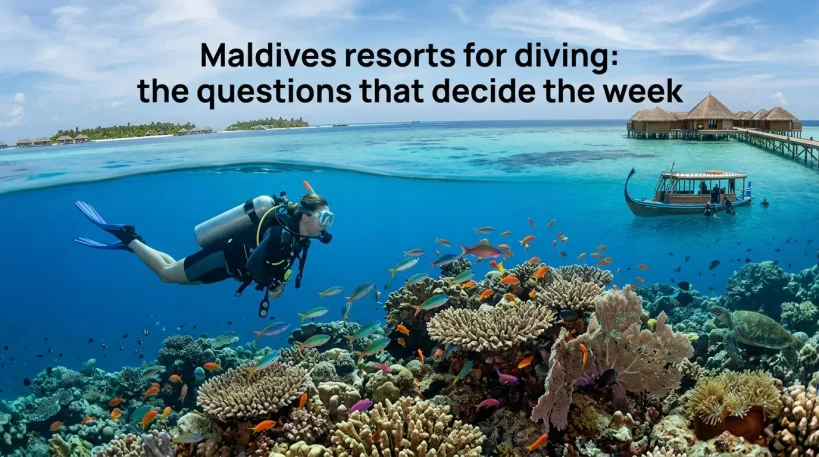
What decides a diving week is not the centre’s certification but its geography and its operation. How many sites sit within thirty minutes, how many boats run, how many people go on each, and whether you can get in the water from the beach without booking anything.
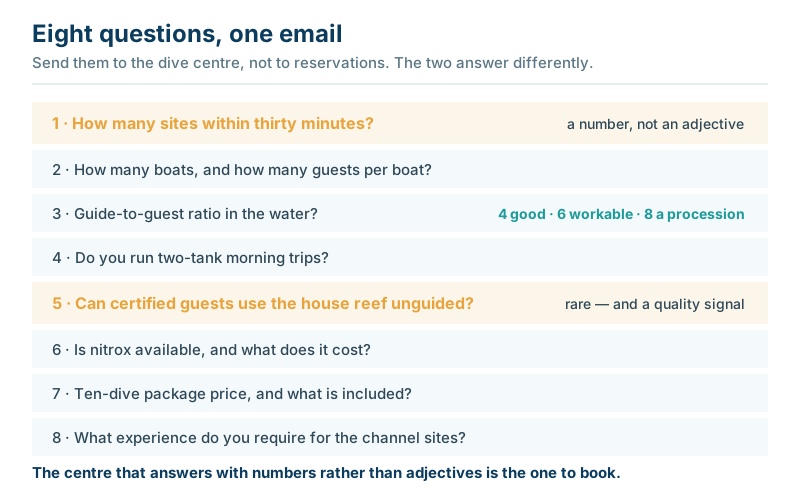
None of that appears on a booking page. All of it is answerable in one email, sent to the dive centre rather than to reservations, because the two answer differently.
What actually decides a diving week
Four things, in order of how much they matter.
1. The sites within reach. A property works whatever it can reach in a reasonable boat ride. Twenty good sites within thirty minutes is a different week from four sites within an hour, and the difference is geography rather than management.
2. The boat schedule. Two departures a day with a two-tank morning trip is a serious operation. One departure at nine, back at noon, is a property that offers the activity rather than specialises in it.
3. The house reef. Whether you can use it, whether you can do so unguided, and whether it is any good — the check is in our guide to reading a house reef.
4. The centre itself. Group sizes, guide ratios, equipment condition and whether nitrox is available. Genuinely important, and fourth, because a good operation in a poor location cannot manufacture sites.
What matters less than people think: the agency affiliation, the number of courses offered, and the photographs of the classroom.
The geography, which you choose first
Region decides the diving before any property does.
Channel atolls — Vaavu, parts of Ari, the southern atolls — have strong current, big animals and the drift conditions experienced visitors come for.
South Ari has the year-round whale shark aggregation and a dense concentration of sites.
Baa has the seasonal manta aggregation and gentler conditions generally.
Kaafu and the central atolls have the largest number of properties, the shortest transfers and a great many sites — with the trade that the popular ones carry other boats.
The far south and far north have the emptiest sites in the country, reached by domestic flight, and the fewest resorts.
Choose the region first, then the property within it. Our atoll decision guide sets out what differs, and the full site picture is in our diving guide.
The eight questions
Email these to the dive centre directly. The address is usually on the property’s diving page, and the reply tells you as much as the answers do.
1. How many sites are within thirty minutes of the island? The single most useful question. A specific number means a centre that thinks in these terms.
2. How many boats do you run, and how many guests per boat? Two boats means flexibility. Twenty-four people on one boat means waiting.
3. What is the guide-to-guest ratio in the water? Four to one is good. Eight to one is a group rather than a guided descent.
4. Do you run two-tank morning trips? The marker of a serious operation, because it means the boat goes somewhere worth a surface interval.
5. Can I use the house reef, and can I do so unguided? Rare, valuable, and a strong signal — see below.
6. Is nitrox available, and what does it cost? For three or four dives a day it changes the week.
7. What are the package prices for ten, and what is included? Equipment, marine park fees and nitrox are frequently separate.
8. What certification and how many logged hours do you require for the channel sites? A centre with a threshold is a centre that assesses.
And one more if you are travelling with a non-diver: what can they do while I am diving? An honest answer is worth having before booking, not after.
Unguided house reef diving
The clearest quality signal available, and most guests do not know to ask.
Most Maldivian resorts require a guide every time, including on the house reef. That is partly regulation, partly liability and partly revenue.
A handful permit certified guests to use the house reef unguided, in buddy pairs, with a check descent first and a plan filed at the centre.
Why it matters. Unlimited access at whatever hour suits, without booking a boat: dawn, dusk, and after dark, which our night snorkelling guide describes from the surface. It transforms both the cost and the character of a week.
What it signals. A centre confident enough to allow it, and a house reef good enough to be worth it.
It is not for everyone, and a centre that assesses you before agreeing is doing the right thing rather than obstructing.
Ask specifically. “Is house reef diving available?” gets a yes. “Can certified divers dive the house reef unguided in buddy pairs?” gets the real answer.
What it costs
| Typical | |
|---|---|
| Single dive, resort | USD 110–200 |
| Ten-dive package | Usually 15–25% below single-dive rates |
| Equipment rental | About USD 15 per dive, or a weekly rate |
| Nitrox supplement | USD 5–10 per dive |
| Marine park fees | USD 6–15 per protected site |
| Guesthouse island dive centre | A third to a half of resort prices |
Then the 28.7%. A service charge of 10% and 17% TGST compound on all of it, as our guide to money in the Maldives explains. A USD 110 dive bills near USD 184 once equipment, park fee and tax are added — the arithmetic is in our main guide.
Package the dives, always. Ten-dive packages are materially cheaper and unused dives are frequently refundable or transferable within the stay — ask which.
And compare against the alternatives. A liveaboard delivers twelve to eighteen dives a week at a fraction of resort per-dive cost, and a guesthouse island dives the same sites at a third to a half of the price.
Group size and the guide ratio
The quality marker that shows up on every dive, and it is worth weighting heavily.
Four guests per guide is good. You are watched, the group stays together, and the guide can point things out rather than count heads.
Six is workable. Eight is a procession, and in current it is a safety question rather than an aesthetic one.
Ask about the maximum, not the average. Every centre’s average looks fine.
Ask whether groups are split by experience. A centre that puts a fresh Open Water certificate and a 500-log instructor with the same guide is managing a boat rather than an activity.
And ask what happens in current. The honest answer involves a reef hook, a briefing, and a guide who calls it off if the group cannot hold position.
The boat matters more than the villa
An underrated variable, and it decides how the middle of the day feels.
A purpose-built dhoni has a covered deck, a bench with tank racks, a rinse tank, a toilet and shade for the surface interval. This is what a serious operation runs.
A speedboat is faster and considerably worse for a two-tank morning: nowhere to sit properly, no shade, and an uncomfortable surface interval.
Ask which vessel goes to which sites, because many centres run both.
Check whether there is a toilet. On a two-tank morning it matters, and nobody asks until they are already out there.
And ask about the surface interval. Some centres return to the island between dives — which wastes an hour — and others stay out with tea and fruit aboard.
The rest of the property still matters
Easy to forget when the water is the point, and it decides how the other eighteen hours go.
Breakfast timing. A boat at seven means breakfast at six, and not every property serves it that early. Ask, because a week of missed breakfasts is a miserable week.
A packed breakfast or a hot one on return is what good properties offer, and it costs nothing to ask.
Room location. A villa at the far end of a large island is a long walk with a camera bag at half past six. Our guide to island size sets out how far “a short stroll” actually is.
Somewhere to dry things. Humidity here means nothing dries indoors. A villa with a line, a rack or a covered terrace is worth more than a category upgrade.
Board basis. Half board suits this pattern well, because you are on a boat through lunch several days a week — the arithmetic is in our guide to budget and all-inclusive.
And the afternoon. Between the last boat and dinner there are four hours, and what a property offers in them — a spa, a shaded deck, a library, a second beach — is what makes a week restful rather than merely busy.
Safety, and the questions that are reasonable to ask
None of these is impolite, and a good centre answers all of them immediately.
Is there oxygen on every boat, and is the crew trained to administer it?
What is the nearest hyperbaric chamber, and how long would it take to reach? There are four in the country, all at resorts, and none south of Dhaalu Atoll. On a southern itinerary that is a material fact, as our safety guide sets out.
Do you require specialist insurance? Many centres do. Chamber treatment runs into thousands of dollars and most standard travel policies exclude it.
What is your policy on solo or unguided descents, and what checks apply?
Is there a doctor on the island? Usually a nurse or a resort doctor at larger properties, and nothing at small ones.
And the one about you rather than them: when were you last in the water? A centre will ask, and if the answer is over a year they will suggest a refresher — which is correct rather than a sales tactic.
The no-fly interval, which shapes the last days
Standard guidance is 18 to 24 hours between the last dive and altitude, and it constrains more of a Maldives trip than divers expect.
It applies to seaplanes, not only to international flights — a point our guide to seaplane transfers makes and which catches people leaving a resort by air.
Which means the last full day is a dry one on most itineraries, and the centre will plan around it if you tell them your departure time on arrival.
Tell them on day one. A centre that knows your flight builds the week backwards from it.
And if you are combining a resort with a liveaboard, put the boat first, so the interval falls at the end of the trip.
Courses on site
Worth a short section, because the economics differ sharply from home.
Open Water certification here costs substantially more than the same course at home, and the theory can be done online before travelling, which shortens the in-water portion.
The sensible pattern: certify at home, use it here. Our main guide sets out the price comparison.
Advanced Open Water is different. It is short, it opens the channel sites, and doing it here with a guide who knows the current is a reasonable use of two days.
Specialities worth doing on site: nitrox, which pays for itself across a week of three-a-day, and drift technique if the centre offers it as a formal course.
A refresher is worth booking if it has been more than a year, and most centres offer one as a pool session plus a shallow outing.
Bring or rent
The equipment question, answered practically rather than ideologically.
Bring your own mask, always. A mask that fits is the single largest comfort variable and the cheapest thing to carry.
Bring a computer if you own one. Rental units are functional and unfamiliar, and reading somebody else’s display in current is not the moment to learn — nor is it the moment to be worrying about photography.
Rent the heavy items. A BCD and regulator set weigh most of a seaplane baggage allowance, which is 20 kg checked plus 5 kg cabin. Rental runs about USD 15 a day.
A 3mm suit or a rash guard is enough. Water sits at 26 to 30°C year-round and nobody needs thick neoprene — the same advice our snorkelling guide gives.
A reef hook for the channel sites, if you have one — several centres supply them and some do not.
A surface marker buoy, which good centres require and excellent ones check.
And service your kit before travelling, because there is no dive shop on an island and a free-flowing regulator ends a week.
The non-diving partner
The scheduling problem that decides whether the week works for two people.
A full day removes you from about seven in the morning until one, and longer if you add an afternoon trip.
Which is fine at a resort with a good house reef, a spa and a beach, and considerably less fine where the alternative is a pool and a book.
Ask the dive centre what the partner can do, and ask the excursion desk separately — our activities overview covers what a resort week can hold.
Snorkelling from the same boat is offered at some centres and not others, and it is the single best answer to this problem when available.
And the alternative structure: three active days rather than seven, with the rest of the week shared. What you do will be better for the rest.
Resort, guesthouse island, or liveaboard
The comparison every Maldives diver eventually makes.
A resort gives you a comfortable base, a house reef, a partner-friendly week and the highest per-descent cost in the country.
A guesthouse island reaches the same sites at a third to a half of the price, with a village to come back to and no alcohol. On a budget it is the strongest option in the country.
A liveaboard gives twelve to eighteen in a week, reaches atolls no resort can, and follows the weather — with no beach and nothing for a partner who stays dry.
And the combination that experienced visitors converge on: a liveaboard week followed by a few nights on land, in that order because of the no-fly interval. The where to stay pillar sets out how the pieces fit.
When to go
The dry season, December to April, brings the best visibility — twenty-five to forty metres — and calmer crossings.
The wet season, May to November, brings plankton, which reduces visibility to fifteen to twenty-five metres and brings the animals that feed on it. Hanifaru runs in this window.
The trade is unavoidable: clear water or big animals, rarely both. Our diving season calendar explains the mechanism, and the current side of an atoll swaps with the monsoon.
The property’s position matters seasonally. One with sites on both sides of its atoll is more robust than one restricted to a single side.
Questions travellers ask
How do I choose a Maldives resort for diving? Email the dive centre rather than reservations and ask how many sites are within thirty minutes, how many boats they run, the guide-to-diver ratio, and whether certified divers can dive the house reef unguided. Those four answers separate operations more reliably than any description.
How much does diving cost at a Maldives resort? USD 110 to 200 per dive, plus about USD 15 for equipment, USD 6 to 15 in park fees and a nitrox supplement, all before a service charge and tax compounding to about 28.7%. Ten-dive packages run 15 to 25 per cent below single-dive rates.
What is a good guide-to-diver ratio? Four to one is good, six is workable, eight is a procession. Ask for the maximum rather than the average, and ask whether groups are split by experience.
Can I dive the house reef without a guide? At a small number of properties, in buddy pairs, after a check dive. Most require a guide for every dive. Ask the specific question rather than “is house reef diving available”, which always gets a yes.
Which atoll is best for diving? Vaavu and the channel atolls for current and big animals, South Ari for whale sharks year-round, Baa for seasonal mantas, Kaafu for choice and short transfers. Choose the region first, then the property.
When can I fly after diving? Standard guidance is 18 to 24 hours, and it applies to seaplane transfers as well as international flights. Tell the dive centre your departure time on arrival and they will plan the week backwards from it.
Should I certify in the Maldives? Open Water is materially cheaper at home. Advanced Open Water is short, opens the channel sites, and is a reasonable thing to do here with a guide who knows the current.
Is a resort better than a liveaboard for diving? Only if you want a beach, a partner-friendly week or fewer dives. A liveaboard delivers twelve to eighteen dives a week against six to ten at a resort, at a fraction of the per-dive cost.
What to take away
- Email the dive centre, not reservations. The two answer differently and only one of them counts dive sites.
- The four things that decide the week: sites within thirty minutes, the boat schedule, the house reef, and the centre’s operation — in that order.
- Ask whether certified divers can dive the house reef unguided. It is rare, it transforms a week, and the answer is a quality signal in itself.
- Four divers per guide is good, eight is a procession. Ask for the maximum rather than the average.
- There are four hyperbaric chambers in the country, all at resorts, and none south of Dhaalu Atoll.
Next step: shortlist three properties by region, then send all three the same eight questions. The replies will separate them within a day. One centre will send a table of sites and boat times; another will send a paragraph about its five-star status. The first one is where your week actually happens, and the difference costs nothing to discover before you have paid anybody.