


Flights to the Maldives: Choose by Arrival Time, Not by Price
There is one number on a Maldives flight booking that matters more than the fare, and most people never look at it.
If your inbound lands after roughly 14:00 and your resort is reached by seaplane, you have missed the last flight of the day. Seaplanes fly in daylight only and stop between about 15:30 and 16:00; immigration takes 75 to 90 minutes at peak. The resort books you a hotel near the airport, at a price set by the fact that you have no alternative at seven in the evening.
A cheaper ticket arriving at 15:00 therefore costs a night, a day and a great deal of goodwill. This guide covers how to get to the Maldives, and how to pick a flight that does not do that to you.
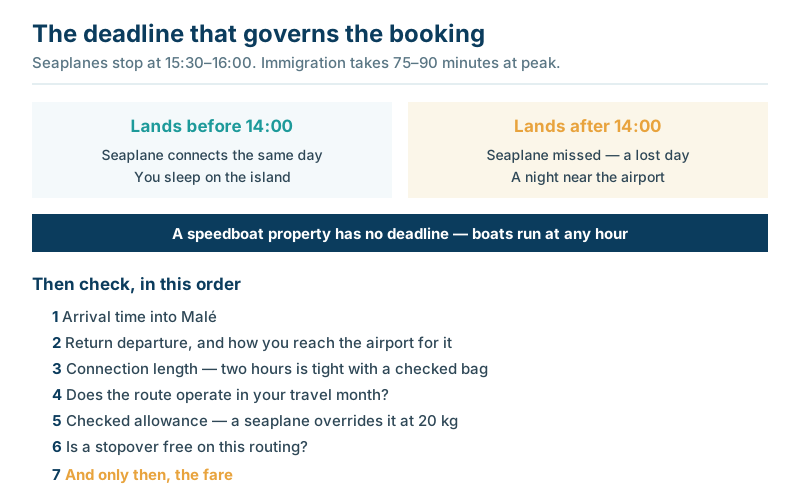
The arrival rule, stated properly
The single most useful thing on this page, and it takes thirty seconds to apply.
Seaplanes stop between about 15:30 and 16:00. They are visual-flight-rules aircraft and do not operate after dark.
Immigration takes 75 to 90 minutes at peak, and peak is when the long-haul arrivals bank.
Which means an arrival after roughly 14:00 does not connect to a same-day seaplane, however short the theoretical gap looks.
A speedboat property has no such deadline. Boats run at any hour, which is why our guide to staying near the airport argues so hard for the near atolls on short trips.
The fix, if your only sensible fare lands late: book a night in Hulhumalé deliberately, at a fraction of what an unplanned one costs. Or choose a property reachable by boat.
And the corollary for departures: international flights leave in the small hours, and a seaplane cannot deliver you at three in the morning — so the last night is frequently spent near the airport whether you planned it or not.
Where you fly into
One Maldives airport handles almost everything, and the rest follows from it.
Velana International, on Hulhulé, adjacent to Malé, is the country’s international gateway and where essentially every visitor arrives — the terminal itself is covered in our guide to Velana.
Three other airports handle some international traffic — Gan in the far south, Hanimaadhoo in the north, and Maafaru — serving specific regions rather than the country as a whole. Which region suits you is the subject of our atoll decision guide.
Everything after Velana is a separate journey: a speedboat, a seaplane or a domestic flight, priced per person and booked separately, as our transfers guide sets out.
Which is the structural fact that shapes the whole journey. You are not flying to your hotel. You are flying to an airport from which another operator will take you somewhere else, under a separate contract, on a schedule that may not match your ticket.
The hubs
Almost every long-haul route to the Maldives connects, and the hub is worth choosing deliberately.
The Gulf carriers — Dubai, Doha and Abu Dhabi — carry the largest share of European traffic, with frequent services and short connection times.
Istanbul is the other major European option and has grown considerably.
Colombo is the short-hop hub, seventy-five minutes away, and it is also a destination in its own right — the case for a fortnight rather than a connection is in our Sri Lanka comparison.
Southeast Asian hubs — Bangkok, Kuala Lumpur, Singapore — serve traffic from Australia, East Asia and some European routings.
Indian cities connect a large regional market, and the flight is short.
Which hub to choose. The one whose arrival into Malé lands before 14:00, first. After that, the one you would not mind spending two nights in — the case for Dubai is in our Dubai comparison, and Bangkok makes a similar argument.
Direct flights
Fewer direct flights to the Maldives than people assume, and seasonal.
Direct services from Europe exist, largely as seasonal charter and scheduled operations concentrated in the winter high season, and they thin out considerably in the wet season.
From China, India, Sri Lanka and the Gulf, direct services are more consistent because the distances are shorter.
A direct flight is worth a premium on this route specifically, because it removes the connection risk that produces most missed-transfer problems.
But check the arrival time even so. A direct flight landing at 16:00 has the same problem as a connecting one, and being direct does not help.
And check the season. A route that operates in January may not operate in July, which catches people planning a wet-season trip on the basis of a winter timetable.
Flight times, roughly
Orientation rather than a timetable, since routings vary.
| From | Typical journey |
|---|---|
| Western Europe | 10–13 hours with one connection |
| The Gulf | About 4 hours direct |
| India | 2–4 hours direct |
| Sri Lanka | About 75 minutes |
| Southeast Asia | 4–5 hours direct or one connection |
| Australia | Two connections, a long day |
| North America | Two connections, and a very long day |
The number that matters is not the flying time but the total elapsed journey plus the transfer at the other end — which our itineraries guide accounts for by treating arrival day as a half day.
From North America and Australia the journey is long enough that a stopover stops being optional and starts being sensible.
Flying to the Maldives from the main markets
Practical orientation by origin, since the answer differs so much by where you start.
From the UK and Western Europe. One connection through a Gulf hub or Istanbul is the standard routing, with seasonal direct services in the winter. Aim for a morning arrival into Malé, which most of these routings permit.
From the Gulf. Direct, about four hours, with frequent departures — and a genuinely wide choice of arrival times, which makes the 14:00 rule easy to satisfy.
From India and Sri Lanka. Short and direct, and Colombo is close enough that a combined trip makes obvious sense, as our Sri Lanka comparison argues.
From Southeast Asia and China. Direct or one connection, with capacity concentrated in the high season.
From Australia and New Zealand. Two connections and a long day, usually through a Southeast Asian or Gulf hub. This is the market for which a stopover is least optional.
From North America. Two connections, typically via Europe or the Gulf, and among the longer journeys available to any beach destination — which is why our Bora Bora comparison concludes that the flight map decides that particular question.
When to book
Different from most destinations, because Maldives capacity at the far end constrains as much as the fare does.
Six to twelve months ahead for peak season — December to April generally, and Christmas and New Year in particular, when both fares and resorts sell out.
Three to six months for the rest of the dry season.
Weeks ahead is viable in the wet season, May to November, when both fares and room rates soften — the price picture is in our guide to high and low season.
Book flights before accommodation for peak dates, because the flight is the scarcer of the two and its timing determines which properties are reachable on your arrival day.
Book them together for everything else, so that the arrival time and the transfer are decided as one — the full sequence is in our booking timeline.
And book the transfer at the same time as the room, not afterwards. It is a separate contract and the commonest thing to leave until later, as our guide to missed connections explains.
Fares, and what actually moves them
Briefly, because the Maldives behaves like other long-haul destinations here with one exception.
Season is the dominant factor, and Christmas and New Year are the peak of the peak.
Advance booking helps, and it helps most on the dates where capacity is genuinely tight.
Hub choice moves the fare meaningfully, and a routing through a city you would like to see is frequently worth a small premium — which is the stopover argument in fare terms.
The exception is the far end. In most destinations a cheaper flight is simply a cheaper flight. Here, a fare that lands at the wrong hour costs a night’s accommodation and a day of the holiday, so the cheapest ticket is not always the cheapest journey — the full cost picture is in our guide to what a trip costs.
And flights are excluded from every budget figure this site publishes, deliberately. They vary so much by origin that including them would make the accommodation comparisons meaningless.
Which means you should price them separately and add them at the end, rather than looking for a single all-in number that cannot exist for a destination reached from four continents.
Booking direct, through an agent, or as a package
The channel question, which matters more here than at most destinations.
A package puts the flight, the room and the transfer on one contract, which is the single most effective way to remove the connection risk this article keeps describing. If something fails, one party owns the problem.
Booking separately is usually cheaper and puts the risk on you. The flight, the room and the transfer become three contracts with no one responsible for the joins — the situation our guide to missed connections sets out in full.
A specialist agent earns a fee on complex trips — a seaplane island, a domestic flight, a split stay — because they hold the pieces together when something moves.
Booking direct with the property frequently produces a better room allocation and occasionally a transfer included, and it is worth an email even where the rate matches.
And whichever you choose, confirm the transfer in writing against your actual flight numbers. It is the piece most likely to be assumed rather than booked.
Baggage, and the limit that overrides your ticket
The Maldives trap that catches divers, photographers and anybody who overpacks.
Your long-haul allowance is generous and largely irrelevant if a seaplane is in the chain.
The seaplane limit governs: 20 kg checked and 5 kg cabin, set by the smallest aircraft you board rather than by the airline that sold you the ticket. Excess is charged per kilo, and the rules are in our guide to seaplane baggage.
A speedboat property removes the limit entirely.
Airport-area hotels will store bags, which means anything you do not need on the island can wait rather than costing excess in both directions.
Dive gear is the usual problem. A BCD and regulators consume most of an allowance. Renting at about USD 15 a day is frequently cheaper than flying them, as our packing list sets out.
And boards, for surfers, which airlines charge for on the long-haul leg and seaplanes carry at the operator’s discretion.
Arriving
What happens between the aircraft door and your transfer.
The visa is free and granted on arrival to almost all nationalities, with nothing to apply for beforehand — the detail is in our guide to the visa on arrival.
The IMUGA traveller declaration must be submitted within 96 hours of travel, in both directions, and it is the piece of paperwork that actually catches people out — our guide to IMUGA covers the form.
Customs is real. Alcohol is confiscated on import and returned on departure. Pork products and religious material for distribution are prohibited, and the list is in our guide to restricted items.
Then you are met. Resort representatives operate desks in the arrivals area, and the handover from airline to transfer operator happens there — including for guesthouse islands, whose speedboats work the same way.
Allow 75 to 90 minutes from touchdown to being ready to move, at peak. Less outside it.
Departing
The half of the journey that goes wrong more often.
International flights leave in the small hours, mostly between midnight and four, with check-in opening two to three hours before.
Which means a seaplane cannot deliver you, so a seaplane property means leaving the island the previous afternoon, or very early on the day — and frequently a night near the airport that nobody budgeted for.
Allow three hours before an international departure, four in the southwest monsoon if any part of the journey is by sea.
And observe the no-fly interval if you dive. Standard guidance is 18 to 24 hours between the last dive and altitude, and it applies to the seaplane as well as to the long-haul flight — our diving guide sets it out.
Duty-free is better bought homeward. Anything bought on the way out sits in a locker at Velana for the whole trip, since alcohol cannot be imported.
Stopovers
Frequently free, occasionally better than the alternative.
You are already changing planes, so the only question is whether you leave the airport.
Two or three nights is the right length in a hub city, and it costs no extra flight — the arithmetic for the whole trip is in our itineraries guide.
Dubai is the commonest, and our Dubai comparison sets out the case — including the argument that the city belongs at the start of the trip rather than the end, so the post-diving interval falls where it costs nothing.
Colombo is different, because Sri Lanka rewards nine nights rather than two.
Bangkok and Kuala Lumpur suit travellers from Australia and East Asia, and the Thai case is in our Thailand comparison.
And a long layover is a day, not a waiting room. Six to twelve hours is enough to leave most hub airports and see something, provided the visa situation allows — and the same is true at Velana itself.
Domestic flights inside the Maldives
Part of the Maldives journey for anyone going beyond the near atolls.
Domestic airports serve the outer regions, and the flight is followed by a boat — the operators and the pattern are in our guide to domestic airlines.
It is a separate ticket from the international one, and the connection is not protected.
Which means the buffer matters. A tight domestic connection after a delayed long-haul flight is the situation our guide to missed connections exists for.
Domestic flights operate later than seaplanes, which is a real advantage for a late arrival to a distant atoll — Baa and the far south among them.
And the baggage limit is different again from both the international and the seaplane allowance — check it for your specific routing.
Choosing a flight: the checklist
Seven checks before booking a Maldives flight, in order, and the first is not the price.
1. What time does it land in Malé? Before 14:00 if your resort needs a seaplane.
2. What time does the return depart, and how do you reach the airport for it?
3. Is the connection long enough? Two hours is tight at most hubs with a checked bag.
4. Does the route operate in your travel month? Some do not run in the wet season.
5. What is the checked allowance, and does a seaplane override it?
6. Is a stopover free on this routing? Frequently it is.
7. And only then, the fare.
Which produces the rule this article opened with: the arrival time is worth more than the saving, because a cheap ticket that costs you a day and a night is not cheap.
Questions travellers ask
Which airport do you fly into for the Maldives? Velana International, on Hulhulé beside Malé, handles essentially all international arrivals. Three other airports take limited international traffic but serve specific regions.
Are there direct flights to the Maldives? Yes, from the Gulf, India, Sri Lanka, China and — seasonally — several European cities. Most long-haul traffic connects through a Gulf hub, Istanbul, Colombo or Southeast Asia.
What time should my flight land? Before about 14:00 if your resort is reached by seaplane, because seaplanes stop between 15:30 and 16:00 and immigration takes 75 to 90 minutes. A speedboat property can collect you at any hour.
How far ahead should I book? Six to twelve months for peak season and for Christmas and New Year, three to six months for the rest of the dry season, and weeks ahead in the wet season.
What is the baggage allowance? Your airline’s allowance applies to the long-haul leg. But if a seaplane is in the chain, the operative limit is 20 kg checked and 5 kg cabin, set by the smallest aircraft you board.
Do I need a visa? No. A free visa is granted on arrival to almost all nationalities. You do need to submit the IMUGA traveller declaration within 96 hours of travel, in each direction.
How long should I allow at the airport on departure? Three hours before an international flight, and four in the southwest monsoon if any part of the journey to the airport is by sea.
Is a stopover worth it? Frequently, and it costs no extra flight since you are already connecting. Two or three nights in a hub city, placed at the start of the trip rather than the end.
What to take away
- Choose the flight by arrival time. Land after 14:00 with a seaplane resort booked and you have lost a day, whatever the fare said.
- Velana is the gateway, and everything after it is a separate journey under a separate contract.
- If a seaplane is in the chain, your baggage limit is 20 kg checked and 5 kg cabin — not whatever your airline allowed.
- Book six to twelve months ahead for peak season, and book the transfer at the same time as the room rather than afterwards.
- International flights leave in the small hours, which a seaplane cannot serve. Plan the last night accordingly.
Next step: before you compare a single fare, write down the latest arrival time that works for the property you want — 14:00 for a seaplane island, any time for a speedboat one. Then filter on that before anything else. It will eliminate some cheap tickets, and every one of them would have cost you more than it saved, in a night near the airport and a day of the holiday you paid for.