Maldives or Zanzibar: In One of Them, the Sea Walks Away
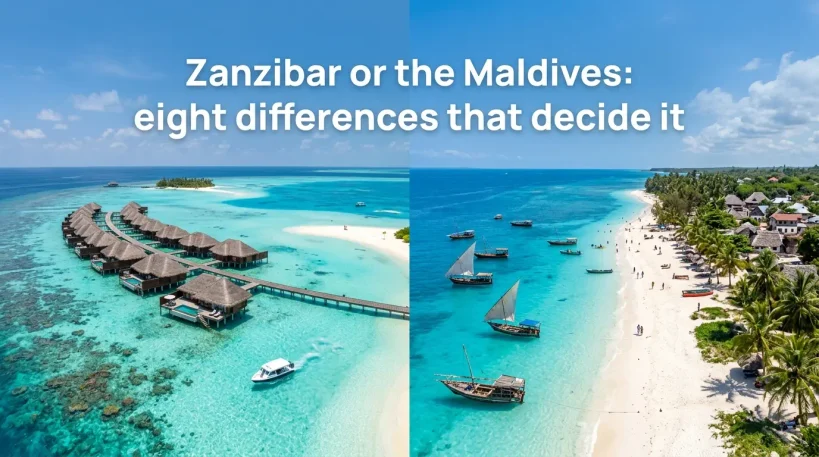
Both are Indian Ocean islands with white sand, turquoise water and thatched roofs. The brochures are interchangeable and the reality is not, and the clearest difference is one that no brochure photograph will ever show you.
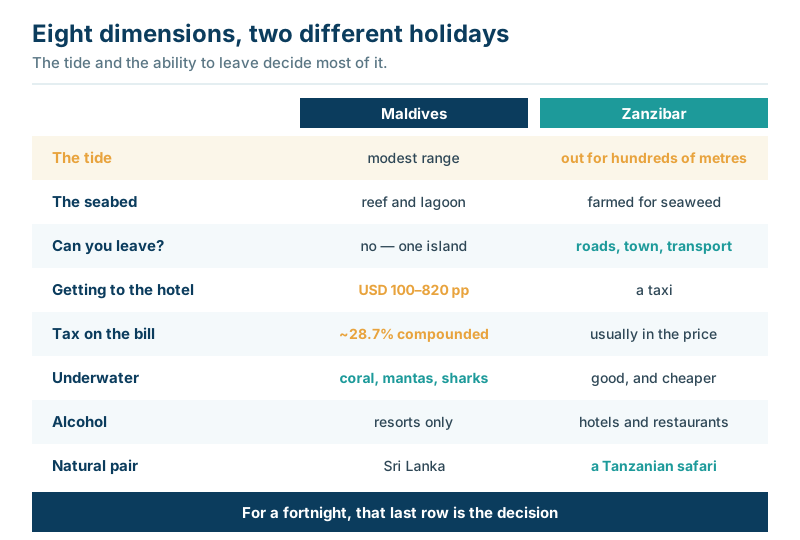
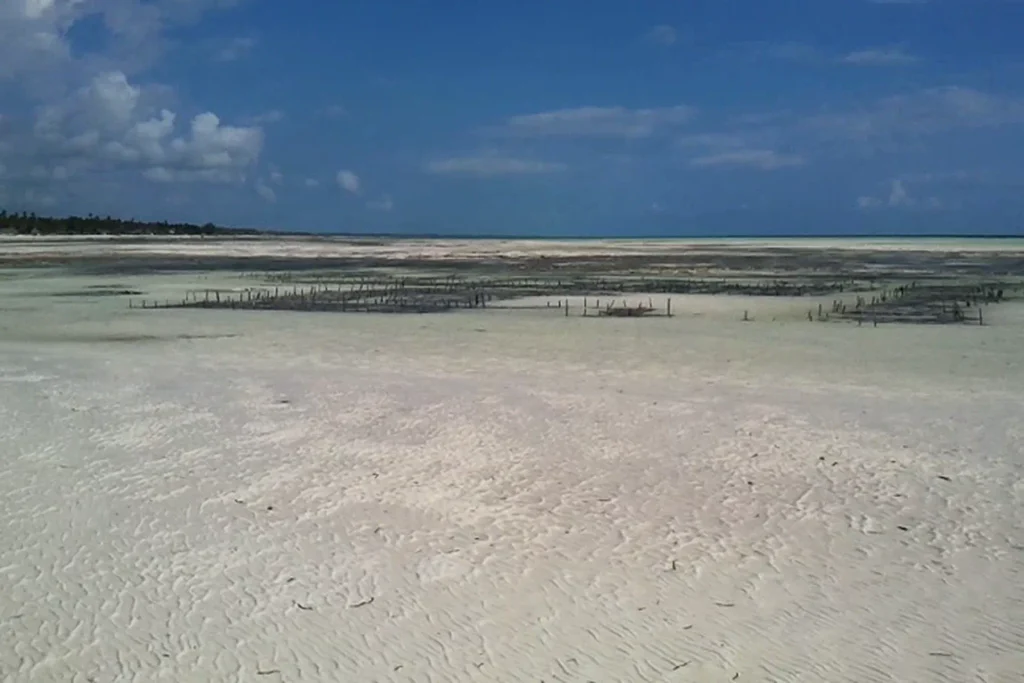
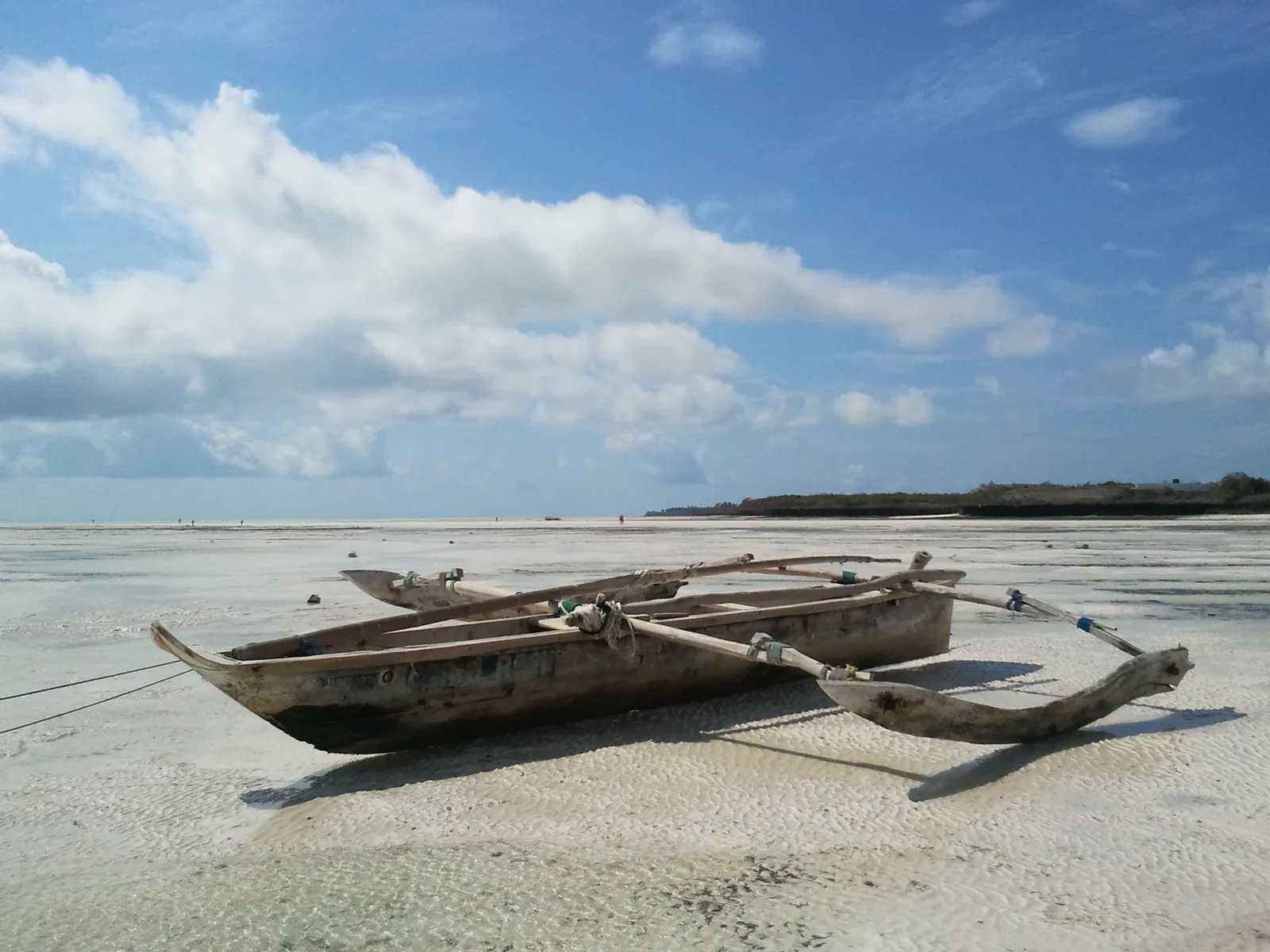
On Zanzibar’s east coast the tide goes out for hundreds of metres. The sea does not retreat a few steps; it leaves, exposing a plain of wet sand and seagrass with fishing boats sitting on it, and comes back hours later. In the Maldives the tidal range is small enough that most visitors never notice it.
That single fact reorganises what a beach day is in each place. It is also the reason the exposed seabed on Zanzibar is farmed, which is a thing the Maldives has no equivalent of at all.
We have been to both, and every photograph in this article is our own.
1. The tide, which changes what a beach is
Start here, because it is the dimension people discover on arrival rather than before booking.
On Zanzibar’s east coast the water withdraws a very long way. At low tide you can walk out for what feels like half a kilometre on firm wet sand, past stranded outrigger boats, with the sea a thin line on the horizon. Hours later the same ground is under water.
Which means swimming from the beach is tide-dependent. For a stretch of every day, in many east-coast spots, you cannot swim from the shore at all. You walk, or you wait, or you take a boat out to the reef.
Nobody tells you this at booking, and it is the single most common surprise reported by first-time visitors to that coast.
The Maldives behaves differently. The tidal range is modest, and the constraint there is geometry rather than timing — whether the reef edge is twenty metres from the beach or four hundred, which our guide to reading a house reef explains how to check before booking. A Maldivian lagoon is shallow at low water; it does not disappear.
What to do about it if you choose Zanzibar: check the tide tables for your dates, and understand that a beach hotel there sells you a rhythm rather than a permanent swimming pool.
And a caution on our own numbers. We are describing what we saw rather than publishing a measured range. Check the figures for a given beach against a tide source before planning around them.
2. The seabed is farmed
The consequence of that tide, and the thing that makes the Zanzibar shoreline unlike anywhere in the Maldives.
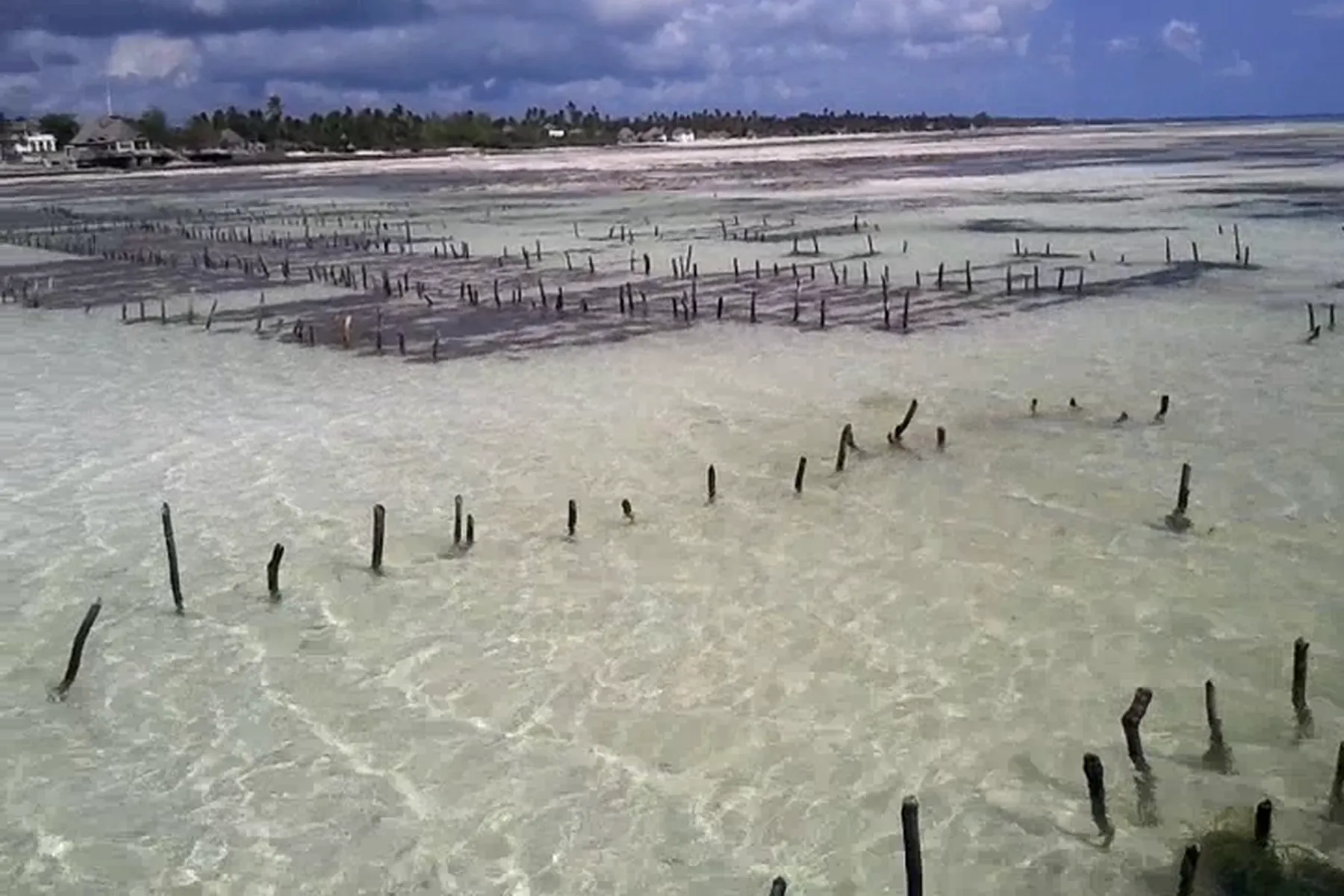
Seaweed is cultivated on the exposed flats. Rows of wooden stakes with lines strung between them, planted in ordered plots across the intertidal zone, tended when the water is out and submerged when it returns.
It is a livelihood rather than a curiosity. The work is done largely by women, and the plots you walk past are somebody’s income.
Which changes how you behave on the beach. Those are not decorations. Walking through a plot is walking through a field.
The Maldives has no equivalent. No intertidal zone of that size, no seaweed cultivation, and no agriculture at scale — the country imports almost all of its food. The comparable maritime livelihood there is fishing, described in our guide to night fishing.
And it is why a Zanzibar beach photograph is not interchangeable with a Maldivian one, whatever the brochures suggest. The stakes are in the frame.
3. Can you leave?
The dimension that runs through this whole comparison set, and it resolves as clearly here as anywhere.
In the Maldives, no. A resort occupies its entire island; there is no second restaurant, no road, and nowhere to walk to. The alternative is a guesthouse island, which is a village you can cross in twenty minutes.
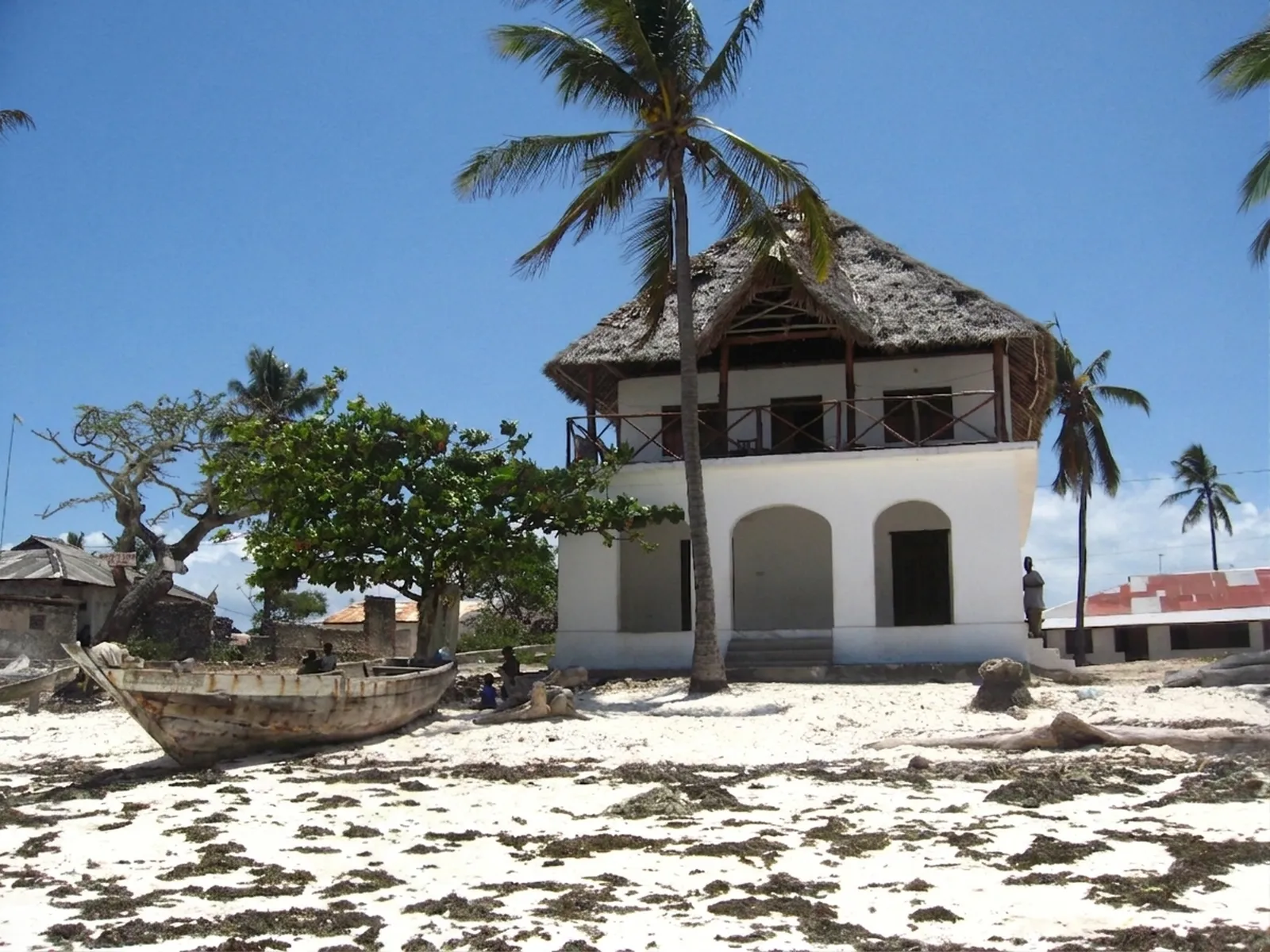
On Zanzibar, yes. It is a populated island with roads, shared minibuses, taxis and towns. You can be on a beach in the east in the morning and in Stone Town by lunchtime.
And Stone Town is a real destination. A dense historic port town of coral-stone buildings, carved doors, narrow lanes and a market — a UNESCO World Heritage Site, and a place that exists for reasons that have nothing to do with tourism.
The Maldives has no equivalent urban place that a visitor experiences in the same way. Malé is a dense and interesting capital, and it is not a historic quarter you wander for an afternoon.
Which produces the structural difference: on Zanzibar the beach is one component of a trip. In the Maldives it is the trip.
4. Getting there and getting around
Where the cost difference is largest and least visible when comparing hotel rates.
Both are long-haul from Europe, and both are usually reached with a connection — the Maldivian routes are in our guide to getting there.
Then the Maldives adds a second journey. Your resort is on a different island: a speedboat at USD 100 to 400 per person return, or a seaplane at USD 400 to 820, charged per person including children — the full picture is in our transfers guide. Seaplanes fly in daylight only and stop between about 15:30 and 16:00, so a late arrival costs a day.
Zanzibar adds a taxi. You land, you are driven to your hotel, at any hour, for a fraction of the cost. Getting to the east coast is an hour or so by road.
And afterwards you can move. Roads, shared transport, hired drivers. In the Maldives every subsequent movement is another boat and another fare.
This is the same finding as in our Mauritius comparison, and it holds against every destination in this set: the Maldivian transfer is a cost category that its competitors simply do not have.

5. What a week costs
Indicative bands for two people, excluding international flights. The Maldivian figures come from our own budget work; the Zanzibar side is orientation rather than quotation.
| Maldives | Zanzibar | |
|---|---|---|
| Budget end | USD 1,100–1,900 on a guesthouse island | Comparable or lower |
| Mid-range | USD 4,500–8,000 at a resort | Substantially less |
| Luxury | USD 12,000+ | High end exists, at lower prices |
| Transfer | USD 200–1,640 for two | A taxi fare |
| Eating outside the hotel | Impossible at a resort | Normal and cheap |
| Tax on the bill | ~28.7% compounded | Local taxes, usually in the price |
The 28.7% is the Maldivian mechanism that surprises people. A 10% service charge and 17% goods and services tax compound on nearly every resort line — dinner, drinks, the spa, excursions, diving. Our guide to money in the Maldives explains it, and our guide to budget and all-inclusive shows what a package excludes.
Zanzibar has no captive-pricing equivalent, because you can eat somewhere else.
Where the Maldives competes is at the very bottom, through guesthouse islands: rooms from USD 60, meals at USD 5 to 13, the same reefs the resorts dive. Most comparisons never mention it, because the Maldives is marketed exclusively at the other end.
And the honest caveat on infrastructure. Zanzibar is a lower-income setting, and power interruptions, water supply and road quality are part of the trip in a way they are not at a Maldivian resort, where the property runs everything.
6. What is in the water
Both have reef; the reef does different things.
The Maldives is the stronger underwater destination. More coral, more reef fish, and reliable encounters with manta rays, whale sharks, reef sharks and turtles. If the trip is about what is under the surface, this is not a close comparison — though our guide to reef health records what the 2024 bleaching cost.
Zanzibar has good diving, particularly around Mnemba and the northern reefs — with the same caveat about choosing a base that our guide to resorts for divers makes. It is a real dive destination rather than a token one, and it is considerably cheaper.
Zanzibar has better wind. The east coast is a serious kitesurfing venue, with steady trade winds and flat water inside the reef — the Maldives has wind sports and is not organised around them.
And Zanzibar has dolphins and a forest. Boat trips run from the south, and Jozani forest holds red colobus monkeys. The Maldives has no terrestrial wildlife to speak of, because it has almost no land.
The spices, and the other half of the island
Worth a section, because a Zanzibar week has an inland component that has no Maldivian counterpart.
Spice farms. Cloves, nutmeg, cinnamon and vanilla grown on smallholdings, visited as a half-day trip. Zanzibar’s spice trade is the reason the island has the history it has, and the tour is one of the more genuinely informative things a visitor can do there.
Jozani. The forest reserve holding Zanzibar red colobus monkeys, which exist nowhere else.
Prison Island and the tortoises, Nakupenda sandbank, and boat trips from Stone Town — which is where the Zanzibar version of a sandbank excursion sits, and it is cheaper than the Maldivian equivalent.
The market and the waterfront in Stone Town, in the evening, which is a food scene rather than a hotel buffet.
None of this exists in the Maldives, and it is not a criticism of the Maldives. A country that is 99% water and imports its food does not have spice farms, forests or a historic trading quarter. It has a reef, and the reef is better.
Which is why the two are complements rather than rivals in the abstract — and why, for any given fortnight, you still have to choose one.
7. The rules you live under
Both are Muslim societies, and this is where they differ most interestingly.
The Maldives operates two legal regimes. Alcohol is served on resort islands under licence and is unavailable on every inhabited island. Swimwear is confined to resorts and designated tourist beaches. The mechanics are in our guides to alcohol and dress codes.
Zanzibar is a Muslim society without that separation. Alcohol is available at hotels and many restaurants; visitors and residents share the same streets, beaches and towns.
Which places the responsibility on you rather than on a boundary. Modest dress in Stone Town and in villages is expected — shoulders and knees covered away from the beach — and it is a matter of courtesy rather than a licensing rule. Ramadan changes the rhythm of the island.
The comparison is instructive. The Maldives solves the tension between a conservative society and a beach tourism industry by separating them physically. Zanzibar does not separate them, which makes the trip more interesting and asks more of the visitor.
One practical consequence. The behaviour our guide to local island visits recommends on Maldivian inhabited islands — dress, photography consent, restraint — applies across all of Zanzibar rather than inside a defined zone.
8. Season, and what the trade is
Neither is a year-round certainty, and their good windows partly overlap.
The Maldives runs on the monsoon. December to April is dry, clear and expensive; May to November is wetter, cheaper, and brings the plankton that draws the big animals. The mechanism is in our monsoon guide and the pricing in our guide to high and low season.
Zanzibar has a long rainy season around March to May, a short one around November, and dry periods either side — roughly June to October and December to February.
Which means the two overlap in December to February, when both are good and both are busy, and diverge in April and May, when Zanzibar is at its wettest and the Maldives is finishing its dry season.
And Zanzibar’s dry June to October window is the European summer, which the Maldives spends in its wet season. For anyone tied to school holidays, that is a real argument.
As always, these are patterns rather than guarantees.
9. Who each one suits
Choose the Maldives if: the water is the point. Diving, snorkelling, big animals, an overwater villa, total isolation, and a week in which nothing is asked of you.
Choose Zanzibar if: you want a beach and a place. A town with a history, a market, a forest, a working coastline, and a trip that contains more than one kind of day.
Divers: the Maldives, though Zanzibar is a genuine and much cheaper alternative.
Kitesurfers: Zanzibar, though the Maldivian surf is a separate and serious proposition.
Families with young children: the Maldives is easier in one specific way — a shallow lagoon that is always there, against a tide that removes the sea for part of the day. Our guide to choosing a resort for a family covers the rest.
Honeymooners: both, differently. The Maldives for seclusion; Zanzibar if you would rather have something to do together than something to be undisturbed by — our honeymoon guide sets out the Maldivian case.
Budget travellers: Zanzibar, or a Maldivian guesthouse island, which is the one Maldivian option that competes.
Anyone curious about where they are: Zanzibar, comfortably — or a Maldivian split stay, which is the closest that country comes.
And anyone who wants to do nothing at all, well: the Maldives, which is better at nothing than anywhere.
10. Can you do both? No — but Zanzibar has a better pair
The most useful thing in this article for anyone planning a fortnight.
Zanzibar and the Maldives are not a combination. Two Indian Ocean beach destinations, a long way apart, offering similar water. There is no reason to do both in one trip.
But Zanzibar has an outstanding pair, and the Maldives does not. Zanzibar is part of Tanzania, and a short flight from the mainland safari circuit — the Serengeti, Ngorongoro and the northern parks. Safari and beach is the classic East African fortnight, and Zanzibar is the beach half of it.
That combination is the real argument for Zanzibar over the Maldives for anybody choosing a two-week trip, and it is structural rather than a matter of taste: the geography permits it and no Maldivian itinerary can offer anything comparable.
The Maldivian equivalent pair is Sri Lanka — a short hop, a completely different trip, and a fortnight that works. It is a good pairing and it is not a safari.
Which reframes the question. If you have a week, compare the two islands. If you have a fortnight, you may be choosing between two entirely different holidays: East Africa with a beach at the end, or South Asia with an atoll at the end.
What we know first-hand, and what we do not
We have been to both countries, and every photograph here is ours. The Zanzibar frames are from 2011 and are dated in their captions. The tide, the seaweed plots, the boats on the flats and the shoreline architecture have not changed; nothing price-related from 2011 is used.
On the Maldivian side we have stayed on Maafushi, an inhabited island, and day-visited one resort. We have not stayed overnight at a Maldivian resort, which is why this article compares structures — tides, transfers, rules, cost mechanics — rather than judging service or atmosphere at either end.
The tidal description is observational. We are reporting what we saw at a specific coast in a specific week, not publishing a measured range, and the article says so where it matters.
And the Zanzibar figures are looser than the Maldivian ones, because we have published price work on one country and not the other. Every Zanzibar number here is a band, labelled as orientation.
That is a narrower promise than most comparison articles make, and it is one we can keep.
Questions travellers ask
Which is better, the Maldives or Zanzibar? Different products. The Maldives is one island, one resort and the strongest reef in the Indian Ocean. Zanzibar is a populated island with a historic town, a working coastline and a beach — where the beach is part of the trip rather than all of it.
Why does the sea disappear in Zanzibar? The east coast has a large tidal range. At low water the sea withdraws hundreds of metres, exposing flats that are farmed for seaweed, and returns hours later. Swimming from the shore is tide-dependent for part of every day.
Does that happen in the Maldives? Not to the same degree. The Maldivian tidal range is modest. What varies there is how far the reef edge sits from the beach, which you can check on a satellite image before booking.
Which is cheaper? Zanzibar, substantially, for equivalent standard — mainly because there is no per-person boat or seaplane transfer and no 28.7% service charge and tax compounding on every line. The Maldives competes only through guesthouse islands.
Which has better diving? The Maldives, clearly, on coral, fish and large animals. Zanzibar has genuine diving at a much lower price.
Is alcohol available in both? In Zanzibar, at hotels and many restaurants, in a Muslim society without a separation between visitors and residents. In the Maldives, only on resort islands; every inhabited island is dry.
Can I combine them? There is little reason to. They are far apart and offer similar water. Zanzibar’s natural pair is a Tanzanian safari; the Maldives pairs well with Sri Lanka.
Which suits a first Indian Ocean trip? Zanzibar if you want to see somewhere, the Maldives if you want to see nowhere. Both are good answers and they are not the same question.
What to take away
- On Zanzibar’s east coast the tide withdraws hundreds of metres, and swimming from the beach is tide-dependent for part of every day. Check the tables before booking.
- The exposed seabed is farmed for seaweed. It is a livelihood, and the plots are somebody’s field rather than scenery.
- Zanzibar is a place you can leave: roads, transport, Stone Town. A Maldivian resort island is not.
- The Maldives wins underwater; Zanzibar wins on cost, on wind, and on having a country attached.
- The decisive point for a fortnight: Zanzibar pairs with a Tanzanian safari, and the Maldives has no equivalent.
Next step: if you are choosing between them for a week, look at a tide table for the Zanzibar beach you are considering and a satellite image of the Maldivian island you are considering. Those two checks answer more than any comparison of hotel photographs. In one country the question is when the water is there; in the other, how far away it is.