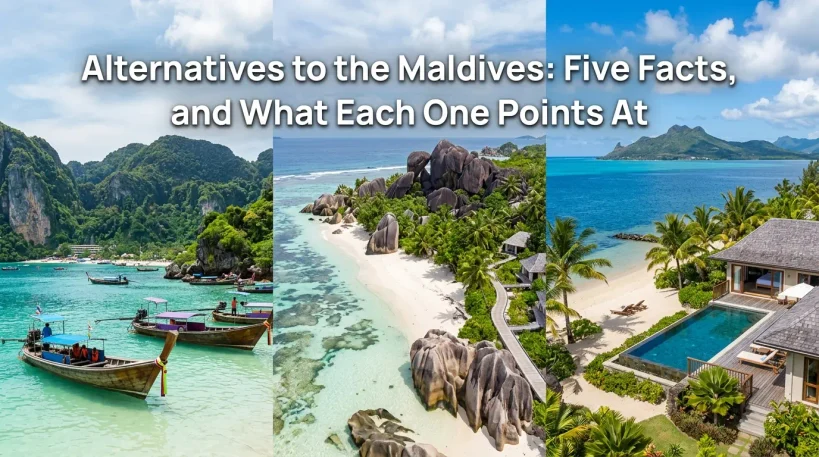
Alternatives to the Maldives: Five Facts, and What Each One Points At
People ask which destination is better than the Maldives. It is the wrong question, and it produces the ranked lists that fill this corner of the internet.
The useful question is narrower. The Maldives is unusual in five specific, checkable ways, and every one of them is an advantage to some travellers and a problem for others. Work out which of the five you want and which you do not, and the alternative chooses itself.
This page sets out the five, explains what each one implies, and points at the comparison that answers it. It also gives an honest answer to the two questions people actually type: what is cheaper, and what is similar.
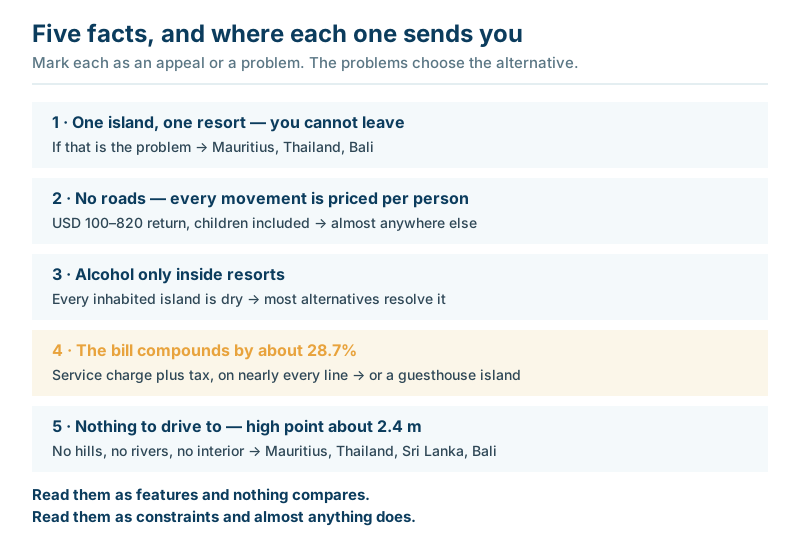
The five facts
1. One island, one resort, and you cannot leave. A property occupies its entire island. There is no second restaurant, no shop, no road and nowhere to walk to — the condition our where to stay pillar describes in full.
2. There are no roads between islands. Every movement is a boat or an aircraft, priced per person, including children. A speedboat runs USD 100 to 400 per person return and a seaplane USD 400 to 820.
3. Alcohol exists only inside resorts. Every inhabited island in the country is dry, as our guide to alcohol rules explains.
4. The bill compounds by about 28.7%. A 10% service charge and 17% goods and services tax stack on nearly every resort line — dinner, drinks, diving, excursions, the spa. Our guide to money in the Maldives sets out the mechanism.
5. There is nothing to drive to, because there is nothing to drive on. The country is roughly 99% water, its high point is about 2.4 metres, and it has no rivers, no hills and no interior.
Read those five as a list of features and the Maldives is the best destination on earth. Read them as a list of constraints and almost anywhere else is better.
Most people find that three of the five are appeals and two are problems, and which two decides everything below.
What each one points at
Not a ranking — a diagnostic.
If “you cannot leave” is the problem, you want a destination with roads, towns and choice. That is Mauritius at the comfortable end and Thailand at the varied one, and it is the most common reason people look elsewhere.
If the transfer cost is the problem, you want somewhere the hotel is reached by taxi. Almost every alternative qualifies — the exception being French Polynesia, where the structure is similar.
If the alcohol rules are the problem, most alternatives resolve it, including Zanzibar, which is a Muslim society where alcohol is nonetheless available at hotels and restaurants.
If the price is the problem, the honest answer is more complicated than a list of cheaper countries, and it is below.
If “nothing to drive to” is the problem, you want somewhere with terrain and a country attached — Mauritius, Thailand, Sri Lanka, Bali.
And if none of the five is a problem, stop reading comparisons. You want the Maldives, and our trip planner sets out the nine decisions in the order that works.
The ten comparisons
One line each. Each links to the article that answers it properly.
Mauritius — the clearest “can you leave” comparison: one volcanic island with roads, buses, mountains and a million people. The strongest alternative for anyone who wants a country attached to the beach.
Zanzibar — cheaper, with a historic town and a tidal range that removes the sea from the beach for part of every day. Its natural pair is a Tanzanian safari, which the Maldives cannot match.
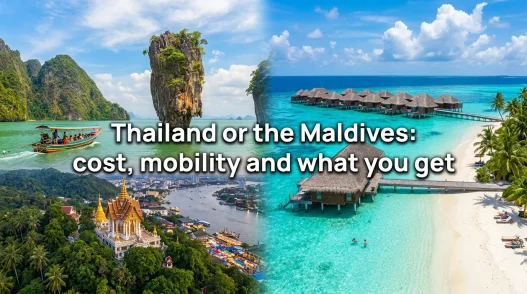
Thailand — a street economy, ferries, hills and rivers, at a fraction of the cost. Frequently the stopover on a Maldives itinerary rather than the alternative to it.
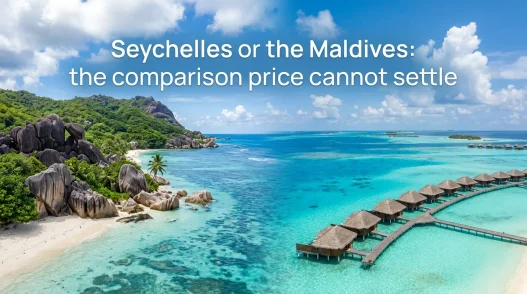
Seychelles — the closest competitor on water quality, with granite islands, a population and public transport. The question there is whether you want the country or the isolation.
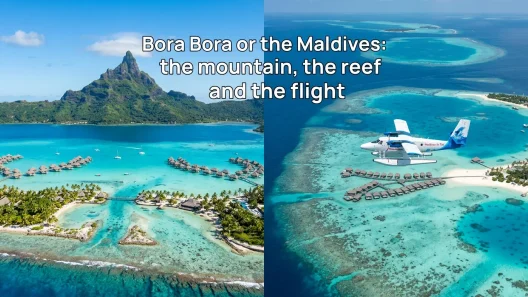
Bora Bora — the overwater villa competitor, and the one destination whose structure genuinely resembles the Maldives. The comparison is about price and flight time rather than about the format.
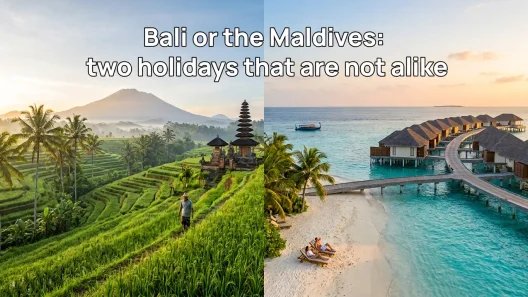
Bali — the opposite proposition: culture, terrain, traffic and things to do, with beaches that are not the point.
Sri Lanka — the Maldives’ natural pair rather than its rival. A short hop, an entirely different trip, and the fortnight that works best of any combination available.
Fiji — the Pacific equivalent, with a very different flight map that decides it for most travellers before anything else does.
Lakshadweep — the same geography in a different country, with permit requirements and far less tourism infrastructure.
Dubai — usually a stopover rather than an alternative, and the comparison is really about whether you want a city with a beach or an island with nothing.
“Cheaper than the Maldives” — the honest answer
The most-searched version of this question, and it has a better answer than a list.
Yes, most alternatives are cheaper, and by a wide margin at the mid-range: Thailand, Zanzibar, Bali and Sri Lanka all deliver a comparable standard for substantially less.
But the reason is not that the Maldives is overpriced. A resort there is a self-contained operation on an island with no economy, importing everything, reached by a per-person transfer. That structure has a floor no competition can lower.
And there is a cheap Maldives that almost nobody comparing knows about. A guesthouse island costs from about USD 60 a night, meals run USD 5 to 13, and the reefs and excursions are the same ones the resorts use. A week for two lands around USD 1,100 to 1,900 all in, which competes directly with the “cheaper alternatives”.
What you give up is alcohol, seclusion and the villa. What you keep is the water, which is what most people came for — the trade our comparison of resort and inhabited islands sets out.
Which reframes the question. “Cheaper than the Maldives” frequently means “cheaper than a Maldivian resort”, and the cheapest answer to that is a different kind of Maldivian trip rather than a different country.
Where the Maldives sits in the money
Worth one section, because “expensive” is doing a lot of work in most of these comparisons and it is not one number.
A week for two, excluding international flights, on our own budget work:
| Maldivian format | Week for two |
|---|---|
| Guesthouse island | USD 1,100–1,900 |
| Liveaboard | from about USD 2,100 |
| Accessible resort | USD 4,500–8,000 |
| Luxury resort | USD 12,000+ |
That is a range of more than ten to one within one country, which is why “is the Maldives expensive” has no useful answer.
The comparison most people are actually making is between a mid-range Maldivian resort and a mid-range hotel somewhere else. On that comparison the Maldives loses on price to almost everything, for the structural reasons above.
The comparison almost nobody makes is between a Maldivian guesthouse island and a mid-range hotel elsewhere. On that one the Maldives is competitive, and it delivers water that the alternatives do not.
And the liveaboard sits oddly in the middle — cheaper than a resort week, twelve to eighteen dives, and the only accommodation in the country that follows the weather rather than sitting in it.
“Similar to the Maldives” — the honest answer
Also searched heavily, and the honest reply is that almost nothing is.
The format is close to unique. One-island-one-resort at national scale, with a state that leases islands to operators and keeps tourism physically separate from the population, exists in very few places.
The closest structural analogue is French Polynesia — atolls, lagoons, overwater villas, expensive transfers, and remoteness. It is genuinely similar and it is further away and more expensive from most of the world.
The Seychelles come next, with comparable water and a very different arrangement on land.
Everywhere else described as “like the Maldives” is a beach destination with turquoise water, which is not the same claim. Turquoise water is common; being unable to leave is not.
And the thing no alternative replicates is the combination of a close reef, complete isolation and a property that has thought about nothing else. That is what the price buys, and it is why people keep going despite all five facts above.
What the alternatives cannot give you
Fair balance, because a page listing alternatives should say what the original does that they do not.
A close reef you can swim from, twice a day, for nothing. Where the Maldives has it — and it does not everywhere, which our guide to reading a house reef shows how to check — the snorkelling from your own beach beats a boat trip anywhere else.
Reliable large animals. Manta rays at cleaning stations and whale sharks resident year-round in South Ari are not things most destinations can offer at all.
Actual quiet. Not “peaceful hotel” quiet — an island in the middle of an afternoon with nobody on it, which our guide to island size and density explains how to buy deliberately rather than hope for.
And the absence of decisions. Nothing to organise, nowhere to get to, no traffic and no schedule. Every alternative on this page trades some of that away for options, and for some travellers the options are the problem rather than the feature.
Which is the honest summary of the whole comparison set. These are not better and worse destinations. They are more and less of the same axis — freedom to move against freedom from having to.
Which pairs with which
The dimension almost no comparison article covers, and the one that decides a fortnight.
| Destination | Its natural pair | Why |
|---|---|---|
| Maldives | Sri Lanka | Short hop, completely different trip |
| Zanzibar | A Tanzanian safari | Same country, short flight to the parks |
| Mauritius | Réunion | Next door, and a mountain island |
| Thailand | Itself | Two coasts, a city, and a month’s worth of country |
| Bali | The rest of Indonesia | Java, Lombok, Flores |
| Bora Bora | The other Society Islands | The archipelago is the trip |
| Dubai | Anything | It is a hub before it is a destination |
A one-week trip is a choice between destinations. A two-week trip is frequently a choice between pairings, and the pairings differ far more than the beaches do.
Which is why Zanzibar beats the Maldives for a lot of fortnights. Not on the beach — because East Africa is attached to it.
And why the Maldives wins some of them too. Sri Lanka and the Maldives in fourteen nights is one of the better fortnights available anywhere — two genuinely different trips rather than two beaches.
A note on when, which cuts across all of this
Seasons rarely align between destinations, and for anybody with fixed dates that decides more than preference does.
The Maldives is at its best December to April, and wetter, cheaper and more alive from May to November — the mechanism is in our monsoon guide and the pricing in our guide to high and low season.
Which means the European summer falls in the Maldivian wet season, and that alone sends a great many school-holiday travellers to alternatives whose calendars work better.
Some destinations have two answers. Thailand’s coasts have offset seasons, so one of them is usually in reasonable shape.
And some overlap with the Maldives entirely, which makes the comparison purely about the trip rather than the timing.
Check the season before the destination. A perfect match in the wrong month is the wrong match, and it is the cheapest mistake on this page to avoid.
How to use this page
Four steps, and it should take ten minutes.
1. Go through the five facts and mark each one. Appeal, neutral, or problem. Be honest about the ones you would rather not admit — most people who dislike being unable to leave describe it as wanting “more to do”.
2. If three or more are problems, you are not looking for the Maldives at all. Read the comparison that matches your biggest objection and stop comparing beaches.
3. If one or two are problems, check whether a different Maldivian format solves it. A guesthouse island solves price and isolation. A property near the airport solves transfer cost and short trips. A split stay solves “nothing to do”.
4. Then read one comparison, not five. The comparisons are written to answer one question each, and reading all ten produces confusion rather than a decision.
And if you have already decided, our trip planner is the next page: nine decisions, in the order that avoids redoing them.
What we know, and how these comparisons are written
Stated plainly, because comparison content is the least trustworthy category in travel writing.
We have been to the Maldives, and specifically to Maafushi, an inhabited island, plus a day visit to one resort. We have not stayed overnight at a Maldivian resort, which is why nothing on this site ranks them.
Of the ten destinations compared, we have been to three — Mauritius, Zanzibar and Thailand. Those three articles carry our own photographs on both sides and say so.
The other seven are structural comparisons. Geography, transport, legal environment, flight access, cost mechanics — facts that are checkable rather than felt. They do not judge food, service, culture or people at the other end, because we have not been there and neither has most of the internet that claims otherwise.
Every comparison discloses which category it is in, in its own text. That asymmetry is visible across the set on purpose.
And none of them ranks. They answer “which is right for what you want”, which is the only question this site can answer honestly and, as it happens, the only one worth asking.
One caution about comparison content generally
Including ours, and it is worth saying on the page that indexes ten of them.
Most destination comparisons are written by people who have been to neither place. They are assembled from press material, other comparisons and stock photography, which is why they agree with each other and why they say almost nothing checkable.
The tell is the vocabulary. “Pristine”, “idyllic”, “unspoilt” and “paradise” are words that carry no information and appear when the writer has none.
What a useful comparison contains is facts you can verify without going: how the transfer works, what it costs per person, whether alcohol is legal, how high the land is, whether there is a road.
Which is the standard this set is written to, and where we fall short of it we say so in the article rather than in a disclaimer nobody reads.
And the practical advice that follows: when you read any comparison, including this one, check whether a single claim in it could be falsified. If none could, it is advertising.
Questions travellers ask
What is a cheaper alternative to the Maldives? Thailand, Zanzibar, Bali and Sri Lanka all cost substantially less for a comparable standard. But the cheapest Maldives is a guesthouse island at around USD 60 a night, which competes directly with all of them and keeps the same water.
What destination is most similar to the Maldives? French Polynesia, structurally — atolls, lagoons, overwater villas and expensive transfers. The Seychelles come next on water quality. Everywhere else described as “like the Maldives” is simply a beach destination.
Why is the Maldives so expensive? A resort is a self-contained operation on an island with no economy, importing everything, reached by a per-person boat or seaplane, with a service charge and tax compounding to about 28.7%. That structure has a floor.
Which alternative is best for families? Mauritius or Thailand, mainly because there is no per-person transfer and there is somewhere to go when everybody has had enough of the beach.
Which is best for diving? The Maldives, on coral and big animals. Thailand is much cheaper for certification, and the Seychelles and Zanzibar are both genuine dive destinations at lower prices.
Can I combine the Maldives with another destination? Sri Lanka is the natural pair — a short hop and a completely different trip. Bangkok and Dubai are common routing stopovers. Pairing it with another Indian Ocean beach destination rarely makes sense.
Is the Maldives worth it? If a close reef, complete isolation and a property that has thought about nothing else are what you want, nothing else delivers them. If two or more of the five facts on this page are problems for you, something else probably suits you better.
Where should I start? With the five facts. Mark each one as an appeal or a problem, then read the single comparison that matches your biggest objection.
What to take away
- The Maldives is unusual in five specific ways, and each one is an appeal to some travellers and a problem for others. Which two are problems for you decides the alternative.
- “You cannot leave” is the most common objection, and it points at Mauritius, Thailand and Bali.
- “Cheaper than the Maldives” frequently means “cheaper than a Maldivian resort” — and the cheapest answer is a Maldivian guesthouse island, not a different country.
- Almost nothing is genuinely similar. French Polynesia is the closest structural match; the rest are beach destinations with turquoise water.
- For a fortnight, compare the pairings rather than the beaches. Zanzibar comes with East Africa; the Maldives comes with Sri Lanka.
Next step: go through the five facts and mark each one honestly, including the ones you would rather not admit to. If three or more come out as problems, you have your answer already and it is not an atoll. If one or two do, read the single comparison that matches your biggest objection — and check first whether a different kind of Maldivian trip solves it, because surprisingly often one does, and it costs a great deal less than most people assume.