
Maldives or Dubai: You Are Probably Flying Through One to Reach the Other
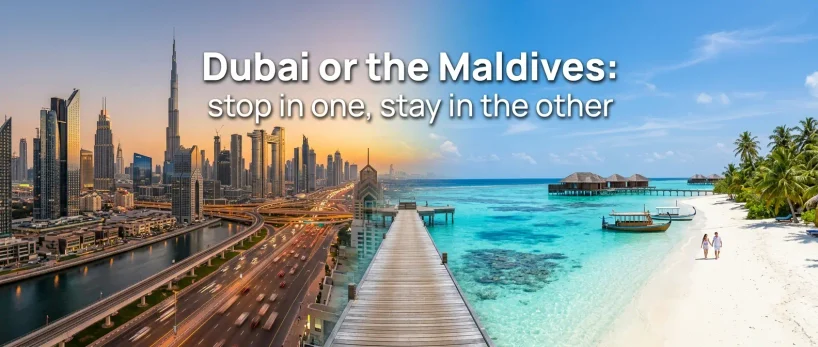
Most people comparing Dubai and the Maldives are not really choosing between them. They are looking at a flight itinerary that routes through one on the way to the other, and wondering whether to stop.
The answer is usually yes, for two or three nights, in the right season, in the right order. And the order is not the one most people book.
This article covers both questions. How the two compare if you genuinely are choosing. And how to combine them properly if, as is more likely, you are not choosing at all but building one itinerary out of two very different places.
1. They are not the same kind of thing
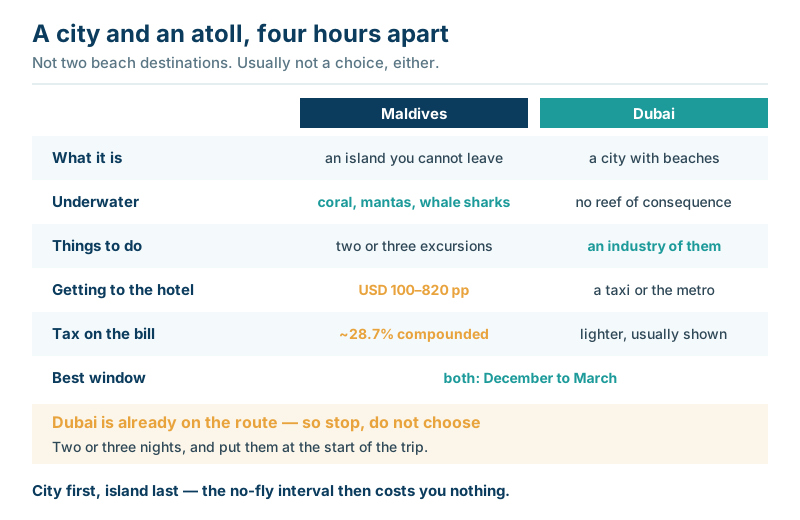
Worth stating before anything else, because it is the whole comparison.
Dubai is a city. A large, dense, air-conditioned metropolis in a desert emirate, with a metro, malls, skyscrapers, restaurants at every price point and an international population.
The Maldives is a country with no cities. A visitor stays on an island occupied by a single resort, with nowhere to walk to and nothing to organise. Our where to stay pillar describes the condition.
Which makes this the least comparable pair in this set. Every other comparison is between two beach destinations. This one is between a beach destination and a city that happens to have beaches.
So the useful question is not which is better. It is which of the two things you want, and whether you can have both — which, unusually, you can.
2. The water
The dimension where the gap is largest, and it is worth being direct.
Dubai’s beaches are city beaches. Jumeirah and the marina strip are wide, clean and pleasant, with a skyline behind them and warm calm water in front.
There is no reef of consequence. The Gulf coast has limited coral and limited marine life by comparison, and Dubai is not a snorkelling destination in the sense this site means. Diving exists — including wrecks, and better sites on the Gulf of Oman side of the country — but it is a niche rather than the point.
The Gulf gets very warm. In high summer the sea reaches temperatures that make it feel more like a bath than a swim, which is a genuine consideration rather than a quibble.
The Maldives is the opposite proposition. Coral, reef fish, manta rays, reef sharks, turtles and the year-round whale shark aggregation in South Ari.
Which is not a criticism of Dubai. It sells a city with a beach attached, and does that very well. It does not sell a reef, and nobody should book it expecting one.
The check still applies on the Maldivian side. “House reef” covers four different arrangements, one of them a sandy lagoon with the reef four hundred metres out. The satellite method is in our guide to reading a house reef.
3. What there is to do
Where Dubai has an enormous advantage, and it is the reason a stopover works.
Dubai is built for filling days. Malls, aquariums, observation decks, museums, a desert on the doorstep, a large restaurant scene, and an entire indoor entertainment industry that exists because outdoor summer is impossible.
The desert is the genuine thing — dunes within an hour of the city, and a landscape with nothing in common with an atoll. The Maldivian equivalent of a landscape excursion is a sandbank trip, which is the opposite in every way.
The Maldives has almost nothing organised, deliberately. Two or three excursions across a week is the right number, as our activities overview argues, and the best hour of most weeks is the house reef at seven in the morning.
Which produces the complementarity. Two or three days of a city that never stops, then a week in which nothing is required of you. That is a better fortnight than either on its own, and it is why so many itineraries are built that way.
And it works with children. Dubai’s indoor attractions solve the problem of a long stopover with a family, in a way that a long airport layover does not.
4. The stopover, and the order
The practical core of this article, and the part most people get wrong.
Dubai is one of the main routing hubs for the Maldives, alongside Doha, Istanbul, Colombo and the Southeast Asian hubs — our guide to getting to the Maldives covers the routes.
Which means a stopover costs no extra flight. You are already changing planes; the only question is whether you leave the airport for two nights.
Do Dubai on the way out, not on the way back. Two reasons, and the second is the one nobody mentions.
First, energy. A city is better at the start of a holiday and an island is better at the end. Arriving home from a week of doing nothing is easier than arriving home from three days of walking.
Second, and more concretely: the no-fly interval. If you dive in the Maldives, standard guidance is 18 to 24 hours between the last dive and altitude, as our diving guide sets out. Put Dubai first and that interval falls at the end of the trip, where it costs you nothing. Put Dubai last and it eats into your Maldivian diving.
Two or three nights is the right length. Long enough for the desert and one or two city things; short enough that you are not paying city prices for a week.
And check the Maldivian arrival time. Seaplanes fly in daylight only and stop between about 15:30 and 16:00, so a late arrival costs a day. The arithmetic is in our guide to missed connections, and the fix is a night in Hulhumalé or a speedboat-served property.
The long layover version
Shorter than a stopover, commoner than people admit, and worth doing properly.
Many Maldives itineraries include a gap of six to twelve hours in Dubai in one direction, which is long enough to leave the airport and short enough to make a hotel pointless.
Entry is straightforward for most nationalities, with visa-free or on-arrival entry, though it is worth confirming for your own passport rather than assuming.
The metro reaches the city from the airport, which makes a half-day genuinely feasible without a taxi budget.
What fits in eight hours: one district, one meal and one thing to look at. What does not: the desert, which needs a half-day of its own plus transfers.
And the caution is the same as anywhere. Re-entering the terminal means clearing security again. Build the same buffer you would for any departure: three hours, more if bags are checked through.
The equivalent on the Maldivian side is the airport-area day, which our guide to hotels in Malé and Hulhumalé covers, including the day-pass resorts that make a long gap usable there too.
5. Season, and why the pairing works in winter
The part that makes the combination practical rather than merely convenient.
Dubai’s comfortable season runs roughly November to March. Warm days, cool evenings, and the outdoor city usable.
April to October is hot, and June to August is extreme — temperatures well above 40°C with high humidity, which confines most activity indoors.
The Maldivian dry season runs December to April, with the best visibility and the highest prices. The mechanism is in our monsoon guide; the pricing is in our guide to high and low season.
Which means the two overlap cleanly from December to March. One set of dates, a comfortable city and a dry atoll. That is the window in which this combination is at its best.
In the European summer the pairing is much weaker. Dubai is brutally hot and the Maldives is in its wet season, so a stopover becomes an air-conditioned interlude rather than a destination.
Which is a genuinely useful planning conclusion: the same itinerary is excellent in January and mediocre in July, for reasons that have nothing to do with the properties you book.
Two cities, one atoll: the hub question
Worth widening for a moment, because Dubai is not the only option.
The Maldives is served through several hubs — Dubai, Doha, Abu Dhabi, Istanbul, Colombo and the Southeast Asian cities among them, as our guide to getting there sets out.
Which means the stopover question is not really about Dubai but about which hub your routing uses and whether it is worth leaving the airport for.
Dubai and Istanbul are the two that most reward it, being large cities with a great deal to see and straightforward entry for many nationalities.
Colombo rewards it differently, because Sri Lanka is a destination rather than a stop — the case our Sri Lanka comparison makes for a full fortnight rather than two nights.
And some hubs are better skipped, where the layover is short, the visa is awkward or the city is far from the airport.
The general principle: compare hubs when you compare fares. A slightly more expensive routing through a city you want to see is frequently better value than the cheapest connection through one you do not.
6. What it costs
Two very different structures, and neither is simply cheap or simply expensive.
Dubai spans everything. Hostels to the top of the market, food from a few dirhams to several hundred, a metro that costs almost nothing, and taxis that are inexpensive by European standards.
Alcohol is the exception. It is served in licensed venues — hotels and licensed restaurants — and it is expensive, which is a meaningful line on a city bill.
The Maldivian bill compounds. A 10% service charge and 17% goods and services tax reach roughly 28.7% on nearly every resort line, as our guide to money in the Maldives explains.
Dubai’s tax structure is lighter — a low VAT rate plus hotel fees — and it is largely visible in the quoted price rather than added afterwards.
A week for two, excluding international flights. Maldivian figures from our own budget work; Dubai as orientation.
| Maldives | Dubai | |
|---|---|---|
| Budget | USD 1,100–1,900 guesthouse island | Achievable, with a wide range |
| Mid-range | USD 4,500–8,000 resort | Substantially less |
| Luxury | USD 12,000+ | Comparable at the top |
| Getting to the hotel | USD 200–1,640 for two | A taxi or the metro |
| Eating outside the hotel | Impossible at a resort | The normal way to eat |
| Tax on the bill | ~28.7% compounded | VAT and hotel fees, usually shown |
The stopover version costs very little extra, which is the point. Two or three nights in a city you were already flying through is a small addition to a Maldivian budget, and it changes the trip considerably.
7. The rules you live under
More similar than people expect, and different in one specific way.
Both are Muslim countries where modest dress is expected in public and swimwear is confined to beaches, pools and resorts.
Both license alcohol rather than prohibiting it outright. In the Maldives it is served on resort islands and every inhabited island is dry — our guide to alcohol rules sets out the arrangement. In the UAE it is served in licensed venues, and public drinking and intoxication are offences.
The difference is the enclave. A Maldivian resort island is a licensed bubble with no surrounding society to navigate. Dubai is a city where the rules apply on the street and a visitor is expected to know them.
Neither is onerous for an ordinary visitor, and both are stricter on paper than most tourists ever encounter in practice.
Ramadan changes both, in different ways: our guide to Ramadan in the Maldives covers the resort and inhabited-island versions, and in a city the effect on daytime eating and opening hours is more visible.
And the dress question is worth checking against where you are going rather than assuming — the Maldivian version is in our guide to dress codes.
8. If you genuinely are choosing
Some people have one week and one budget, and the comparison is real.
Choose Dubai if: you want a city break with a beach, things to do every day, air conditioning, shopping, restaurants and a short flight from Europe or South Asia.
Choose the Maldives if: you want the water, the isolation and the absence of decisions, and you are prepared to pay for a transfer to get there.
Families: Dubai for variety, indoor options and value; the Maldives for a contained lagoon and no traffic anywhere. Our guide to choosing a resort for a family covers the Maldivian side.
Divers: the Maldives, and it is not close. Our guide to choosing a resort for diving covers how to pick a base.
Winter sun with things to do: Dubai, comfortably.
Winter sun with nothing to do: the Maldives, and that is a compliment — the case our comparison hub makes for the whole country.
Honeymooners: the Maldives, unless the couple would rather be busy — our honeymoon guide sets out the case.
Short trips of three or four nights: Dubai, on flight time alone from most of Europe. A Maldivian trip that short spends too much of itself on transfers, as our guide to staying near the airport shows.
9. The version most people should book
Stated plainly, since it is what this article recommends.
Two or three nights in Dubai, then seven in the Maldives, between December and March, with Dubai first.
Book the Maldivian half around a speedboat-served property if the Dubai flight lands in the afternoon, or accept a night near the airport.
Use the Dubai nights for the desert and one city thing, not for a full sightseeing programme. The point is contrast, not coverage.
And consider a guesthouse island for the Maldivian half if the budget is tight. At around USD 60 a night with meals at USD 5 to 13, it keeps the whole trip inside a sane figure and puts you on the same reefs the resorts use.
What not to do: a week in each. Dubai is a two-to-four-night city for most visitors, and a week there at the expense of the atoll half is a poor trade.
What we know first-hand, and what we do not
We have been to the Maldives — to Maafushi, an inhabited island, with a day visit to one resort. We have not stayed overnight at a Maldivian resort, which is why nothing on this site ranks them.
We have not spent time in Dubai beyond transiting. This comparison is structural: geography, climate, transport, cost mechanics and legal environment — facts that are checkable rather than felt.
Which is why this article says nothing about Dubai’s restaurants, hotels or atmosphere. We are not in a position to, and the comparison does not need us to.
The Maldivian figures are ours, from published work on this site. The Dubai figures are bands, labelled as orientation.
Three of the ten comparisons in this set were written after visiting both places — Mauritius, Zanzibar and Thailand. This is not one of them.

Questions travellers ask
Should I choose Dubai or the Maldives? For most people, neither — you are probably flying through Dubai anyway, so stop for two or three nights and then go on to the Maldives. If you genuinely have to choose, Dubai is a city break with a beach and the Maldives is water and isolation.
Is Dubai a good stopover for the Maldives? Yes, and it costs no extra flight since it is one of the main routing hubs. Two or three nights is the right length, between December and March.
Which way round should I do it? Dubai first. A city suits the start of a holiday and an island suits the end. And if you dive, the 18-to-24-hour no-fly interval then falls at the end of the trip, where it costs nothing.
Does Dubai have good snorkelling? Not in the sense the Maldives does. The Gulf coast has limited coral and marine life, and the sea gets very warm in summer. Diving exists in the UAE, including wrecks and better sites on the Gulf of Oman side, but it is a niche rather than the attraction.
When is the best time for both? December to March. Dubai is comfortable and the Maldives is in its dry season. In the European summer Dubai is extremely hot and the Maldives is wet, so the pairing is much weaker.
Which is cheaper? Dubai, for a comparable standard, mainly because there is no per-person boat or seaplane transfer and no 28.7% compounding on the bill. Alcohol is the exception — it is expensive there.
Are the rules similar? Broadly. Both are Muslim countries with modest dress expected in public and alcohol served in licensed venues. The difference is that a Maldivian resort island is an enclave with no surrounding society, and Dubai is a city where the rules apply on the street.
How long should I give each? Two or three nights in Dubai and seven in the Maldives. A week in each is a poor trade for most travellers.
What to take away
- This is a city and an atoll, not two beach destinations. Most people comparing them are routing through one to reach the other.
- Stop in Dubai for two or three nights — it costs no extra flight, since it is already a main Maldives hub.
- Do Dubai first. A city suits the start of a trip, and the post-diving no-fly interval then falls at the end where it costs nothing.
- December to March is the window where both are at their best. In the European summer the pairing is much weaker.
- Dubai is not a snorkelling destination. The Gulf has limited reef, and the sea gets bath-warm in summer.
Next step: look at your flight itinerary rather than at hotels. If it already routes through Dubai, as a great many do, the only decision left is whether to stop for two nights or three, and at which end of the trip. That is a much easier question than the one you thought you were asking.