
Maldives in January: Is It Worth Visiting This Month?
Some destinations are at their best exactly when they’re hardest to book. The Maldives in January is one of them — and if you’re on the fence about peak-season timing and peak-season prices, this guide is the honest version of the conversation you need to have before you commit.
January sits at the heart of the Iruvai, the Dhivehi name for the northeast monsoon. The word means “easterly winds” in the Maldivian language, and those winds define the experience: minimal rain, flat blue seas, clear skies, and underwater visibility that stretches to 30 metres in some atolls. It’s the month most travel guides call the best on the calendar — and they’re not entirely wrong. But “best weather” and “best trip for every traveller” are two different things, and that distinction is worth spelling out.
What January Weather in the Maldives Actually Looks Like
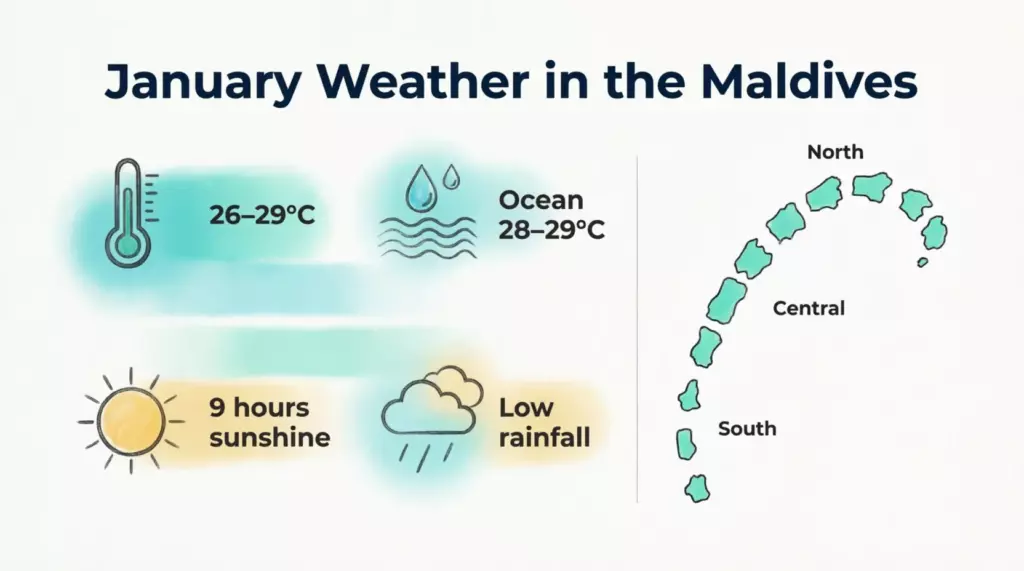
The Maldives Meteorological Service data puts January air temperatures between 26°C and 29°C (79–84°F), with ocean temperatures holding steady around 28–29°C. Rainfall is at its annual minimum — roughly 50–75 mm across the month, compared with 200 mm or more during the wet season. Average daily sunshine hits about 8–10 hours. Humidity, while never truly low in the tropics, is noticeably drier than the southwest monsoon months: around 60–65% versus 75–85% in the summer.
The northeast wind that gives Iruvai its name keeps the sea calm and the air moving, so midday feels genuinely comfortable — not the heavy heat of late April. Those winds also push plankton across the atolls in a specific direction, which has direct consequences for marine life (more on that below).
One thing most articles skip: weather in the Maldives is not uniform across 900 km of archipelago. The northern atolls dry out first and most completely. The central atolls — the ones most tourists visit — closely follow the textbook January pattern. The southern atolls, however, can still see afternoon showers and passing cloud cover even in peak dry season. If your resort is in Addu Atoll or around Fuvahmulah, expect slightly less reliable sunshine than northern and central locations.
There’s also a longer-term trend worth noting. The Maldives Independent confirmed that in the 2024–25 season, the Met Office declared the northeast monsoon’s official onset on 2 January 2025 — the latest recorded start since systematic data collection began. Climate patterns are shifting. January remains the most reliable month for good weather, but the traditional certainty of the Iruvai calendar is somewhat less absolute than it was a generation ago.
The Real Trade-Offs: What January Costs You
Most guides on “Maldives in January” are essentially promotional. Here’s what they tend to leave out.
Peak pricing, with nowhere to hide. The high season runs December through April, and January sits firmly in its centre. Resort prices peak at $600–$1,500 per night for overwater villas; mid-range beachfront properties run $300–$600; budget guesthouses on local islands start at $50–$150. Kayak’s booking data puts average hotel costs at around $621 per night during peak season versus $333 in the low season — almost double. Shoulder months like May or November offer the same water, the same reefs, and 30–40% lower prices.
Hanifaru Bay mantas are not happening. This is the most important factual correction to make. Hanifaru Bay in Baa Atoll is arguably the most spectacular wildlife spectacle in the Indian Ocean — hundreds of manta rays feeding in a single bay. But it requires the southwest monsoon pushing plankton into the bay from June to October. In January, Hanifaru is quiet, accessible, and beautiful — but the mass aggregations are over. If a manta feeding frenzy is the primary reason you want to go to the Maldives, visit in July or August instead.
Advance booking is non-negotiable. Premium overwater villas at well-reviewed resorts fill 6–9 months in advance for January dates. Popular guesthouses on local islands like Dhigurah and Ukulhas can be fully booked 2–4 months out. Last-minute January travel to the Maldives often means compromised accommodation or significantly higher prices for whatever remains.
Marine Life in January: Which Atolls, Which Species
This is where January in the Maldives earns its reputation among underwater enthusiasts — but the picture has more nuance than “everything is amazing.” The northeast monsoon pushes plankton to the western sides of the atolls, which means marine life concentrates accordingly. The practical rule: in January, dive the western channels, not the eastern ones, for the best encounters with large animals.
South Ari Atoll is the top choice for whale sharks year-round. The South Ari Atoll Marine Protected Area hosts a permanent aggregation of juvenile male whale sharks that feed near the surface — making encounters accessible to snorkellers without dive certification. January’s calm current and 25–30 m visibility make excursions here particularly effective. Most South Ari resorts run 2–4 hour snorkel trips to the protected area; rules are strict (no touching, 3-metre minimum distance, one operator per animal), and encounters are typically brief but genuine.
Central Atolls (North Malé, South Malé, Ari, Vaavu) deliver the most diverse diving on any January itinerary. Classic sites like Maaya Thila and Kandooma Thila operate beautifully in the Iruvai season, with grey reef sharks, eagle rays, schools of jacks and snappers, and — on the western channel sides — cleaning stations where manta ray sightings remain possible, though not guaranteed. Visibility regularly exceeds 25–30 metres. Currents begin stronger in November–January and ease toward April, which means some channel dives require drift diving experience; check with your resort’s dive centre before committing.
Rasdhoo Atoll (North Ari) offers a specialised experience worth planning around: hammerhead shark dives at dawn. A small school of scalloped hammerheads frequents the deep channel off Rasdhoo during early morning dives, and January and February are the most reliable months. The window is narrow — typically before 8 AM before the sharks descend — but experienced divers report it as one of the best shark encounters available anywhere in the Indian Ocean.
Fuvahmulah (Southern Atoll) is a specialist destination, known year-round for tiger sharks. January and February bring some of the clearest water conditions to this remote atoll, and the tiger shark sightings — at a dedicated dive site called Tiger Zoo — are among the most reliable in the world. Getting there requires internal flights or a long speedboat connection, but serious shark divers consider it worth the logistics.
Best Beaches and Islands for a January Visit
The Maldives doesn’t have competitive public beaches the way other destinations do. Each island — whether resort or local — is essentially its own beach world. What you’re choosing is the combination of water, reef, and atmosphere around one specific place. January’s calm conditions make any island accessible, but some offer more distinctly than others.
Dhigurah (South Ari Atoll) stands out for local island visitors. It has the longest natural beach of any inhabited island in the Maldives — about a kilometre of uninterrupted white sand — and sits directly in the whale shark zone. In January, the sea on the western shore is so flat you can snorkel out to the reef edge with almost no current resistance. Guesthouses range from $80–$200 per night; a whale shark excursion costs roughly $50–$80 per person.
Ukulhas (North Ari Atoll) has earned a reputation as one of the cleanest and most eco-conscious local islands. Its house reef is accessible directly from the bikini beach — no boat transfer required. In January, the water is at its clearest, and the reef at Ukulhas is in noticeably better condition than on many of the more heavily visited islands.
Thoddoo (Alif Alif Atoll), the “fruit island,” combines agricultural farms thick with watermelons, papayas, and coconuts with some of the most peaceful beaches in local island tourism. January is harvest season for the watermelons, which means you can buy them fresh at the farm for almost nothing. The northwest beach is often completely empty in the mornings.
Maafushi (South Malé Atoll) is the practical hub for budget travellers — the highest density of guesthouses, tour agencies, and day-trip operators in local island tourism. It’s busier and more commercial than Dhigurah or Ukulhas, but the logistics efficiency is unmatched, and you can reach it by speedboat from the airport in 45–60 minutes.
Rasdhoo (North Ari Atoll) is the best single choice for divers who want to base on a local island. Small, well-serviced, close to the hammerhead dive site, and significantly less commercial than Maafushi. Dive packages here typically cost 20–40% less than at resort dive centres.
What It Actually Costs: A January Budget Breakdown
A realistic week in the Maldives in January, all-in, across three traveller types:
Budget traveller (local islands, guesthouses): $1,800–$2,500 per person for a week. This assumes $80–$120/night for a guesthouse room, $5–$15 per meal at local cafés, and 2–3 excursions at $50–$80 each. Getting between islands on public ferries ($1–$5 each) instead of speedboats ($30–$60) makes a meaningful difference. The downside is that public ferry schedules are infrequent — one departure per day on many routes.
Mid-range traveller (3–4 star resort, half board): $3,500–$5,500 per person for a week. This covers a beachfront room rather than an overwater villa, breakfast and dinner included, and basic excursions through the resort’s own dive centre.
Luxury traveller (overwater villa, premium resort): $7,000–$15,000+ per person for a week. This includes the overwater villa premium, full board at resort restaurants ($60–$100 per meal before the 26–28% government service tax), seaplane transfer ($250–$500 each way per person), and excursions booked through the resort. The advertised nightly rate understates the real spend by 30–40% once meals, transfers, and taxes are totalled.
Flights from Europe typically run $600–$1,200 return in January; from North America, $1,000–$2,000. Emirates, Qatar Airways, and Etihad offer the most competitive connections via Gulf hubs.
Resort vs. Local Island in January: The Honest Comparison
This question gets clearer in January than in any other month. Here’s what each option actually delivers.
Choose a resort if: you want guaranteed seclusion (the “one island, one resort” model means you never share your beach with another hotel’s guests), you’re celebrating a honeymoon or anniversary where environment matters more than budget, or you want organised diving without having to coordinate across multiple operators.
Choose a local island if: budget is a genuine constraint, you want to stay longer for the same money, you prefer a mix of water time and cultural experience, or you’re a diver who wants to dive multiple sites from a flexible base without paying resort markup. Local island diving is often $60–$100 per day versus $150–$250 at resort dive centres.
One nuance about “crowds”: resorts in January can feel crowded at the pool bar and at mealtimes, because the island has only one restaurant and nowhere else to go. Popular local islands like Maafushi are busy at the bikini beach during the day but generally comfortable. The difference in seclusion between a $1,200/night luxury resort and a well-positioned $150/night guesthouse on Dhigurah is narrower than the price gap suggests.
Real Traveller Reviews: Patterns from January Visitors
Across verified booking platforms and travel forums, January visitors to the Maldives consistently highlight three things: exceptional water clarity, transfer smoothness (flat seas mean even long speedboat rides are comfortable), and the reliability of weather across the full trip. Unlike November or December, where patchy conditions can still catch you, January visits almost universally report uninterrupted sunshine.
The main complaints that recur: prices were higher than expected once meals, excursions, and internal transfers were totalled; overwater villas were harder to secure than anticipated even with months of advance notice; and some travellers who’d read about manta rays arrived expecting Hanifaru Bay-level encounters, which January simply doesn’t deliver.
One observation from repeat visitors across multiple travel communities: the second half of January offers marginally better value than the first two weeks. The post-Christmas and post-New Year peak softens after January 15, particularly for guesthouses. The weather is identical. Flight prices and accommodation rates reflect slightly less demand — not dramatically, but enough to notice on a two-week itinerary.
Who Should Go in January — and Who Shouldn’t
January is right for you if:
- Perfect weather with no acceptable risk of rain is genuinely important — a once-in-a-decade trip, a honeymoon, a milestone anniversary.
- You want the best underwater visibility for photography or diving certification.
- Whale shark snorkelling in South Ari Atoll is on your list and you want calm, flat-sea conditions.
- You’ve booked well in advance and secured the accommodation you actually want.
- You prefer calm seas for boat transfers and water sports.
January is not right for you if:
- Hanifaru Bay’s manta aggregation is the primary reason for the trip (visit July–September instead).
- Budget is a genuine constraint — May and November offer nearly identical marine conditions at 30–40% less cost.
- You’re planning last-minute and can’t find decent accommodation — other months offer more flexibility.
- You want to surf — Thulusdhoo’s surf season runs April to October, not January.
Frequently Asked Questions
Is January the best month to visit the Maldives? For weather, yes — it’s the most statistically reliable month for sunshine and calm seas. For value, no — May or November give very similar conditions at meaningfully lower prices. For manta aggregations, no — that season runs June to October.
What is Iruvai? The Dhivehi (Maldivian) word for the northeast monsoon. It means “easterly winds” and traditionally covers mid-December through April. January is considered the heart of Iruvai, when conditions are most stable.
How much rain should I expect in January? Minimal — around 50–75 mm across the month, mostly as brief afternoon showers that rarely last more than 30 minutes. The northern atolls see less rain than the southern ones even in January.
Can I see whale sharks in January? Yes, in South Ari Atoll, year-round. January’s calm conditions make snorkel excursions very effective. These are surface snorkel encounters, not dive-only, so certification isn’t required.
Will the resorts be crowded? Peak season means higher occupancy, but the one-island-one-resort model limits what “crowded” can mean — you’re never sharing your beach with guests from another hotel. Popular local islands will have busy bikini beaches in the middle of the day.
How far ahead do I need to book for January? Luxury overwater villas: 6–9 months. Mid-range resorts: 3–6 months. Local island guesthouses: 2–3 months minimum, especially for the most popular islands like Dhigurah and Ukulhas.
The Bottom Line
The Maldives in January genuinely delivers what the brochures promise — and in some respects exceeds them. The northeast wind keeps the heat manageable, the visibility underwater is as close to a guarantee as any tropical destination offers, and the flat seas make every speedboat transfer an easy one. If you’re planning a milestone trip and weather reliability matters more than budget efficiency, January justifies the premium.
But it is a premium — on accommodation, flights, and practically every service. It’s also the wrong month for the Hanifaru Bay experience that draws a specific kind of traveller. Go in knowing both sides of that equation, and the Maldives in January will meet or exceed what you came for.