The Maldives Without the Crowds: Why Faafu Atoll Has Just One Resort — and Why That Is the Point
Ask which resorts are good in Faafu Atoll and you hit an awkward answer: there is exactly one. Filitheyo Island Resort has had the entire atoll to itself since 1999, and no competitor has opened since. That single fact explains almost everything worth knowing about this place — the empty dive sites, the modest room rates, the seaplane that is not optional, and the reason most Maldives guides skip Faafu Atoll entirely. This is the verified picture: what the atoll actually is, what the one resort delivers and withholds, what staying on a local island really involves, and where the value for money is real rather than advertised.
What is Faafu Atoll, and why has almost nobody heard of it?
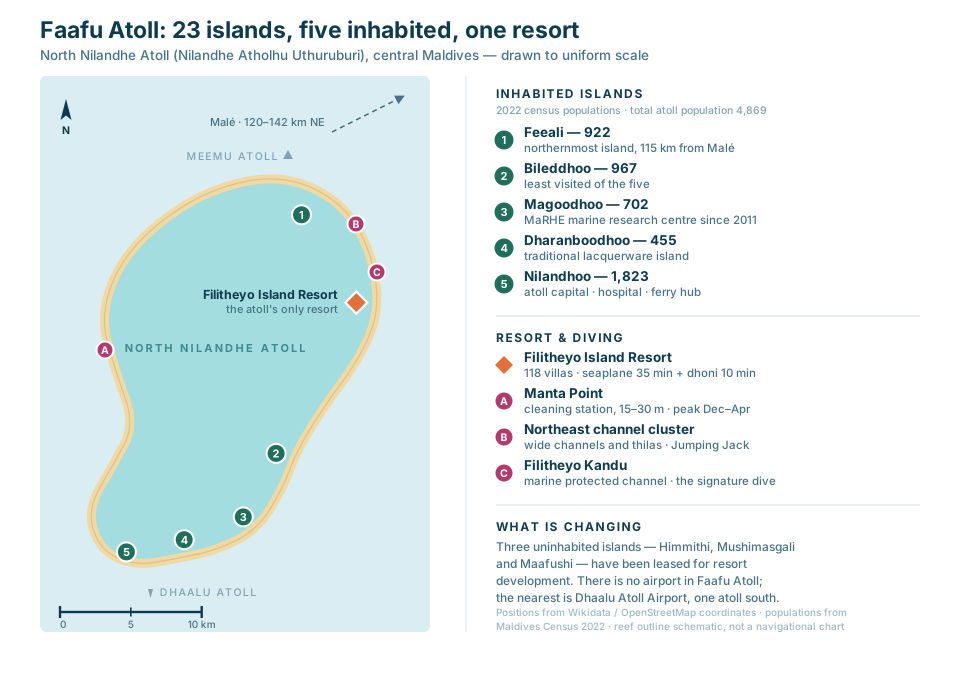
Faafu Atoll is an administrative division of the Maldives in the central chain of atolls, sitting between Meemu to the north and Dhaalu to the south. Its geographic name is North Nilandhe Atoll, or Nilandhe Atholhu Uthuruburi in Dhivehi. The atoll holds 23 islands, only five of which are inhabited, and its total population is around 4,869 people.
Distance is the first reason for the obscurity. The islands lie roughly 120 to 142 kilometres southwest of Malé — far enough that a speedboat day trip is impractical, close enough that the far-south atolls get more attention for being genuinely remote. Faafu falls into an awkward middle band that the tourism industry has largely ignored.
The five inhabited islands, with 2022 census populations:
- Nilandhoo — 1,823 residents, the atoll capital, home to Faafu Atoll Hospital
- Bileddhoo — 967 residents
- Magoodhoo — 702 residents, and the site of a European marine research station
- Dharanboodhoo — 455 residents, known for traditional lacquerware
- Feeali — the least-visited of the five, at the northern end
The second reason is structural. Kaafu Atoll, around Malé, carries dozens of resorts. Faafu Atoll carries one. There is no domestic airport, no resort cluster to justify a transfer network, and no critical mass of guesthouses to build a backpacker route. What is left is a quiet atoll of the kind that existed across the whole country thirty years ago.
Are there good resorts in Faafu Atoll? There is exactly one
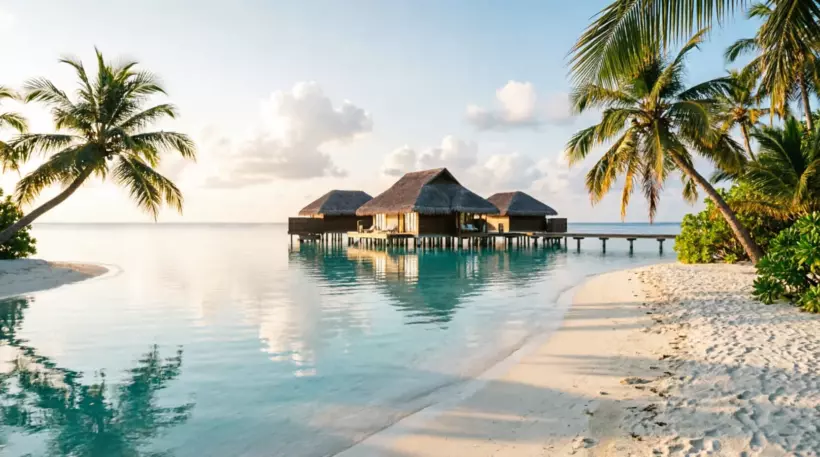
Filitheyo Island Resort occupies a 900-by-500-metre island on the eastern rim of the atoll, about 120.7 kilometres from Velana International Airport. It opened in 1999 under AAA Hotels & Resorts and currently operates 118 villas — a figure worth noting, because older listings still repeat 125. There are two restaurants, two bars, an infinity pool with a swim-up bar, and a spa set inland among dense vegetation rather than on the beach.
A small piece of the island’s history sets the tone. When the land was cleared for construction, workers found a graveyard about 25 metres in from the southwest shore, marked by roughly thirty headstones. Who was buried there, and why on an uninhabited island, has never been established.
Filitheyo Island Resort — the honest verdict
This is a four-star diving resort with a genuinely exceptional house reef, not a luxury statement. The accommodation runs to three tiers: Superior Villas at 56 square metres, semi-detached along the beachfront; Deluxe Villas at 67 square metres, standalone and with a bathtub; and Water Villas at 90 square metres on stilts, with a jacuzzi, a traditional swing seat on the deck and steps straight into the lagoon.
The all-inclusive package is the reason most guests book. It bundles meals, drinks and several activities into one rate, and the resort markets it openly as one of the better-value all-inclusive offers in the country. Guests consistently report the same practical conclusion: take the package, because à la carte drinks and connectivity are priced steeply without it.
What you give up in Faafu Atoll’s only resort
The trade-offs are real and worth stating plainly. The hard product shows its age. There are no pool villas, no butler service, and no roster of speciality restaurants — the main restaurant runs a buffet, with one à la carte alternative at the sunset end of the island. Guests who arrive expecting the polish of a new Baa Atoll opening will be disappointed.
What you get instead is exclusivity of a different kind. One resort in an atoll means no other property’s boats on the dive sites, no competition for the manta cleaning station, and no other guests on the sandbank. In the Maldives, that arrangement has become close to unbuyable at any price.
Why Faafu Atoll stayed empty: the $10 billion project that never happened
The atoll’s emptiness is not an accident of geography alone. In January 2017, then-president Abdulla Yameen announced on Magoodhoo that a major Saudi-backed development was coming to Faafu Atoll. Reports put the figure near $10 billion and described a mixed development spanning residential districts, several resorts and airports.
The announcement detonated. Speculation spread that the atoll would be leased for 99 years as a special economic zone, that its residents might be relocated, and that the deal amounted to a sale of national territory. Protests were held on the atoll’s islands. Transparency Maldives publicly demanded that the government disclose its plans. The president’s office issued a flat denial that any atoll had been sold off. King Salman’s planned visit to the Maldives was cancelled, and within months the president was conceding that the investment might not arrive at all.
For a traveller, the relevance is straightforward. Through the years when neighbouring atolls were signing resort leases, Faafu Atoll was earmarked for something else entirely, and ordinary tourism development simply stopped. That freeze is now thawing: three of the atoll’s uninhabited islands — Himmithi, Mushimasgali and Maafushi — have since been leased for resort development.
The quiet in Faafu Atoll is therefore a window, not a permanent condition.
Faafu Atoll’s reefs are unusually healthy — and there is data behind it
Every Maldives destination claims pristine reefs. Faafu is one of the few where the claim can be checked against published survey work rather than brochure copy.
After the 2016 global bleaching event, the IUCN published a national assessment of coral bleaching across the Maldives. Amid heavy losses, the report identified a short list of sites that had held up — places recording under 45% incidence of bleaching and over 25% live coral cover, which the authors labelled “hope spots”. Two of the named sites, Blue Cove and Coral Gardens, are at Magoodhoo island in Faafu Atoll.
There is a plausible mechanism behind that result. A 2020 study in Frontiers in Marine Science by Montefalcone, Morri and Bianchi analysed Maldivian coral cover from 1997 to 2019 and found that after the 2016 heat wave, reefs in atolls under higher human pressure suffered greater mortality than those in low-pressure atolls. The same work found that ocean-exposed reefs fared better than sheltered lagoon reefs. Faafu has fewer than 5,000 residents, one resort, and a dive scene concentrated on current-swept channel reefs on the outer rim. It scores well on both variables.
The atoll is also unusually well studied. The University of Milano-Bicocca has run its Marine Research and High Education (MaRHE) Centre on Magoodhoo since 2011, and the university has been present in the atoll since 2009. In 2019 alone the centre hosted 43 professors and researchers along with 223 students, and its affiliated staff have published on coral disease within Faafu Atoll specifically. Few atolls anywhere in the country have a decade and a half of resident academic monitoring behind them.
One caveat belongs here, because omitting it would be dishonest. No Maldivian atoll escaped 2016. Shallow reef tops across Faafu took damage alongside everywhere else, and the healthiest sections today are the deeper reefs and the channel walls exposed to current. The atoll’s reefs are comparatively strong, not untouched.
Diving Faafu Atoll: the sites, the seasons, and the shape of the water
Diving is the reason experienced visitors choose Faafu Atoll over more convenient alternatives. The resort’s dive centre counts more than 40 sites across the atoll, with over 30 reachable inside an hour by boat. The best of them cluster along the northeastern rim, where a series of wide, relatively shallow channels cut through the atoll wall and pull ocean water — and everything that feeds in it — across the reef.
The dive centre is operated by Werner Lau, a long-established German outfit running a PADI five-star operation with a multilingual instructor team. That matters more than it sounds: in an atoll with a single resort, the dive centre is the only professional operation in the water, so its standard sets the ceiling for the whole destination.
Filitheyo Kandu, Jumping Jack and Repeater’s Paradise
Filitheyo Kandu is the atoll’s signature dive, a marine protected channel where current brings grey reef sharks, eagle rays and Napoleon wrasse into view along the edges. It is the site every visiting diver is taken to, and it deserves the reputation.
Jumping Jack is the structural oddity of the atoll — a single channel containing roughly seven thilas, the submerged coral pinnacles that define Maldivian diving. Divers move from one to the next in a single dive, checking each reef in turn while watching the blue for tuna, sharks and eagle rays.
Repeater’s Paradise runs as a wall from about 6 metres down to 23 metres, covered in coral and stocked with the small stuff — a macro dive rather than a big-animal one, and a useful counterweight to the channel sites.
The house reef deserves separate mention because it removes the boat from the equation. It has seven entry points, two small wrecks to explore, and a northern face that drops past 50 metres. Divers and snorkellers can walk in from the beach, which on a seven-night stay adds up to a great deal of water time that costs nothing extra.
Manta Point and the December-to-April window
Faafu Atoll has a cleaning station known as Manta Point, sitting between roughly 15 and 30 metres. Mantas can turn up at any time of year, but the dependable window runs from December to April, and during that season the dive boat visits two to three times a week as a full-day trip with two dives. Whale sharks appear occasionally at the northern drop-off of the house reef where the wall falls away steeply, though anyone travelling primarily for whale sharks should book South Ari instead.
A note on conditions: the channel dives here are current dives. They are not beginner terrain, though the atoll also holds gentle wall and thila sites suitable for newly certified divers. Visibility is best across the northeast monsoon months, which coincides neatly with the manta window.
Faafu Atoll islands and guesthouse options: staying on a local island
Local-island tourism reached Faafu late and remains small. A handful of guesthouses operate, concentrated on Nilandhoo with a few properties on Dharanboodhoo and Magoodhoo. Anyone picturing the guesthouse density of Maafushi or Dhigurah should reset expectations: this is a few dozen rooms across an entire atoll.
Nilandhoo is the natural base. As the capital it carries the atoll hospital, shops, cafés and the ferry hub. It also holds two of the more interesting archaeological sites in the country. Aasaari Miskiy is described as the second mosque ever built in the Maldives, and the site known as Foahmathi sits above the remains of a Buddhist temple, including stupa material excavated by Norwegian archaeologists during Thor Heyerdahl’s Maldivian expedition. Pre-Islamic history is visible here in a way it rarely is elsewhere.
Magoodhoo is the research island — 22 hectares, roughly 700 residents, the MaRHE Centre at the edge of the village, and the two reefs named as post-bleaching hope spots. For a snorkeller who cares about what they are looking at, it is arguably the most interesting island in the atoll.
Dharanboodhoo keeps a traditional lacquerware craft alive and is the quietest of the three that host visitors. Bileddhoo and Feeali see almost no tourism at all.
What guesthouse life in Faafu actually involves
Inhabited islands in the Maldives operate under local norms. Modest dress is expected in the village, alcohol is not available anywhere on an inhabited island, and swimwear is restricted to a designated tourist beach. None of this is unique to Faafu, but it is worth deciding in advance whether it fits the trip you want.
Movement between islands is possible. MTCC’s ferry network, operating as Raajje Transport Link, placed Faafu inside Zone 04 and has run intra-atoll routes since 2019, including a service linking Bileddhoo, Magoodhoo, Dharanboodhoo and Nilandhoo. The schedule runs daily except Friday and is built around a single round trip — a morning run down to Nilandhoo and an afternoon return — which means island-hopping is feasible but has to be planned around one departure a day, not improvised.
The honest limitation is dependency. With few operators competing, your guesthouse controls your boat access, your excursion pricing and your transfer. Choose it carefully, and confirm in writing what a sandbank trip, a snorkel excursion and the airport transfer will cost before you commit.
Seaplane access to Faafu Atoll and the transfer maths that decides your trip
Getting to Filitheyo means a 35-minute seaplane flight from Velana International Airport followed by a 10-minute dhoni ride to the jetty. The seaplane does not land at the island itself. It is also the only option — there is no speedboat alternative and no domestic flight route to the resort.
Three constraints follow from that, and they shape the whole itinerary:
- Seaplanes fly in daylight only. Transfers operate through the middle of the day, roughly from early morning to mid-afternoon. An international arrival after about 15:30 means an overnight stay near the airport at your own expense, in both directions.
- Luggage is capped at 20 kilograms checked plus 5 kilograms hand baggage per person, enforced more strictly than on the international leg.
- Waiting is normal. Seaplane transfers are shared and consolidated around other passengers’ arrivals, so a wait of up to three hours at the seaplane terminal is a standard part of the day.
There is no airport in Faafu Atoll — and bad information about this is everywhere
Faafu Atoll has no domestic airport. The nearest is Dhaalu Atoll Airport at Kudahuvadhoo, which opened in 2018 in the neighbouring atoll and serves Dhaalu’s resorts rather than Faafu’s.
This matters because a striking number of online guides to Faafu Atoll instruct readers to fly to Dharavandhoo Airport and take a 30-minute speedboat onward. Dharavandhoo is in Baa Atoll, roughly 150 kilometres north of Faafu, in the wrong direction entirely. That itinerary does not exist. If a Faafu article names an airport, treat everything else in it with suspicion.
Local islands are reached by private speedboat arranged through a guesthouse, or by the slower scheduled boat services from Malé. Either way the journey runs to several hours, and departures are built around residents’ needs rather than tourist convenience.
The cost that people forget to budget
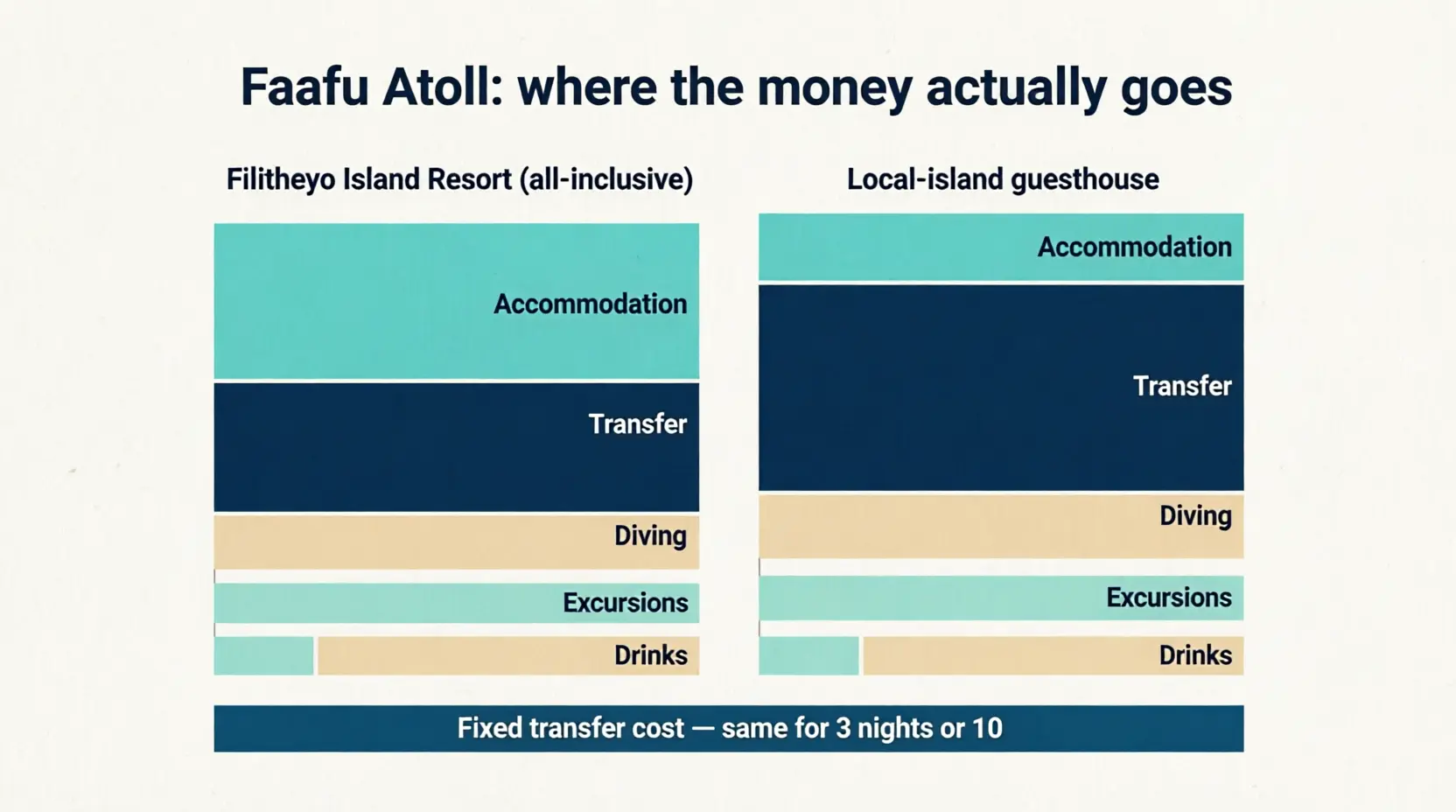
The seaplane is quoted per adult, separately from the room rate, and it is the single largest hidden line in a Faafu booking — a mid-three-figure sum per person for the return trip is a realistic planning assumption, with the resort confirming the exact figure against your flight details. On a short stay that can equal a night or two of accommodation, which is why the length of the trip changes the entire value calculation.
Value for money in Faafu Atoll: where the savings are real
| Cost line | Filitheyo Island Resort | Faafu local-island guesthouse |
|---|---|---|
| Accommodation | Four-star all-inclusive; meals, drinks and some activities bundled | Two-figure nightly rates, usually half board |
| Getting there | Seaplane only; quoted per adult, return; daylight hours | Speedboat or scheduled boat; cheaper, slower, weather-dependent |
| Diving | On-island PADI five-star centre; multi-dive packages | Arranged through the guesthouse; fewer boats and less choice |
| Alcohol | Available; costly outside the all-inclusive package | Not available on inhabited islands |
| Excursions | Manta and whale shark trips, fishing, island hopping, sandbanks | Sandbanks, snorkelling and fishing; limited operators |
| Where the money goes | The room rate is the saving; the transfer is the penalty | The room rate is very low; boats and transfers dominate |
The pattern is consistent. Compared with Baa or South Ari, Faafu Atoll saves you money on the room and on the dive package, and saves you nothing at all on the flight. It is cheaper per unit of quality rather than cheap in absolute terms.
That has a direct planning consequence that most guides never state. Because the transfer is a fixed cost, short stays here are poor value — on three or four nights, the seaplane distorts the entire budget. Seven to ten nights is where the arithmetic turns favourable, and it is also the length at which the house reef, the channel dives and the manta trips actually get used. Faafu rewards commitment and punishes sampling.
Who should go to Faafu Atoll — and who should book a different atoll
Faafu Atoll is right for you if: diving or snorkelling is the actual purpose of the trip; you want a house reef you can enter from the beach several times a day; you can stay a week or more; you would rather have an unfussy resort with an excellent dive operation than a designed one with a mediocre reef; and the idea of having an entire atoll’s dive sites to yourself appeals more than a choice of restaurants.
Book elsewhere if: you want pool villas, butler service, or four restaurants to rotate between; you have only three or four nights; a seaplane plus a boat transfer is too much with young children; you want a lively guesthouse island with bars and a choice of operators; or whale sharks are the headline reason for the trip, in which case South Ari is the more reliable atoll.
Faafu Atoll FAQ
How many resorts are there in Faafu Atoll? One. Filitheyo Island Resort has been the atoll’s only resort since it opened in 1999, though three uninhabited islands have now been leased for future resort development.
How do you get to Faafu Atoll? Filitheyo is reached by a 35-minute seaplane flight from Velana International Airport plus a 10-minute dhoni transfer, and no other route exists. Local islands are reached by private speedboat or scheduled boat services from Malé, taking several hours.
Is there an airport in Faafu Atoll? No. The nearest airport is Dhaalu Atoll Airport at Kudahuvadhoo, in the neighbouring atoll, and it does not serve Faafu’s resort.
When is the best time to dive Faafu Atoll? December to April, when visibility peaks and the Manta Point cleaning station is reliably active, with the dive boat running there two to three times a week in season.
Can you stay on a local island in Faafu Atoll? Yes. A small number of guesthouses operate, mainly on Nilandhoo with a few on Dharanboodhoo and Magoodhoo. Expect local rules on dress and alcohol, and limited excursion choice.
Is Faafu Atoll worth it for non-divers? Partly. Snorkellers do well on the house reef and the Magoodhoo reefs, and the archaeological sites on Nilandhoo are genuinely unusual. But a non-diver paying a seaplane fare to reach a resort with no pool villas and one buffet restaurant is paying for something they will not use.
Will Faafu Atoll stay this quiet? Probably not indefinitely. Himmithi, Mushimasgali and Maafushi have been leased for tourism development, and the atoll’s decade-long development freeze — a side effect of the collapsed 2017 investment plan — has ended.
Faafu Atoll: the short version
Faafu Atoll is the central Maldives with the crowds subtracted: 23 islands, five of them inhabited, fewer than 5,000 residents and a single resort holding every dive site in the atoll. Its reefs came through the 2016 bleaching event better than most, and that is documented in survey work rather than asserted in marketing. The diving is the reason to come, the house reef is the reason to stay a week, and the seaplane is the reason not to come for three nights. The savings against Baa or South Ari are real on accommodation and diving, and absent on the transfer.
If Faafu Atoll fits the trip you want, book it soon and book it long. Three islands are already leased, and an atoll with one resort does not stay an atoll with one resort forever.