Why Shaviyani Atoll Costs More to Reach Than It Looks — and Who Should Still Go
The cheaper-sounding way into Shaviyani Atoll costs USD 1,600 per adult. The seaplane costs USD 680. That is not a typo and not a seasonal quirk — it is how the two published transfer routes compare in Sirru Fen Fushi’s own 2025 rate sheet. Get that one decision wrong and a couple has spent an extra USD 1,840 before seeing a reef.
Shaviyani Atoll is the least-developed large atoll in the Maldives, and almost everything written about it in English is several years stale. This guide covers what is actually there in 2026: two resorts, a working domestic airport, a handful of guesthouses that leading guides claim do not exist, and reefs that liveaboards mostly skip. It also flags where the top-ranking pages are simply wrong.
What Shaviyani actually is, and the numbers three guides get wrong
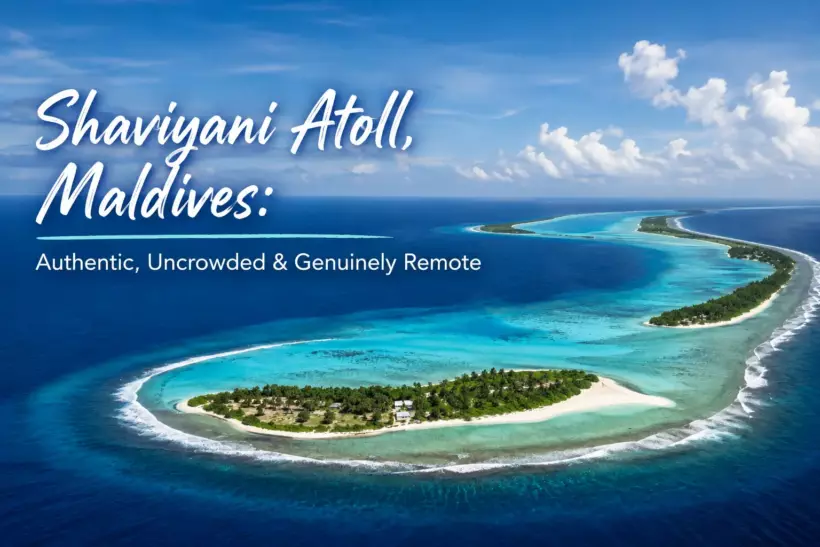
Shaviyani Atoll is the administrative division covering the northern section of the natural Miladhunmadulu Atoll, roughly 270 km north of Malé. Its Dhivehi name is Miladhunmadulu Uthuruburi. It sits inside Boduthiladhunmathi, the largest naturally formed coral atoll structure in the world, which it shares with Haa Alifu, Haa Dhaalu and Noonu. That shared geography matters more than the administrative label, because the reef systems and the weather ignore the boundary entirely.
The population of Shaviyani Atoll is 13,698. That figure comes from the Maldives Bureau of Statistics census of September 2022, up from 12,636 in 2014. Fourteen of the atoll’s 51 islands are inhabited. The capital is Funadhoo with 2,255 residents, followed by Milandhoo at 2,094, Foakaidhoo at 1,571 and Kanditheemu at 1,193.
Those numbers matter because the pages currently ranking for Shaviyani Atoll disagree with them and with each other. One leading guide opens by giving the atoll a population of 16,000, then states 12,000 in its own fact box a few paragraphs later, and claims 16 inhabited islands while listing 14. Another describes the atoll’s air access in the future tense. If you are planning around headcounts, island size or transport frequency, use the census and ignore the rest.
One piece of local politics explains conversations you may overhear. In October 2009 the government moved the capital of Shaviyani Atoll from Funadhoo to Milandhoo, citing convenience for residents. Parliament reversed the decision in June 2010, and by 2012 the materials shipped to Milandhoo had been carried back to Funadhoo. The capital question is still a live grievance on the larger island.
That is the whole general-knowledge section, because the useful part of Shaviyani Atoll is not its statistics. The decisive part is the arithmetic of arriving. That arithmetic behaves unlike anywhere else in the country, and it is where most trips go wrong.
Getting to Shaviyani: why the domestic-flight route costs more than the seaplane
Most Maldives atolls follow a simple rule: seaplanes are the expensive option, and a domestic flight plus a boat is the budget one. In Shaviyani Atoll that rule inverts. It catches out experienced travellers who have booked the northern atolls before, and it is the single most expensive mistake available here.
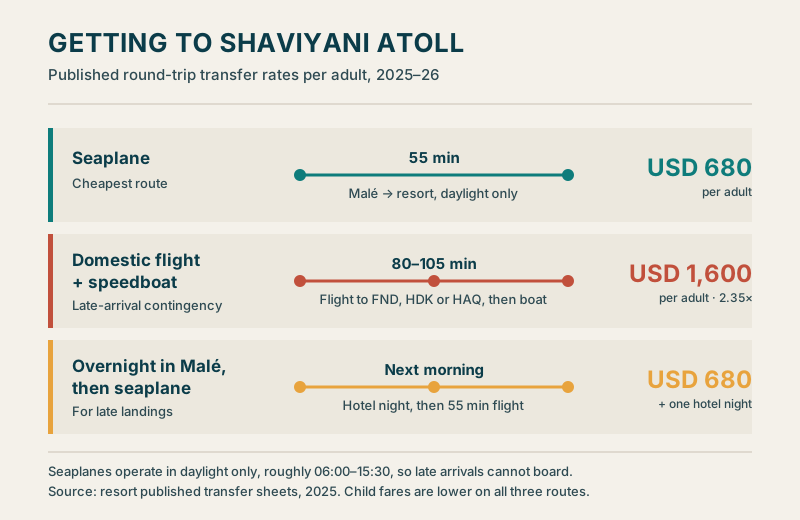
Sirru Fen Fushi’s published 2025 transfer rates are USD 680 round trip per adult and USD 400 per child by seaplane, on a flight of about 55 minutes. The domestic-flight-and-speedboat alternative is USD 1,600 per adult and USD 960 per child. That is 2.35 times the seaplane fare for a journey that takes longer and involves an extra transfer. JW Marriott’s seaplane transfer to Shaviyani Atoll sits near USD 600 per person round trip, which is normal for the northern band.
The reason is that the land-and-sea route is not a budget product at all. Seaplanes into Shaviyani Atoll fly in daylight only, roughly 06:00 to 15:30, so a passenger landing at Velana International Airport at 19:00 cannot board one. Resorts therefore price the alternative as a contingency rather than a saving. If your inbound flight lands late, the two real options are paying that contingency or booking a night in Malé and flying out the next morning — and the Malé night is usually cheaper.
The overland route itself runs through one of three airports. Funadhoo (FND), inside Shaviyani Atoll, is about 45 minutes from Malé. Kulhudhuffushi (HDK) in Haa Dhaalu is about 55 minutes, and Hanimaadhoo International (HAQ), also in Haa Dhaalu, is around 40 minutes. From any of them it is a further 40 to 50 minutes by speedboat, which is where the late-afternoon sea state starts to matter.
Funadhoo Airport deserves a paragraph of its own, because the English-language guides have not caught up with it. It opened on 3 February 2020, with the national carrier Maldivian operating scheduled flights onto a 1,200 m runway built on reclaimed land. One page currently ranking for Shaviyani Atoll still describes it as an airport due to open at the end of 2019. Another omits the domestic-flight route entirely and presents the seaplane as the only way in. Neither has been accurate for six years.
For independent travellers that airport changes everything about Shaviyani Atoll. It converts a guesthouse stay from a two-legged boat expedition into a 45-minute flight and a short hop, which is the difference between a plausible trip and a theoretical one. Resort guests barely notice it; everyone else should plan around it.
Where to stay in Shaviyani: two resorts, and the guesthouses guides say do not exist
The resort footprint here is genuinely tiny. Two properties serve the 51 islands of Shaviyani Atoll, a ratio no central atoll comes close to, and both sit at the upper end of the market. Neither has a neighbour within sight. That scarcity is the product, and it is also the constraint.
Sirru Fen Fushi: the resort that stopped being a Fairmont
Sirru Fen Fushi, on the island of Gaakoshinbi, opened in 2018 as Fairmont Maldives Sirru Fen Fushi — Accor’s first Fairmont in the country. It launched with 112 villas, each with a private pool, and later listings put the count at 120. The name means “secret water island” in Dhivehi. It was the only resort in Shaviyani Atoll for its first eighteen months.
The brand is the part that trips up bookings. After six years the property was de-flagged and, from 1 May 2024, has operated independently as Sirru Fen Fushi, Private Lagoon Resort, joining the Leading Hotels of the World portfolio (Hotelier Maldives, April 2024). Search results, older guides and most Shaviyani Atoll round-ups still carry the Fairmont name. It is the same island and the same villas, but anyone booking through a brand loyalty programme should know the Accor points are gone.
The physical case for the place is unusual even by Maldivian standards, and it is the strongest single reason to choose Shaviyani Atoll over a closer alternative. The lagoon runs to roughly 600 hectares, among the largest resort lagoons in the country. The house reef is about nine kilometres long, reachable straight off the beach, and it carries a manta cleaning station — rare on a house reef rather than a boat ride away. The 200-metre infinity pool is the longest of its kind in the Maldives.
Then there is the Coralarium, which is the strangest story in Shaviyani Atoll and the reason some people have heard of the atoll at all. British eco-artist Jason deCaires Taylor completed the world’s first semi-submerged tidal art gallery here in July 2018. Its human-form sculptures were criticised by religious scholars and ruled against by the courts.
On 21 September 2018 the installation was demolished by authorities acting on the then-president’s orders. Taylor called the destruction heartbreaking; the resort, then the only luxury property in Shaviyani Atoll, said it had been very surprised by it. A replacement was unveiled in September 2019 — abstract, coral-inspired forms rising from ten semi-submerged plinths, up to five metres tall, each built from more than 500 ceramic pieces designed to catch biomass and seed coral larvae.
What you can see today is therefore the second Coralarium, not the one in the 2018 press photographs. Anyone travelling specifically for the original will be disappointed. Anyone interested in reef regeneration will find the current version more functional than the first, and the resort’s Sustainability Lab — the first of its kind in the Maldives — sits alongside it in Shaviyani Atoll.
JW Marriott Maldives Resort & Spa on Vagaru
The second resort in Shaviyani Atoll opened on 1 November 2019 on Vagaru island, marking the JW Marriott brand’s debut in the Maldives (Marriott International, November 2019). It holds around 60 villas across roughly 22 acres. The villas are the headline: they start at approximately 2,520 square feet, which puts them among the largest standard villas in the archipelago.
The seaplane transfer is 55 minutes, priced near USD 600 per person round trip. The resort runs five restaurants including a treetop dining room, a wine list past 300 labels, the Little Griffins kids’ club with a 13-yard pirate ship, and an adults-only infinity pool at the island’s tip. Of the two properties in Shaviyani Atoll it is the more family-shaped, while Sirru Fen Fushi is the more design-led. Couples without children usually prefer the latter; multi-generational groups usually prefer the former.
Guesthouses on Milandhoo, Kanditheemu and Foakaidhoo
One of the three pages ranking for Shaviyani Atoll states flatly that there are no guesthouses on the local islands. That is wrong, and it is the most consequential error in the English-language coverage of this atoll. It is also the error that quietly removes the only affordable way to visit.
Milandhoo alone carries several. Villaasa, Handhuvaru Maldives and Boegas View Guesthouse all take bookings, at roughly USD 38 to USD 95 a night depending on property and season. Kanditheemu has North Edge Inn, and Foakaidhoo appears in rental inventories too, which gives Shaviyani Atoll three local islands with bookable rooms. Villaasa sits about 15 km from Funadhoo Airport, which is the practical link that makes the whole thing work.
The caveats are real, and they are not about price. These are inhabited Maldivian islands, so local rules apply: modest dress away from any designated tourist beach, no alcohol, and far less support infrastructure than Maafushi or Dhigurah. There is no established dive-shop cluster anywhere in Shaviyani Atoll outside the resorts. Ask a specific guesthouse what it can actually arrange — boats, excursions, meals — before building a week around it.
Diving Shaviyani: near-empty sites and one honest caveat
The diving argument for Shaviyani Atoll is not that the sites are the best in the Maldives. It is that almost nobody else is on them. That distinction decides whether the trip is worth the transfer, and most write-ups blur it deliberately.
ZuBlu, one of the more careful dive-travel publishers, notes that liveaboards on the northern route only rarely visit Noonu and Shaviyani, and virtually never continue into Haa Alifu and Haa Dhaalu. Most northern itineraries stop at Baa, Raa and Lhaviyani, where the manta aggregations are concentrated. That leaves the reefs of Shaviyani Atoll with a diver density unlike anything in the central atolls. On many days a site here sees one group or none.
Named sites are few but real. Maroshi Thila, in the south of the atoll, is a pinnacle rising from about 16 metres with overhangs, canyons and soft coral, where leopard sharks, silvertip sharks and guitar rays are regular. Sirru Fen Fushi Manta Point, northwest of the resort, is a working manta cleaning station. Seven Palm Island is a favoured overnight anchorage with a sheltered lagoon, and PADI puts typical visibility across Shaviyani Atoll at 20 to 30 metres or better.
Now the caveat, which belongs here rather than buried in a forum thread. An experienced liveaboard guide writing up the northern route rated the Shaviyani Atoll dives as very good but not comparable with the rest of that itinerary — you dive this atoll on the way north, not as the destination. If your trip is built around a shortlist of world-class sites, Shaviyani Atoll will not deliver it. If it is built around having a thila to yourself, it will deliver exactly that.
Farukolhu, mangroves and flamingos: the land-side case for Shaviyani
The reefs are only half of what makes this atoll unusual. The other half is wet ground, and it is the half that almost never appears in resort marketing. Many islands in Shaviyani Atoll carry mangrove systems and brackish lakes — kulhi — linked to the sea by natural channels. These act as nurseries for juvenile marine life and as staging posts for migratory birds.
The most significant wetland in Shaviyani Atoll is Farukolhu, an uninhabited island holding seven distinct wetland and mangrove areas. It was designated a protected area in 2018 under the Environment Protection and Preservation Act (4/93), in the “Protected Area with Sustainable Use” category. Fishing, sand mining, stone removal and shell collecting are banned inside it. Snorkelling, diving and picnics are not, which is what makes it visitable at all.
Farukolhu nearly became something else entirely. A second airport for Shaviyani Atoll was planned there and scrapped in 2014 after the environmental impact assessment raised alarms. The IUCN now treats the island as a test case: its CATENATE project held an inception meeting on Farukolhu in April 2025, aimed at building a management model that other Maldivian protected areas can copy. The reefs and wetlands there shelter juvenile stingrays and eagle rays, Endangered hawksbill turtles and Vulnerable sicklefin lemon sharks.
The flamingos are the part everyone repeats and almost nobody qualifies. Greater flamingos — gudugudaa dhooni locally — travel the Central Asian flyway between the Indian subcontinent and East Africa, and since 2021 they have been arriving in northern Maldivian wetlands in numbers around the onset of the northeast monsoon. Funadhoo in Shaviyani Atoll is one of the two locations named most often, alongside Kulhudhuffushi in Haa Dhaalu.
Two qualifications keep this honest. First, the behaviour is recent: ornithologist R. Charles Anderson’s 2007 review of Maldivian bird records in Forktail logged only exceptional, solitary flamingo sightings, nothing resembling a migration pattern. Second, the birds usually stay about a week, so anyone booking a trip to see them is buying a lottery ticket rather than an itinerary. The Environmental Protection Agency listed the greater flamingo among 104 protected bird species on 23 June 2021, and approaching them closely is both illegal and the fastest way to make them leave Shaviyani Atoll.
Maroshi, Komandoo and what the local islands of Shaviyani are really like
If you stay on a local island in Shaviyani Atoll, the history is more interesting than the beach. Maroshi, population 479, is the anchor of it. Local oral history holds that Bodu Thakurufaanu sheltered the vessel Kalhuoffummi in the island’s mangrove swamps at night during the sixteenth-century campaign against Portuguese occupation.
The same tradition points to a sea trumpet stump on Maroshi — kaani gas — said to have grown from one of the wooden posts used for that vessel’s sail. It is oral history rather than documented fact, and it is worth encountering on those terms. What it does tell you accurately is that the mangroves of Shaviyani Atoll were strategically useful long before anyone called them an ecosystem.
The census reveals something less romantic. Between 2014 and 2022 every inhabited island in Shaviyani Atoll gained population except one: Komandoo fell from 1,111 to 921, a drop of roughly 17%. Every other island grew, several by more than 15%. Komandoo’s own origin story runs through the abandoned islands of Mathikomandoo and Keekimini, where ruins of houses and wells still stand, and the modern movement is towards Malé and the larger islands rather than away from invaders.
Other islands carry their own marks. Feydhoo, in the centre of the atoll between the Noomara Kandu channel and Bileffahi, was severely damaged in the cyclone of 1821 and covers about 94 hectares of land, much of it wetland. Kanditheemu has been named among northern islands reporting mangrove decay, which is precisely why the conservation work on Farukolhu matters beyond one island. A local-island stay in Shaviyani Atoll puts you inside that story rather than adjacent to it.
When to go to Shaviyani: season, monsoon and the flamingo window
November to April is the dry northeast monsoon and the right answer for most travellers to Shaviyani Atoll. Seas are calmer, underwater visibility is at its best, and the diving window overlaps with the flamingo window. That overlap is the main reason to weight the calendar rather than take whatever is cheapest.
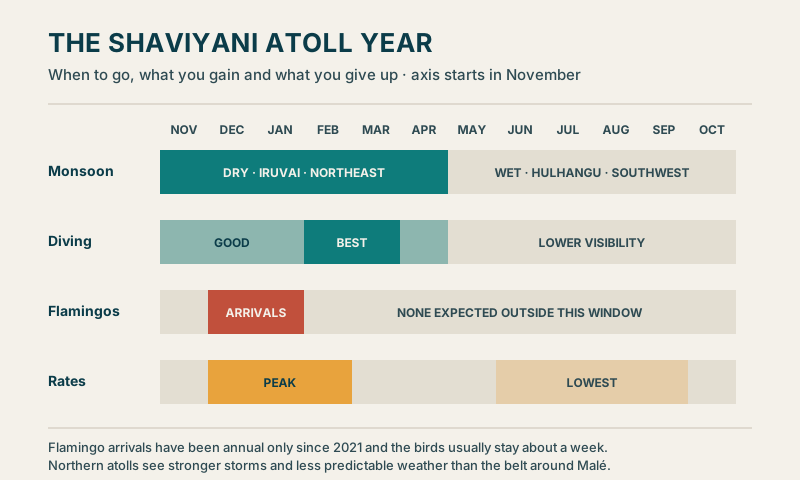
The northern atolls carry a weather caveat the central ones do not. This part of the Maldives sits under stronger storm activity and less predictable weather than the resort belt around Malé. That is worth knowing if you are committing a single week rather than a flexible fortnight to Shaviyani Atoll, because there is no easy plan B within the atoll. A southwest-monsoon trip between May and October will be cheaper and greener, and you trade visibility and sea state for it.
If flamingos are on your list, aim your Shaviyani Atoll trip at late December or January and treat any sighting as a bonus rather than a plan. If diving is the priority, February and March are the safest bet inside the dry window. If price is the priority, the shoulder months of May and October give you most of the calm at a noticeably lower rate.
Who Shaviyani suits, who it does not, and when it will not work

It suits repeat visitors to the Maldives who already know what a resort week feels like and now want emptiness instead of choice. It suits divers who value having a site to themselves over ticking off famous names. It suits families willing to pay for villa space, particularly at the JW Marriott. And it suits anyone who wants a genuine local-island stay in Shaviyani Atoll, reachable by a 45-minute domestic flight rather than a half-day boat journey.
It does not suit first-time Maldives visitors, who pay a premium in transfer cost and flexibility for a difference they are not yet equipped to notice. It does not suit anyone hoping to move between resorts, because with two properties in Shaviyani Atoll there is nothing to island-hop to. It does not suit travellers who assume local islands automatically mean cheap access, since the flight still has to be paid for. And it does not suit anyone expecting the guesthouse ecosystem of Maafushi.
It will not work at all if your international flight lands after roughly 15:00 and you refuse both the USD 1,600 contingency transfer and a night in Malé. It will not work on a tight itinerary that also takes in Malé, Hulhumalé or a second atoll. It will not work if your dive log is the point of the trip — go to Fuvahmulah or Baa instead, and save Shaviyani Atoll for the year you want quiet rather than the year you want sharks.
What is actually coming to Shaviyani, and what is not
As of mid-2026 no major branded opening has been confirmed for this atoll, and that deserves stating plainly. At least one 2026 opening round-up places a Rosewood resort in Shaviyani Atoll with 60 villas and an Asaya spa. That property does not exist as described. Rosewood’s Maldives debut is Rosewood Ranfaru — roughly 120 villas across a chain of private islands in South Malé Atoll, developed by Estithmar Holding at a reported USD 343 million and now targeted at 2027.
What is real is quieter. Nalandhoo, a 60-hectare natural island in Shaviyani Atoll, is being openly marketed to resort developers. Its promotional material references construction of a new domestic airport terminal on an adjacent island, plus proximity to the Hanimaadhoo and Maafaru international airports. The government has been incentivising integrated tourism development across the northern atolls, and industry coverage notes brands pushing into Raa and Shaviyani in search of untouched reef.
Treat every date you read with suspicion, including those. A slip of 12 to 24 months between the first press release and the first guest is normal in the Maldives rather than exceptional, and several 2025 openings have already moved to 2027. If you are choosing Shaviyani Atoll because it is empty, the honest planning assumption is that it stays roughly this empty through 2027. That is a reason to go now rather than to wait.
Shaviyani travel FAQ
How many resorts are there in Shaviyani Atoll? Two: Sirru Fen Fushi, Private Lagoon Resort on Gaakoshinbi, and JW Marriott Maldives Resort & Spa on Vagaru.
How long is the transfer from Malé? About 55 minutes by seaplane from Malé to Shaviyani Atoll. The domestic-flight alternative runs 40–55 minutes in the air plus a 40–50 minute speedboat.
Is Fairmont Maldives Sirru Fen Fushi still open? Yes, under a different name. It left the Fairmont brand and has operated as Sirru Fen Fushi, Private Lagoon Resort since 1 May 2024 — the same island in Shaviyani Atoll.
Are there guesthouses on the local islands? Yes — Shaviyani Atoll has guesthouses on Milandhoo, Kanditheemu and Foakaidhoo, from roughly USD 38 a night, despite what several guides state.
Does Shaviyani Atoll have an airport? Yes. Funadhoo Airport (FND) opened on 3 February 2020 and takes scheduled domestic flights from Malé.
When is the best time to visit? November to April in Shaviyani Atoll, with February and March the most reliable for diving and late December to January for flamingo sightings.
The short version on Shaviyani
- Shaviyani Atoll holds 13,698 people across 14 inhabited islands and just two resorts — the emptiest large atoll in the Maldives by resort density.
- The seaplane at USD 680 is the cheap route; the domestic-flight transfer at USD 1,600 is a late-arrival contingency, not a saving.
- Funadhoo Airport has been open since February 2020, which is what makes guesthouse stays on Milandhoo and Kanditheemu genuinely practical.
- The diving is empty rather than exceptional, and the honest reason to come is diver density, not a site list.
- Farukolhu’s protected wetlands and the December–January flamingo arrivals are the land-side case, and both reward patience over scheduling.
Your next step: decide the transfer before the villa. Check your inbound arrival time against the 15:30 seaplane cutoff, and if you land later, price a night in Malé against the contingency transfer before booking anything else. Every other decision about a Shaviyani Atoll trip is easier than that one.