Republic Day in the Maldives (November 11): The Second Time They Tried Democracy
Most public holidays mark one thing that happened once. The Maldives’ Republic Day on November 11 marks the second time the country abolished its sultanate and declared a republic — because the first attempt, in 1953, lasted less than eight months before collapsing in a coup while the president was abroad getting medical treatment.
That’s the part most travel guides leave out. The 1968 transition that this holiday actually celebrates wasn’t a clean break from monarchy to democracy. It was a retry — with a different leader, a more cautious referendum process, and a cleaner institutional handover. Understanding why 1953 failed and 1968 succeeded gives the date a completely different weight.
For tourists arriving in early November, the timing is also interesting for separate reasons. Republic Day falls at the very beginning of the Maldives’ dry season, just eight days after Victory Day (November 3), making the first two weeks of November unusually festival-dense for a country that otherwise runs primarily on beach tourism. This guide covers both dimensions: the history you won’t read on a resort information card, and what the holiday actually looks like on the ground.
The Sultanate That Lasted 853 Years
To understand why November 11 matters, it helps to know what it replaced.
The Maldivian sultanate dates to 1153 AD, when the reigning Buddhist king converted to Islam and assumed the Muslim title of Sultan, giving the dynasty its foundational legitimacy. Over the following eight centuries, the sultanate survived nine different ruling dynasties, Portuguese and Dutch colonial pressure, a British protectorate (from 1887), and multiple succession crises. By the 20th century, the sultan held little real authority — a constitutional monarchy in form, largely symbolic in practice — but the institution remained intact.
The Didi family had dominated the sultanate since 1759. When Sultan Abdul Majeed Didi died in 1952, parliament elected his relative Mohamed Amin Didi as the natural successor. He refused the throne.
His exact words, as preserved in Maldivian political history: “For the sake of the people of Maldives, I will not accept the crown and the throne.” A referendum was held instead, and the country became a republic on January 1, 1953, with Amin Didi as its first president.
The First Republic: Seven Months and Twenty-One Days
Mohamed Amin Didi was a reformer in a country that wasn’t entirely ready for his reforms. He had studied abroad, helped establish the first political party in Maldivian history (the Rayyithunge Muthagaddim Party), and served as principal of the country’s main school while simultaneously holding ministerial positions.
His presidency introduced significant changes — including efforts to modernize education and loosen some conservative social norms. These changes generated friction, particularly in Malé.
In August 1953, while Amin Didi was in Ceylon (now Sri Lanka) receiving medical treatment, a revolution broke out in Malé. His vice president, Ibrahim Muhammad Didi, assumed control. When Amin Didi returned, he was taken to Dhoonidhoo Island under “supervision for his safety.” A subsequent attempt to retake power failed. An enraged mob attacked him — he never recovered from his injuries and died in January 1954 at the age of 43.
The referendum that followed was decisive: 98 percent of voters chose to restore the sultanate. The Maldives returned to a monarchy, and Muhammad Fareed Didi (a cousin of the former president) was elected the 84th Sultan in March 1954. The First Republic was erased from the constitution as if it had never happened.
The Second Try: Why 1968 Worked
Independence came first. On July 26, 1965, Maldives’ Prime Minister Ibrahim Nasir signed an agreement with the British ending protectorate status — the Maldives gained full sovereignty as a constitutional monarchy under Sultan Muhammad Fareed Didi.
Three years later, Nasir turned his attention to the sultanate itself. He took the transition more slowly than his predecessor had in 1953. Rather than a single presidential referendum, the process ran in three deliberate stages:
November 15, 1967 — Parliament voted on the question. Of 44 members, 40 voted in favor of becoming a republic.
March 15, 1968 — A national referendum was held across the islands. Voter turnout was broad; 81.23% voted in favor of replacing the sultanate with a republic.
September 27, 1968 — A presidential election took the form of a referendum on Nasir’s candidacy. He received 97.16% support.
November 11, 1968 — The republic was formally declared, the 853-year sultanate dissolved, and a new constitution came into force. Nasir was inaugurated as the first president of what Maldivians now call the Second Republic.
The last sultan, Muhammad Fareed Didi, stepped down quietly. He had held little real power for years; the transition was, as contemporary observers noted, largely institutional rather than revolutionary. He left the royal palace, moved to his personal residence, and died less than five months later in March 1969.
The critical difference from 1953: this time, the man leading the transition was the existing Prime Minister, not a reformist outsider. The institutional continuity — the same government, the same administrative structures, just with an elected president replacing a symbolic monarch — made the change far less disruptive to those who had opposed Amin Didi’s version.
What Happens on Republic Day
The holiday is called Jumhooree Dhuvas in Dhivehi — literally “Republic Day.” It is one of five fixed public holidays on the Maldivian calendar.
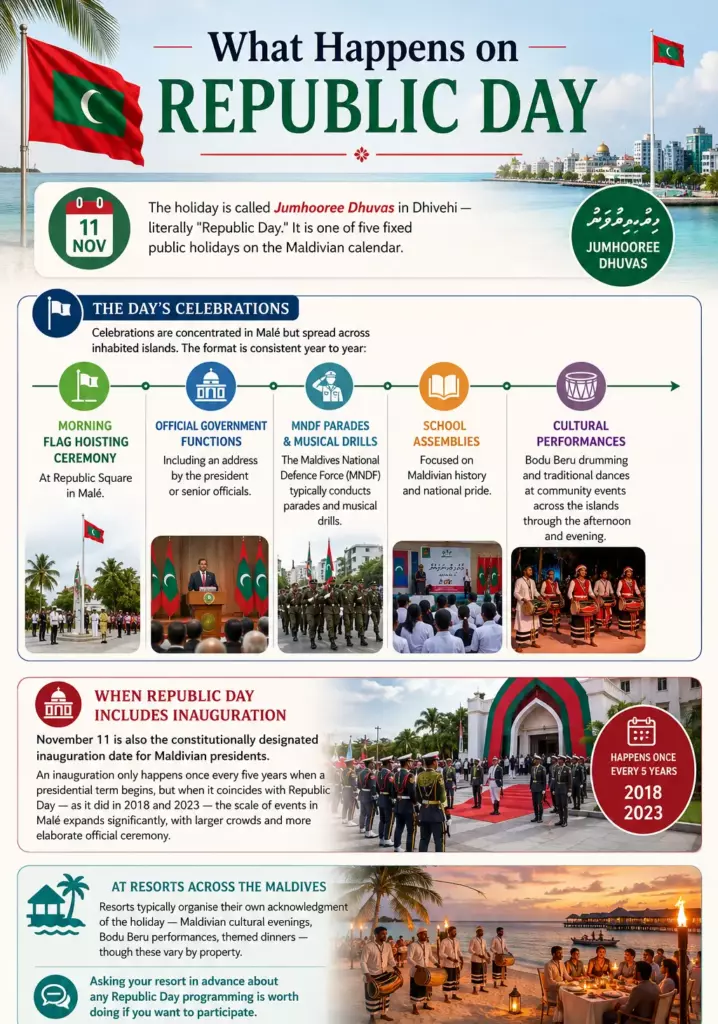
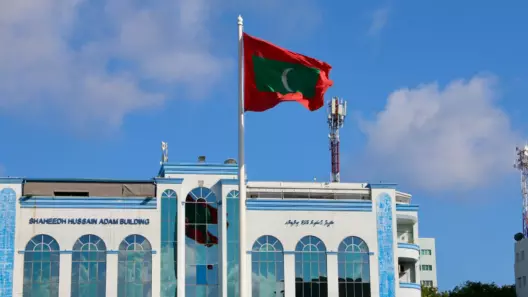
Celebrations are concentrated in Malé but spread across inhabited islands. The format is consistent year to year: a flag hoisting ceremony in the morning at Republic Square, followed by official government functions including an address by the president or senior officials. The Maldives National Defence Force (MNDF) typically conducts parades and musical drills. Schools hold assemblies focused on Maldivian history; cultural performances featuring Bodu Beru drumming and traditional dances appear at community events on the islands through the afternoon and evening.
One logistical detail worth knowing: November 11 is also the constitutionally designated inauguration date for Maldivian presidents. An inauguration only happens once every five years when a presidential term begins, but when it coincides with Republic Day — as it did in 2018 and 2023 — the scale of events in Malé expands significantly, with larger crowds and more elaborate official ceremony.
Resorts typically organise their own acknowledgment of the holiday — Maldivian cultural evenings, Bodu Beru performances, themed dinners — though these vary by property. Asking your resort in advance about any Republic Day programming is worth doing if you want to participate.
The November Patriotism Window
Republic Day doesn’t stand alone in the calendar. The first two weeks of November form what locals sometimes call a patriotic window: Victory Day on November 3, followed eight days later by Republic Day on November 11.
Victory Day (Nasruge Dhuvas) commemorates an event from 1988 rather than 1968: a coup attempt by about 80 Tamil mercenaries hired by a dissident Maldivian businessman, who briefly seized strategic government buildings in Malé before India’s Operation Cactus — an emergency military response authorized by the Indian government — repelled the attackers within hours. The failed coup is now framed as a story of national resilience and regional solidarity.
The week between these two holidays carries a distinctly patriotic atmosphere across inhabited islands and in Malé: flag displays, school events, and evening community gatherings. For a visitor based in a resort, this may register only faintly. For anyone spending time on local islands or in Malé, it’s a meaningful cultural window.
November Weather: What You’re Actually Arriving Into
November marks the opening of the Maldivian dry season, which runs through April. The southwest monsoon — the wetter half of the year — officially ends in November, though the transition isn’t instant.
Temperatures settle in the 27°C to 29°C range through the month. The sea sits at around 28°C, comfortable for extended water time.
Rainfall doesn’t disappear entirely. November typically brings 150–200mm of rain spread across 10 to 12 days, usually in short, intense showers that clear quickly. By the second half of the month, conditions are reliably sunny. Early November arrivals (around Republic Day, November 11) can still encounter some residual wet-season rain, though nothing that significantly disrupts activities.
Water visibility improves steadily through November, reaching 25 to 30 metres by mid-month — good conditions for diving and snorkelling after the lower-visibility wet months of September and October.
Pricing sits in a transitional zone. The full peak season (December through April) brings significantly higher resort rates; November is noticeably more affordable while already offering good weather. If the dates align, arriving for Republic Day puts you in the early part of this window: better value than December, with weather that’s largely — though not yet perfectly — reliable.
What’s Open, What’s Closed, and What to Plan Around
Republic Day is a national public holiday. Government offices, courts, banks, and schools are closed. Most administrative services are unavailable.
Resorts are unaffected. A resort is effectively a self-contained island; they operate seven days a week, on public holidays as on any other day. Your excursions, restaurant bookings, and check-in logistics should be unaffected if you’re staying at a resort property.
Local islands present a more nuanced picture. Small shops and local restaurants typically close or reduce hours on public holidays, especially in the morning. If you’re on a guesthouse stay on an inhabited island on November 11, expect limited options for the first half of the day and don’t rely on ferry offices or administrative services being operational. Markets and cafés often reopen in the afternoon.
Malé sees the clearest impact: expect busier public spaces and Republic Square in particular to be active with official events in the morning. If you’re transiting through Malé on November 11, factor in possible road congestion around the main square and government buildings during the morning ceremony.
Ferries — the main inter-island transport network — generally operate on reduced schedules on public holidays. If Republic Day falls mid-trip for you, confirm your ferry connections in advance.
Republic Day vs. Independence Day: Same Format, Different History
Visitors sometimes conflate these two. They’re distinct in date, meaning, and historical context.
Independence Day (Minivan Dhuvas) falls on July 26, marking the day in 1965 when Prime Minister Ibrahim Nasir signed the agreement with the British ending protectorate status. It celebrates the end of foreign control.
Republic Day (Jumhooree Dhuvas) falls on November 11, marking the day in 1968 when the sultanate was replaced by an elected presidency. It celebrates a choice about internal governance structure.
The format of both holidays is similar: flag hoisting, parades by the National Security Services and National Cadet Corps, school performances, speeches in Malé’s Republic Square. Independence Day celebrations tend to feature slightly larger military parade participation; Republic Day carries more explicitly political symbolism around the choice of republican government over monarchy.
One distinction worth noting: Independence Day is a public holiday, but Republic Day is effectively the national day — the date more closely tied to Maldivian constitutional identity. November 11 is when presidents are inaugurated. The constitution was ratified on this date. It’s the holiday the country’s founding political structure points back to.
Practical Summary for Travelers
- Date: November 11, fixed annually
- Weather context: Start of dry season; mostly good conditions, occasional short rain showers early in the month
- Tourism season: Early peak — better pricing than December, weather improving but not yet fully stable
- Events: Morning flag ceremony and parades in Malé and on local islands; Bodu Beru and cultural performances through the day; resort events vary by property
- What’s closed: Government offices, banks, schools. Resorts operate normally.
- November patriotism week: Victory Day on November 3 + Republic Day on November 11 — expect increased flag displays and community events on local islands in this period
- Presidential inaugurations: Also held on November 11 every five years; if your trip coincides with an inauguration year (2023, 2028, etc.), expect significantly larger events in Malé
Frequently Asked Questions
When is Republic Day in the Maldives? November 11, every year. The date doesn’t move — it’s a fixed public holiday.
What does Jumhooree Dhuvas mean? It’s the Dhivehi name for Republic Day: Jumhooree refers to “republic” and Dhuvas to “day.”
Is November a good time to visit the Maldives? Generally yes. November opens the dry season, meaning improving weather, good water visibility for diving and snorkelling, and lower prices than December through April peak season. Early November has a small chance of residual wet-season rain.
Did the Maldives try to become a republic before 1968? Yes. The First Republic was declared on January 1, 1953, under President Mohamed Amin Didi. It lasted seven months and twenty-one days before being overthrown when Amin Didi was abroad. The sultanate was restored in 1954. The Second Republic — which this holiday commemorates — was declared in November 1968, this time successfully.
Is Republic Day the national day of the Maldives? Functionally, yes. While Independence Day (July 26) marks the end of British protectorate status, Republic Day is the date the current constitutional order traces itself to. Presidential inaugurations are held on November 11; the 1968 constitution came into force on this date. It carries more foundational weight in Maldivian political identity.
Will resorts be operating normally on Republic Day? Yes. Resort islands are unaffected by public holiday closures. Some resorts organize special cultural programming for the holiday; check with your property in advance if you’re interested.