Victory Day in the Maldives (November 3): The Dramatic Story Behind the Flags and Parades
You fly into Malé on November 3rd expecting turquoise water and an overwater bungalow. Instead, the streets of the capital are thick with soldiers in dress uniform, a flag rises over Republican Square to the sound of a seven-gun salute, and the MNDF brass band fills the air with something that sounds far more like a memorial than a beach holiday. Nobody at your resort told you about this. Most tourists arriving in the Maldives in early November see Victory Day — Nasruge Dhuvas in Dhivehi — pass by as a blur of flags and official-looking ceremonies without knowing what it commemorates.
It commemorates a mercenary invasion that nearly succeeded, ended by Indian paratroopers who landed at the wrong airport at exactly the right moment. The story is fast-paced, geopolitically strange, and surprisingly recent: it happened in 1988, not 1888. This guide explains what occurred, why it still matters, and what you can expect to see if you’re visiting when the date rolls around.
What Happened on November 3, 1988: An Island Capital Under Gunfire
The night of November 2nd, 1988, was ordinary in Malé. The capital of the Maldives — an island barely two kilometers across — was quiet by 11 pm, as it usually was. By 4 am the following morning, armed men were moving through the dark streets.
Around 80 fighters from the People’s Liberation Organisation of Tamil Eelam (PLOTE), a Sri Lankan Tamil separatist group, had arrived aboard hijacked freighters. They were armed with AK-47s, heavy machine guns, grenades, and mortars — a weapons load that dwarfed anything the Maldives’ small National Security Service (NSS) possessed. Traveling with a small number of Maldivian dissidents, they had one objective: seize the capital, capture or kill President Maumoon Abdul Gayoom, and hand power to a new regime before dawn.
Within hours, they had seized the airport, TV and radio stations, major government buildings, and the NSS headquarters. They took hostages. In the firefights that erupted across Malé, nineteen Maldivians were killed — eight soldiers and eleven civilians. For a nation of under 200,000 people spread across a thousand islands, that figure carried the weight that a mass-casualty attack carries in a much larger country.
Gayoom, warned early, was escorted from the Presidential Palace by his security chief and moved from safe house to safe house as the mercenaries searched for him. The Maldives had no military force capable of repelling the invasion. From a safe house, the president reached out to every government he could contact: the United States, the United Kingdom, Pakistan, Malaysia, Sri Lanka, and India. The Americans wanted to help but were thousands of miles away. India was four hours’ flying time distant — and willing to move immediately.
Who Was Behind the Coup — and What They Actually Wanted
The plot’s mastermind was Abdullah Luthufee, a Maldivian businessman with a history of political grudges against Gayoom’s government. He had made two earlier, smaller attempts to destabilize the administration — in 1980 and 1983 — but neither had been taken seriously. By 1988 he had graduated to a far more ambitious operation, partnering with Uma Maheswaran, the leader of PLOTE, to fund and deploy a professional mercenary force.
Luthufee’s stated grievance was political opposition to Gayoom. His alleged underlying motivation was more cynical: analysis of the plot suggested he intended to install a puppet government that would allow him to operate a smuggling network — gold, arms, narcotics — from Maldivian territory, shielded by a compliant administration. The PLOTE fighters were mercenaries working for cash and the prospect of a sympathetic base of operations in the Indian Ocean.
Understanding this matters for reading Victory Day properly. It is not a holiday commemorating a war of independence or an ideological uprising. It commemorates the defeat of an armed criminal conspiracy that happened to have enough firepower to temporarily hold an entire national capital.
Operation Cactus: India’s 18-Hour Intervention
Indian Prime Minister Rajiv Gandhi convened a crisis committee meeting at 9 am on November 3rd, within hours of learning of the attack. The decision to intervene was swift. India’s military response — codenamed Operation Cactus — was one of the fastest long-distance military deployments the country had ever executed.
The 6th Battalion of the 50th Independent Parachute Brigade and the 17th Parachute Field Regiment were airlifted aboard an Ilyushin-76 transport aircraft from Agra, flying roughly 2,000 kilometers to the Maldives. The force was commanded by Brigadier Farukh Bulsara. They touched down at Malé International Airport on Hulhule Island — the same airfield the mercenaries had briefly controlled — at around 3:30 pm. The PLOTE fighters had, critically, failed to hold the airport. Indian paratroopers secured it immediately, then crossed to Malé island by boat.
A prolonged firefight followed. By nightfall, Indian forces had cleared Malé, neutralized or captured most of the mercenaries, and restored control to President Gayoom. The entire operation concluded in roughly eighteen hours. No Indian soldiers were killed. The mercenaries who survived and attempted to flee aboard a hijacked freighter were intercepted by Indian Navy frigates INS Godavari and INS Betwa off the Sri Lankan coast.
The international reaction was striking. US President Ronald Reagan praised India’s role in stabilizing the region. British Prime Minister Margaret Thatcher reportedly said, “Thank God for India.” Sri Lanka, notably, criticized the intervention as an overreach — unsurprising given that the attacking force had originated on Sri Lankan soil.
Operation Cactus is studied in Indian military academies as a rare example of a successful tri-service operation (army, navy, and air force acting in coordination) completed with zero friendly-force casualties in under 24 hours. It also marks the beginning of what became a defining strategic relationship between India and the Maldives.
A Name Worth Knowing: Corporal Hussain Adam
Most tourists who see the November 3 Memorial in Malé — a modest monument not far from Republican Square — will not know whose sacrifice it honors most specifically. One name stands out in Maldivian memory: Corporal Hussain Adam.
Hussain Adam was an NSS soldier on duty when the mercenaries reached the National Security Service headquarters. Outnumbered and outgunned, he continued to defend his post, giving colleagues time to protect President Gayoom’s position. He was killed in the action. His final stand became the defining image of Maldivian resistance on November 3rd, and he is the soldier most cited in annual presidential speeches and school curricula on that date.
The memorial in Malé is a quiet site — not a grand monument, but a genuine one. Flowers are laid there on November 3rd. If you are in the capital and want to understand the emotional weight of the holiday, standing there briefly is worth more than watching the military parade from a distance.
Modern Victory Day: What the Celebrations Actually Look Like
Victory Day’s observances are centered on Malé, since the capital is where the events of 1988 took place. If you are staying at a resort island on November 3rd, you are unlikely to see much of anything — resorts operate normally, and the holiday’s events are concentrated in the urban center.
In Malé and Hulhumalé, the day unfolds in a specific rhythm:
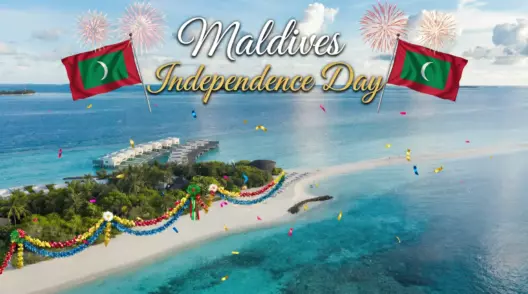
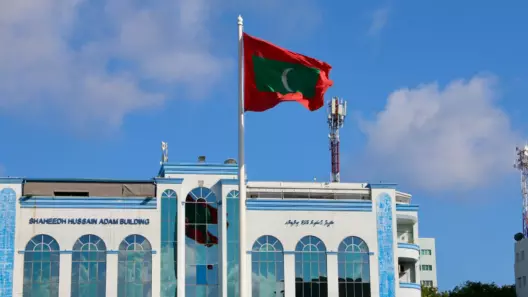
Dawn prayers at the Islamic Centre are attended by the President and senior officials, followed by a flag-hoisting ceremony at the November 3 Memorial. The sight of the Maldivian flag — red, white, and green — raised at that specific location carries a weight that a casual observer can sense even without knowing the history.
The MNDF military display at Republican Square is the main public event. In recent years, this has expanded beyond a simple march: the 2024 ceremonies included live demonstrations of responses to simulated terror scenarios, special forces operations, and a display of military hardware — President Muizzu framing the occasion as a prompt for further investment in national defense capability.
Presidential address. The sitting president gives a nationally broadcast speech, typically emphasizing sovereignty, vigilance, and the lessons of 1988. The tone is consistently serious rather than celebratory — more Remembrance Day than Independence Day.
Schools and cultural institutions often show documentary footage of the 1988 attack in the days surrounding November 3rd. An animated video reconstructing the events has been screened at official ceremonies for years. Young Maldivians encounter the story annually from early school age.
Tourists in Malé can attend the flag ceremony and watch the parade from public areas. Access to formal military events at NSS headquarters may be restricted, but the main parade and memorial ceremony are public. It is an opportunity to observe a side of Maldivian life that has nothing to do with beach tourism — and that most visitors never see.
How Victory Day Differs from Independence Day and Republic Day

The Maldives observes three major secular national holidays in the calendar year, each with a distinct emotional register that Maldivians themselves recognize clearly:
Independence Day (July 26) marks the end of the British Protectorate in 1965. It is the closest equivalent to what most countries call a founding holiday — a celebration of national birth, with a tone that leans toward pride and festivity. Public gatherings tend to be more community-oriented, with cultural performances alongside official ceremonies.
Republic Day (November 11) commemorates the proclamation of the Second Republic in 1968, when a national referendum abolished the six-hundred-year-old Sultanate. It follows Victory Day by eight days, creating what locals sometimes call a “patriotic November.” Republic Day is civic in character — it honors the form of government and democratic self-determination. Inauguration of new presidents always takes place on November 11th, which gives the date periodic political resonance beyond the standard anniversary.
Victory Day (November 3) is the most martial and the most solemn of the three. It is built around specific deaths — named individuals, documented bodies, a particular morning in a particular year. The military is not just present as a ceremonial ornament; it is the center of the ceremony, because soldiers actually died defending the country that day. The register is defiant rather than festive: we were nearly overthrown and we were not.
For a foreign visitor, the practical difference is this: on Independence Day and Republic Day, Maldivians celebrate. On Victory Day, they remember — and the remembrance has a sharpness to it that the others lack, because 1988 is within living memory. Many Maldivians who attend the November 3rd ceremony were alive when it happened.
The Aftermath: What Happened to the People Behind the Attack
Abdullah Luthufee was captured following the coup’s failure, convicted of treason, and initially sentenced to death. President Gayoom commuted the sentence to life imprisonment, which under Maldivian law amounted to 25 years. Luthufee was released in 2014 on medical grounds — a furlough that became effectively a fugitive status after he failed to return. He lived abroad for nearly a decade, at one point prompting an Interpol Red Notice.
He was eventually compelled to surrender to the Maldivian embassy in Colombo in May 2019 — specifically because he feared arrest in Sri Lanka in the aftermath of the Easter Sunday bombings, when that country launched sweeping security operations. Back in Maldives, he faced a further charge of escaping custody, pled guilty, and received a reduced sentence of seven months. He completed his full 25-year sentence and the additional term in late November 2023 — and was released a free man.
That fact is not lost on Maldivians who mark November 3rd. The man who organized the coup that killed nineteen of their countrymen outlived the legal system’s capacity to hold him and died with no major crime on his official record for the final chapter of his life. It gives Victory Day an undercurrent of unresolved justice that is rarely mentioned in tourist literature.
Practical Notes for Visitors: What to Expect on November 3rd
Victory Day is a full public holiday across the Republic of the Maldives. Government offices, schools, banks, and most local businesses in Malé and other inhabited islands are closed. If you need government services — visa extensions, official document processing — plan around the date.
Resort islands are not affected in any operational way. Restaurants, water sports, boat excursions, and all resort services run on a normal schedule. November 3rd falls within the tail of the monsoon season and the beginning of the “surf monsoon” window on the outer atolls — reef breaks of up to three meters are common if that interests you, though good equipment is difficult to source locally.
If you are in Malé, the morning hours are the most active, with flag ceremonies from dawn. The military display at Republican Square typically runs in the evening. Foot traffic around Republican Square and the November 3 Memorial will be heavy in the morning. Government ferries may operate on a reduced schedule.
The holiday sits eight days before Republic Day on November 11th, which is also a public holiday. If your itinerary involves any administrative tasks in the capital, be aware that you are visiting during a stretch of patriotic observances when routine government services can be intermittent.
FAQ
Is Victory Day a public holiday in the Maldives? Yes. November 3rd is a designated public holiday throughout the Republic of the Maldives. Government offices, schools, and most businesses in inhabited islands are closed.
What is the November 3 Memorial in Malé? It is a monument in the capital erected to commemorate those who died defending the Maldives during the 1988 coup attempt. Flag-hoisting ceremonies take place there each year on Victory Day. Tourists can visit it.
Can tourists attend Victory Day events? The main public events — the flag ceremony at the November 3 Memorial and the military parade at Republican Square — are accessible to the public. Formal military displays at NSS headquarters may have restricted access. Dress modestly and arrive early for the flag ceremony.
What was Operation Cactus? Operation Cactus was the Indian military intervention on November 3, 1988, that repelled the PLOTE mercenaries from Malé. Indian paratroopers were airlifted from Agra, landed at Hulhule Airport, and cleared the capital in approximately 18 hours. No Indian soldiers were killed. It remains one of the most cited examples of successful Indian power projection in the region.
Are resort beaches and restaurants open on Victory Day? Yes. Maldivian resort islands operate completely normally on Victory Day. The holiday’s observances are concentrated in inhabited islands, particularly Malé.
What is PLOTE? The People’s Liberation Organisation of Tamil Eelam was a Sri Lankan Tamil separatist militant group. Unlike the better-known LTTE, PLOTE operated primarily as an underground political and military organization during the Sri Lankan civil war. In 1988, a contingent of its fighters was hired by Abdulla Luthufee as mercenaries for the Maldives coup attempt.
Summary
Victory Day is the Maldives’ most serious national holiday — a date that marks real gunfire, real deaths, and a real crisis that was resolved within a single day thanks to an alliance that still shapes Indian Ocean geopolitics. The 1988 coup attempt was not a historical abstraction: the man who organized it spent decades in and out of prison before dying free, and the soldiers who died defending the capital have relatives who still attend the November 3rd ceremonies.
Tourists arriving in the Maldives in early November encounter a country with a dramatic modern history that most beach brochures do not mention. The paratroopers are long gone, the overwater villas are open for business, and the Indian Ocean is exactly as turquoise as promised. But the flags over Republican Square on November 3rd mean something specific — and now you know what.