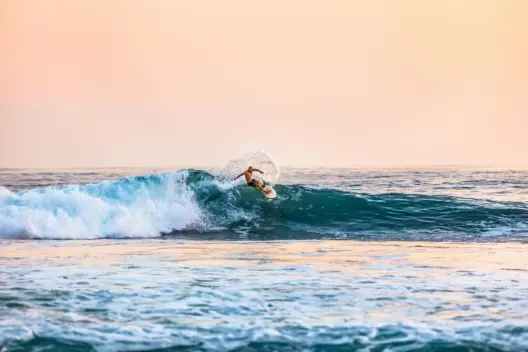
Most people who fly to the Maldives expecting to see surfing end up at the Four Seasons Trophy, watching legends like Kai Lenny and Kelly Slater ride Sultans from the deck of a luxury yacht. The waves are real. The surfing is spectacular. The daily room rate is somewhere between $800 and $1,200.
What most surf-curious visitors never see — because no travel brand is pushing it — is the Dhivehi Surf League.
This is the Maldives’ national surf circuit, a multi-atoll competition series run by the Maldives Surfing Association that has nothing to do with overwater bungalows, Tropicsurf packages, or invitation-only guest lists. It takes place on community islands. Entry is free. The audience is mostly islanders. And the surfers grew up reading the reef passes the way Maldivians have read the ocean for generations.
What the Dhivehi Surf League Is
The Dhivehi Surf League (DSL) is the annual national surfing competition circuit operated by the Maldives Surfing Association (MSA), the country’s governing body for surfing, founded in 2000 by Mohamed Sobah, Hussain Salah, and Mohamed Waheeduddeen. The national league format was established in 2022, though the association has been running island-level competitions — under names like the Gadhdhoo Pro — since at least 2020.
The league structure is straightforward: MSA signs cooperation agreements with local island councils across multiple atolls, each hosting a named competition tied to the island’s own surf break. Athletes accumulate points over the season, with the final standings determined by their two best results. The concluding event — the Rannamari Challenge, held at Raalhugandu in Malé — is an invitation-only final reserved for surfers who have competed in at least two preceding legs. This creates genuine stakes across the entire season, not just the closing weekend.
Competition divisions include Men’s Open, Junior Men, and Women’s Open. The women’s division has been one of the more notable growth areas; a women’s draw was attempted as early as the 2022 Gadhdhoo event with only three competitors, and the association has since set a minimum participation threshold while continuing to develop the women’s field.
The league’s naming convention is telling. Each competition takes the name of the island’s own surf break — not a sponsor, not a celebrity surfer, not a marketing acronym. Kalhegalekoda, Mulikolhu Wave, Kerandhoo. These names have been used by local surfers for decades before any circuit existed around them.
2025 DSL Calendar and the Pattern for 2026
The 2025 season was confirmed to include three legs. The first was the Mulikolhu Wave competition at M. Muli in Meemu Atoll, scheduled for July. The second was the Kerandhoo competition at L. Maabaidhoo in Lhaviyani Atoll, set for early September — marking the first time the league visited Lhaviyani Atoll since the circuit’s founding. The third and final leg, the Rannamari Challenge, returned to Raalhugandu in Malé for the championship heat.
Muli (M. Muli) and Fuvahmulah have both been established as core DSL venues in recent cycles. The circuit has also visited R. Kinolhas, K. Himmafushi, and K. Thulusdhoo in previous seasons. MSA typically announces confirmed venue agreements island by island through official channels in the early months of each year; the 2026 schedule is expected to follow a similar regional spread across central and southern atolls.
For surf-curious tourists planning to attend, targeting Muli or Fuvahmulah legs during June–September gives the best chance of overlapping with the swell season and the competition window.
The Waves: What You’ll Actually See

Mulikolhu Raalhugandu, M. Muli
Muli in Meemu Atoll is about 130 kilometres south of Malé. The surf break here — Mulikolhu Raalhugandu — is a right-hander with two sections: the outside break, known informally as Mushrooms, has a more open, beach-break character; the inside break (sometimes called F1) is fast, hollow, and barreling with long walls that can get shallow at low tide. It is well-protected from southerly winds, which makes it consistently rideable during the Indian Ocean swell season. On bigger days, the inside section throws hard — the kind of competition wave that separates surfers who have grown up on reef passes from those who haven’t.
Eleyi’s, Fuvahmulah
Fuvahmulah occupies its own singular geography in the Maldivian chain. Unlike most of the atolls, this island rises steeply from deep ocean, with no lagoon to buffer it. The result is a surf environment unlike anything else in the country. Eleyi’s, on the island’s western side, is widely cited as the only genuine beach break in the entire Maldives — a rarity in an archipelago defined by reef passes. Waves here peel across a sand bottom and work for a wide range of skill levels. During high tide, gentler walls move toward shore. At the right swell angle, it can produce powerful, well-shaped rides. The island also hosts the Machine wave on its eastern exposure, which has been used in competition contexts.
Raalhugandu, Malé
The Rannamari Challenge finals take place at Raalhugandu on the southeast corner of Malé city. This is the oldest and best-known surf break in the Maldives — a break with actual folklore attached to it. In Maldivian oral tradition, the waves at Raalhugandu are said to have begun after a tragic story involving a king’s son and his lover; the waves, so the story goes, have not stopped breaking since. In practical terms, Raalhugandu is one of the most consistent breaks in the country, best at low tide, working as shifting peaks with both lefts and rights. Before coastal protection tetrapods were installed in the 1990s, locals describe it as having been a proper long right that reeled along the southern point. It remains the gathering place for Malé’s surf community, with sessions starting when schools let out and continuing until evening prayers.
Getting to the Competition Islands from Malé
Muli (Meemu Atoll)
Muli lies roughly 130 kilometres south of Malé. The quickest options are a direct seaplane transfer (approximately 35 minutes, though weather-dependent and expensive) or a domestic flight to a nearby atoll airport followed by a speedboat connection. The public ferry from Malé to Meemu Atoll takes around 2.5 to 3 hours, with fares in the range of $8–$12. Budget travellers willing to work with ferry schedules can reach Muli affordably; the key constraint is that ferries run once daily and scheduling connections between atolls requires transit through Malé.
Fuvahmulah
Fuvahmulah has a domestic airport. Maldivian Air Taxi and other domestic operators run scheduled flights from the domestic terminal at Velana International Airport; the flight takes approximately 80 minutes. On arrival, the island is compact enough that the surf breaks are easily accessible without additional transport. Fuvahmulah is also a standalone island-atoll, meaning there are no ferry complications — it’s a direct flight in and out.
Thulusdhoo (for other DSL legs)
When the league visits Thulusdhoo — which has hosted DSL events in previous years — the speedboat from Malé takes 20 to 30 minutes and costs around $25–$35. This is the most accessible of the competition islands by far.
The Domestic Surfing Scene: How It Has Grown
Surfing was practised in the Maldives long before foreign visitors arrived. What changed in the early 1970s was visibility: a group of Australian surfers reached Thulusdhoo and found Cokes — the right-hand reef break named for the Coca-Cola bottling plant on the island — and word spread through international surfing networks. But local Maldivians had been reading these same passes, the raalhugandu (literally “the surf spots”), for generations.
The MSA was founded in 2000 and spent its first two decades building the foundational infrastructure: training programmes with foreign coaches, cooperation with the Ministry of Youth, Sports and Community Empowerment, environmental advocacy to protect reef breaks from coastal development, and international representation. In 2023, the MSA co-hosted the Asian Surfing Championship at Thulusdhoo — the largest surfing competition in Asia since 2004.
The Dhivehi Surf League, launched in 2022, was a different kind of project: inward-facing, grassroots, designed to develop the domestic competitive circuit rather than attract international attention. Entry fees are set at accessible levels. Island councils, local NGOs, and community guesthouses are all involved in running each leg. In Meemu Muli, the local residents (the rahvehin) play a central role in organising the event. In Himmafushi, it was the Minivanfaru NGO. In Thulusdhoo, the island’s own surfing association works alongside the council.
The result, over three seasons, has been a visible expansion in the competitive pool. The inaugural 2022 Kalhegalekoda event drew 37 competitors in Men’s Open alone. Women’s participation has grown from near-zero to a functioning divisional draw. The junior pipeline — a key MSA priority — continues to develop through its Youth Development Programme run jointly with the Maldives Bodyboarding Association.
Surfers to Watch
The most prominent name to emerge from the domestic circuit onto the international stage is Hood “Hoobs” Ahmed, a goofy-footer from Malé who became Maldivian national champion in 2021. In 2023, he was selected as the local wildcard for the Four Seasons Maldives Surfing Champions Trophy — the first Maldivian to compete in the event — describing it as a dream he had barely allowed himself to have. His selection traced a direct line from the domestic surf community to the international stage.
Beyond Ahmed, the surfers who stand out at DSL events tend to be islanders who have grown up surfing specific breaks from childhood — riders whose knowledge of their home reef is encyclopaedic. At Muli, local surfers read the F1 barrel in a way that visiting competitors often don’t. At Fuvahmulah, the exposure to deep-water swells from multiple directions has produced a style of surfing more open-water than the sheltered atolls to the north.
MSA does not currently maintain a public-facing rankings page with consistent biographical data, but the liveheats.com/msasurf platform is used for live scoring and heat draws during competition, and surfing-curious visitors can track draws and results in real time.
Spectator Access: Show Up and Watch
There is no ticket. No wristband. No Tropicsurf package required.
DSL events are community affairs. The competition happens in view of the island’s main beach or reef pass. Locals watch from the shore, from fishing dhonis, from the reef flat. Visitors who show up on competition days — which are announced through MSA’s social media channels and the edition.mv sports section — are welcome to watch from the same vantage points.
What this looks like in practice: a fishing village. A concrete pier. Surfers waiting in the water, a boat in the channel acting as the judges’ platform, a small PA system. Islanders who know every competitor by name. Children who will be in the next generation of DSL draws. This is not a spectacle designed for consumption. It is a community doing what it does on a competition weekend.
The contrast with the resort circuit could not be sharper, and that is precisely the point.
DSL vs. Four Seasons Trophy: A Direct Comparison
| Factor | Dhivehi Surf League | Four Seasons Surfing Champions Trophy |
|---|---|---|
| Who competes | Maldivian nationals and domestic athletes | Invitation-only international legends (Kelly Slater, Taj Burrow, Joel Parkinson, Kai Lenny) |
| Venue | Community islands across multiple atolls | Four Seasons Resort Kuda Huraa, Sultans break, North Malé Atoll |
| Cost to attend | Free | Resort accommodation from $800–$1,200/night; spectator packages via Tropicsurf |
| Atmosphere | Island community event — fishing boats, local crowds, no infrastructure | Luxury event — yacht viewing, cocktail functions, behind-the-scenes access |
| Board disciplines | Shortboard, standard competitive format | Single fin, twin fin, and thruster across three championship rounds |
| Dates (2026) | July–September (multiple legs across atolls) | September 4–11, 2026 (one week) |
| Discovery | Via MSA social media and liveheats.com/msasurf | Via surfingchampionstrophy.com and Four Seasons booking channels |
| Who it’s for | Surf-curious travellers wanting authentic Maldivian sporting culture | Surf fans willing to pay Four Seasons rates for world-class access |
Both events are legitimate. Both produce exceptional surfing. The Four Seasons Trophy is a carefully produced luxury occasion and it delivers what it promises. The DSL is something different: the actual national sport scene of a country that has been surfing longer than modern tourism has existed here.
If you want to watch Kai Lenny from a yacht while a butler brings you something cold, the Four Seasons is the answer. If you want to watch Maldivian surfers on their own reef passes, in front of their own communities, competing for a national title — take the ferry to Muli.
How to Follow the 2026 Season
- Official competition draws and live scoring: liveheats.com/msasurf
- MSA announcements: @msasurfing on Instagram and the MSA Facebook page (facebook.com/MSAsurfing)
- News coverage: edition.mv (sports section) covers DSL events in Dhivehi and English
- Four Seasons Trophy comparison: surfingchampionstrophy.com for the resort circuit
Competition dates for 2026 were not fully published at time of writing. MSA typically announces confirmed venue agreements in the early months of the year through its social channels, often island by island as MOUs with local councils are signed.