Most people planning a Maldives trip go straight to North Malé Atoll. It’s what travel agents default to. It’s where the most-photographed resorts are. It’s where Banana Reef is — the dive site everyone’s read about. So South Malé Atoll, sitting just across the water, quietly goes unnoticed.
That’s a mistake worth correcting.
South Malé Atoll has fewer resorts, fewer day-trippers, and fewer dive boats crowding its channels. Some of its resorts are a shorter speedboat ride from the airport than anything on the northern side. And for couples, honeymooners, and divers who want shark encounters without a queue, it often outperforms its more famous neighbour at a price that’s easier to justify.
Here’s an honest look at what South Malé Atoll is, what’s there, how it compares, and who it actually suits.
What Is South Malé Atoll, Exactly?
South Malé Atoll is the southern part of Kaafu Atoll — the same reef system that contains the capital Malé and Velana International Airport (MLE). Locals and the tourism industry sometimes refer to the whole zone as “the Male Atolls,” which is one reason South Malé gets lumped together with North Malé and then forgotten in the detail.
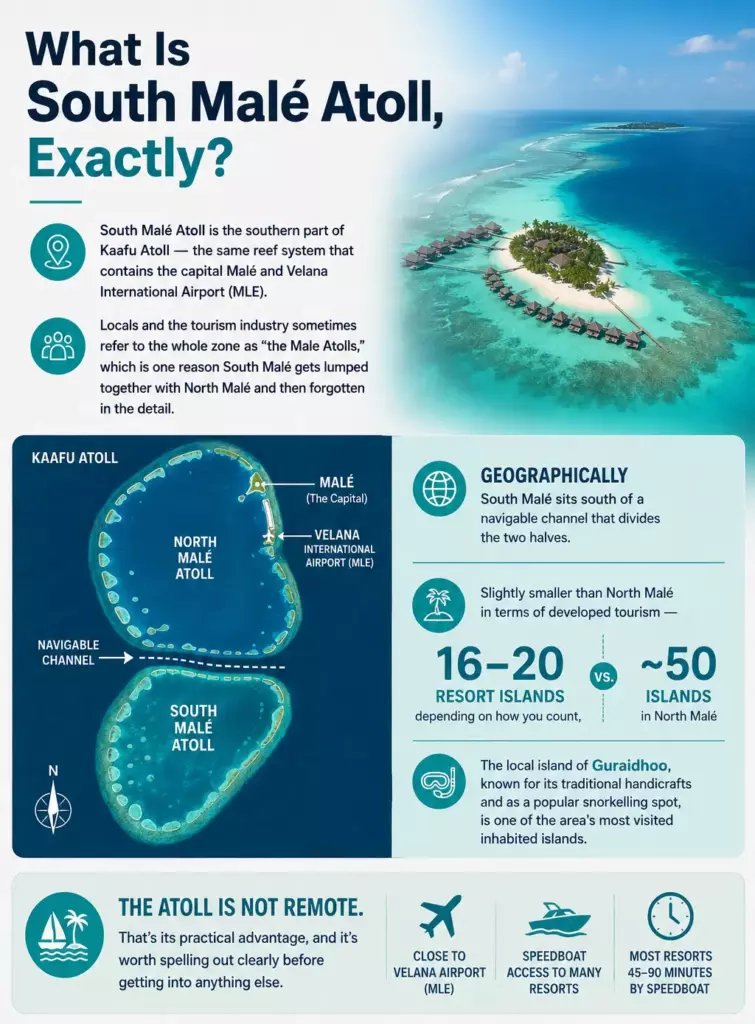
Geographically, South Malé sits south of a navigable channel that divides the two halves. It’s slightly smaller than North Malé in terms of developed tourism — around 16 to 20 resort islands, depending on how you count, compared to roughly 50 islands in North Malé. The local island of Guraidhoo, known for its traditional handicrafts and as a popular snorkelling spot, is one of the area’s most visited inhabited islands.
The atoll is not remote. That’s its practical advantage, and it’s worth spelling out clearly before getting into anything else.
How Far Is South Malé Atoll from the Airport?
Transfer times from Velana International Airport (MLE) vary by resort, but South Malé is entirely reachable by speedboat — no domestic flight, no seaplane, no overnight airport hotel required. That alone separates it from atolls like Baa or Lhaviyani, where a seaplane is the only practical option and you lose a half-day to transfers.
Here are verified transfer times for the main resorts:
| Resort | Transfer Mode | Time from Airport |
|---|---|---|
| CROSSROADS (Hard Rock / SAii Lagoon) | Speedboat | ~15 minutes |
| Adaaran Prestige Vadoo | Speedboat | ~15 minutes |
| Velassaru Maldives | Speedboat | ~25 minutes |
| Waldorf Astoria Maldives Ithaafushi | Private yacht | ~40 minutes |
| Anantara Dhigu / Anantara Veli | Speedboat | ~30–35 minutes |
| OZEN LIFE MAADHOO | Speedboat | ~45 minutes |
| Sun Siyam Olhuveli | Speedboat | ~45–50 minutes |
| Naladhu Private Island | Speedboat | ~35 minutes |
The Waldorf Astoria deserves a note: the resort is geographically close to the airport, but it does not allow third-party transfers and operates its own private yacht. Shared transfer pricing starts at $960 per person each way (as of 2025), which is a meaningful cost that budget-conscious luxury travellers should factor in before booking.
The CROSSROADS cluster, by contrast, is 15 minutes away — faster than most North Malé resorts.
South Malé vs North Malé: The Honest Comparison
The following table cuts through the marketing language:
| Factor | North Malé Atoll | South Malé Atoll |
|---|---|---|
| Resort count | ~50 developed islands | ~16–20 resorts |
| Vibe | Busier, more variety | Quieter, more secluded |
| Famous dive sites | Banana Reef, HP Reef, Maldives Victory wreck | Embudu Express, Miyaru Kandu, Embudu Channel |
| Transfer from airport | 20–60+ min speedboat | 15–50 min speedboat |
| Seaplane required? | No | No |
| Best for | Divers seeking iconic sites, those who want resort-hopping options | Honeymooners, couples, divers wanting fewer crowds |
| Price positioning | Wide range, skews higher at flagship names | Wide range; comparable upper tier, often better value in mid-range |
| Marina / multi-resort hub | No | Yes — CROSSROADS |
| North Malé iconic brands | One&Only Reethi Rah, Four Seasons Kuda Huraa, Baros, Gili Lankanfushi | — |
| South Malé iconic brands | — | Waldorf Astoria Ithaafushi, Anantara cluster, Naladhu |
The core difference in one sentence: North Malé is the Maldives that the brochures built. South Malé is what those brochures were trying to photograph.
North Malé’s dive sites are world-famous, and rightly so. Banana Reef has been on magazine covers for fifty years. But that fame brings boat traffic. The same channel that produced those extraordinary shark photographs now sees multiple dive boats in rotation. South Malé’s channels — particularly Embudu Express and Miyaru Kandu — are genuinely uncrowded by comparison.
For non-divers, the distinction is less about underwater bragging rights and more about atmosphere. North Malé has more resorts within closer proximity of each other, which makes it feel slightly more populated. South Malé’s resorts feel more private by default, not because they’re doing something special, but because there are fewer of them.
One area where North Malé does hold a real advantage: the ability to visit Malé City easily. From several North Malé resorts, a day trip to the capital is a half-hour speedboat ride. From deeper in South Malé, that excursion is possible but takes longer and makes less logistical sense.
The Resorts of South Malé Atoll
Ultra-Luxury
Waldorf Astoria Maldives Ithaafushi is the headline property and one of the most ambitious resort builds in the Maldives. Spread across three man-made islands encircling a private lagoon, it covers 2.2 miles of beaches and has 121 villas, 11 dining venues (including a Chinese restaurant, a Middle Eastern kitchen, and an overwater treehouse restaurant), and a kids’ club that’s among the largest in the country. Every villa comes with an infinity pool. The transfer cost is steep; the resort experience justifies it for those who can absorb that figure.
Naladhu Private Island is Anantara’s most secluded property and operates on a different logic to most Maldives resorts. The island has only 20 houses — not villas, not rooms, houses — each with a private pool and a personal butler. There’s no buffet restaurant, no resort activities schedule. The ethos is closer to renting a private residence than staying at a hotel.
Taj Exotica Resort and Spa sits on Emboodhu Finolhu and has built a strong reputation for its food and the quality of its staff. Reviews consistently cite personal service and the resort’s lagoon access as standouts.
Luxury
Velassaru Maldives is the resort that regularly appears on “best house reef” lists, and it earns its place. The 25-minute speedboat transfer is one of the most convenient in South Malé, and the house reef drops off sharply enough for productive snorkelling directly from the beach. 129 overwater and beachfront villas, five restaurants, an overwater spa, and complimentary marine biology talks round out the offer. For couples who want serious snorkelling without travelling to a dive site, Velassaru is a standout choice.
Anantara Dhigu and Anantara Veli share a jetty and are connected by boat. Dhigu is family-friendly; Veli is adults-only. The ability to use facilities at both resorts under a single booking is an unusual advantage. Dhigu has overwater suites and a beach that faces both sunrise and sunset depending on your villa. Veli is smaller, quieter, and built for couples who want adults-only atmosphere without sacrificing access to a broader range of restaurants and activities next door.
OZEN LIFE MAADHOO is one of the more compelling all-inclusive options in the atoll — a category where Maldives resorts often underdeliver. It operates a genuinely generous all-inclusive model that includes premium spirits, a selection of non-motorised water sports, and spa treatments in the base rate. The 45-minute speedboat ride is the longest transfer in South Malé but the trade-off is that Maadhoo sits further south in the atoll with correspondingly more open water around it.
SO/ Maldives is the design-forward property in the atoll and tends to attract a different demographic than the traditional Maldives luxury traveller. Bold interiors, a beach club atmosphere, and strong social-media aesthetics appeal to guests who want the classic overwater villa experience with a more contemporary edge.
Mid-Range and Integrated
CROSSROADS Maldives — comprising Hard Rock Hotel Maldives and SAii Lagoon (a Curio Collection by Hilton property) — is genuinely unlike anything else in the Maldives. The Marina @ CROSSROADS connects the two hotels via a walkable boardwalk with 12 restaurants, a beach club, dive centre, Marine Discovery Centre, shopping, and entertainment. Guests of either resort can use all facilities.
The 15-minute speedboat transfer makes this the most accessible cluster in either atoll. Hard Rock’s brand identity — music memorabilia, rock-and-roll energy, a loud pool area — is either its appeal or its dealbreaker depending on who you are. SAii Lagoon is softer and more family-neutral. For travellers who want company, social atmosphere, and the freedom to walk to a different restaurant without getting on a boat, CROSSROADS is the only option in either atoll.
Sun Siyam Olhuveli spans three islands and appeals to travellers who want a large, activity-dense resort with good diving access and competitive pricing relative to the top end of South Malé. The house reef is solid; the dive operation is well-reviewed.
Adaaran Prestige Vadoo is adults-only, all-inclusive, and at 15 minutes from the airport, the fastest transfer of any resort in South Malé. Consistently rated as good value for the category, it suits couples who want a no-fuss, quick-transfer, all-inclusive experience without the ultra-luxury price tag.
Biyadhoo Island Resort is among the more affordable resort islands in the atoll and has a well-regarded dive operation and an excellent house reef. It attracts dive-focused travellers who want proximity to South Malé’s channels without spending resort-island prices for everything else.
Diving in South Malé Atoll: Underrated and Crowd-Free
The dive sites in South Malé Atoll are not famous in the way Banana Reef is famous. That’s a quirk of marketing, not a reflection of quality.
Embudu Express (also called Embudhoo Kandu) is a marine protected area and sits at the northeast corner of the atoll. The defining feature is its grey reef shark and whitetip reef shark population, which is dense enough to have earned it protected status. It’s a drift dive — the current through the channel can be strong — and divers drop in on the south side of the channel, sink to around 30 metres at the edge of the abyssal drop, and let the current carry them past the reef wall where sharks, rays, and Napoleon wrasse appear against the blue. Advanced divers rate it highly; beginners have a gentler entry point via the adjacent Embudu Channel.
Miyaru Kandu means “Shark’s Reef” in Dhivehi — the local language — which makes clear what to expect. White tips, grey reef sharks, nurse sharks, and occasional leopard sharks concentrate here. The site is a drift dive with steep walls.
The south side of the atoll has six channels (kandus) through which tidal water passes. Channel diving here is the defining experience. Marine life congregates at these passages because tidal flow brings nutrients; the abundance of jacks, fusiliers, moray eels, lionfish, and large pelagics is the result. Current conditions vary by tide and season, and a good dive guide will read the water before committing to a site.
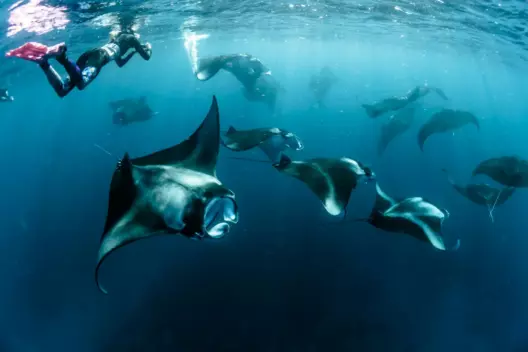
The northeast monsoon period (late December to May) generally gives the calmest seas and best visibility. The southwest monsoon (June to November) brings more surface chop and slightly reduced visibility, but manta rays appear at cleaning stations in the atoll’s interior during August and November.
South Malé’s dive sites see fewer boats than North Malé’s most famous spots. That translates to fewer divers in the water, less anchor damage on the reefs, and dive experiences that are quieter. Whether that matters depends on how seriously you dive.
The CROSSROADS Factor: South Malé’s Unique Ace Card
Nowhere in the Maldives replicates what CROSSROADS does. The standard Maldives resort model is a single island with a fixed number of restaurants, a single spa, and whatever water sports operation the resort maintains. CROSSROADS breaks that model by connecting two full resorts through a shared marina with independent dining, a beach club, entertainment, and a Marine Discovery Centre that accepts day visitors from Male as well as resort guests.
For guests who want the seclusion of an island resort but worry about “island fever” — the mild claustrophobia that some travellers feel after four or five days with the same pool, the same restaurants, the same view — CROSSROADS is a structural solution. You can walk to a completely different bar for sundowners and walk back.
For the Maldives, this is unusual enough to be genuinely worth naming as a selling point.
Who South Malé Atoll Is For (and Who It Isn’t)
South Malé suits you if:
- Privacy and a quieter atmosphere matter more than the ability to resort-hop between famous names.
- You’re a diver interested in shark encounters and channel dives with fewer boats in the water.
- You want a short speedboat transfer — the atoll has more sub-30-minute options than North Malé.
- You’re on a honeymoon or romantic trip and the “secluded” version of the Maldives is the point.
- You want the CROSSROADS integrated-resort model and can’t find that anywhere else.
- Your budget is mid-range for the Maldives and you want maximum value: Adaaran Vadoo, Biyadhoo, and Fihalhohi all deliver more per dollar than equivalent price points in North Malé’s most famous properties.
North Malé may be the better choice if:
- You want to tick off Banana Reef specifically, or dive the Maldives Victory wreck, or have your dive logbook stamped at HP Reef.
- You want the maximum number of resort options within a comparable price range.
- A half-day trip to Malé City is something you plan to do.
- You want resorts like One&Only Reethi Rah, Baros, or Four Seasons Kuda Huraa, which are based in North Malé.
Neither atoll is wrong. The question is which one matches what you’re actually there for.
Practical Notes Before You Book
Transfer costs are not included in most resort rates. Budget for the speedboat transfer separately. At standard resorts it’s typically $60–$120 per person round-trip on shared transfers. At Waldorf Astoria, it’s $960 per person each way on the resort’s private yacht — a figure that materially affects the trip budget.
Shared transfers involve waiting. Most resorts collect passengers from arriving flights on scheduled boat departures. That can mean 30 minutes to 2 hours at the airport waiting for fellow guests to clear arrivals. Private transfers eliminate this; they cost more.
The southwest monsoon period (June–November) brings lower rack rates across both atolls. The sea is choppier and there are more rain days, but the Maldives is still an extraordinary place to be and many resorts offer their best all-inclusive deals during this window.
South Malé has no inhabited “local island” budget accommodation in the way Maafushi does for guests who want a genuine guesthouse experience in the vicinity. Maafushi sits technically within the South Malé region but is the only budget-traveller base in the area. Resort islands are privately managed and access is by guest booking only.
FAQ
Is South Malé Atoll better than North Malé? It depends on what you want. South Malé is quieter, often better value, and well-suited to honeymooners, couples, and divers who want fewer boats at the dive sites. North Malé has more resort options and the most famous named dive sites. Neither is objectively better; they serve different traveller types.
How far is South Malé Atoll from the airport? Between 15 and 50 minutes by speedboat, depending on the resort. CROSSROADS and Adaaran Prestige Vadoo are the fastest at around 15 minutes. OZEN LIFE MAADHOO is the furthest at around 45 minutes. No seaplane is required for any South Malé resort.
What are the best resorts in South Malé Atoll? For ultra-luxury: Waldorf Astoria Maldives Ithaafushi and Naladhu Private Island. For luxury couples: Velassaru Maldives, Anantara Veli, and OZEN LIFE MAADHOO. For families: Anantara Dhigu and Hard Rock Hotel Maldives (CROSSROADS). For value: Adaaran Prestige Vadoo and Biyadhoo Island Resort.
Is diving good in South Malé Atoll? Yes, and it’s underappreciated. Embudu Express is a marine protected area with one of the most consistent shark populations in the Male atolls. The kandu (channel) diving across the east of the atoll is world-class. It sees fewer dive boats than North Malé’s flagship sites.
Do I need a seaplane to get to South Malé Atoll? No. All resorts in South Malé Atoll are accessible by speedboat from Velana International Airport, including at night, which eliminates the seaplane scheduling problem that affects Baa, Noonu, and other remote atolls.
Is South Malé good for a honeymoon? It’s arguably the better choice for honeymooners compared to North Malé. The quieter atmosphere, smaller number of resorts, and strong line-up of adults-only properties (Anantara Veli, OZEN LIFE MAADHOO, Adaaran Prestige Vadoo, Naladhu) make it naturally suited to couples who want privacy.