


You’ve been dreaming about the Maldives for years. The question is: if February is the only window you have, are you walking into a trap — paying peak-season prices for something that could wait? Or is February actually the smartest month you could pick?
This guide gives you the honest version: not just “February is beautiful,” but why it’s exceptional, what most travel sites get wrong about it, and how to avoid the two biggest mistakes first-time visitors make when planning a winter trip to the Indian Ocean.
February Weather: More Than Just “Warm and Sunny”
Most travel articles stop at “February is warm and dry,” which is true but undersells it. Here’s what the numbers actually mean for your trip.
February sits inside the northeast monsoon — the Maldives’ dry season, which runs from November to April. But within that window, February is the standout month. February sees around 10 hours of daily sunshine, making it the sunniest month of the year in the Maldives. It’s also the driest month, with a total precipitation of only about 50mm spread over roughly five days. For context, September — the wettest month — can see 9.5 inches of rain. February’s 50mm is barely a rounding error.
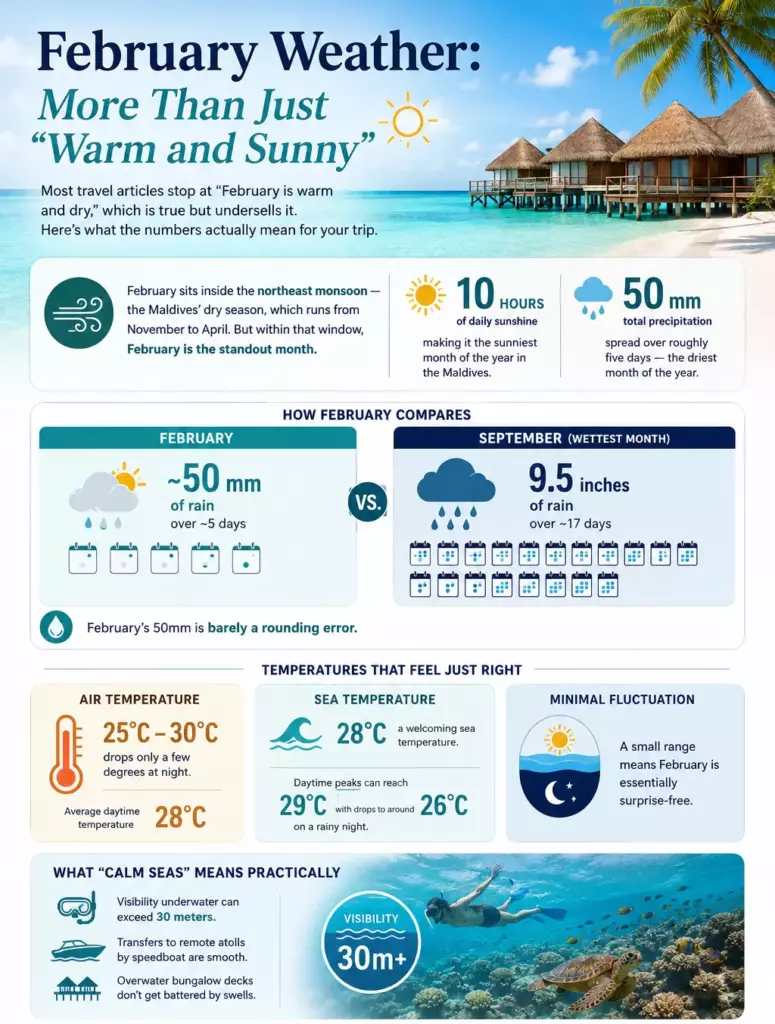
The temperature ranges between 25°C and 30°C, dropping only a few degrees at night. The average daytime temperature is around 28°C. The sea temperature is a welcoming 28°C, making beach conditions ideal, and daytime peaks can reach 29°C with drops to around 26°C on a rainy night — a minimal fluctuation that makes February essentially surprise-free.
What “calm seas” means practically: visibility underwater can exceed 30 meters. Transfers to remote atolls by speedboat are smooth. Overwater bungalow decks don’t get battered by swells. If you’ve ever been on a trip where rough seas cancelled your snorkeling excursion — that scenario almost doesn’t exist in February.
There is one footnote. February is generally dry and pleasant, but occasional brief showers are possible. They don’t significantly impact travel plans, but a light, waterproof jacket is worth packing. These showers typically pass in 15–20 minutes and are followed by the kind of clean blue sky that makes the water look almost synthetic.
The Two Things Most Travel Guides Get Wrong About February
Misconception 1: February is the Best Time for Manta Rays
This is repeated so often it has become a kind of travel folklore — and it’s backwards. The large-scale manta ray aggregations that made the Maldives famous happen during the wet season, not the dry one.
From June to November, Baa Atoll’s Hanifaru Bay becomes the stage for the world’s largest known manta ray gathering. At peak season, hundreds of mantas swoop in to feast on plankton, working together in mesmerising formations that scientists call “feeding chains.” The bay’s unique reef shape traps plankton in perfect concentration — the mechanism that drives the spectacle. Without the southwest monsoon pushing plankton-rich water in from the west, the gathering simply doesn’t happen on the same scale.
What you can reliably see in February is manta rays at cleaning stations — solitary or small-group encounters at sites like Maaya Thila and Manta Point. These are genuinely rewarding dives. They’re just not the hundred-strong feeding frenzy that fills the photographs. If that specific experience is the reason you’re choosing the Maldives, it’s worth knowing that May through October delivers it and February doesn’t.
There’s an important exception, however. Dhigurah Island in South Ari Atoll — part of the South Ari Marine Protected Area — is notable for year-round whale shark encounters, as well as seasonal manta ray congregations. According to Maldives Whale Shark Research Programme data, over 8,000 whale shark encounters have been recorded in South Ari Atoll over the past decade, with 527 spotted specifically around Dhigurah. If whale sharks are your priority, South Ari in February is one of the most reliable places on the planet to find them — regardless of season.
Misconception 2: February is Just Like December or January
It isn’t — at least not in terms of price and crowd levels. February is considered less crowded than December and January, offering the enjoyment of good weather with more room to breathe on the islands. The holiday rush of Christmas and New Year’s has passed. February starts quietly — and then runs directly into Valentine’s Day.
Valentine’s Day in February drives a meaningful price premium. Lead-in rates at some resorts in February start from $250 per night for a studio, climbing significantly for beach and water villas. Around February 12–16, expect romantic dinner packages, mandatory beach dinners, and champagne add-ons that inflate your stay cost by 20–40% compared to, say, February 5th. If you’re not celebrating Valentine’s Day as a couple, it pays to time your trip in the first two weeks of the month or after the 16th.
Best Atolls and Beaches for a February Visit
North Malé Atoll — Classic Access and Exceptional Diving
The most accessible atoll — directly reachable from Velana International Airport — delivers what many consider the Maldives’ finest dry-season diving. Visibility can exceed 30 meters in North Malé Atoll during February, with calm seas and extended sunshine creating near-perfect conditions. Drift diving is a major highlight, with nutrient-rich currents bringing sharks and pelagics to cleaning stations and channel walls. Classic sites like Banana Reef offer colourful coral gardens and turtle sightings accessible to beginners, while Kandooma Thila challenges experienced divers with grey reef sharks and fast currents.
The practical advantage of this atoll: no seaplane required. Speedboat transfers are short, relatively affordable, and not weather-dependent. Budget guesthouses on islands like Thulusdhoo and Maafushi sit within 30–45 minutes of the airport.
South Ari Atoll — The Whale Shark Corridor
If marine life encounters are your priority, South Ari Atoll earns the trip. Dhigurah Island, one of the longer islands at roughly 3 km, offers long beaches, an endlessly long sandbank, and a traditional Maldivian village. The island preserves its charm — before tourism was approved here, regulations stipulated no building could be higher than four storeys, so approaching by boat you still see palm trees rather than concrete towers.
The island’s proximity to the South Ari Marine Protected Area makes it the most consistent location in the Maldives for whale shark sightings in February. Dives at nearby sites like Kuda Rah Thila and Reethi Thila also deliver reef sharks, eagle rays, and turtles during the dry season.
Vaadhoo Island — The Beach That Glows at Night
This is one detail that surprises visitors who only researched daytime activities. February falls within the optimal window — August to February during new moon phases — for seeing the bioluminescent beach on Vaadhoo Island, where glowing phytoplankton is tossed onto the sand by waves at night. The island is approximately 8 km from Malé and reachable by ferry or speedboat. Timing a visit around a new moon in early or late February maximises the chance of a clear, glowing shore.
Baa Atoll — Without the Manta Crowds
With Hanifaru Bay quiet in February, Baa Atoll is a different experience than the high-season spectacle — and for some travellers, a better one. The UNESCO Biosphere Reserve status means the atoll has strict development limits; resorts and guesthouses are fewer and more spread out. House reef snorkelling is excellent year-round, and the atoll’s local islands like Dharavandhoo offer the cheapest ferry-accessible base in the region.
Activities at Their Best in February
The combination of calm seas, high visibility and dry air creates conditions where almost everything works in February. The crystal-clear waters are ideal for swimming, snorkelling, diving, surfing and sailing, and lower humidity makes sightseeing and outdoor activities on land more enjoyable too.
Snorkelling: with visibility regularly exceeding 20 metres at house reefs, February is the month where even average snorkelling spots punch above their weight. You’ll see farther, clearer and with less effort than at any other time of year.
Island hopping: the calm seas make speedboat transfers comfortable, and with no risk of swells cancelling trips, multi-island itineraries are reliably executable. Most island-hopping tours in the Maldives start in Malé; as you visit each destination, you’ll have a chance to unwind at the beaches and embark on several water sports activities.
Night diving: the dry season coincides with excellent night dive conditions. Maaya Thila in South Ari Atoll, considered one of the world’s great night dive sites, is at its best from November to April — moray eels, lionfish and hunting white-tip reef sharks.
Sandbank picnics: Operators across all atolls offer private sandbank excursions — a strip of white sand surrounded by turquoise water, accessible only by boat. February’s calm seas and guaranteed sunshine make these a near-certain success rather than a weather gamble.
What February Actually Costs — and How to Pay Less
February pricing is close to the annual peak. April–May transition months provide excellent weather with fewer crowds, and prices drop 20–30% from peak rates, while the wet season can see resort rates drop 40–50% from peak season, making luxury properties considerably more accessible. February doesn’t benefit from either discount.
The Valentine’s week surcharge is real but avoidable. Book dates that don’t span February 13–15, and the Valentine’s premium disappears. The base pricing for February 1–12 and February 16–28 is essentially the same as January — high, but without the specific couple’s supplement.
The larger decision is resort versus local island guesthouse.
Resort vs Local Island: The Budget Decision That Changes Everything
The “one island, one resort” model dominates the Maldives’ international image — and the price tag. Overwater villas at premium resorts routinely start at $800–$1,200 per night in February before food, transfers and activities.
The local island alternative is a genuinely different experience, not a compromise version of the same trip. Local islands like Maafushi in Kaafu Atoll, Thulusdhoo in Kaafu Atoll, Dhigurah in South Ari Atoll, and Fulidhoo in Vaavu Atoll have embraced tourism, offering a network of guesthouses, local cafes, and tour operators.
On a local island, the daily budget is typically $70–110 per person. One constraint: very few guesthouses are available on lesser-known islands, so booking 2–3 months in advance is essential during peak season. For February, booking 4–5 months ahead is safer — this is when the Maldives fills fastest.
There’s one cultural note: on local islands, each island has a “bikini beach” — the only beach where swimwear is permitted. The rest of the island follows conservative local norms. Resort islands have no such restrictions. For travellers prioritising beach freedom across the entire island, a private resort remains the logical choice.
Who Should Go in February — And Who Should Wait
Go in February if:
- Weather certainty matters more than price. February is the most reliable month in the Maldives — minimal rain, maximum sunshine, near-zero chance of a trip-ruining storm.
- You’re primarily interested in diving or snorkelling. The 30m+ visibility window and calm seas make February the strongest month for underwater photography and exploration.
- You want whale sharks without the May–November wet season pricing. South Ari Atoll in February offers year-round encounters.
- You want fewer tourists than December and January without sacrificing weather.
- You’re celebrating a honeymoon or romantic trip — the atmosphere in February genuinely supports that, especially outside Valentine’s week.
Consider another month if:
- Manta ray feeding frenzies at Hanifaru Bay are your primary goal. Come between June and October instead.
- Budget is a significant constraint. April and May offer nearly identical weather with a 20–30% price reduction.
- You want to see whale sharks and manta ray aggregations in the same trip. That intersection happens in the shoulder period of May, when some manta activity begins in Baa Atoll while whale sharks remain consistent in South Ari.
- You dislike crowds on Valentine’s week — either avoid those specific dates or push the trip to late February.
Real Traveler Insights: What Visitors Say About February
Experienced visitors consistently note that February provides a balance: it’s technically peak season, but with fewer tourists than December and January. Resorts feel less frenetic, service is more personalised, and the beaches are less likely to have a constant flow of new arrivals from holiday packages.
Divers and underwater photographers repeatedly identify February as the month they’d return to. The combination of clear water, calm sea state, and reduced wind means conditions align across multiple dives in a row rather than having one good day interrupted by weather. The dry season has been recognised as the best time to dive for clear skies and excellent visibility, particularly on the eastern sides of the atolls, with snorkelling visibility reaching 20–30 metres.
The most consistent complaint from February visitors — particularly on social forums — isn’t the weather but the price. The gap between what a February Maldives trip costs and what travellers expected to pay surprises people who didn’t research seasonal pricing before booking. The lesson: budget for February as you would a European Christmas ski trip — it’s genuinely expensive, and trying to save money by compromising on transfer type or atoll location often reduces the experience more than it saves.
Practical Tips for Booking a February Trip
Book at least 5–6 months ahead. Popular resorts and the best-positioned local island guesthouses fill in August and September for the following February. This is not hyperbole — if you decide in November that you want a February trip, your options are already significantly narrowed.
Choose your atoll based on your priority, not just your budget. North Malé for diving, South Ari for whale sharks, Baa for remoteness, Vaadhoo for the bioluminescent beach. Don’t let transfer cost alone drive atoll selection.
Time around Valentine’s Day deliberately. If you’re not celebrating as a couple, February 7–12 is the sweet spot — post-New-Year crowds have thinned, Valentine’s week hasn’t started, and you’ll get the same weather for the same base rate without romantic surcharges.
Factor in transfers. Seaplane transfers to remote atolls can add $350–600 per person return to the cost of the trip. Speedboat-accessible atolls (North Malé, South Malé, Ari Atoll via domestic flight + speedboat) significantly cut this cost without sacrificing weather quality.
Pack reef-safe sunscreen. The Maldives is a UNESCO Biosphere Reserve across significant portions of its waters. Many resorts prohibit chemical sunscreens near coral, and oxybenzone-based products are harmful to reefs. Bringing mineral sunscreen avoids a problem and a lecture at check-in.
Buy travel insurance that covers dive-related incidents. Standard travel insurance typically excludes diving above recreational depth. If you plan to dive, confirm your policy covers diving to at least 40 metres.
FAQ
Is February the best month to visit the Maldives? For beach holidays, diving, snorkelling and weather certainty, yes — it’s statistically the sunniest and driest month of the year. For manta ray aggregations at Hanifaru Bay, the wet season (June–October) is better.
How hot is the Maldives in February? Average daytime temperature is around 28°C (82°F), with sea temperature also at approximately 28°C. Nights drop to around 25–26°C. Humidity is lower than in the wet season, making it comfortable for outdoor activities.
Is the Maldives too expensive in February? February is peak-season pricing. Budget-conscious travellers should consider local island guesthouses (from around $70–110/person/day) as an alternative to luxury resorts. The weather is identical regardless of accommodation type.
Can you see whale sharks in the Maldives in February? Yes — South Ari Atoll, particularly around Dhigurah Island and the South Ari Marine Protected Area, offers year-round whale shark encounters. February is one of the most consistent months for sightings.
What should I pack for the Maldives in February? Lightweight, breathable clothing; swimwear; reef-safe (mineral) sunscreen; a wide-brim hat; UV-protective rash guard for snorkelling; one light waterproof layer for occasional brief showers; and a dry bag for boat transfers.
Is it worth going to the Maldives in February as a solo traveller? Entirely — particularly on local islands where the guesthouse culture is social and tour groups are diverse. The beach, diving and island-hopping activities are enjoyable solo. Some overwater bungalow packages include compulsory dinner arrangements designed for couples; check booking terms in advance.