Where You Can Legally Drink: Alcohol Rules in the Maldives, Island by Island
Alcohol is illegal in the Maldives. It is also served, chilled, on a beach, within forty minutes of the airport.
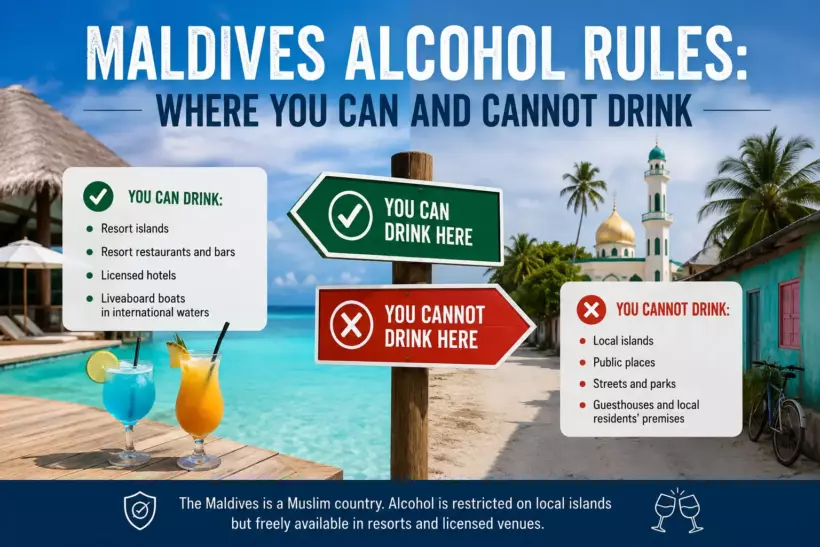
Both statements are true, and the gap between them is the single most confusing thing about Maldivian law for visitors. The country prohibits alcohol for its citizens and on every inhabited island, and carves out a narrow exception for licensed tourist establishments on islands where nobody lives.
This guide sets out exactly where the line falls, what happens to the duty-free bottle in your bag, how the floating bars work, and the rules that catch people out.
The law in one paragraph
The Maldives is a Muslim country in which citizenship is tied to the faith, and alcohol is prohibited for Maldivians without exception. It is also prohibited across all inhabited islands — every local island, the capital, and every public space in the country.
The exception exists because tourism was built on separate islands from the start. When the first resort opened in 1972, it opened on an uninhabited island, and that separation allowed the state to license alcohol inside the tourism enclave without permitting it in Maldivian society. The resort and local island systems are two different legal environments, and alcohol is the sharpest line between them.
An expatriate permit once allowed foreign residents to buy alcohol for personal consumption. It has been discontinued.
Where you can legally drink
Four categories, and no others.
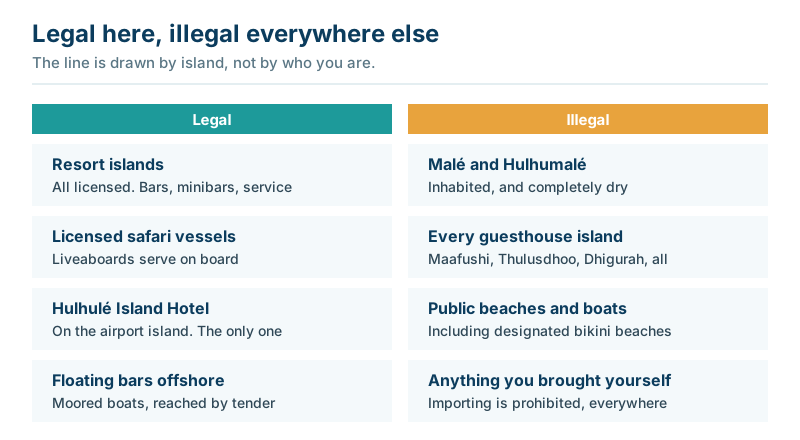
Resort islands. Every resort holds a licence. Bars, wine lists, minibars, poolside service — all normal, all legal, all inside the property. This covers the overwhelming majority of alcohol consumed in the country.
Licensed safari vessels. Liveaboards operating for tourists hold licences and serve on board, which is why a dive week and a dry week are not the same thing.
The airport hotel. Hulhulé Island Hotel, on the airport island itself, is the only licensed venue anywhere near the capital. It has bars, a pool bar and a sports pub, and it is a well-known destination for expatriates and transiting travellers passing through Malé. If you have a long layover or a late landing and you want a drink, this is the address — and our guide to late arrivals in Malé covers the rest of that situation.
Floating bars. Vessels moored offshore near guesthouse islands, licensed as boats rather than premises. More on these below.
That is the complete list. There are no liquor stores, no off-licences and no bottle shops anywhere in the Maldives. Alcohol exists only where it is served.
Where you cannot
Everywhere else, without nuance.
Malé and Hulhumalé. Both are inhabited islands and both are dry. No hotel, restaurant or café in either serves alcohol. Hulhumalé has a bikini beach and a relaxed attitude to visitors, and it still has no bar.
Every guesthouse island. Maafushi, Thulusdhoo, Dhigurah, Ukulhas, Fulidhoo — none of them serves alcohol, and no guesthouse on any of them will produce a bottle from a back room. Asking puts the owner in an awkward position at best.
Public beaches, boats and streets. Including bikini beaches, which are a dress-code exception rather than an alcohol one — the distinction is set out in our guide to what to wear where.
Your own supply, anywhere. Bringing your own bottle to an island is not a loophole. It is the offence.
One rule people underestimate: do not take alcohol off a resort island. A can taken onto an excursion boat, a bottle carried to a local island, a hip flask in a day bag — all of it converts a legal drink into an illegal import.
The duty-free bottle: what actually happens
This is where travellers lose things, and the outcome is better than most guides suggest.
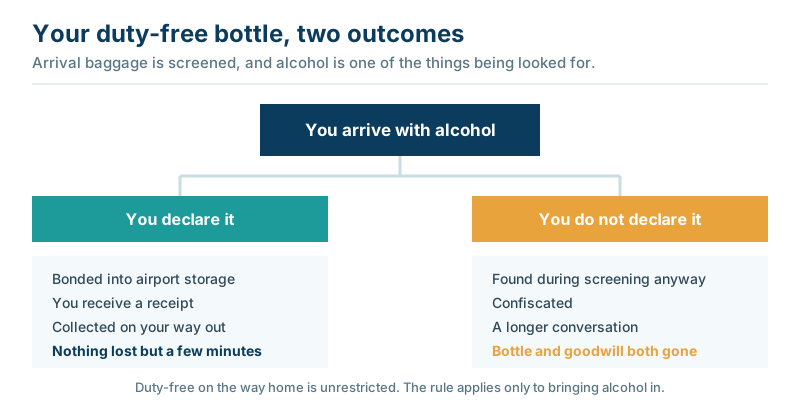
Alcohol may not be imported by travellers, whatever your visa status on arrival. If you buy at a duty-free shop en route, or bring a bottle from home, it will be found at Velana International Airport — arrival baggage is screened thoroughly and alcohol is one of the specific things the scanner operators are looking for.
What happens next depends entirely on whether you declare it.
Declared alcohol is bonded, not destroyed. It goes into secure storage at the airport, you receive a receipt, and you collect it on your way out of the country. Nothing is lost except the time at the counter.
Undeclared alcohol is confiscated, and the conversation is longer and less friendly.
So the practical advice is unusual for a customs rule: if you already have a bottle, declare it. If you have not bought one yet, do not — you are carrying a bottle across the Indian Ocean in order to leave it in a warehouse for a week.
The same screening covers pork products and material treated as religious in nature, and the full picture is in our guide to dress codes, banned items and customs rules. Departure duty-free, on the way home, is entirely normal and unrestricted.
The floating bar
If you are staying on a guesthouse island and want a drink, this is how it is done legally.
A floating bar is a boat — often a converted safari vessel — moored offshore in international-style licensing terms, outside the jurisdiction of the inhabited island it serves. Guesthouses and excursion desks arrange the tender, which is usually a short free ride out and back.
The practicalities are consistent across the islands that have a floating bar:
- A beer runs around USD 5, spirits and cocktails more
- Payment is usually cash in dollars, though some take cards
- Boats typically operate late afternoon into the evening
- You return sober enough to walk through a residential community, which is the unwritten rule that keeps the arrangement working
Not every guesthouse island has a floating bar. Maafushi and the larger tourism islands do; smaller and more conservative islands do not, and it is worth asking before you book if this matters to you.
Liveaboards and dive boats
Safari vessels licensed for tourism serve alcohol on board, which makes a dive week a different proposition from a stay on a dry island.
Two constraints apply, and neither is legal.
Diving and alcohol do not mix, and reputable operators enforce it: no drinking between dives, and a sensible gap before the first dive of the following day. Dehydration raises decompression risk, and the Maldives has only four decompression chambers, none of them south of Dhaalu Atoll.
The boat is moored somewhere. Vessels anchored off an inhabited island keep service discreet, and crews will ask guests not to carry drinks onto a local island during a village visit.
Dive itineraries across Vaavu, Ari and Baa all run on licensed vessels, so the question is rarely whether alcohol is available and usually whether the schedule leaves room for it.
The resort day pass
The other route from a dry island to a legal drink is a day trip.
Excursion desks on guesthouse islands across South Malé and Kaafu sell resort day passes, typically including the beach, the pool, lunch and often an alcohol package for a fixed fee. It buys the whole resort experience for eight hours, alcohol included, and returns you to your guesthouse in the evening.
Establish what is included before paying — particularly whether drinks are in the price or charged separately, which is the detail most often left vague. Numbers vary widely by property, and the same applies to the boat transfer.
Occasions: honeymoons, New Year and sunset cruises
The occasions people plan around are also the ones where alcohol pricing bites hardest.
Honeymoons. Champagne on arrival, in the villa, or on a private sandbank is a standard resort offer, and it is one of the items where the gap between the package price and the à la carte price is largest. Our honeymoon guide covers what is typically included and what is sold separately.
New Year. Resorts run gala dinners with mandatory supplements over the New Year period, and drinks are frequently excluded from the supplement even at all-inclusive properties. Christmas works the same way, and Valentine’s Day attracts its own set-menu pricing.
Sunset cruises. Sold by resorts with drinks included, and by guesthouse excursion desks without them, since a boat leaving an inhabited island cannot serve alcohol unless it is separately licensed. Check which version you are buying.
Weddings and vow renewals. Symbolic ceremonies at resorts are common and champagne is part of the standard package. Legal marriage in the Maldives is a separate matter with its own requirements.
What drinks cost
Alcohol in the Maldives is expensive, and the reason is structural: every bottle is imported into a country that taxes it heavily, then transported by boat to an island with one seller.
| Where | Typical price |
|---|---|
| Beer, floating bar | USD 5–8 |
| Beer, resort | USD 8–15 |
| Cocktail, resort | USD 12–20 |
| Glass of wine, resort | USD 12–25 |
| Bottle of wine, resort restaurant | USD 60–200 |
| Beer, airport hotel | USD 6–10 |
Add a 10% service charge and 17% TGST, which compound to roughly 28.7% above the menu price — the arithmetic is covered in our guide to money in the Maldives.
This is why all-inclusive packages are more popular in the Maldives than in most destinations. On a resort where a beer is USD 12, a drinking couple recovers the supplement quickly. On a resort where you plan two glasses of wine across a week, they do not.
Ramadan, and what changes
On resort islands, very little. Bars operate, service continues, and resorts are explicitly outside the restrictions that apply to Maldivian society.
On inhabited islands, everything changes — but not the alcohol rules, because there was never any alcohol to restrict. What changes is daytime eating, café opening hours and the general rhythm, as our guides to Ramadan and Eid al-Fitr explain.
Some floating bars reduce hours or suspend operations during the month out of respect for the island they are moored beside. If a drink matters and your dates fall inside Ramadan, ask the guesthouse directly rather than assuming.
The rules that catch people out
Seven, in rough order of how often they cause a problem.
- Buying duty-free on the way in. The most common mistake by a distance, and the reason for the bonded warehouse.
- Taking a can off the resort. On an excursion boat, to a sandbank, to a local island — all of it illegal, however casual it feels.
- Assuming Hulhumalé is different. It is a modern, tourist-facing island with a bikini beach, and it is completely dry.
- Offering a drink to Maldivian staff. Alcohol is prohibited for citizens, and a well-meant gesture puts someone’s job at risk.
- Bringing alcohol as a gift. Same problem, more paperwork.
- Assuming a guesthouse can arrange it. They cannot, and the request is uncomfortable.
- Expecting a bar at the airport hotel to be typical. It is the exception that proves the entire rule.
The minimum drinking age is 18, and resorts apply it.
If you are not drinking
Worth a paragraph, because a dry holiday in the Maldives is genuinely easy.
Fresh juices, coconut water straight from the nut, and the sweet black or milk tea that runs the local food culture are available everywhere, on every inhabited island in the country. Resorts run extensive mocktail menus, and non-alcoholic beer and wine are increasingly stocked.
Local raa, the sap tapped from coconut palms, is drunk fresh and unfermented and is sweet rather than alcoholic — fermented toddy is a different matter and is not legally available.
For travellers who do not drink for any reason, a guesthouse island is arguably the better trip: no bar bill, no all-inclusive supplement, and none of the arithmetic above.
The etiquette nobody writes down
Three unwritten rules, all of them easy, all of them noticed.
Do not carry a drink where it does not belong. Not onto the tender, not to a village visit, not into a photograph on a local island. The rule is legal, but the practice is social — resort staff and boat crews are the people who get in trouble, not you.
Do not discuss it with Maldivians as a puzzle. Asking a guesthouse owner how locals “really” handle alcohol is asking someone to comment on the legality of their neighbours’ behaviour, to a stranger, in their own home. It reads exactly as it sounds.
Do not treat the resort bubble as the country. A visitor who spends a week drinking on an island staffed entirely by people who cannot legally drink, and concludes the Maldives is relaxed about alcohol, has misread the arrangement completely. The enclave exists precisely because the country is not relaxed about it.
None of this requires effort. It requires noticing which of the two systems you are standing in — which, as our comparison of resort and inhabited islands sets out, is the single most useful thing a Maldives visitor can learn to do.
Why the law is what it is
Some context, because visitors occasionally read the rules as arbitrary.
The Maldives has been Muslim since the twelfth century, and the constitution ties citizenship to the faith. Alcohol prohibition is not a tourism policy or a recent conservative turn; it is the ordinary law of the country, and the resort exception is the anomaly rather than the rule.
That exception was a deliberate economic decision, made when the country had almost no other exportable resource. It has been maintained with unusual discipline: the enclave is real, the licences are enforced, and the two systems have stayed separate for over fifty years. The arrangement is periodically debated domestically, which is worth remembering when reading older articles about proposed changes.
The practical upshot for a visitor is simple. You are not being asked to accept an inconvenience. You are visiting a country that made a specific bargain, and the bargain is the reason your resort has a wine list at all.
Five questions to ask before you book
If alcohol is part of how you want the holiday to feel, these five answers settle it, and all of them are obtainable before you pay.
Is the property licensed to serve alcohol? Every resort is. Every guesthouse is not, and no guesthouse can become licensed for your visit.
Does the island have a floating bar? Ask the guesthouse directly, and ask what the tender costs and when it runs. Some islands have one, some do not, and the situation changes.
What does the all-inclusive package actually cover? Premium spirits, wine by the bottle and anything at the pool bar are the usual exclusions. On a resort where a cocktail is USD 18, the difference between “all-inclusive” and “all-inclusive except the things you want” is substantial. Our atoll decision guide is the place to start narrowing properties.
Is there a supplement for your dates? Gala nights over New Year and Christmas carry mandatory charges, and drinks are often outside them.
How long is the transfer? A resort reached by seaplane after a long-haul flight means arrival-day drinking happens at the airport or not at all. The transfer comparison shows how long each option really takes.
One more, on the way out. A bar bill at a resort already carries a 10% service charge, so anything beyond it is discretionary — our guide to tipping covers who actually receives it.
Questions travellers ask
Can you drink alcohol in the Maldives? Yes, but only on licensed resort islands, licensed safari vessels and at the Hulhulé Island Hotel on the airport island. Alcohol is prohibited for Maldivian citizens and on every inhabited island, including Malé and Hulhumalé.
Can I bring alcohol into the Maldives? No. Importing alcohol is prohibited for travellers, and duty-free bought en route is not exempt. Declare anything you are carrying and it will be bonded at the airport and returned to you on departure.
Is there alcohol on local islands like Maafushi? Not on the island. The legal option is a floating bar moored offshore, reached by a short tender, where a beer costs around USD 5. A resort day trip is the other route.
Can I drink in Malé or Hulhumalé? No. Both are inhabited islands and are completely dry, including hotels and restaurants. The nearest licensed venue is the Hulhulé Island Hotel on the airport island.
How much does a beer cost in the Maldives? Around USD 8–15 at a resort, USD 5–8 at a floating bar, plus a 10% service charge and 17% TGST at licensed businesses.
Is alcohol served during Ramadan? On resort islands, yes, normally. Some floating bars reduce hours out of respect for the island they serve, so ask the guesthouse if your dates fall inside the month.
What is the legal drinking age? Eighteen, and resorts apply it.
Can I give a drink to a resort employee? No. Alcohol is prohibited for Maldivian citizens, and offering one puts the person at professional and legal risk.
What to take away
- Alcohol is legal only on resort islands, licensed safari boats and the Hulhulé Island Hotel. Everywhere else in the country, including Malé and Hulhumalé, is dry.
- Do not buy duty-free on the way in. If you already have a bottle, declare it — it will be bonded and returned when you leave.
- On a guesthouse island, the legal routes to a drink are the offshore floating bar and a resort day pass.
- Never take alcohol off a resort island, and never offer it to a Maldivian.
- Resort prices are high enough that an all-inclusive package pays for itself quickly if you drink, and wastes money if you do not.
Next step: decide before you book whether alcohol matters to you. It is one of the very few Maldives questions that cannot be solved after arrival, because the answer is fixed by which island you are standing on. If it does, book a resort or check that your guesthouse island has a floating bar. If it does not, a dry island is cheaper, calmer and no worse a holiday.