Night Fishing in the Maldives: The Excursion Guests Rate Highest
Ask people at the end of a Maldives trip which excursion they enjoyed most and a surprising number say night fishing. Not the whale sharks, not the sandbank — the three hours they spent sitting on a wooden boat in the dark holding a nylon line.
Three reasons. Expectations are low, so it over-delivers. It is participatory rather than observed, which almost nothing else here is. And you eat what you catch.
It is also cheap, traditional, and the same thing Maldivians do for a living. This guide covers what happens, what you catch, the rules, and the one thing that ruins it for people who did not see it coming.
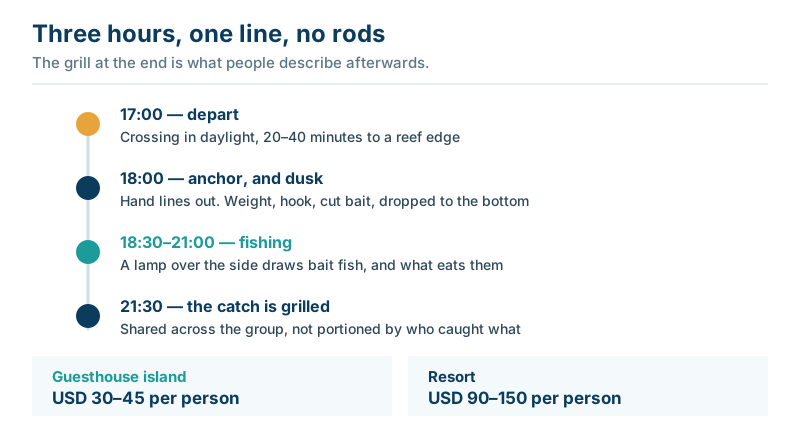
What actually happens
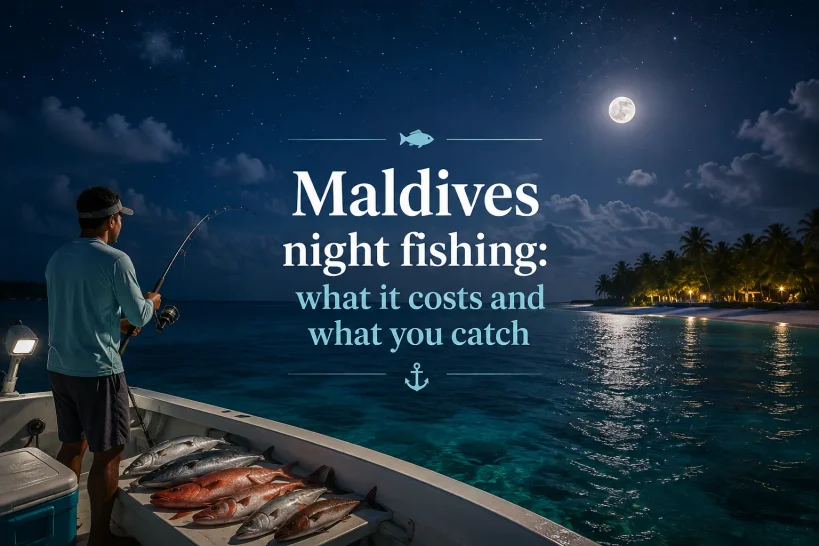
Departure around five or half past. Boats leave in the late afternoon so the crossing happens in daylight and the fishing starts at dusk.
Twenty to forty minutes to the spot, usually a reef edge or a drop-off where the boat anchors.
Hand lines, not rods. A nylon line wound on a spool, a weight, a hook, and cut fish or squid for bait. You drop it to the bottom, take up the slack, and feel.
The crew bait, unhook and advise, and they are the reason a first-timer catches anything.
Two to three hours of fishing, in the dark, with a lamp over the side that draws bait fish and — with them — everything that eats bait fish.
Back by nine or ten, and on most trips the catch goes to the kitchen and comes back grilled.
On a resort version, the boat is more comfortable, the drinks are included, and the fish appears at a table rather than on a plastic plate. The activity is identical.
What you catch
Reef species, mostly, and the composition varies by site and season.
Snapper, in several species, and the most common catch.
Emperor and grouper, the prizes, and larger.
Jacks and trevally, which fight hard and are the reason people who have never fished before end up standing.
Squirrelfish and soldierfish, nocturnal, and the ones that keep the line busy on a slow night.
Barracuda, occasionally, and dramatic.
And a great deal of nothing, which is fishing. Blank stretches of twenty minutes are normal, and the crew move the boat rather than sit through an hour of them.
Realistic expectation: a boat of twelve people brings up somewhere between a handful and a couple of dozen fish across an evening. Individual results are wildly uneven and the crew redistribute the catch to the kitchen rather than to the person who caught it.
The rules, which are stricter than visitors expect
The Maldives regulates fishing carefully, and three points matter for a visitor.
Spearfishing is illegal. Nationwide, for everybody, without exception. Bringing a speargun into the country is a customs matter, as our guide to restricted items covers.
Sharks are fully protected. The Maldives banned shark fishing nationwide in 2010, and the protection is total. If a shark takes your bait, the crew cut the line.
No fishing in protected areas. Marine protected areas, including Hanifaru Bay and the South Ari whale shark area, are closed to fishing entirely. Licensed operators know the boundaries.
Turtles and rays are protected, and any accidental hooking is released — the reasoning is in our turtle guide.
Your operator should be licensed, which is the practical version of all of the above. An unlicensed boat is cheaper and is fishing somewhere it should not be.
Why the tradition matters here
Worth two paragraphs, because it changes what the activity is.
The Maldives runs one of the world’s few one-by-one tuna fisheries. The national fleet catches skipjack and yellowfin by pole and line, one fish at a time, rather than with purse seines or nets. It is unusually selective, produces very little bycatch, and it is the reason Maldivian tuna carries the certifications it does.
Which means the hand line in your hands is not a tourist novelty. It is a smaller version of how this country has fished for centuries and still fishes commercially. Our guides to the economy and to Maldivian food both come back to the same fact: fish is the country’s other industry and its actual cuisine.
The crew on your boat are usually fishermen. Asking them about the commercial side produces better conversation than asking about the resort.

Where it runs, and when
Available almost everywhere, with two variables worth checking.
Every guesthouse island runs night fishing, and most resorts do. It is one of the few excursions with no geographic constraint — reef edges are everywhere, and every island has a boat.
Kaafu is the busiest, with trips from Maafushi and its neighbours across South Malé and North Malé every evening.
Quieter atolls mean quieter marks. Fewer boats working the same reef edge produces better fishing, which is one of the small advantages of Ari, Baa or anywhere further out.
The moon matters, though less than for diving. A dark night concentrates fish around the boat’s lamp; a full moon spreads them out.
The season is the sea state. Fishing runs year-round and the deciding factor is whether the evening is calm — the wind pattern our monsoon guide describes.
Book a day ahead in high season, and the same evening is usually fine otherwise.
The thing that ruins it
Seasickness, and this trip is the worst combination in the country for it.
An anchored boat rolls. A moving boat is stabilised by its own motion; a stationary one at anchor sits beam-on to the swell and moves in every direction at once.
It is dark, so you cannot see the horizon, which is the single most effective thing a queasy person can look at.
You are looking down, at a line, at your hands, and at the deck.
For three hours.
What to do: take something an hour before departure rather than when you feel it. Sit at the back, outside, in fresh air. Look at the horizon while there is still light. Eat something light beforehand rather than nothing. And if it is bad, tell the crew — they have seen it, and a spot at the stern helps.
Check the forecast. Wind and swell make it worse, and in the southwest monsoon from May to November a marginal evening is a bad bet — the pattern our monsoon guide sets out.
The good news: the same conditions that make a dolphin cruise pleasant make this pleasant, and a calm dry-season evening is genuinely comfortable.
Is it sustainable?
A fair question, and the answer is better than it would be in most destinations.
Hand-line fishing is inherently selective. One hook, one fish, no nets and no bycatch beyond what can be released.
Undersized fish go back, and a good crew do this without being asked.
Protected species are protected, and the shark and turtle rules above are enforced rather than notional.
Protected areas are closed to fishing entirely, and licensed operators stay outside them.
The scale is small. A boat of twelve tourists catching twenty reef fish in an evening is not a pressure on anything, particularly beside a national commercial fishery.
Where to be careful: operators who fish inside protected boundaries, keep undersized fish or take sharks. All three are illegal, all three happen occasionally, and all three are avoided by booking a licensed boat rather than the cheapest one on the street.
The wider pressure on Maldivian reefs is bleaching rather than line fishing, as our reef health guide sets out.
What it costs
| From | Typical price |
|---|---|
| Guesthouse island, shared trip | USD 30–45 per person |
| Guesthouse island, private boat | USD 150–300 per boat |
| Resort, shared excursion | USD 90–150 per person |
| Resort, private with dinner | USD 300–600 per couple |
The usual three-times multiplier, documented across every activity in our excursion price guide, and resort prices carry the 28.7% service charge and tax explained in our guide to money in the Maldives.
What is usually included: boat, crew, lines, bait, and the cooking of the catch. Water on most trips, soft drinks on some.
What is not: alcohol, which does not exist on an inhabited island in any case.
At USD 30 to 45 from a guesthouse island, this is among the two or three best-value excursions in the country. It is three hours, it feeds you, and it is the one activity where nobody is performing for you.
Booking, and what to ask
Five questions, and they take a minute.
Is the boat licensed? The single question that covers the protected areas, the shark rules and the undersized-catch question at once.
What time do we leave and return? Five or half past out, nine or ten back, is the standard shape.
How many people on the boat? Twelve is comfortable on a dhoni. Twenty-five means waiting for a place at the rail.
Is the catch cooked, and where? On the boat, at the guesthouse, on the beach, or not at all — all four exist.
What happens if the weather turns? Refunds when the operator cancels are standard; nothing when you do inside the notice period, as our excursion price guide explains.
Where to book. On a guesthouse island, compare two or three shopfronts on the main street. At a resort, the excursion desk is the only seller. Wind rather than rain is what cancels it — the distinction our rainy day guide draws.
And one safety note: there are no lifeguards anywhere in this country, boats are dark and decks are wet. Our safety guide covers what that means in practice.
What to bring
Short, because the boat has the rest.
A layer. It gets cool on the water after dark, and wet hands make it feel cooler.
Closed shoes or nothing. Wet deck, fish, hooks, and a weight swinging in the dark.
Insect repellent for the harbour and the return, though less needed offshore.
A hat and sunglasses for the outbound leg in daylight.
A torch or a headlamp, which the boat will have but not one each.
Seasickness tablets, taken before departure.
Cash for a tip. The crew do the work, unhook the fish and cook the catch — our tipping guide covers the amounts.
Not a camera you care about. Salt, dark, wet hands and a moving deck — the low-light problem our underwater photography guide describes applies above the surface too.
The technique, briefly
You will be shown, and knowing it in advance means catching more.
Drop to the bottom, then wind up two or three turns so the hook sits just above it.
Hold the line over a finger, not in a fist. You feel the bite through the fingertip.
Do not strike hard. A short firm lift sets the hook; a big sweep pulls the bait out of the fish’s mouth.
Wind steadily. No pumping, no slack, and hand over hand rather than by the spool.
Expect to lose gear. Reef takes hooks, and the crew re-rig without comment.
Rebait every few minutes if nothing is happening. A stripped hook catches nothing and most blank evenings are baitless ones.
The children’s version is exactly the same, which is why it works for them.
With children
One of the best family excursions in the country, with one caveat.
Something happens every few minutes, which is more than can be said for a whale shark boat.
They can do it properly, not a simplified version. A ten-year-old on a hand line is doing precisely what the adults are doing.
The catch and the grill close the loop in a way children understand immediately.
The caveat is seasickness, and it hits children harder. A calm evening or nothing.
Ages: most operators take children from about six with an adult, and there is no minimum for sitting on the boat.
Hooks and dark decks need supervision, and the crew are good about it.
Our activities overview ranks this among the family activities worth booking, alongside sandbanks and shallow snorkelling.
Sunset fishing versus night fishing
Two products, sold under similar names.
Sunset fishing leaves earlier, fishes the last light and returns by seven or eight. Shorter, calmer, better for children, and less productive.
Night fishing goes out later or stays longer, fishes properly in the dark, and catches more. The lamp over the side is the difference.
Some operators combine them with a dolphin run on the way out, which is the best value in the category — the dolphin transit at dusk happens on exactly the same schedule.
Which to book: night fishing if you want to fish, sunset fishing if you want an evening on the water with a line in it.
The other trips sold under this heading
Three variants, and they are different products at different prices.
Morning fishing leaves at dawn and works the same reef edges in daylight. Calmer for anyone prone to motion sickness, and the light makes it a better outing with a camera.
Big game and sport trips troll offshore for tuna, wahoo and, on the right day, sailfish. These are full or half days, cost several hundred dollars for the boat rather than per person, and are a serious undertaking rather than an evening out. Most resorts and the larger guesthouse operators arrange them.
Catch and release is the norm on sport trips for billfish and is not the norm on reef trips, where the catch is dinner. If that distinction matters to you, ask before booking rather than on the boat.
Sunrise and sunset combinations pair the fishing with a dolphin run or a reef stop, which suits a mixed group where not everybody wants to hold a line.
What none of them are is a fishing holiday in the sense a keen angler would recognise. The Maldives is a diving and snorkelling destination that also fishes, and our activities overview puts the whole list in order.
Eating the catch
The part people describe afterwards.
The kitchen cooks it, usually grilled whole with a simple spice rub, sometimes as a curry.
It is not portioned by who caught what. The catch goes in together, which is both practical and the correct social arrangement.
On a guesthouse island it is served on the beach or at the guesthouse, that evening or the next day.
On a resort it arrives as a proper plated dinner, sometimes as a private beach setting for a supplement.
If nothing is caught, dinner still happens. Nobody goes hungry over a blank evening.
The fish is as fresh as fish gets, which is the honest reason it tastes better than the buffet — our food guide covers the wider Maldivian kitchen.
Is it worth it?
Yes, and it is the most consistently underrated excursion in the Maldives.
Best value from a guesthouse island at USD 30 to 45, where it competes with nothing else at that price.
Worth it at resort prices too, though the multiplier applies as it does everywhere.
Worth combining with a dolphin run on the way out.
Not worth it if you are prone to seasickness and the forecast is marginal. This is the one excursion where that caveat outweighs everything else.
Not worth it if you want a trophy. Nobody is catching anything large, the crew redistribute the catch, and the point is the evening rather than the fish.
The comparison that matters: night fishing costs a third of a whale shark day and about the same as a sandbank trip. It is the only one of the three where you make something happen rather than watch it.
Questions travellers ask
What is night fishing in the Maldives? An evening trip on a traditional dhoni, using hand lines rather than rods, anchored over a reef edge. Trips run two to three hours and the catch is usually cooked and served afterwards.
How much does it cost? USD 30 to 45 per person from a guesthouse island and USD 90 to 150 from a resort, with private boats from USD 150 to 300. It is among the best-value excursions in the country.
What will I catch? Reef species — snapper most commonly, plus emperor, grouper, jacks and nocturnal species like squirrelfish. A boat of twelve people typically brings up between a handful and a couple of dozen fish.
Is spearfishing allowed? No. Spearfishing is illegal throughout the Maldives, for everyone, and bringing a speargun into the country is a customs matter.
What happens if I hook a shark? The crew cut the line. Sharks have been fully protected in the Maldives since a nationwide fishing ban in 2010.
Will I get seasick? Possibly. An anchored boat at night with no visible horizon is the worst combination in the country for motion sickness. Take something an hour before departure and sit at the back in fresh air.
Can children come? Yes, and it is one of the best family excursions here — something happens every few minutes and they use the same equipment as adults. Seasickness is the limiting factor.
Do we eat what we catch? Usually. The catch goes to the kitchen and comes back grilled, shared across the group rather than portioned by who caught it. If nothing is caught, dinner still happens.
What to take away
- Night fishing is consistently the excursion guests rate highest, because expectations are low, it is participatory, and you eat the result.
- Hand lines, not rods, from an anchored dhoni over a reef edge, for two to three hours after dusk.
- Spearfishing is illegal nationwide and sharks have been fully protected since 2010. Licensed operators know where fishing is prohibited.
- An anchored boat in the dark is the worst seasickness combination in the country. Take something before departure, not after.
- USD 30 to 45 from a guesthouse island makes it one of the two or three best-value excursions available anywhere in the Maldives.
Next step: book it for a calm evening early in the trip rather than late. If it goes well you will have time to go again, and this is the one excursion in the country that people genuinely repeat before the week is out.