
Ari Atoll Explained: Alifu Alifu, Alifu Dhaalu and What the Names Mean
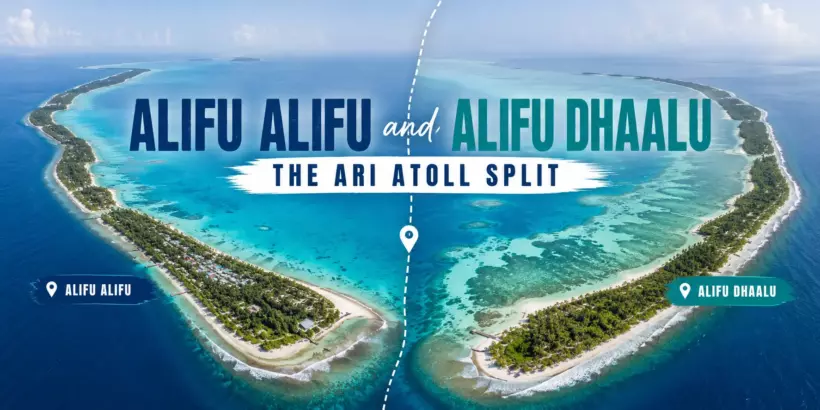
Book a resort on the same coral ring and you may end up in two different administrative atolls. One booking says Alifu Alifu, another says Alifu Dhaalu, a third says North Ari or South Ari, and a fourth just says Ari Atoll. Travellers assume the labels describe different destinations. They describe one reef with a government line drawn across it in 1984. Ari Atoll is a single natural structure roughly 96 kilometres long, and the division of it produced the two newest administrative units in the country. This guide sets out where the line falls, what each half quietly includes beyond the reef, and which published figures are wrong.
One reef, two divisions, one line drawn in 1984
Most Maldivian naming confusion comes from bundling: several separate reefs pushed under a single administrative label. Here the opposite happened. Ari Atoll, one large geographic structure, was cut in half.
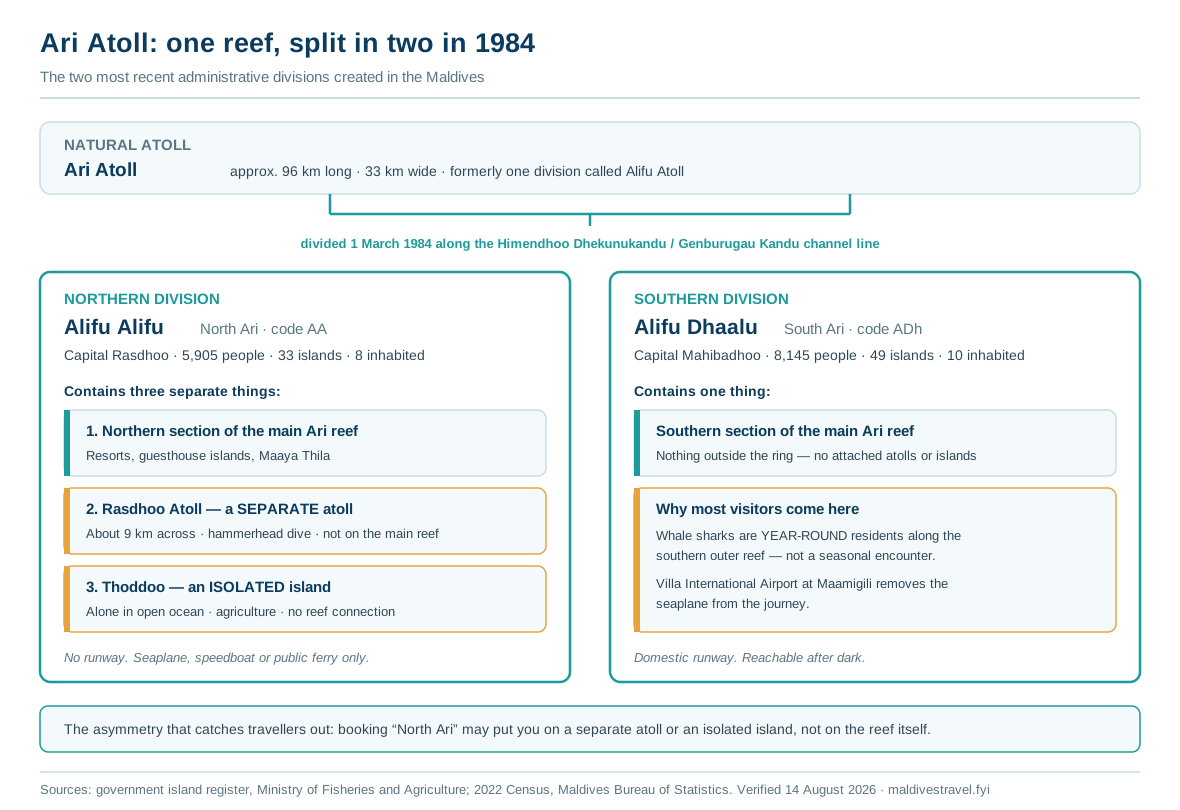
The split took effect on 1 March 1984, when the former Alifu Atoll became Alifu Alifu and Alifu Dhaalu. These are the two most recent administrative divisions created in the Maldives — every other division predates them. Huvadhu in the far south, by comparison, was split back in 1962.
The letter codes follow the Thaana alphabet and run north to south down the archipelago. Alifu Alifu carries އއ, Alifu Dhaalu carries އދ. Both begin with Alifu because both descend from the same parent atoll. That shared first letter is the clearest signal in the whole system that these two divisions are siblings rather than neighbours.
English usage never caught up. Resorts, dive operators and booking platforms almost universally say North Ari and South Ari, because those names describe the geography a traveller can see. Government paperwork says Alifu Alifu and Alifu Dhaalu. Our guide to the 26 atolls maps the full set of these pairings.
Where the line actually falls
The boundary is not a convenient midpoint. Alifu Dhaalu lies south of a line drawn between two channels: Himendhoo Dhekunukandu and Genburugau Kandu. Everything north of that line belongs to Alifu Alifu, everything south to Alifu Dhaalu.
Channels matter in Maldivian geography far more than distance does. A kandu is a break in the reef where ocean water pours in and out with the tide, and those breaks concentrate current, nutrients and consequently marine life. Drawing an administrative boundary along a channel line makes sense for boats, which have to cross open water there anyway.
For travellers this has one direct consequence. Two resorts a short distance apart on the map may sit in different divisions, with different atoll councils, different ferry routes and different names on your paperwork. The reef does not care. The forms do.
What North Ari includes beyond the reef
Here is the fact that almost no guide states clearly, and it changes how you should read a booking.
Alifu Alifu is not simply the northern half of Ari Atoll. When the division was created in 1984, it combined three separate things: the northern section of Ari Atoll, the small Rasdhukuramathi Atoll, and the isolated island of Thoddoo. Two of those three are not part of the main ring at all.
Rasdhukuramathi — usually called Rasdhoo Atoll, and marked as Ross Atoll on older Admiralty charts — is a compact separate atoll about nine kilometres across, sitting northeast of the main reef with deep water between them. Thoddoo is a single island standing alone in open ocean to the north, with no reef connection to anything.
This is the practical part. A traveller who books “North Ari” imagining a short dhoni ride to neighbouring resorts may find themselves on Rasdhoo, across a channel, or on Thoddoo, entirely alone. Both are excellent destinations. Neither sits on the main Ari Atoll ring that most people picture when they read the name. Our North Ari guide covers the resorts and local islands in detail.
The structure mirrors what happens further east, where Kaafu Atoll bundles four separate reefs under one name. The difference is direction of travel: Kaafu bundles, Ari Atoll splits, and Alifu Alifu manages to do both at once.
Why a reef this size gets split at all
Splitting is rare in the Maldives. Most administrative divisions do the opposite, gathering several small reefs under one label because none is large enough to justify its own council. Ari Atoll went the other way for a simple reason: size.
The main reef runs roughly 96 kilometres north to south and 33 kilometres across. That makes it one of the largest atolls in the country by area, and it is populated along its whole length. A single council seated at one end would have left communities at the other end a full day’s boat journey from any administrative service — in the 1980s, before speedboats were common, considerably more than a day.
The same logic produced the Huvadhu split in 1962 and the various Thiladhunmathi and Maalhosmadulu divisions. Where a natural atoll is too big to administer as one unit, it gets cut. Where several are too small, they get bundled. Ari Atoll is simply the most recent application of the first rule.
There is one consequence worth carrying into a booking. Because the split was administrative rather than geographic, nothing physical changed at the boundary. The reef continues, the currents continue, and dive sites near the line are functionally identical on both sides. Only the paperwork changes.
Diving across the line
The dive profile shifts along the length of Ari Atoll, and it shifts by position on the reef rather than by division.
The outer rim on both sides drops into open ocean and carries the pelagic traffic: reef sharks, eagle rays, tuna and the whale sharks along the southern stretch. The inner lagoon holds the thilas — submerged pinnacles rising from the lagoon floor — which offer calmer conditions and dense soft coral rather than big animals.
Three named sites carry most of the reputation. Rasdhoo Madivaru in the north is the hammerhead descent, run at dawn in open water off the separate Rasdhoo reef. Maaya Thila, roughly mid-atoll, is a pinnacle known for night dives with white-tip reef sharks. The southern outer reef between Dhigurah and Maamigili is where the whale shark boats work, usually as a snorkel rather than a dive because the animals sit near the surface.
None of these follows the administrative boundary. A diver choosing between Alifu Alifu and Alifu Dhaalu is really choosing between hammerheads at dawn and whale sharks at midday, and the honest answer is that few trips deliver both without moving.
The two capitals, and why neither is famous
Each half of Ari Atoll has an administrative seat, and neither appears in resort marketing.
Rasdhoo governs Alifu Alifu. It is small — roughly 575 by 400 metres, with 1,282 residents at the 2022 census — and sits 58 kilometres west of the capital. Divers know it for Rasdhoo Madivaru, the channel where hammerheads are seen on early morning descents, which makes it one of the few genuine shark dives reachable from a guesthouse rather than a liveaboard.
Mahibadhoo governs Alifu Dhaalu. It is one of the larger islands in the southern half and functions as a working administrative and fishing centre rather than a tourist destination.
The asymmetry is worth noting. Rasdhoo, the capital of the northern division, is not even on the main Ari reef — it governs from a separate atoll nine kilometres across. That arrangement would look odd anywhere else. In a country where administrative boundaries routinely ignore geography, it is unremarkable.
The split in numbers
Figures for these two divisions circulate in badly mangled form, so here they are against primary sources.
| Alifu Alifu (North Ari) | Alifu Dhaalu (South Ari) | |
|---|---|---|
| Thaana code | އއ (AA) | އދ (ADh) |
| Capital | Rasdhoo | Mahibadhoo |
| Population | 5,905 | 8,145 |
| Islands of all types | 33 | 49 |
| Inhabited islands | 8 | 10 |
| Created | 1 March 1984 | 1 March 1984 |
| Includes beyond the main reef | Rasdhoo Atoll, Thoddoo Island | nothing |
The southern half of Ari Atoll is larger on every measure that counts: more people, more islands, more resorts. It also holds the single feature that draws most visitors to this part of the country.
Whale sharks are year-round residents in Alifu Dhaalu waters. Not seasonal visitors, not occasional passers-by — resident. The stretch of outer reef along the southern rim supports one of the few reliable year-round aggregations anywhere, which is why whale shark trips here work in months when the animals are absent elsewhere. Our South Ari guide covers where the boats go and what the encounters actually look like.
That single fact explains most of the traffic imbalance between the two halves. It also explains why the southern division has a runway and the northern one does not: Villa International Airport at Maamigili serves the southern resorts directly, cutting the seaplane out of the journey.
Errors in published guides, and what the register says
We checked pages currently ranking for Ari Atoll against the government island register and the 2022 census. Four errors recur.
| Claim found in published guides | What the sources show |
|---|---|
| North Ari has “approximately 20 inhabited islands” | Eight: Bodufolhudhoo, Feridhoo, Himandhoo, Maalhos, Mathiveri, Rasdhoo, Thoddoo, Ukulhas |
| South Ari has “10 islands with a population of more than 12,000” | Ten inhabited islands, total division population 8,145 |
| Rasdhoo described as “an island in Alifu Atoll” | Alifu Atoll has not existed as a division since 1984 |
| Rasdhoo population “about 1,500” | 1,282 at the 2022 census |
The first error is the largest in proportion — an inhabited island count inflated by a factor of two and a half. Inhabited islands are the single most consequential number in a Maldivian atoll guide, because they determine where independent travellers can actually stay. A page that gets this wrong has not consulted any register.
The second is stranger. The population figure quoted exceeds the division’s actual population by roughly 4,000 people, and the sentence structure suggests the writer conflated an island count with a population count. Both numbers are published by the Maldives Bureau of Statistics.
The third is a dating problem rather than a factual slip, but it matters here more than usual. Alifu Atoll is precisely the name this article exists to explain, and describing Rasdhoo as belonging to it reproduces the confusion instead of resolving it.

The eighteen inhabited islands
Between them the two halves of Ari Atoll hold eighteen inhabited islands. Several have become substantial guesthouse destinations, and the differences run deeper than the shared reef suggests.
| Island | Division | Known for |
|---|---|---|
| Ukulhas | Alifu Alifu | Waste management model island, strong beach |
| Thoddoo | Alifu Alifu | Agriculture, watermelons, isolated position |
| Rasdhoo | Alifu Alifu | Division capital, hammerhead diving |
| Mathiveri | Alifu Alifu | Quiet guesthouse island, sandbank access |
| Bodufolhudhoo | Alifu Alifu | Small, low visitor volume |
| Feridhoo | Alifu Alifu | Fishing, minimal tourism |
| Himandhoo | Alifu Alifu | Fishing, minimal tourism |
| Maalhos | Alifu Alifu | Westernmost island, Vajrayana Buddhist remains |
| Dhigurah | Alifu Dhaalu | Whale shark access, long sandbank |
| Maamigili | Alifu Dhaalu | Domestic airport, whale shark boats |
| Dhangethi | Alifu Dhaalu | Guesthouses, traditional layout |
| Mahibadhoo | Alifu Dhaalu | Division capital, fishing centre |
| Fenfushi | Alifu Dhaalu | Historic mosque with lacquerwork panels |
| Omadhoo | Alifu Dhaalu | Guesthouses, quiet |
| Dhiddhoo | Alifu Dhaalu | Small community |
| Hangnaameedhoo | Alifu Dhaalu | Small community |
| Kunburudhoo | Alifu Dhaalu | Small community |
| Mandhoo | Alifu Dhaalu | Small community |
Two entries carry history that predates the resorts by a millennium. Maalhos holds Vajrayana Buddhist remains, and Fenfushi has an ancient mosque with decorated wooden ceilings and lacquerwork panels. Buddhist remains including a stupa have also been found on Ariadhoo. These islands were inhabited long before the conversion to Islam in 1153, and Ari Atoll holds more of that archaeology than any resort brochure suggests.
Dhigurah and Maamigili are the two names to know if whale sharks are the reason for the trip. Both sit at the southern end, both run boats daily, and both offer guesthouse pricing rather than resort pricing. The dress code rules apply on all eighteen of these islands.
Which half you are actually booking
The two halves of Ari Atoll have drifted into genuinely different roles, and the choice between them is real once you know what it is.
South Ari is the marine wildlife half of Ari Atoll. Year-round whale sharks, a long outer reef, the largest concentration of dive sites in the atoll and a runway at Maamigili that removes the seaplane from the equation. If your trip is built around getting in the water with large animals, the southern division is the answer and the northern one is a compromise.
North Ari is the quieter, more varied half. Fewer resorts, stronger guesthouse islands, the hammerhead dive at Rasdhoo Madivaru, and Thoddoo standing alone with agriculture and a good beach. Transfers are typically by seaplane or a long speedboat run, since there is no runway on this side.
The honest limitation applies to both. Neither half offers the manta spectacle of Baa during Hanifaru season or the shark-heavy channel diving of Vaavu. What Ari Atoll offers is reliability: the whale sharks are there in months when other marine encounters are a lottery. Our ranking of atolls and the companion piece on which to skip place both halves against the rest of the country.
What the naming means when you book
Three things follow from the 1984 split.
First, treat North and South as one reef with two councils, not as competing destinations. A resort’s position on the outer or inner rim of Ari Atoll matters more than which division issued its licence. Inner-lagoon properties have calmer water and less dramatic diving; outer-rim properties have the opposite.
Second, check whether your northern property is actually on the main reef. Rasdhoo and Thoddoo are administratively North Ari and geographically separate. That affects excursion options, boat times and whether nearby resorts are reachable at all.
Third, let the runway drive the decision if time is tight. A southern resort near Maamigili can be reached by domestic flight plus a short boat, which beats a seaplane on both reliability and operating hours. Seaplanes do not fly after dark, so a late arrival at Velana can cost you a night in the capital — see our guide to overnighting in Malé. The transfer comparison sets out the trade-off in full.
The same split-versus-bundle pattern repeats across the country. Gaafu Alifu and Gaafu Dhaalu divide Huvadhu the same way, Faafu and Dhaalu divide the Nilandhe atolls, while North Malé and South Malé sit inside a single division despite being two separate reefs.
Getting there, and why it differs by half
Access is the one area where the administrative line does correspond to something real, because the runway sits on only one side.
Southern resorts and guesthouses are reached by domestic flight to Maamigili followed by a boat transfer, typically 25 minutes in the air and anything from 10 to 40 minutes on the water. The flight operates on a fixed schedule and, crucially, is not restricted to daylight in the way a seaplane is.
Northern properties have no runway. They are reached by seaplane, which takes roughly 25 minutes from Velana but only operates between sunrise and sunset, or by speedboat, which runs 60 to 90 minutes depending on where in Ari Atoll you are heading. Rasdhoo and Thoddoo are served by public ferry as well, at a fraction of the price and several times the duration.
The practical rule: if your flight lands in the evening, the southern half of Ari Atoll is reachable the same day and much of the northern half is not. That single constraint drives more booking decisions in this atoll than any difference in reef quality.
Frequently asked questions
Is Alifu Alifu the same as North Ari Atoll? Yes, with one qualification. Alifu Alifu is the administrative name and North Ari the common English one, but the division also includes Rasdhoo Atoll and Thoddoo Island, which are separate geography rather than part of the northern reef.
When was Ari Atoll divided? On 1 March 1984, when the former Alifu Atoll became Alifu Alifu and Alifu Dhaalu. These are the two newest administrative divisions in the Maldives.
Which half has the whale sharks? Alifu Dhaalu, the southern division. The animals are year-round residents along the southern outer reef, which is unusual — most Maldivian marine encounters are seasonal.
What are the capitals? Rasdhoo for Alifu Alifu and Mahibadhoo for Alifu Dhaalu. Neither is a resort island, and Rasdhoo is not on the main reef.
How many islands are there? Thirty-three in the northern half of Ari Atoll and forty-nine in the southern, eighty-two in total. Eighteen are inhabited; the rest are resorts, uninhabited islands, an airport island and sandbanks.
Is there an airport in Ari Atoll? Yes, in the southern half. Villa International Airport at Maamigili serves domestic flights and removes the need for a seaplane to southern resorts. The northern division has no runway.
Is Conrad Rangali in Ari Atoll? Yes, in the southern division. Rangalifinolhu sits in Alifu Dhaalu, and guides that place this resort in the Malé atolls have it roughly 90 kilometres out of position — a common enough error to be worth checking on any page listing resorts by atoll.
Can I island-hop between the two halves? Not easily. Public ferry networks inside Ari Atoll run within divisions rather than across them, and the channel crossing between Rasdhoo and the main reef needs a scheduled boat. Most travellers pick one half.
What to take from this
Ari Atoll is one coral structure with a government line through it, drawn in 1984 and never reflected in how the place is marketed. The northern half of Ari Atoll carries two pieces of geography that are not part of the reef at all. The southern division carries the whale sharks and the runway. Neither name tells you anything about the resort you are booking.
Read the position on the reef, check whether a northern property is actually on the main ring, and let the runway decide if your trip is short. The division names belong on the paperwork, not in the decision.
Next step: read the North Ari and South Ari guides side by side, then check whale shark season before fixing dates.
Verified 14 August 2026 against the government island register maintained by the Ministry of Fisheries and Agriculture, and the 2022 Maldives Census published by the Maldives Bureau of Statistics.