Guesthouses in the Maldives: A Room in a Village
Until 2009 you could not do this. Tourists stayed on uninhabited resort islands and Maldivians lived elsewhere, and the separation was deliberate policy.
Then guesthouses on inhabited islands were legalised and a second Maldives opened. Rooms from about USD 60 a night, meals at USD 5 to 13, the same reefs and excursions at a third of the price, and an island with a working community on it.
It is not a cheaper version of the resort holiday but a different one, with its own rules. This guide covers what a guesthouse stay involves, including the parts less comfortable than the price suggests.
Why the category exists at all
Two paragraphs of history, because they explain everything about how a guesthouse stay feels.
The original model separated tourism from the population entirely. One island, one resort, no residents. It protected a conservative society from the industry paying for it, and it worked commercially for three decades.
Guesthouses on inhabited islands were legalised in 2009. The effect has been substantial: a tourism industry owned by Maldivians rather than by international operators, on islands that previously saw no visitor money at all. Rooms, boats, cafés and dive centres, run by the people who live there.
Which is why the rules feel improvised in places. Fifteen years is not long, communities are still deciding what they want from visitors, and the answer differs island by island. It is also why visitor behaviour matters more here than at a resort: how open these islands stay is partly a function of how guests behave now.
And why the category is still growing fast. New islands open to guesthouse tourism regularly, which means the quiet island of five years ago is the busy one today — the pattern our guide to choosing a local island tracks.
The wider background is in our history of how the Maldives embraced Islam and our guide to what the country runs on.
What a guesthouse actually is
Not a hostel, and not a resort villa.
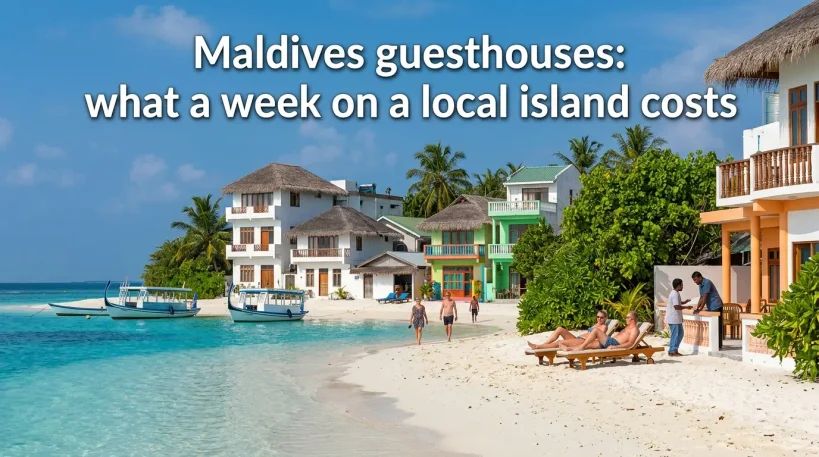
A guesthouse is a small hotel in a village, typically eight to thirty rooms, frequently family-owned and family-run, in a building on an ordinary street among ordinary houses.
The room. A guesthouse room has air conditioning, hot water, a private bathroom, wifi and usually breakfast. Clean and functional rather than designed. At the upper end of the category some are genuinely smart; at the lower end they are a bed and a fan-cooled room.
No bar, no spa at most properties, no room service, no beach of its own.
Guesthouse staff live on the island, which is the single largest difference from a resort. The person at the desk walks home at the end of a shift, to a house four streets away.
And a village around it. Cafés, shops, a harbour, a mosque, a school, a football pitch. That is the product, and it is what a resort cannot supply at any price.
What it costs
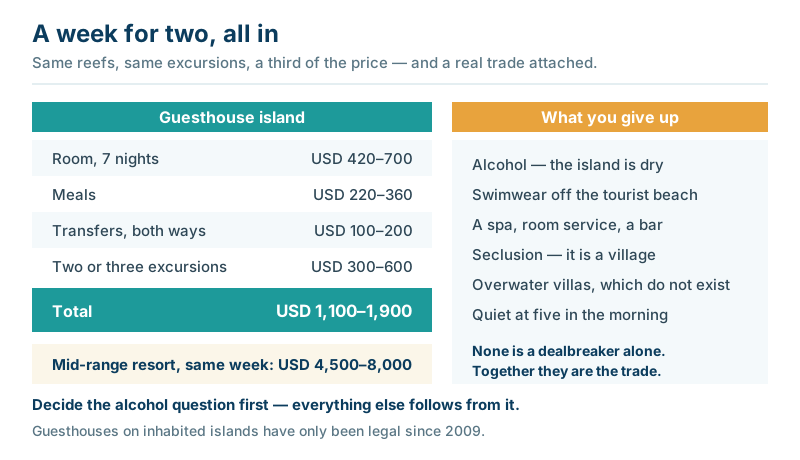
Seven nights for two people in a guesthouse, excluding international flights.
| Guesthouse island | |
|---|---|
| Room, 7 nights | USD 420–700 |
| Meals | USD 220–360 |
| Transfers, both ways | USD 100–200 |
| Two or three excursions | USD 300–600 |
| Rough total | USD 1,100–1,900 |
Against USD 4,500 to 8,000 for the same week at a mid-range resort, on the comparison in our where to stay pillar.
Where the saving comes from. Not from worse water — the reefs are the same reefs. It comes from accommodation built at village scale, food at local prices and excursions sold by independent operators. It also comes from the absence of the service charge and 17% TGST that compound to about 28.7% at a resort, as our guide to money explains.
What is not cheaper: the international flight, and the transfer if you choose a speedboat over the public ferry.
The rules you live under
This is the part that decides whether a guesthouse stay suits you, and none of it is negotiable.
No alcohol. Inhabited islands are dry. None is sold, none is served, and bringing it through customs is an offence — our guide to alcohol rules covers the detail, including the floating bars some islands have offshore.
Swimwear on the designated tourist beach only. Not on the walk there, not in the guesthouse garden if it faces the street, and not anywhere else on the island. Shoulders and knees covered otherwise, for men and women both — the specifics are in our guide to dress codes.
No public displays of affection, which catches honeymooners.
Friday is the weekend, and the island closes for the main prayer, roughly 11:30 to 13:30.
During Ramadan cafés close during daylight and the rhythm of the island inverts. Guesthouses continue to serve guests, and eating discreetly is the expectation.
The call to prayer sounds five times a day from a loudspeaker, the first at around five in the morning. On a small island you will hear it from every room. Some visitors stop noticing after two nights; some do not.
None of these are impositions on visitors specifically. They are how the island lives, and you are staying in it rather than beside it.
The bikini beach
The arrangement that makes the whole model work, and it is worth understanding properly.
Islands with tourism designate a stretch of beach where swimwear is permitted. It is frequently screened by matting or planting, and it is usually the best beach on the island.
Its size and quality vary enormously. On the established islands it is a proper beach. On a smaller island it can be a short strip with a view of the harbour.
Check it before booking, because it is where you will spend the daylight hours you are not on a boat. Satellite imagery shows it; reviews mention it; and a guesthouse will answer a direct question about how far it is from the property.
Outside it, cover up — including on the walk back, wet, which is the rule visitors most often forget.

What a day actually looks like
From our own stay on Maafushi, and consistent with what the established islands offer generally.
Seven. Breakfast at the guesthouse — mas huni, roshi, eggs, fruit, sweet tea. Included at almost every property.
Nine. The excursion boat, if you booked one. Sandbank, snorkelling, dolphins, fishing — USD 25 to 60 rather than the resort’s USD 90 to 300, on the comparison in our excursion price guide.
Two. Back, and the island goes quiet. This is the hottest part of the day and nothing happens in it.
Four. The cafés fill for hedhikaa — short eats and sweet tea — and this is the most sociable hour on any Maldivian island. Two dollars, and it is the thing we remember most clearly.
Six. Football on the pitch, every evening, and the light goes gold. Nobody sold you a ticket.
Eight. Dinner. Tuna curry, reef fish, rice, roshi, at USD 5 to 13 — the range is in our food guide.
Eleven. The island is asleep.
What is missing from that day: a bar, a spa, a sunset cocktail and a sense of occasion. What is in it: an actual place.
Choosing the island first
The island matters more than the guesthouse itself, and most people research it the other way round.
Maafushi is the largest and most developed: dozens of guesthouses, a wide choice of operators, restaurants, and the busiest tourism scene on any inhabited island. Easiest, and least like a village.
Quieter alternatives — Thoddoo, Ukulhas, Dhigurah, Fulidhoo, Rasdhoo, Thulusdhoo and others — trade choice for character. Our guide to choosing a local island compares them properly.
The general rule: the more guesthouses an island has, the easier the stay and the more it resembles a tourist environment. The fewer it has, the more interesting and the more responsibility falls on you to behave well.
Distance from Malé decides the transfer, which decides both cost and how fixed your dates are — the ferry runs on its own schedule and does not run on Fridays.
And the island decides the diving. Dhigurah for whale sharks, Rasdhoo for hammerheads, Fulidhoo for Vaavu’s channels, Thulusdhoo for surf.
Guesthouse islands are changing fast
Worth a short section, because the island you read about is not always the island you arrive at.
New islands open to guesthouse tourism regularly, and established ones keep building. The category is fifteen years old and still in its expansion phase.
Which means reviews date quickly. A two-year-old review describing a quiet island with three guesthouses may be describing a place that now has twenty.
And the busiest islands are becoming something else. Maafushi has restaurants, dive centres, souvenir shops and a tourism economy that dominates the island. That is convenient, and it is less like a village than it was.
The quieter islands carry the opposite risk: fewer boats, fewer excursion options, a smaller bikini beach and less English spoken.
What to do about it. Read reviews from the last six months rather than the last three years, and weight them for noise, construction and the beach. Those three change fastest.
And accept the trade honestly. There is no island that is both fully equipped and untouched. The choice is where on that line you want to sit, which is what our guide to choosing an island exists to help with.
Choosing the guesthouse
Seven things to check on a guesthouse listing, and none of them is the photograph of the room.
Distance to the bikini beach, in minutes. Two is a different holiday from twelve, in this heat, several times a day.
Whether the room has a window, and what it faces. Some rooms in this category are internal.
Air conditioning, and whether it is included. A few properties meter it.
Generator and mosque proximity. Small islands run generators, and a room beside one is loud. The mosque loudspeaker is loudest nearest the mosque, and the first call is at five.
Construction. These islands are building, constantly, and a guesthouse next to a site is a guesthouse with a jackhammer at seven in the morning. Recent reviews mention it; photographs do not.
Whether breakfast is included, and whether the property serves other meals. Many do not, which is fine on an island with cafés and awkward on one without.
Whether they arrange transfers, and at what price. Most do, and the price is usually fair; the alternative is booking a scheduled speedboat yourself.
What not to weight heavily: the star rating, which is not standardised, and the pool, which most properties do not have and which matters less than the beach.
The honest downsides
Written by people who stayed in one, and none of these are dealbreakers on their own.
No alcohol is the one most visitors underestimate. Seven days without a drink at sunset is fine for some and a genuine absence for others. Be honest with yourself before booking.
The five o’clock call to prayer. Amplified, close, daily.
Water is not drinkable from the tap. Bottled water is cheap and constant, and it is a plastic problem the country is aware of.
Beaches vary. The bikini beach on a busy island can be crowded and the sand can be coarse. The photographs on booking sites are usually of a sandbank an hour away.
Food gets repetitive on smaller islands, where three cafés serve broadly the same menu.
Construction noise, as above.
No privacy in the resort sense. You are in a village, and villages are not quiet or empty.
Boats are the schedule. If the ferry does not run, you do not travel, and Fridays remove the option entirely — a constraint our ferry guide covers in detail.
And the honest summary: you are trading comfort and licence for cost and reality. Whether that is a good trade is a question about you rather than about the islands.

What you actually do all week
The question people ask about a guesthouse island when they hear there is no bar.
Snorkel. From the beach where the reef allows it, or on a boat trip — our snorkelling guide covers the difference, and the house reef on a guesthouse island is a real thing at several of them.
Dive. Guesthouse island dive centres run the same sites as the resorts at a third to a half of the price, on the arithmetic in our diving guide.
Take two or three excursions across the week: a sandbank, a dolphin cruise, a night fishing trip. That is the right number, as our activities overview argues.
Visit a neighbouring island, which costs a few dollars by ferry and shows you a quieter version of where you are.
Eat in the cafés, which is the underrated part.
And do nothing, on a beach, for large parts of several days. That is the actual product of this country and it is free.
Who it suits
Divers on a budget, unambiguously. The single strongest case for the model.
Independent travellers who would rather be somewhere than at a property.
Anyone curious about the country, which a resort cannot show you.
Families with older children, who find other children and a football pitch.
Long trips. Two weeks on a guesthouse island costs what four nights at a resort does, and the country rewards time.
Who it does not
Anyone who wants a drink at sunset. Say so early and book a resort.
Honeymooners looking for seclusion, which is the one thing a village cannot provide — our honeymoon guide covers the alternatives.
Families with very young children, where the shallow lagoon and kids’ club of a resort genuinely earn their price.
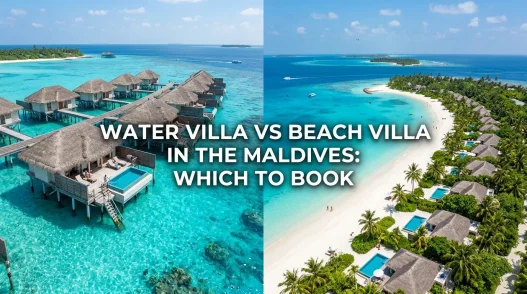
Anyone travelling for the villa, since there are no overwater villas on inhabited islands at all — the comparison is in our villa guide.
Anyone whose comfort threshold is high. These are simple properties, and simple means simple.
The split stay
The pattern this site keeps recommending, and the guesthouse half is what makes it work.
Three or four nights on an inhabited island, three or four at a resort. The total lands below a full week at the resort alone, and the trip contains both halves of the country.
Do the island first. Village then resort reads as an upgrade; the reverse reads as a downgrade, however unfair that is to the island.
Logistically it is easy if both are in Kaafu, where a transfer between them is an hour and a modest fare.
And it answers the alcohol question, for anyone who wants both the village and the sunset drink.
Booking
Book directly or through the standard platforms. The price gap between the two is smaller for a guesthouse than for a resort.
Confirm the transfer when you book the guesthouse, including the price, the departure time and what happens if your flight is delayed. Guesthouse islands are reached by scheduled speedboat or public ferry, and the last boat is earlier than people expect — the risk is covered in our guide to missed connections.
Ask three questions before paying: how many minutes to the bikini beach, is breakfast included, and do you arrange excursions or should I book on the street. The third answer tells you whether the guesthouse takes a margin, which is normal and worth knowing.
Book weeks rather than months ahead outside the December to April peak, on the pattern in our seasonal guide.
Read recent reviews specifically for noise, construction and beach condition. Those three change faster than anything else on a small island.
Health, safety and practicalities
There are no lifeguards, anywhere in the country, and the current at a channel edge is the genuine hazard — our safety guide covers what actually goes wrong here.
Medical facilities are limited on smaller islands: a health post rather than a hospital, with serious cases moved to Malé.
Bring what you need. Pharmacies exist on the larger guesthouse islands and stock less than you would expect.
Mosquitoes at dusk, more than at a resort, because a village has vegetation and standing water.
Cash matters. Cards are accepted at most guesthouses and frequently not at cafés and small shops — our guide to money covers what to carry.
Power is the British three-pin type, as our guide to sockets and adapters explains.
A local SIM or eSIM is worth buying at the airport. Guesthouse wifi is real and variable.
Where we stayed, and what that is worth
Stated plainly, because most accommodation writing does not.
We stayed on Maafushi, and the photographs in this article are our own. The four o’clock café hour, the walk to the bikini beach, the difference between a guesthouse’s excursion price and the same trip bought from a shopfront on the main street — those are things we did rather than things we read.
We have not stayed on every island in this category, and the article says which ones are quieter rather than ranking them, because that is what we can support.
We have not stayed overnight at a Maldivian resort, which is why the comparisons in this article are structural — price, rules, transfer, what is included — rather than judgements about which is nicer.
That is a narrower promise than most sites make, and it is one we can keep.
Questions travellers ask
What is a guesthouse in the Maldives? A small hotel, usually eight to thirty rooms, on an inhabited island among ordinary houses. Air conditioning, hot water, wifi and breakfast are standard. There is no bar, no spa at most properties and no private beach.
How much does a guesthouse cost? From about USD 60 a night, with meals at USD 5 to 13 and excursions at USD 25 to 60. A week for two, all in, runs roughly USD 1,100 to 1,900 including transfers.
Can you drink alcohol on a guesthouse island? No. Inhabited islands are dry. Some islands have a floating bar offshore, which is a boat ride and a separate expense.
Can I wear a bikini? Only on the designated tourist beach, which islands with tourism provide. Elsewhere, shoulders and knees covered — including on the walk to and from the beach.
Is the diving as good as at a resort? The sites are the same sites. Guesthouse island dive centres run to the same reefs and channels at a third to a half of the price.
Which island should I choose? Maafushi is the largest and easiest. Thoddoo, Ukulhas, Dhigurah, Fulidhoo and Rasdhoo are quieter, with the trade-off that fewer guesthouses means less choice and more responsibility to behave well.
Are guesthouses suitable for families? For families with older children, yes — there are other children, a football pitch and shallow water. For very young children, a resort’s kids’ club and shallow lagoon are worth the price difference.
What is the biggest downside? No alcohol, for the people it matters to. After that: the five o’clock call to prayer, construction noise, and beaches that vary far more than the booking photographs suggest.
What to take away
- Guesthouses on inhabited islands have only been legal since 2009, and they opened a second Maldives at a third of the price.
- A week for two runs USD 1,100 to 1,900 all in, against USD 4,500 to 8,000 at a mid-range resort — for the same reefs and the same excursions.
- The rules are not negotiable: no alcohol, swimwear on the designated beach only, covered shoulders and knees everywhere else.
- Choose the island before the guesthouse, and check the distance to the bikini beach in minutes before anything else.
- The honest downsides are the dry island, the five o’clock call to prayer, construction noise and variable beaches. None is a dealbreaker; together they are the trade.
Next step: decide the alcohol question honestly, because everything else follows from it. If a drink at sunset matters, book the split stay and put the island first. If it does not, a guesthouse island gives you the same water, the same reefs and the actual country for a third of the money.