
The Hotel That Moves: Liveaboards in the Maldives
Every resort in this country has the same structural weakness: when the wind turns, the island cannot follow it.
A liveaboard can. If the current reverses or the swell builds on one side of an atoll, the boat sails overnight to the sheltered side and the week continues. That single capability makes a liveaboard the best value in the Maldives for anyone whose trip is built around what is underwater. It is also invisible on a price comparison.
This guide covers what the week involves, what it costs once the extras are added, the support-boat arrangement that surprises first-timers, and the safety questions worth asking.

What you are actually booking
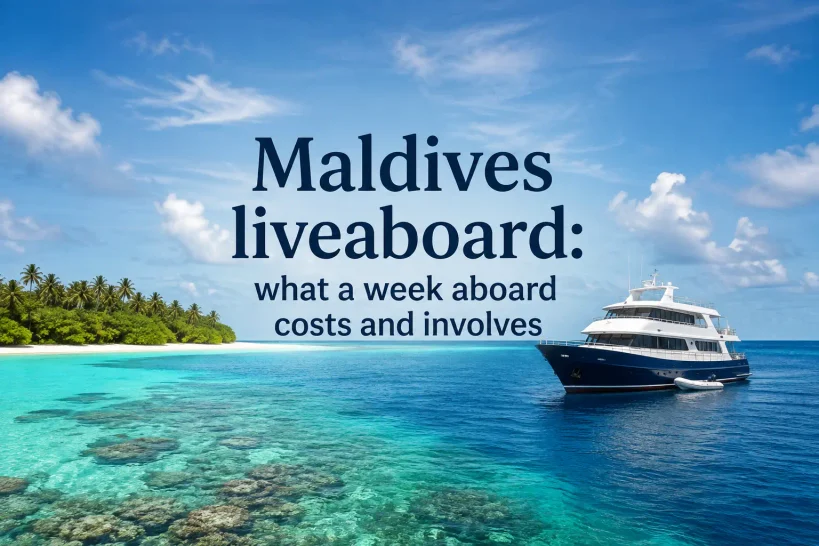
A liveaboard is a boat that is also your hotel, typically for seven nights, moving between dive sites and anchoring overnight.
Cabins with ensuite bathrooms and air conditioning on almost every liveaboard operating commercially here. This is not a sailing holiday; the boats are purpose-built for diving and the cabins are hotel rooms that move.
Full board is included, with a cook aboard. Meals are frequent and substantial, because four dives a day is work.
Three to four dives daily, plus night dives on scheduled evenings.
Ten to thirty guests, depending on the vessel — a small enough group that the week has a social character no resort island offers.
And a crew who live aboard, several of them dive guides who work the same routes all season and know where the animals are — including the turtles and reef sharks most guests hope for.
The dhoni, which surprises people
The Maldivian liveaboard arrangement is unusual and worth explaining before you arrive.
Most liveaboards here run with a separate support vessel — a traditional dhoni running alongside the main boat.
The dhoni carries the diving. Tanks, the compressor, weights, assembled kit and the crew who handle it. You dive from the dhoni, not from the mothership.
Which means your gear stays set up all week, on the same bench, and you never carry a tank up a ladder.
It also means the two vessels separate. The dhoni takes divers to the site while the mothership repositions, and the two meet again afterwards. On a drift dive you surface somewhere entirely different from where you entered, and the dhoni is there.
Non-divers stay on the mothership, which is quieter and more comfortable than a dive boat.
Why it matters practically: the compressor noise, the wet gear and the mess of a dive operation are all on the other boat. It is a genuinely better arrangement than most liveaboard destinations offer, and almost nobody explains it in advance.

What it costs
From about USD 150 per person per day, including the cabin, all meals and three to four dives. Seven nights is therefore roughly USD 1,050 upward, with mid-range boats considerably more and luxury vessels several times that.
What is included: cabin, full board, the diving, tanks, weights and guides.
What is not, and it adds up:
| Extra | Typical |
|---|---|
| Green tax and government fees | Per person per night |
| Marine park fees | USD 6–15 per protected site |
| Nitrox, if you use it | USD 80–150 for the week |
| Equipment rental | USD 15 per dive, or a weekly rate |
| Soft and alcoholic drinks | Charged aboard |
| Crew gratuity | Customary, and see below |
| Airport transfer | Sometimes included, often not |
Budget 20 to 35 per cent above the headline fare for a realistic total, and more if you rent everything and drink.
Against a resort: twelve to eighteen dives aboard, against perhaps six to ten at a resort at USD 110 to 200 each. Add equipment, and the 28.7% compounding service charge and tax explained in our guide to money. The arithmetic is in our diving guide, and the liveaboard wins clearly for anyone diving daily.
The routes
Liveaboard itineraries follow the monsoon rather than a fixed schedule, which is the point of the format.
The central route — Malé, Ari and sometimes Baa — is the classic week and the one most first-time liveaboard guests book. Channel diving, manta cleaning stations, whale sharks in the south of Ari, and Maaya Thila at night.
The northern route reaches atolls with very little resort development and correspondingly few boats — the geography is in our atolls guide.
The southern route — Huvadhu, Addu and the far south — has the biggest channels, the strongest current and the emptiest sites in the country. It usually requires a domestic flight to join and leave the boat, covered in our domestic airlines guide.
Special itineraries run for the Hanifaru manta season and for whale shark focus, and these fill furthest ahead. The seasonal picture is in our high and low season guide.
The route is chosen by the operator against the conditions, and a good one will change it mid-week. That flexibility is what you are paying for, and a boat that runs the identical itinerary regardless of weather is not using the format.
Why the weather flexibility matters
The argument that decides it for many divers, and it is worth being explicit.
A resort dives what is within an hour of its island. If the wind is on that side of the atoll for a week, the week is compromised.
A boat moves overnight. Different atoll, different side, different sites — and the guest notices only that the diving was good.
This matters most in the transition months, April and November, when the monsoon reverses and nobody can forecast the current a day ahead. Our diving season calendar explains the mechanism.
And in the southwest monsoon, May to November, when wind cancels resort boat dives that a liveaboard simply sails away from — the distinction our rainy day guide draws between rain and wind.
The corollary: a liveaboard week in the wet season is a far better proposition than a resort week in the same conditions, at a lower price. This is the strongest seasonal argument in the whole accommodation category.
What a day looks like
Consistent across liveaboard operators, and more demanding than people expect.
06:00. Wake, light breakfast — fruit, toast, coffee. Nobody dives on a full stomach.
06:45. First briefing. The site is chosen that morning against the current.
07:00. Onto the dhoni, and the first dive of the day, frequently the best one — dawn is when the channel sites are most active.
08:30. Proper breakfast, back aboard.
10:30. Second dive, then lunch.
14:30. Third dive.
Late afternoon. The mothership repositions while you sleep, read or sit on the sun deck. This is the hour that makes the format restful rather than relentless.
18:30. Night dive on scheduled evenings, then dinner.
21:00. Most guests are asleep by ten. Four dives is genuinely tiring.
And one day is different: the last full day is usually a single morning dive or none at all, because of the no-fly interval before your flight out of Velana.
The no-fly rule, which shapes the last day
Worth its own section, because it catches people out at the expensive end.
You cannot dive and then fly immediately. Standard guidance is an interval of at least 18 to 24 hours between the last dive and altitude, and every operator plans the week around it.
Which means the final day is a non-diving day, spent on the boat or in Malé.
It also applies to seaplane transfers, not just the international flight — a point our guide to seaplane transfers makes and which surprises divers heading to a resort afterwards.
If you are combining a liveaboard with a resort, put the boat first. The no-fly interval then falls at the end of the trip rather than in the middle.
And build a buffer. A liveaboard returning to Malé on the morning of an evening flight has no margin if the sea is rough, which is the situation our guide to missed connections exists for.
Who it does not suit
The honest list, and it is longer than the marketing suggests.
Non-divers. There is very little to do on a boat between dives if you are not diving. Some boats accommodate snorkellers well and most do not, and a week is a long time.
Couples where one dives and one does not. This is the commonest liveaboard mistake. The non-diving partner spends seven days on a boat with four dive briefings a day and no way to leave.
Anyone prone to seasickness. The boats are stable at anchor and less so under way, and the mothership repositions at night. Take something before boarding rather than after, and choose a lower-deck midships cabin.
Anyone who wants a beach. You will see beaches and rarely stand on one. A sandbank stop is a highlight rather than a routine.
Nervous or very new divers. Many Maldivian routes want an Advanced certification and a logged-dive minimum, because the channel diving involves current — the requirements are in our diving guide.
Anyone who needs privacy. Cabins are small, the boat is shared, and there is nowhere to be alone.
Families with small children. A few boats accept them and the format is not designed for it.
If one of you does not dive
The single most common liveaboard mistake, and it deserves its own section rather than a warning line.
Seven days is a long time on a boat with four dive briefings a day if you are not diving. There is no beach to walk on, no town, no spa and nowhere else to be.
What some boats offer non-divers: snorkelling from the dhoni at some sites, a sun deck, and the sandbank stops. That is a real offer on the boats that mean it and a courtesy on the ones that do not.
Ask the operator directly: how many sites on this itinerary are snorkellable, and does the dhoni drop snorkellers separately? A specific answer means they have thought about it; a vague one means they have not.
The honest alternatives. A guesthouse island where one partner dives daily at a third of resort prices and the other has a village, a beach and excursions. Or a resort with a strong dive centre, where the diving is worse and the week is better for one of you.
Or split the trip. A week’s liveaboard for the diver, then a few nights together at a resort afterwards — which the no-fly rule requires in that order anyway.
The pattern to avoid is booking a boat because the diver wants it and assuming the other person will find something. On a liveaboard, there is nothing to find.
The safety questions worth asking
This section exists because liveaboard incidents happen, including fires. The questions below are reasonable to ask of any operator.
What is the vessel’s safety record, and has it been surveyed recently? A confident operator answers directly.
Are there smoke detectors in the cabins, and where are the escape routes? Know both before the first night, in the same way you would on an aircraft.
How many crew, and are any dedicated to safety rather than service?
Is there oxygen aboard, and is the crew trained to administer it? This is not optional on a dive boat.
What is the nearest hyperbaric chamber to the route? There are four in the country, all at resorts, and none south of Dhaalu Atoll. That matters enormously on a southern itinerary, as our safety guide sets out.
Is dive insurance required, and does yours cover chamber treatment? Treatment costs USD 5,000 to 15,000 and many standard travel policies exclude it.
Where does the boat sleep? Anchoring in a sheltered lagoon overnight is normal. Sleeping under way is less comfortable and, on some routes, unavoidable.
None of these questions is impolite. An operator who is irritated by them has answered the first one.
Cabins, and which to book
Small differences between liveaboard cabins, and they affect the week.
Lower deck, midships is the most stable and the least affected by motion. Book it if you are prone to seasickness, and accept a porthole rather than a window.
Upper deck cabins are larger, brighter and move more.
Twin versus double matters on a boat where cabins are narrow, and a couple in a twin converted to a double may find it tight.
Air conditioning is standard, and it is also noisy on older vessels.
Ensuite is standard on any boat operating for international guests. If a listing does not say so, ask.
And the sun deck is the actual living space. Cabins are for sleeping; the week happens on the deck between dives.
Booking
Book a liveaboard six to twelve months ahead for peak season and for the Hanifaru manta itineraries, which fill first.
Deposits are substantial and cancellation terms are strict, because a boat sells a fixed number of berths.
Group charters — booking the whole vessel — are common for dive clubs and are frequently better value per person than individual berths, with the added benefit that you choose your fellow guests.
Check what certification the route requires before paying, not after.
Read what is included with the same care our budget and all-inclusive guide recommends for resorts. The gap between the headline fare and the final bill is larger on a boat than at a hotel.
And ask about the gratuity convention. Crew tipping on liveaboards is customary, expected and larger than at a resort — frequently a percentage of the fare, pooled across the crew. Our tipping guide covers the wider picture; on a boat, ask the operator directly what is normal.
Surf charters, briefly
The same model applied to a different sport.
A surf charter is a liveaboard with boards instead of tanks, running the central atoll breaks that no resort can reach.
The flexibility argument is even stronger. Surf depends on swell direction and wind, both of which move, and a boat follows them.
The season is the southwest monsoon, roughly March to November, on the pattern our surf season calendar sets out.
And the crowds are the point. The central atolls are empty because access requires a boat, which is precisely what a charter provides.
Liveaboard or resort?
The liveaboard comparison, made plainly.
Book a liveaboard if: you dive daily, you want the most dives per dollar, you are travelling in the wet season, or you are a group of divers who can charter the whole vessel.
Book a resort if: you are travelling with a non-diver, you want a beach, or seasickness is a real concern. Also if you are diving two or three times across a week rather than daily.
Book a guesthouse island if: you want serious diving at low cost and the option to stop. Dive centres there run the same sites at a third to a half of resort prices, as our guesthouse guide explains.
Or do both. A liveaboard week followed by three nights at a resort, in that order because of the no-fly rule, is what experienced Maldives divers converge on.
Questions travellers ask
How much does a Maldives liveaboard cost? From about USD 150 per person per day including cabin, all meals and three to four dives — so roughly USD 1,050 upward for seven nights, before extras. Budget 20 to 35 per cent above the fare for park fees, nitrox, equipment, drinks and gratuity.
How many dives will I do? Twelve to eighteen across a week, against perhaps six to ten at a resort. Three to four a day, plus night dives on scheduled evenings.
What is the dhoni for? On Maldivian liveaboards a separate traditional boat carries the tanks, the compressor and the dive operation. You dive from it while the mothership repositions, and your gear stays set up all week.
Do I need to be an experienced diver? For most routes, yes. Advanced certification and a logged-dive minimum are common requirements because the channel diving involves current. Nitrox is recommended for three or four dives a day.
Will I be seasick? Possibly. The boats are stable at anchor and move at night. Take something before boarding, and book a lower-deck midships cabin if you are prone to it.
Can non-divers come? They can, and most will not enjoy a week. There is little to do between dives, and some boats accommodate snorkellers better than others — ask specifically before booking.
When can I fly after the last dive? Standard guidance is 18 to 24 hours, which is why the final day of a liveaboard is a non-diving day. It applies to seaplane transfers as well as to international flights.
Is a liveaboard better than a resort? For anyone diving daily, on cost and on dive count, clearly. A boat also follows the weather, which no island can do. For non-divers, families and anyone wanting a beach, a resort is better.
What to take away
- A liveaboard moves when the weather turns, which no resort island can do. That is the format’s real advantage and it matters most in the wet season and the transition months.
- From about USD 150 per person per day including cabin, meals and three to four dives — then budget 20 to 35 per cent more for park fees, nitrox, equipment, drinks and gratuity.
- Maldivian boats dive from a separate dhoni that carries the whole operation, so your gear stays set up and the mess stays on the other vessel.
- The last day is a non-diving day because of the 18 to 24 hour no-fly interval, which applies to seaplanes as well as flights.
- Ask the safety questions — survey, escape routes, oxygen, and the nearest chamber, of which there are four in the country and none south of Dhaalu.
Next step: if you dive daily and your dates fall in the wet season, price a boat against the resort week you were considering, adding the extras to both sides so the comparison is honest. The vessel usually wins on dives per dollar, and it remains the only accommodation in this country that can simply sail away from bad weather.