
Free, Automatic and Still Refusable: The Maldives Visa on Arrival Explained
There is no Maldives visa to apply for. Almost every passport in the world receives a free 30-day visa on arrival, stamped at the border, with no form to file in advance and no fee to pay at the counter.
That simplicity is why people arrive underprepared. The visa is automatic; admission is not. Immigration officers grant entry after checking a specific short list of things, and travellers who fail that check are refused at the desk regardless of what they paid for the holiday.
This guide covers the immigration side of arrival only: what officers ask to see, the document rule most published guides get wrong, and how the process runs at the airport.

The visa in one paragraph
Maldives Immigration grants a visa on arrival to visitors of nearly every nationality. No pre-approval is required, no fee is charged at the border, and the standard permission is 30 days from the date of entry. It covers tourism on resort islands, on inhabited islands with licensed guesthouses, and aboard liveaboard vessels.
One exception applies. Since 15 April 2025, entry is not granted on Israeli passports. That restriction sits on the Immigration department’s own tourist visa page and is a passport-document rule rather than a nationality rule, so dual nationals travelling on another document are unaffected.
Everything else on this page is about qualifying for that 30-day visa on arrival — because a visa granted on arrival is, by definition, a visa that can also be declined on arrival.
The passport rule almost every guide gets wrong
Search for entry requirements and you will read, over and over, that the Maldives requires six months of passport validity. Three separate guides published in 2026 state it as fact. It is not what the rule says.
Maldives Immigration requires a passport or travel document with a machine-readable zone and at least one month of validity. That is a materially different rule, and it matters most to travellers who discover a short-dated passport a fortnight before departure and assume the trip is lost.
Two cautions before you rely on the shorter window. Your onward destination may demand six months, and Maldives Immigration explicitly expects you to satisfy the entry rules of wherever you fly next — so a short-dated passport can still end the trip, just at a different border. And several airlines apply the six-month convention at check-in regardless of the destination’s actual rule, which means the argument happens at your departure airport rather than in Malé.
Two further document rules catch people out:
- Hand-extended passports are refused. Where an authority has extended validity by endorsement rather than issuing a new book, Immigration does not accept it.
- Children need their own passports. A child recorded on a parent’s passport is not admitted. This applies to infants.
The practical advice remains: travel on a passport with six months to run if you have one. But if you have four months and a booked holiday, the Maldives is not the country that will stop you.
What immigration actually asks to see
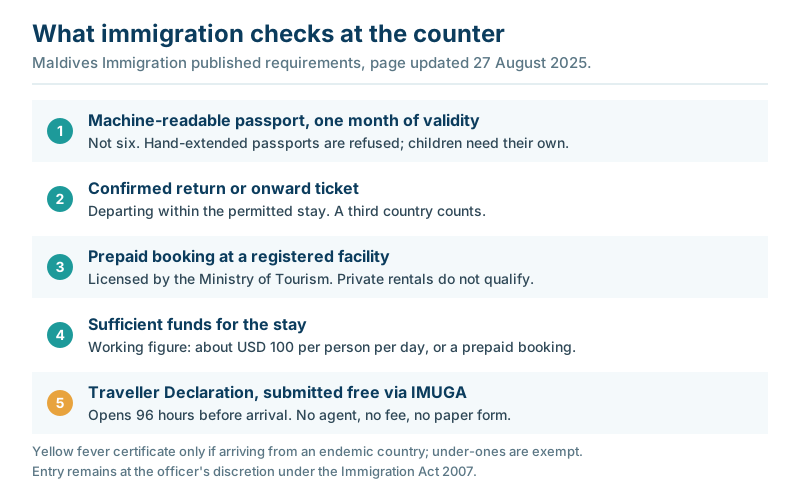
The published requirement for a visa on arrival is a complete travel itinerary, and it has three components. Officers do not always ask for all three, but they can ask for any of them.
A confirmed return or onward ticket. Departing within your permitted stay. An onward flight to a third country counts; it does not have to be a return to your home country.
A prepaid confirmed booking at a registered facility. The word registered is doing real work here. The property must be licensed by the Ministry of Tourism. Every resort and every legitimate guesthouse is; a private apartment, a friend’s spare room or an unlicensed rental is not. “Staying with friends” without a sponsorship arrangement is where refusals cluster. If you are island-hopping, hold confirmations for every night, not just the first.
Sufficient funds. The commonly cited working figure is around USD 100 per person per day, with roughly USD 50 per day on top if you have no prepaid accommodation. Cash, a card with a visible statement, or a banking app all serve. In practice, a prepaid resort booking answers this question by itself.
There is a fourth item that reads like boilerplate and is not: you must meet the entry requirements of your next destination. If you are continuing to a country that requires a visa you do not hold, that is a problem the Maldives will notice.
Alternatively, a pre-approved sponsorship visa from Maldives Immigration replaces the itinerary requirement entirely. That route exists for people visiting residents rather than staying commercially, and it has to be arranged before travel.
The Traveller Declaration is free, and some websites are charging for it
Every foreign traveller must submit a Traveller Declaration through the IMUGA portal. It opens 96 hours — four days — before your flight time, takes a few minutes, and produces a QR code that is checked at the immigration counter. Paper arrival cards no longer exist.
Maldives Immigration has published a direct warning about this form, and it deserves repeating in full because it costs travellers real money. The declaration is a free self-declaration submitted by you. No agent is required. There are reports of websites and individuals charging a fee to file it, and the department states plainly that the only correct route is the official portal at imuga.immigration.gov.mv.
If a site asks you to pay to submit a Maldives traveller declaration, it is not Immigration, and you are buying a form you could file yourself for nothing.
Two practical points. Fill it in on a laptop rather than a phone if you can, because the accommodation fields want the property’s registered name. And screenshot the QR code and save it to your camera roll — airport Wi-Fi at Velana is unreliable when several wide-bodies land together, and an email you cannot open is not a declaration.
On the question of whether a departure declaration is still required, the official portal settles it. IMUGA states that travellers must submit the declaration within 96 hours before their flight time for arrival, and the portal offers only three actions: new declaration, edit, and verify. Industry sources date the retirement of the separate departure form to August 2024.
The Ministry of Foreign Affairs consular page still describes submission in both directions. On the evidence, that page is out of date and the arrival declaration is the one that matters.
Our step-by-step walkthrough of the form, field by field, is a separate guide.
What actually happens at the airport
Velana International Airport moved all international arrivals into the new Terminal 1 in July 2025, and border control has changed more in the last year than in the previous decade.
The sequence, from wheels down:
- Disembark and follow signs to immigration. Terminal 1 has operational jetbridges for the first time at Velana, so most arrivals now walk straight in rather than boarding an apron bus.
- Queue for border control. E-gates went live at the start of 2026 and process passengers from more than twenty nationalities by facial recognition after a single passport scan. If your passport is not eligible, you queue for a staffed counter.
- Present passport and QR code. The officer checks the declaration, may ask for your accommodation confirmation and onward ticket, and stamps 30 days into the passport.
- Baggage reclaim, then customs. Screening on arrival is thorough and the prohibited-items list is stricter than most visitors expect.
- Meet your transfer. Resort desks sit in the arrivals hall; speedboat and seaplane counters are a short walk beyond.
Budget realistically for this. Even with the new terminal, travellers report 75 to 90 minutes from disembarking to the arrivals hall when several long-haul flights land in the same window. If you have a domestic connection, allow at least two hours; more in high season. Our guide to Velana International Airport covers the terminal layout, and if your flight lands in the evening, read what to do about a late arrival in Malé before you book, because seaplanes do not fly after dark.

Entry is a decision, not an entitlement
This is the part worth internalising, and the Immigration department states it directly: a complete travel itinerary does not guarantee entry. Admission is determined at the port of entry by an immigration officer under Sections 7 and 8 of the Maldives Immigration Act 2007.
In practice, refusals of a visa on arrival are rare and cluster around a few patterns: no confirmed accommodation at a licensed property, no onward ticket, answers that contradict the declaration, an obvious intent to work, or a history of overstaying. Frequent back-to-back visits can also attract questions, since the tourist visa is not a residence route.
None of this should worry an ordinary holidaymaker with a resort booking. It should, however, stop you from treating the paperwork as a formality you can improvise at the counter after a nine-hour flight.

Staying longer than thirty days
The visa on arrival can be extended once, by up to 60 days, for a maximum stay of 90 days. The extension is discretionary, it is not automatic, and it must be applied for before the original permission expires.
Reported requirements are consistent across sources: a local sponsor, usually your resort or guesthouse, paid accommodation covering the extended dates, evidence of funds, and an updated departure ticket. The fee is generally quoted at MVR 750, roughly USD 50.
Sources disagree on the mechanics, and the disagreement is worth knowing about before you rely on either version. Some describe an online application through the IMUGA portal. Others describe an in-person process at the Immigration head office in Malé requiring two separate visits on consecutive days, with the office closed Friday and Saturday. A third set quotes a different fee structure entirely. Ask your property to confirm the current procedure early in your stay rather than in your final week.
Overstaying is the one immigration mistake with real consequences: fines, possible deportation, and a record that complicates future entry. Airlines can also be penalised for carrying an overstayed passenger, which turns a paperwork problem into a boarding problem. If a cancelled flight or a medical issue makes departure impossible, go to Immigration before your permission expires. A late application is classified as an overstay even by one day, and proactive contact is treated far more favourably than a discovery at the departure gate.

Edge cases that come up more often than you would think
Transit passengers. Travellers connecting onward without clearing Maldivian immigration are handled separately and do not receive a tourist visa. If you leave the sterile area, you are entering the country.
Yellow fever. A vaccination certificate is required if you are arriving from, or have transited through, a country the Maldives treats as endemic. Children under one year old are exempt. No other vaccination is required for entry.
Liveaboards and cruise arrivals. A vessel booking is accommodation for these purposes, provided the boat is a registered facility. Safari vessels carried more than 23,000 visitors in the first seven months of 2026, so this is a routine case rather than an exotic one.
Working remotely. A tourist visa does not permit employment, paid or unpaid, or business engagements in the Maldives. Answering email from a beach is not what the rule targets; taking on local work is.
Second entries. Leaving and returning restarts a fresh 30-day permission at the officer’s discretion. It is not a documented route to indefinite stay, and repeated use invites the questions described above.
Arriving by sea privately. Yachts clear at designated ports with their own procedures. If that is your route, contact Immigration in advance rather than relying on a tourist-arrival guide.
When the visa on arrival is not the right route
The tourist visa on arrival covers holidays, and it covers almost everyone reading this. A handful of situations fall outside it, and the distinction matters because the wrong visa is a refusal rather than an inconvenience.
Working, paid or unpaid. Employment in the Maldives requires a work visa arranged by the employer before travel. This is not a formality that can be regularised afterwards, and it is one of the patterns officers watch for.
Business engagements. Short commercial visits — meetings, site visits, investment discussions — are commonly made on the standard tourist visa on arrival, but Immigration also issues dedicated business and meeting visas. If the trip involves anything contractual, ask your host which they expect. A meeting visa cannot be converted into a business visa from inside the country.
Staying with residents. Where there is no commercial booking, the route is a pre-approved sponsorship visa arranged by your host before you fly. Turning up and explaining the arrangement at the counter is the version that goes wrong.
Living here. Marriage, dependent and resident visas exist and are handled entirely separately. Repeated 30-day entries are not a substitute for any of them, and Immigration is explicit that frequent tourist entries can be refused.
For the overwhelming majority of visitors none of this applies. Book a resort or a licensed guesthouse, hold a ticket out, and the visa on arrival is the whole of your immigration paperwork.
What this guide deliberately does not cover
Immigration decides whether you may enter. Customs decides what your luggage may. They are different desks with different rules, and travellers conflate them constantly.
The Maldives operates one of the region’s stricter import regimes. Alcohol, pork products and material treated as religious in nature are confiscated on arrival, and the country now maintains a total prohibition on vaping devices and e-liquids alongside a generational tobacco ban. Alcohol confiscated at the border can be reclaimed on departure; other categories cannot. The full list, and what happens to each category, is in our guide to dress codes, banned items and customs rules.
The rules that apply after you clear both desks differ by where you are staying. On a resort island almost nothing is restricted; on an inhabited island, dress and alcohol rules apply from the jetty inwards, as our Maafushi guide sets out in practice.
After the stamp: getting to where you are staying
Immigration is not the last step of arrival day, and the step after it is the one that shapes your first evening.
Resorts reached by seaplane operate only in daylight, and a mid-afternoon landing usually means an unplanned night near the airport. Speedboat transfers run at any hour but vary enormously in price by distance. Remote atolls add a domestic flight before the boat, from a terminal a short walk from international arrivals. Our guide to domestic airports by atoll shows which one serves where, and how many airports the country has explains why published counts differ.
The full transfers guide compares all three methods and the cost comparison shows how quickly the numbers move by atoll. If you are staying in the capital rather than moving on the same day, Malé is a twenty-minute crossing from the airport.
Timing: the dates that change how arrival feels
The visa on arrival does not change with the calendar. Everything around it does.
Peak season queues. The visa on arrival takes the same two minutes in every season, but the queue for it does not. The northeast monsoon from December to April fills every wide-body into Velana, and immigration halls fill with them. Arriving in January or February can mean the upper end of that 75-to-90-minute range, and December around the New Year block is the worst of it. In June or September the same terminal can clear you in twenty minutes.
Ramadan. The border operates normally throughout, and no visitor rule changes at immigration. What changes is everything after it: government offices keep reduced hours, and daytime dining largely stops on inhabited islands. Read Ramadan in the Maldives if your dates fall inside it.
Public holidays. This matters only if you need an extension, but it matters a lot then. The Immigration head office in Malé closes on Fridays and Saturdays and on public holidays, and the two Eid periods — Eid al-Fitr and Eid al-Adha — can close it for several consecutive days. An extension you planned to file “next week” can lose a week to the calendar.
Where you are heading. The stamp is the same whichever atoll you have booked, but the connection after it is not. If you are still choosing, our atoll decision guide and the complete atolls guide explain which regions need a domestic flight and which are a boat ride away. Kaafu Atoll, including North Malé and South Malé, is the one region where a late landing rarely costs you a day.
Questions travellers ask before flying
Do I need a visa for the Maldives? Not in advance. Almost every nationality receives a free 30-day visa on arrival, stamped at the border with no application and no fee. The exception is Israeli passports, which have not been granted entry since 15 April 2025.
How long is the Maldives visa on arrival valid? Thirty days from the date of entry. It can be extended once by up to 60 days, for a maximum stay of 90 days, on application to Maldives Immigration before the original permission expires.
How much does the Maldives visa on arrival cost? Nothing. The visa is free and so is the Traveller Declaration. Any website charging a fee to submit the declaration is not affiliated with Maldives Immigration.
How many months of passport validity do I need? Maldives Immigration requires a machine-readable passport with at least one month of validity, not the six months most guides state. Check what your onward destination requires, and be aware that airlines may apply the six-month convention at check-in anyway.
Do I need a return ticket for the Maldives? Yes. A confirmed ticket out of the country within your permitted stay is part of the published requirement. An onward flight to a third country is acceptable.
Do I need to show a hotel booking? Yes, and it must be at a facility registered with the Ministry of Tourism. Resorts, licensed guesthouses and registered liveaboards qualify. Private accommodation does not, unless a sponsorship visa has been arranged in advance.
When can I fill in the IMUGA Traveller Declaration? From 96 hours — four days — before your scheduled flight time, not before. The window is counted from departure, not from landing. Save the QR code to your phone’s gallery rather than relying on airport Wi-Fi to open an email.
Can children travel on a parent’s passport? No. Every child, including infants, needs an individual passport to enter the Maldives.
What happens if I overstay? Fines and possible deportation, plus a record affecting future entry. If departure becomes impossible, contact Immigration before your permission expires rather than after.
What to take away
- The Maldives visa on arrival is free, valid 30 days, and available to almost every nationality; Israeli passports have been excluded since April 2025.
- Passport validity is one month with a machine-readable zone, not six. Hand-extended passports are refused and children need their own.
- Immigration checks a return ticket, a prepaid booking at a registered property and sufficient funds. “Staying with friends” is the answer that causes trouble.
- The Traveller Declaration opens 96 hours before your flight time, is free, and is filed by you. Sites charging for it are selling nothing.
- Entry is granted at the officer’s discretion under the Immigration Act, so treat the documents as documents rather than formalities.
Next step: submit the declaration exactly four days out, screenshot the QR code, and put the accommodation confirmation and onward ticket in the same folder on your phone. That is the entire preparation, and it takes about ten minutes.