Sandbank Trips in the Maldives: A Place That Exists at Low Tide
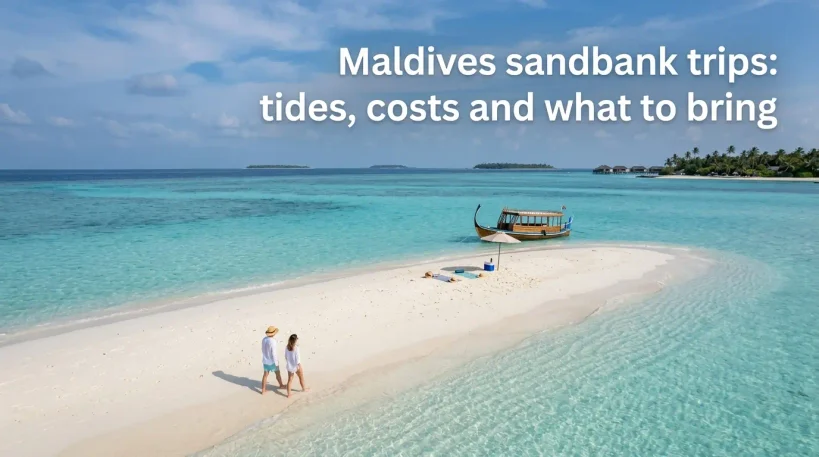
The sandbank photograph is the one that sells the Maldives. Two people, a curve of white sand, open ocean in every direction.
What it does not show is that the sandbank may not have been there yesterday and may be gone by four o’clock. These are not islands. They are unvegetated deposits of sand on a reef platform, moved by current and covered by tide, and the trip is built around a window the moon decides.
This guide covers what a sandbank actually is, why the tide is the whole booking, what the trip costs, and the four things nobody mentions before you are standing on one with no shade.
What a sandbank actually is
Not a small island, and the distinction matters.
It is sand on a reef platform. Coral rubble and shell fragments, broken down by wave action and deposited by currents onto a shallow part of the reef. No soil, no vegetation, no fresh water, nothing to anchor it.
It moves. A sandbank migrates across its platform as the monsoon reverses the prevailing current. It is the same mechanism our guide to whether the Maldives is sinking describes for inhabited islands, running far faster because no vegetation holds the sand.
It appears and disappears. Many sandbanks are exposed only at low or mid tide and are entirely underwater at high water.
Some are permanent. A finolhu is a sandbank stable enough to have persisted, occasionally with a few scrubby plants. Several have been developed into resorts.
Some are private. Resorts lease or control specific sandbanks and run exclusive trips to them, which is what you are paying for at the top of the price range.
The Dhivehi word to know is finolhu, and it appears in island names across the country — our guide to reading Maldivian place names covers the rest of the decoder.
The tide is the entire booking
If you take one thing from this article, take this.
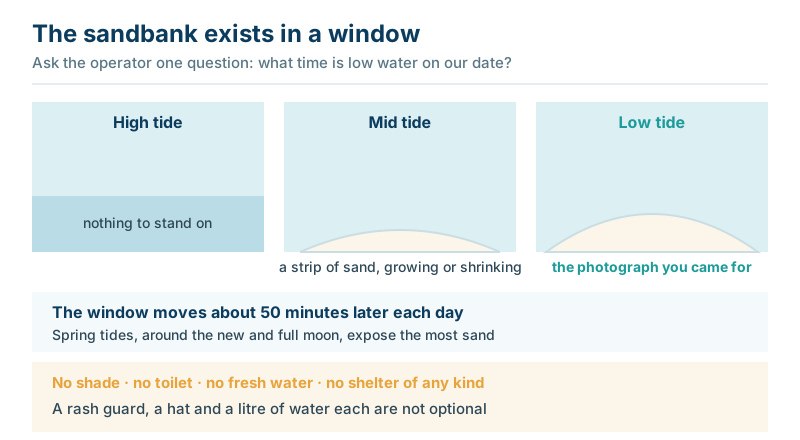
A tidal sandbank exists for a window of a few hours around low tide, and the window moves by roughly fifty minutes a day as the moon does.
Book the trip to the tide, not to your schedule. A morning departure is not automatically right. The correct question to an operator is: what time is low water on the day, and what time do we arrive?
Spring tides expose more sand, around the new and full moon. Neap tides expose less.
The sandbank shrinks while you are on it. Arriving two hours before low water gives you a bank that grows; arriving at low water gives you one that is disappearing under your feet for the rest of the visit. Both are fine if you know which is happening.
A good operator plans this without being asked. One that offers you a fixed departure time regardless of the date is selling boat hours rather than a sandbank.
What a trip actually involves
Predictable, and worth setting out because the reality is simpler than the marketing.
A boat ride of twenty to sixty minutes, usually on a dhoni, occasionally on a speedboat.
Two to four hours on the sand. Longer is uncomfortable; there is no shade.
Snorkelling off the edge, which is frequently the best part. Sandbanks sit on reef platforms, and the drop-off at the perimeter can be excellent — our snorkelling guide covers what to look for.
A picnic or barbecue, on the fuller packages. Some operators bring a table and a cool box; resorts bring a great deal more.
Nothing else. No facilities, no buildings, no toilet, no shop, no shelter. That is the point of the place and it is also the constraint.
Often combined with dolphin watching or a reef stop on the same half day, which is how most guesthouse-island operators sell it — the wider list is in our activities overview.
The four things nobody mentions
There is no shade. None. A bare sandbank at the equator between eleven and three is a genuinely hostile environment, and sunburn on a sandbank is the most common minor injury on the whole excursion list.
There is no toilet. Two to four hours, on a bare spit of sand, with a boat that may or may not have one aboard. Plan accordingly, and note that this rules the trip out for some people.
There is no fresh water except what you brought.
The sand reflects. You burn from above and below simultaneously, which is why people who applied sunscreen still come back scalded.
None of this is a reason not to go. All of it is a reason to bring a rash guard, a hat and more water than you think, and to book a morning or late-afternoon slot rather than the middle of the day.

What to bring
Short list, and every item earns its place.
A long-sleeved rash guard. More effective than any sunscreen across three hours, and it does not wash off into the water.
A hat with a brim, and sunglasses. The reflection off white sand is the problem.
Reef-safe sunscreen for everything the rash guard does not cover.
More water than you expect. A litre per person minimum, and operators do not always supply it.
A dry bag. Everything gets wet between the boat and the sand, because there is rarely a jetty.
Snorkelling gear, if the operator does not provide it and there is reef at the edge.
Reef shoes, for the entry and exit.
Nothing you cannot afford to lose in water. Phones go in the dry bag; jewellery stays in the room.
A towel to sit on, because there is nothing else to sit on.
Sandbanks with children
The trip divides sharply by age, and it is worth thinking through before booking.
Under five: probably not, unless the operator provides a canopy. Two hours of unshaded equatorial sun with no toilet is a hard proposition for a toddler and for whoever is carrying them.
Six to twelve: excellent, and among the best excursions in the country for this age. Shallow warm water on all sides, sand to dig, fish at the edge and no traffic of any kind.
Teenagers: the snorkelling at the drop-off is the draw, and the photographs.
What makes it work with children: a morning departure, a shade solution, a float each, and a shorter visit than the operator’s default. Ask for two hours rather than four.
What breaks it: midday heat, no toilet, and a long boat crossing in swell. Choose a nearby sandbank over a spectacular distant one.
Child pricing runs roughly 40 to 50 per cent of the adult fare on guesthouse islands and varies widely at resorts, as our excursion price guide covers.
What it costs
| From | Typical price |
|---|---|
| Guesthouse island, shared trip | USD 35–50 per person |
| Guesthouse island, private boat | USD 150–300 per boat |
| Resort, shared excursion | USD 150–300 per person |
| Resort, private sandbank with picnic | USD 300–800 per couple |
| Sandbank dinner or celebration | USD 500–1,500 per couple |
The usual multiplier applies. A resort sandbank trip costs roughly three times a guesthouse-island one, and it is frequently the same sandbank — the pattern our excursion price guide sets out across every activity.
Resort prices carry a 10% service charge and 17% TGST, compounding to about 28.7%, as our guide to money in the Maldives explains.
What the resort premium buys on this particular trip is real: exclusivity on a private bank, shade in the form of a rigged canopy, proper food, and nobody else in your photographs. Whether that is worth three times the money is the same question the whole country poses.
What a sandbank trip combines with
Most operators sell it as part of a half day, and the combinations are worth knowing because they change the value.
Sandbank plus snorkelling is the standard package and the best value: two stops, one boat, three to four hours.
Sandbank plus dolphin cruise works in the late afternoon, since dolphins are most active then and the light on the sand is at its best.
Sandbank plus a local island visit is the standard full-day trip sold from resorts, giving guests the village and the bare sand in one outing.
Sandbank plus turtle snorkelling, where the reef nearby holds them.
Sandbank as a stop on a whale shark day, which is how most full-day South Ari trips break up the boat time.
What does not combine well is a sandbank and anything on a fixed clock, because the tide sets the sandbank’s hours and nothing else on the itinerary will move for it.
Photography
The reason most people book, so it deserves proper treatment.
Go early or late. Morning light before nine and afternoon light after four. Midday sun on white sand produces a blown-out white rectangle and squinting faces.
Shoot from low and wide. Crouching at sand level with a wide lens exaggerates the curve of the bank and puts more sky behind the subject.
Include the edge. The transition from white sand to turquoise to deep blue is the image; a photograph of the middle of a sandbank is a photograph of sand.
Drones are restricted. They need permission, resorts have their own policies, and the aerial shot everybody wants is the one most likely to be refused. Our guide to restricted items covers the position.
Underwater from the edge. The shallow water around a sandbank is the easiest clear-water photography in the country, covered properly in our underwater photography guide.
Ask the crew. Boat crews take these photographs several times a week and know exactly where to stand.
When to go
The dry season, December to April, gives calm water, clear light and the most reliable conditions. Sandbanks are at their most photogenic.
The wet season, May to November, brings wind and swell. A sandbank trip is the excursion most often cancelled in the southwest monsoon, because the crossing and the landing both depend on a workable sea — our monsoon guide explains the pattern.
Within the day, early morning is the best combination of light, calm water and tolerable heat.
Around the moon, spring tides expose more sand.
One planning note: if a sandbank trip matters to you, build a spare day into the week. It is weather-dependent in a way that a spa booking is not, and operators cancel late because the sea decides late.
Sandbank dining, weddings and set pieces
The premium end of the category, and worth understanding as a separate product.
A private sandbank dinner puts a table on the sand at sunset, with staff, a cook and a boat standing off. USD 500 to 1,500 per couple at a resort, and considerably less arranged privately from an inhabited island.
A sandbank breakfast or picnic is the daytime version, cheaper and easier.
A sandbank wedding ceremony is the most photogenic setting in the country and the most fragile — it depends on tide, swell and the day, and it has no wet-weather backup. Our guide to weddings and vow renewals covers what that means for planning.
Proposals are the commonest private-sandbank booking of all, and every resort excursion desk has done it before.
One practical caution. All of these depend on the sandbank existing at the hour booked. A dinner scheduled for high water on a tidal bank is a dinner in the sea, and the resort will move it — which is fine unless you have flown family in for it.
Safety, honestly
Nothing dramatic, and four things worth knowing.
Sun is the hazard. More people are hurt by a sandbank trip through sunburn and dehydration than by everything else in this article combined.
Current runs at the edges. A sandbank sits on a reef platform, and water moves around it. The swimming is usually easy, and the drop-off is not always where you expect. Ask the crew where it is safe to swim.
No shade means no relief. For small children and anyone with a heat-sensitive condition, two hours is a long time.
There are no lifeguards, anywhere in the country, as our safety guide sets out. The responder is the boat crew.
Watch the boat. Operators anchor off and tender in, or beach the dhoni. Know where it is and when it leaves.
Leave it as you found it
Sandbanks are bare and fragile, and they matter ecologically more than they look.
Seabirds nest and roost on them. An undisturbed bank can hold significant numbers, and a group walking across a nesting area does real damage.
Turtles come ashore on some of them. Nesting is disrupted by lights, noise and traffic.
Take nothing. Sand and shells are covered by export restrictions, and removing either from a bank that is already migrating is worse than pointless.
Leave nothing. No bottles, no cigarette ends, no food waste. There is no bin and no cleaner, and everything you drop stays there or enters the water.
Stay off the vegetation where a bank has any — it is the only thing anchoring the sand.
None of this costs anything, and the alternative is a bare spit of sand with litter on it, which is not what anybody flew here for. The wider picture on Maldivian marine pressure is in our guide to coral reef health.
Where the good sandbanks are
Everywhere, is the honest answer, and that is unusual for a Maldivian activity.
Every atoll has them. Sandbanks form wherever current deposits sand on a shallow platform, which is most of the country.
South Malé and North Malé are the most accessible from the guesthouse islands and from Kaafu resorts, with several banks within a short boat ride of Maafushi and its neighbours.
Ari Atoll has a great many, often combined with whale shark or reef trips.
Baa, Lhaviyani and the northern atolls have quieter banks with fewer boats on them.
The far south has the emptiest of all, and almost nobody visiting them.
The practical point: you do not need to choose an atoll for its sandbanks. Choose it for the diving, the transfers or the budget — our atoll decision guide covers the factors that actually differ — and a sandbank will be within reach wherever you land.
Is it worth it?
Yes, once, and preferably from a guesthouse island. At USD 35 to 50 it is among the best-value excursions in the country, and the photograph is genuinely the one you came for.
Worth doing twice only if the first was cancelled or crowded.
Worth the resort premium if you want it private, and specifically if you are proposing, celebrating or photographing something that other people should not be standing in.
Not worth it in the middle of a hot day with small children, or for anyone who dislikes boats, sun or the absence of a toilet.
The underrated version: ask a guesthouse-island operator for a private boat at USD 150 to 300 and take four friends. That is a private sandbank for the price of a shared resort seat, and it is the single best-value line in our excursion price guide.
Questions travellers ask
What is a sandbank in the Maldives? An unvegetated deposit of sand sitting on a shallow reef platform. It has no soil, no vegetation and no fresh water, it migrates with the current through the year, and many are exposed only at low or mid tide.
How much does a sandbank trip cost? USD 35 to 50 per person from a guesthouse island, USD 150 to 300 per person from a resort, and USD 300 to 800 per couple for a private sandbank with a picnic. A private boat from an inhabited island runs USD 150 to 300 for the whole boat.
Does the sandbank disappear at high tide? Many do. Tidal sandbanks are exposed for a window of a few hours around low water, and that window shifts by about fifty minutes a day. Ask your operator what time low water falls on your date.
Is there shade on a sandbank? No. There is no shade, no shelter, no toilet and no fresh water. Bring a rash guard, a hat and more water than you think you need.
What is the best time of day to go? Early morning or late afternoon, for the light, the calmer water and the heat. Midday on white sand is uncomfortable and produces poor photographs.
Can you snorkel at a sandbank? Usually, and it is often the best part. Sandbanks sit on reef platforms and the drop-off at the edge can be excellent. Ask the crew where the current runs before you swim.
Can I fly a drone? Only with permission. Drones are restricted in the Maldives and resorts have their own policies, so arrange it in advance rather than assuming.
Which atoll has the best sandbanks? All of them. Sandbanks form throughout the country, so choose your atoll for the diving, transfers or budget and take the sandbank that is nearby.
What to take away
- A sandbank is sand on a reef platform, not an island. It migrates through the year, and many exist only for a few hours around low tide.
- Book to the tide rather than to your schedule, and ask the operator what time low water falls on your date.
- There is no shade, no toilet, no fresh water and no shelter. A rash guard, a hat and a litre of water each are not optional.
- USD 35 to 50 from a guesthouse island against USD 150 to 300 from a resort, for what is frequently the same sandbank.
- The best-value version is a private boat from an inhabited island at USD 150 to 300, split between four or five people.
Next step: before you book, ask two questions — what time is low water, and what time do we arrive. An operator who answers both precisely is selling you a sandbank. One who does not is selling you a boat trip that may end at a patch of shallow water where a sandbank used to be.


