What to Pack for the Maldives: Four Things That Matter, and a Weight Limit
Most Maldives packing lists are a wardrobe inventory. This one starts with two facts that change what actually goes in the bag.
The first is that sunburn is the commonest injury of a Maldives trip. A long-sleeved rash guard prevents it better than anything you can apply, because it does not wash off, does not get missed, and works for the hours you spend face-down over a reef.
The second is that your baggage allowance may not be the one on your ticket. If any part of your journey is by seaplane, the limit is set by the smallest aircraft in the chain: 20 kg checked and 5 kg cabin, whatever your long-haul airline allowed.
The four that matter
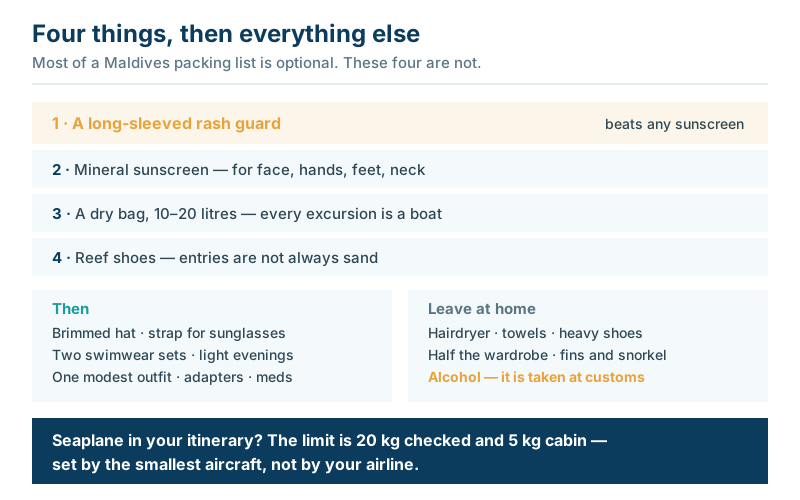
A long-sleeved rash guard. The single most useful item. The equatorial sun burns in under twenty minutes at midday, snorkelling exposes your back for hours, and sunscreen washes off. One rash guard removes the whole problem, and it removes it for children too.
Reef-safe sunscreen, for the parts a rash guard does not cover — face, hands, feet, the back of the neck.
A dry bag. Every excursion is a boat, boats produce spray, and a phone in a pocket is a phone in the sea. Ten to twenty litres is enough.
Reef shoes. Entries are not always sand, coral cuts infect quickly in warm water, and a cut foot on day two ruins a week of swimming.
Everything else is comfort, and most of it is replaceable on arrival.
A note on “reef-safe” sunscreen
Worth being precise, because the term is doing more work than it can bear.
“Reef-safe” is not a regulated claim. Any manufacturer may use it, and there is no standard test behind it.
What is checkable is the ingredient list. Mineral filters — non-nano zinc oxide or titanium dioxide — are the conventional choice, and the filters most often named in reef-damage research are oxybenzone and octinoxate.
Some properties have their own policy and will ask you not to use certain products, or will supply their own. Ask, rather than discovering it at the dive centre.
And the honest framing. Sunscreen is one pressure on reefs among several, and a much larger one is water temperature — the picture is in our guide to reef health. Choosing a mineral sunscreen is worth doing and it is not the thing that saves a reef.
Which is another argument for the rash guard. The most reef-friendly sunscreen is the one you do not need to apply.
The weight limit, in detail
The constraint that decides how much of the rest of this list you can actually take.
Your international allowance is not the operative one if a seaplane is involved. The seaplane limit governs, and our guide to seaplane baggage sets out the excess arrangements.
Twenty kilograms checked and five in the cabin is the standard figure, and excess is charged per kilo.
A speedboat transfer removes the problem entirely — the arithmetic on choosing one is in our guide to staying near the airport.
And there is a trick worth knowing. Most hotels in the airport area will store luggage, so anything you do not need on the island — a coat, city clothes, a second bag — can wait for you rather than costing excess in both directions.
Diving equipment is the usual culprit. A BCD and regulator set consume most of an allowance. Renting at USD 15 a day is frequently cheaper than flying them, as our guide to choosing a resort for diving sets out — bring your own mask and computer, rent the heavy items.
Why the Maldives packs differently from other beach destinations
Worth setting out, because it explains most of the choices above.
There is nowhere to buy anything. On a resort island the property owns the only shop, and it stocks a small selection at a large markup — the structural condition our guide to budget and all-inclusive describes. In most beach destinations a forgotten item is a ten-minute errand; here it is not.
You will be in the water far more than you expect. A Maldives week is snorkelling twice a day for most people, which is why water-facing items dominate the list and evening clothes barely feature.
The dress rules are real and geographic. Swimwear on resorts and designated beaches, covered shoulders and knees everywhere else. One modest outfit is not optional if any part of the trip touches an inhabited island.
The transfer imposes a weight limit that no other beach destination in this region does.
And the climate is uniform. No cool season, no altitude, no rain gear beyond a light layer. That simplifies the list enormously compared with somewhere like Sri Lanka or Thailand, where a trip crosses climates.
Which is why a Maldives bag is smaller than most. Fewer clothes, more water gear, and a hard weight ceiling.
Clothes, and how few you need
Shorter than most lists suggest, because a resort island has a laundry and a guesthouse island has one too.
Swimwear, two sets. One is always wet.
Light clothes for the evening. Resorts are informal; a shirt and trousers or a dress covers every restaurant on almost every island.
One modest outfit, covering shoulders and knees, for an inhabited island — required rather than polite, as our guide to dress codes explains. If you are staying on a guesthouse island, make that most of your wardrobe rather than one outfit.
Something with sleeves for the evening, because air conditioning at dinner is colder than the weather — and on a liveaboard the deck at night genuinely is.
Flip-flops, and that is the footwear. Resort islands are sand; you will wear shoes on the arrival day and not again.
A hat with a brim. A cap leaves your ears and neck exposed, which is exactly where people burn — and shade is not guaranteed, as our guide to island size explains about vegetation.
And sunglasses that float or a strap, which sounds trivial until you lean over the side of a dhoni.
What not to bring
The list that saves the most weight.
A hairdryer. Every resort room has one, and most guesthouses do.
Beach towels. Provided everywhere, including for excursions.
Full snorkel gear, unless you dive. Masks, snorkels and fins are available at every property, frequently free — though a mask that fits your face is worth its space, and our snorkelling guide explains why fit matters more than quality.
Heavy shoes. Nowhere to walk to in them.
A large wardrobe. Laundry exists, and on a guesthouse island it is cheap.
Books in hardback, if weight matters. An e-reader is the single best weight saving available.
And alcohol. It will be confiscated at customs — see below.
What is confiscated at the border
The section that turns a packing list into something more useful, because it involves an actual search.
Alcohol is prohibited on import. Duty-free bought en route is taken at Velana and, in principle, returned on departure. Bringing it deliberately does not work.
Pork products are prohibited.
Religious materials for distribution are prohibited, though personal items for your own use are not an issue.
Drones require permission, and the position varies by property and area — check before travelling rather than at the belt.
And the general principle: the Maldives runs a real customs check on arrival, and the list is enforced rather than nominal. Our guide to restricted items has the full picture, and it is worth two minutes before you pack.
The practical consequence for packing is small but worth stating: buy your duty-free on the way home rather than on the way out, because anything bought outbound sits in a locker at the airport for the whole trip.
Medication and the small first aid kit
Worth more attention than it usually gets, because a resort island has no pharmacy.
Bring what you rely on, in original packaging, in quantities that cover the trip plus a delay.
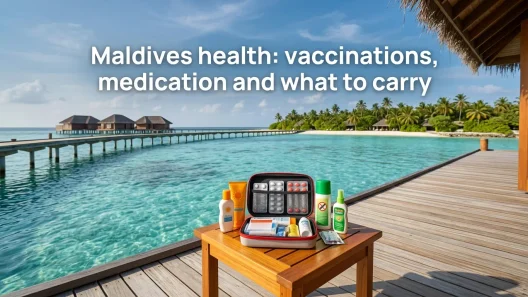
The kit that earns its space: antiseptic, plasters, painkillers, rehydration sachets, an antihistamine and anything for motion sickness.
Motion sickness is the one people forget. Every excursion is a boat, and the worst combination — anchored, at night, looking down — is exactly what a night fishing trip involves. Take it before boarding rather than after.
Antiseptic is for coral, and it is the injury of a Maldives trip. Clean a cut the same day.
Larger resorts have a doctor or nurse, smaller ones have neither, and serious cases go to Malé — the picture is in our safety guide.
And check your insurance covers what you will do. Many standard policies exclude diving and motorised water sports, and chamber treatment runs into thousands — our guide to travel insurance covers the exclusions.
Electronics
Short, and two items matter more than the rest.
Plug adapters. The Maldives predominantly uses the UK-style three-pin socket, and our guide to sockets and adapters covers the detail — bring two rather than one, because a room has fewer sockets than you have devices.
A power bank, for boat days and for guesthouse islands where the supply is occasionally interrupted.
A waterproof phone case or pouch, which is not the same as a dry bag and covers the moments the bag is closed.
Underwater camera housing, if you have one — the technique is in our guide to underwater photography, and the short version is that you need to get closer than you think.
And a local SIM or eSIM, bought on arrival rather than packed — coverage is good, roaming is not cheap, and our guide to SIM cards sets out the options.
Packing for a guesthouse island
Different from a Maldives resort, and the difference is mostly clothing.
Modest clothing is the default rather than the exception. Shoulders and knees covered outside the designated beach, including on the walk to it — the full picture is in our guesthouse guide.
A sarong or light cover-up is the single most useful addition, because you will put it on and take it off several times a day.
Bring more toiletries. Island shops stock the basics and not much beyond them.
Cash in small notes. Cards are increasingly accepted and cafés and boats frequently prefer cash — our guide to money covers the mechanics.
And bring less of everything else. Guesthouse rooms are small, laundry is cheap, and there is nowhere formal to dress for — the daily rhythm is in our guide to choosing a local island.
Packing for a liveaboard
Different again, and space is the constraint.
Soft bags only. There is nowhere to store a hard case on a boat, and crews will ask.
Less than you think. You will wear swimwear and a rash guard for a week, and evenings are a T-shirt.
A torch, for night dives and for finding your cabin.
Seasickness remedies, taken before boarding — the format and its constraints are in our liveaboard guide.
And a warm layer, which surprises people. Three or four dives a day is cold by the last one, and a boat at night in the wind is not tropical.
Packing with children
The additions that matter, and the ones that do not.
Rash guards for everybody, and this is where they matter most. Twenty minutes of midday sun burns a child, and reapplication is a fight.
Reef shoes, for the same reason as adults and more so.
Bring the medication you use at home, because the brands will not be there — and our guide to health before you go covers what else to check.
Formula, baby food and anything specific should be brought rather than assumed. Resorts will heat and store; they will not necessarily stock.
Ear defenders for a seaplane, which nobody mentions and which transforms the flight — the point our guide to choosing a resort for a family makes.
And less clothing than instinct suggests. Children live in swimwear, and laundry exists.
What to buy there rather than pack
The Maldives has one shopping opportunity worth using, and it is before you reach the island.
Sunscreen, a rash guard, a dry bag and reef shoes are all available in Malé and Hulhumalé at a fraction of resort shop prices.
Anything forgotten is easier to solve there than on an island — and the trip planner sets out where this decision sits in the sequence, in our guide to planning the trip.
A SIM card, at the airport.
And snacks, if you are the kind of traveller who wants them, because a resort minibar is priced accordingly and the 28.7% applies to it — the mechanism is in our guide to money in the Maldives.
What not to leave until arrival: prescription medication, a mask that fits, and anything you actually depend on.
The documents, and what to do before you leave
Not packing exactly, and it belongs in the same fifteen minutes.
The visa is free and granted on arrival to almost all nationalities, with nothing to apply for — the process is in our guide to the visa on arrival.
The IMUGA traveller declaration must be submitted within 96 hours of travel, in both directions, and it catches people out — our guide to IMUGA covers the form.
Passport validity should cover the trip with margin, as everywhere.
Insurance documents, saved offline rather than in an inbox you may not be able to reach.
Dive certification and a logbook, if you dive. Centres ask, and a card left at home means a check dive at best.
Your transfer confirmation, which is a separate contract from the flight and the thing most likely to fail — as our guide to missed connections explains.
And screenshots of everything, because a phone with no signal on a dhoni is a phone with no bookings on it.
The bag itself
Briefly, because it is the one decision made before packing starts.
Soft-sided is better — for the seaplane, for a dhoni, and for a guesthouse room with no space.
One checked bag and a small daypack covers almost every trip.
The daypack carries what must not get wet or lost: documents, medication, camera, a change of clothes for a delayed bag.
And keep it under the seaplane cabin allowance if that is your transfer, because the 5 kg is checked in practice rather than nominally.
The short version
Everything above, compressed into a Maldives packing list you can read at the wardrobe.
Essential for any Maldives trip: rash guard, mineral sunscreen, dry bag, reef shoes, brimmed hat, sunglasses with a strap, two swimwear sets, light evening clothes, one modest outfit, flip-flops, plug adapters, power bank, personal medication and a small first aid kit.
Bring if you already own them: mask, dive computer, e-reader, waterproof phone pouch, underwater housing.
Do not bring: hairdryer, towels, heavy shoes, a large wardrobe, alcohol, pork products, a drone without permission.
Buy on arrival in the Maldives: SIM card, anything forgotten, snacks.
And the weight check: if a seaplane is in your itinerary, 20 kg and 5 kg, with anything surplus left in airport-area storage.
Questions travellers ask
What should I pack for the Maldives? Four things do most of the work: a long-sleeved rash guard, mineral sunscreen, a dry bag and reef shoes. After that, two swimwear sets, light evening clothes, one modest outfit for inhabited islands, a brimmed hat, plug adapters and your own medication.
What is the baggage allowance? If any part of your journey is by seaplane, 20 kg checked and 5 kg cabin — set by the smallest aircraft in the chain rather than by your international ticket. A speedboat transfer removes the limit.
Do I need reef-safe sunscreen? It is worth choosing a mineral filter — non-nano zinc oxide or titanium dioxide — and some properties have their own policy. Note that “reef-safe” is not a regulated claim, and a rash guard removes most of the need for sunscreen at all.
What can I not bring into the Maldives? Alcohol, pork products and religious material for distribution. Drones need permission. Duty-free alcohol is taken at the airport and returned on departure.
Do I need to bring snorkel gear? Not usually — properties provide or rent it. A mask that fits your own face is worth bringing; fins and snorkels are not.
What should I wear on a local island? Shoulders and knees covered outside the designated beach, including the walk there. Swimwear is confined to the tourist beach. On a guesthouse island, make modest clothing most of your wardrobe.
What do I need for children? Rash guards above everything, reef shoes, your usual medication and any specific food. Ear defenders help enormously on a seaplane, and children need far less clothing than instinct suggests.
What should I buy there instead of packing? A SIM card, snacks, and anything forgotten — all far cheaper in Malé and Hulhumalé than at a resort shop. Never leave prescription medication or a mask that fits to chance.
What to take away
- A long-sleeved rash guard is the most useful thing in the bag. Sunburn is the commonest injury of a Maldives trip and the rash guard prevents it better than anything you apply.
- If a seaplane is in your itinerary, the limit is 20 kg checked and 5 kg cabin, whatever your airline allowed.
- “Reef-safe” is an unregulated claim. Look at the ingredient list, and remember that the sunscreen you do not need to apply is the best one.
- Alcohol, pork and religious material for distribution are confiscated at the border, and the check is real.
- Leave the hairdryer, the towels and half the clothes. Laundry exists, and airport-area shops are a fraction of resort prices.
Next step: put the rash guard, the reef shoes and the dry bag in first, then weigh the bag. If it is over 20 kg and a seaplane is in your itinerary, take things out rather than paying excess. Almost everything you would remove can be bought in Hulhumalé for less than the excess charge, and anything you might want at the end of the trip can wait in airport-area storage rather than flying twice.