Very Safe, and Very Far From a Hospital: Assessing Risk in the Maldives
Ask whether the Maldives is safe and the answer comes back reassuring, because on the risk most people have in mind — crime — it is genuinely excellent. Resort islands are private, staffed by vetted employees, and effectively crime-free. Violent crime against tourists is close to unheard of.
The risks that actually injure visitors are the ones nobody researches: water, distance and diving. Several tourists drown here every year, the nearest surgical hospital may be a boat and a domestic flight away, and the whole country has four decompression chambers.
This guide covers what the advisories say, what the medical system can do, and where those four chambers are.
What the official advisories actually say
Governments do not agree on the Maldives, and the disagreement is informative.
Canada and Australia both advise a high degree of caution. The Canadian advisory cites terrorism, dangerous coastal waters and, specifically, fatal accidents at whale shark tourism sites in the South Ari Marine Protected Area, in what is now South Ari Atoll. Australia flags strong tidal currents and rips, notes that many tourists drown every year, and warns that transport and tour operators do not always follow safety and maintenance standards.
The United States sits lower and emphasises drowning, modest dress and the strict enforcement of alcohol rules. British guidance is similarly measured.
Read those side by side and the pattern is clear. Nobody is asking whether the Maldives is safe on your resort island. The warnings are about water, about operator standards, and about the capital — and they exist alongside a tourism industry that handled more than two million arrivals last year with an extremely low incident rate. Check your own government’s live safety page before you fly, because the wording changes and ours is a summary rather than a substitute.
Putting the risk in proportion
Numbers help, because the emotional weighting of these risks is wrong in almost everyone.
The Maldives received more than two million visitors last year. Against that, several drownings a year is a small number in absolute terms and a large one relative to every other cause. Crime against tourists barely registers in the same table. Dive accidents are rarer still, but they are the ones with a five-figure bill attached.
So the sensible way to think about safety here is not “is the Maldives safe” as a yes-or-no question. It is a question of which specific risk applies to your trip. A honeymooner who does not dive and swims in a lagoon faces almost no meaningful risk at all. A diver heading to the far south faces a real one, entirely manageable with the right insurance and a look at the map.
Match the safety precautions to the trip you are actually taking, and ignore the rest.
Crime: the honest picture
On a resort island, crime is close to a non-issue and the honest safety answer is unqualified. The one-island-one-resort model means controlled access, no through traffic, no passing crowd and staff who are vetted and rotated. Room theft happens occasionally and is treated seriously. Leaving a phone on a sunbed is the realistic exposure, not being robbed.
In Malé the picture is ordinary urban. Petty theft, pickpocketing in crowded areas, occasional bag snatching. Drug-related and gang-related violence exists in the capital and on some inhabited islands, and it is real, but it runs between local groups and does not target visitors. Australian guidance names it explicitly and still rates the destination as broadly safe.
On inhabited islands like Maafushi, safety concerns are closer to nuisance than danger: excursion mis-selling, unlicensed operators, and the occasional dispute about what a price included.
The growth area is online rather than physical. Booking scams, fake resort listings, prepayment fraud and romance scams targeting people planning trips are common enough that advisories now mention them. Book through the property directly or a recognised platform, and treat any Maldives deal requiring a bank transfer as a risk in itself. Paying safely matters as much as travelling safely, and our guide to money in the Maldives covers how payment actually works once you arrive.
The water is the actual risk
This is the section that matters, and most safety guides bury it under paragraphs about crime. If you only read one part of this article, read this one.
Maldivian atolls are ringed by reef, and the gaps in that reef — the channels — move enormous volumes of water on the tide. Currents inside a lagoon can be gentle and 50 metres away, at the reef edge, be unswimmable. The water is warm, clear and calm-looking, which removes every visual cue a temperate-water swimmer relies on.
Four rules cover most of it:
- Ask before you swim. Resort staff and guesthouse owners know their own channel, tide and safe hours. The answer changes through the day.
- Snorkel with a buddy, and with a float. Most drownings involve people snorkelling alone, drifting further than intended, and tiring against a current on the way back.
- Wear a life jacket if you are not a confident swimmer. It is the cheapest safety equipment on the boat and nobody will think less of you. Operators carry them; use one.
- Do not swim near breakwaters or channel mouths. The engineered shorelines on inhabited islands create currents that are not obvious from the beach.
There are no lifeguards on most beaches, on resorts or local islands. Safety signage is inconsistent, and where it exists it is rarely updated for the day’s conditions. If something goes wrong in the water, the responder is whoever is nearest, and rescue services are not comparable to what you are used to at home. That is the single biggest difference between swimming here and swimming somewhere with a safety infrastructure.
Diving: four chambers for 1,192 islands
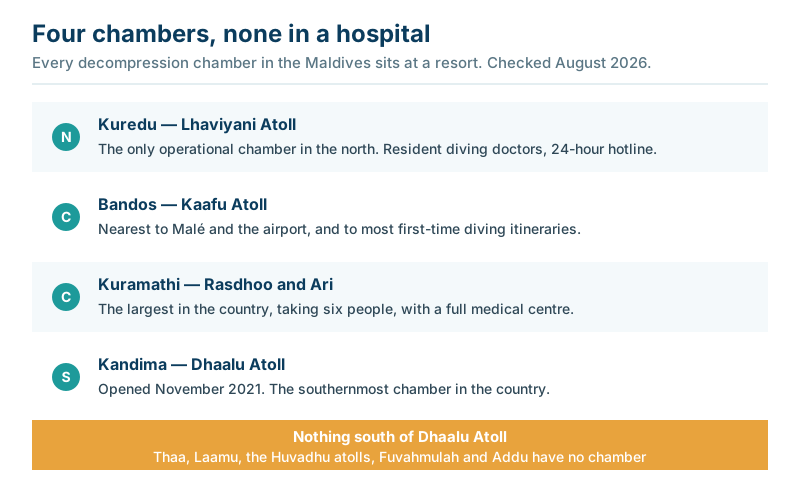
If you dive, this is the single most useful fact in this article. The Maldives has four hyperbaric chambers, and none of them is in a hospital. All four sit at resorts:
- Bandos, in Kaafu Atoll, nearest to Malé and the airport
- Kuramathi, in the Rasdhoo and Ari area — the largest in the country, taking six people
- Kuredu, in Lhaviyani Atoll, the only operational chamber in the north, with resident diving doctors and a 24-hour hotline
- Kandima, in Dhaalu Atoll, opened in November 2021 and the only one serving the central-southern atolls
Look at that list geographically and the gap is obvious. Everything south of Dhaalu — Thaa, Laamu, the Huvadhu atolls, Fuvahmulah, Addu — has no chamber at all. Fuvahmulah has become a serious destination for tiger shark diving, and it is a long way from a chamber.
Treating a dive accident costs roughly USD 5,000 to USD 15,000 for one person, which is why dive insurance is not an optional extra. Chamber treatment is not covered by ordinary travel insurance in many policies. Dedicated dive cover from DAN or an equivalent is the standard recommendation, and it is inexpensive relative to the exposure.
One more piece of arithmetic that catches divers. If your resort is reached by seaplane, your last dive and your flight home have to be at least the recommended interval apart — and the seaplane counts. Plan your final dive day around the transfer, not just the international departure. Diving guidance for the channel sites around Vaavu Atoll covers conditions in more detail.
Marine life that actually hurts
Sharks are not on this list. Reef sharks, nurse sharks, whale sharks and the tiger sharks of the far south are not a meaningful risk to swimmers, and shark attacks in the Maldives are essentially unheard of.
What does cause injuries:
- Stonefish, superbly camouflaged in shallow sand and rubble. The sting is severe and needs medical attention. Shuffle your feet; wear reef shoes.
- Sea urchins, on reef flats and around jetty pilings. Spines break off in the skin and can become infected.
- Fire coral and coral abrasion. Coral cuts are notorious for infecting in the tropics. Clean thoroughly, cover, watch for redness.
- Lionfish and scorpionfish, beautiful and best photographed from a distance.
- Stingrays, harmless if you do not step on one.
- Moray eels, which bite only hands that go into holes.
None of these risks is exotic. All of them fall to nearly zero with reef shoes, hands kept to yourself, and a shuffling step rather than a striding one in shallow water.
The medical system, tier by tier
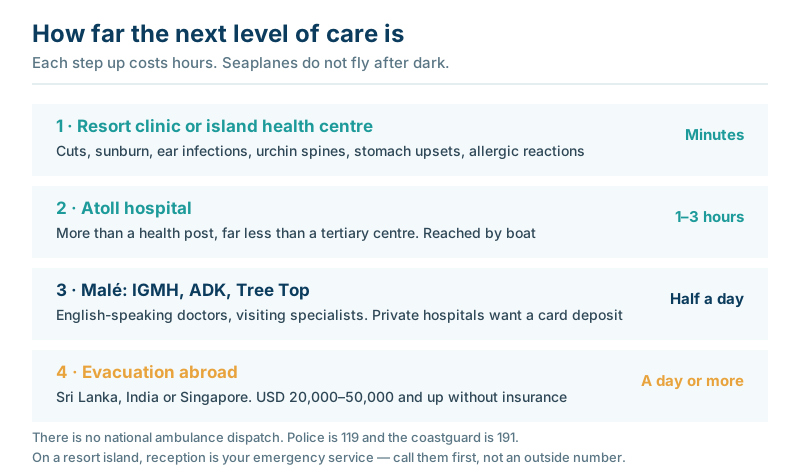
Understanding the ladder is what makes the rest of this article actionable. Care in the Maldives escalates through four levels, and each step costs time.
Level one: the resort clinic. Most resorts run a clinic staffed by a doctor or nurse, and it handles the great majority of safety incidents on the island. They handle cuts, sunburn, ear infections, urchin spines, stomach upsets and allergic reactions, and they generally stock adrenaline. On an inhabited island the equivalent is a government health centre with more limited hours and stock.
Level two: the atoll hospital. Regional hospitals handle more than a health post but far less than a tertiary centre. Getting there means a boat.
Level three: Malé. Indira Gandhi Memorial Hospital is the main public hospital. ADK is the leading private one, with Tree Top Hospital in Hulhumalé the other private option. All three have English-speaking doctors, and specialists rotate in from India and Sri Lanka. This is where a serious case ends up.
Level four: leaving the country. For anything the Malé hospitals cannot handle, the standard is evacuation to Sri Lanka, India or Singapore, on a flight out of Velana International Airport. Without insurance, air evacuation is routinely quoted at USD 20,000 to USD 50,000 and upwards.
Two practical details rarely mentioned. Public hospital services do not generally work with foreign insurance, and private hospitals commonly require a large deposit by card on admission — thousands of dollars — which your insurer reimburses later. Bring a card with headroom.
And the geography compounds everything. From an outer-atoll resort, level three is a boat plus a domestic flight, and seaplanes do not fly after dark — the same constraint that shapes arrival day also shapes a medical emergency. A night-time emergency in a remote atoll waits for daylight or moves by boat. That single fact is the strongest safety argument for choosing a nearer atoll if anyone in the party has a chronic condition. Our atoll decision guide sets out which regions sit close to Malé, and the transfer comparison puts numbers on the distance.
There is no 999 here
This surprises almost everyone, and it is worth knowing before you need it.
The Maldives has no single emergency number equivalent to 911, 999 or 112. 119 reaches the police. 191 reaches the coastguard for maritime emergencies. There is no national ambulance dispatch: you call an individual hospital and ask for one, and ambulance capability varies.
What this means in practice is straightforward. On a resort island, the resort is your emergency service. Call reception, not an outside number. They have the protocol, the boat, the radio and the relationship with the receiving hospital, and they will move faster than anything you can arrange yourself.
On an inhabited island, the guesthouse plays the same role, with a health centre a short walk away. If you are diving, the dive centre — not reception — is the right first call, because they know which chamber is nearest and how to reach it.
Save your insurer’s emergency assistance number offline before you travel. A local SIM or eSIM is worth the twenty dollars purely for this.
Insurance: what the policy actually has to cover
Insurance in the Maldives is not prudence, it is safety infrastructure. European health arrangements do not apply, nothing is reciprocal, and the expensive item is never the treatment — it is the transport to reach it.
Check these five lines before you buy:
- Medical evacuation by sea and air, including speedboat, seaplane and air ambulance, to Malé.
- Repatriation or evacuation to a third country, since the standard path for complex cases leaves the Maldives entirely.
- Diving cover to the depth you actually dive, if you dive at all. Many standard policies stop at 30 metres or exclude diving outright, and chamber treatment is the specific thing to check for.
- A high enough medical ceiling. A policy capped at USD 50,000 does not comfortably cover an evacuation plus hospitalisation.
- Direct billing or a 24-hour assistance line. With deposits required upfront, having someone to call at 3am matters more than the headline price.
If you dive seriously, add dedicated dive cover on top rather than assuming your travel policy handles it.
Health risks worth planning around
The Maldives is a low-disease destination by tropical standards, and the country has been certified malaria-free by the World Health Organization since 2015.
Mosquito-borne illness is the real one. Dengue is present year-round with periodic outbreaks, and chikungunya and Zika also occur. Repellent, long sleeves at dusk and covered accommodation handle it. Dengue matters most on inhabited islands and in Malé; resort islands are heavily managed.
Sun and heat injure more visitors than anything microbial. The equatorial UV index is brutal, water reflects it, and a snorkelling session burns backs badly. Rash guards beat sunscreen, and reef-safe formulations are increasingly required by resorts.
Water and food. Do not drink the tap water on inhabited islands; resorts serve desalinated water that is safe. Bottled water is everywhere and cheap. Food hygiene at resorts and established guesthouses is good; the usual caution applies to street-level food, though the local food is generally cooked to order.
Vaccinations. None are required for entry except yellow fever if you are arriving from an endemic country, as covered in our guide to the visa on arrival. Hepatitis A and typhoid are commonly recommended for longer stays on inhabited islands. Ask a travel health professional at least eight weeks before you fly, because this is medical advice and we are not qualified to give it. Entry paperwork is separate and covered in our guide to the IMUGA declaration.
Laws that can turn a holiday into an incident
The legal risks in the Maldives are not subtle, and enforcement is real. This is the one area where a traveller creates the risk rather than encountering it.
Drugs. Penalties are severe, including long custodial sentences. There is no leniency for tourists and no useful ambiguity.
Alcohol. Legal on resorts, illegal everywhere else. Bringing it through customs means confiscation, and drinking on an inhabited island is an offence. Our guide to dress codes, banned items and customs rules covers what is taken at the border, including the total prohibition on vapes.
Religious material and public behaviour. Importing religious texts other than for personal use is prohibited, and public displays of affection on inhabited islands are best avoided.
Drones. Restricted, and permission is required. Ask the resort before you fly one.
Nothing here is a trap. All of it is published, consistent and easy to comply with once you know the system you are in.
Who should think harder about this
Solo travellers, including women. The Maldives is comfortable, low-hassle and safe by any reasonable standard. Modest dress on inhabited islands, and the usual sense about unlit areas at night, is the whole of it.
Families. Resort lagoons are shallow, calm and about as safe as tropical water gets, and most resorts run kids’ clubs. The considerations are sun, the reef edge and the distance to a paediatric facility rather than anything else.
Anyone with a chronic condition. This is the group for whom atoll choice is a genuine safety decision. Bring more medication than the trip requires in original packaging, carry a doctor’s letter, and choose a resort within speedboat range of Malé rather than a seaplane hop away.
LGBTQ+ travellers. Same-sex relationships are criminalised under Maldivian law. In practice, resort islands are private and visitors report no difficulties, but the legal position is what it is and discretion on inhabited islands is sensible.
Divers. Covered above. The four chambers, and the insurance that pays for them, are the reason to read that section twice.
Weather, water and the long-term question
The monsoon runs roughly mid-May to November — June through September at its wettest — bringing strong winds, rough seas and heavy rain. Crossings get bumpy, seaplanes get delayed and snorkelling visibility drops. It is a comfort issue rather than a safety issue, provided you accept operator decisions about when not to sail. How the seasons behave is covered in the full transfers guide.
Cyclones are rare — the country sits south of the main Indian Ocean cyclone belt — but tsunamis are possible, as 2004 demonstrated. Know your accommodation’s safety and evacuation plan the way you would locate a fire exit: once, briefly, and then forget about it.
For the longer-term picture, including what sea level actually means for a country whose highest natural point is under three metres, see our piece on whether the Maldives is sinking.
Questions travellers ask about safety
Is the Maldives safe for tourists? Yes. On crime — resort islands are effectively crime-free and violent crime against visitors is very rare. The genuine risks are drowning in strong currents, dive accidents and the distance to hospital care from remote atolls.
Is the Maldives safe for solo female travellers? Yes. Resort islands are private and managed, and inhabited islands are low-hassle provided you dress modestly outside the designated tourist beach. Standard precautions apply in Malé at night.
What is the biggest safety risk in the Maldives? Water. Several tourists drown each year, most often while snorkelling unsupervised near reef channels where currents are far stronger than the surface suggests.
Are there sharks in the Maldives? Yes, many, and they are not a threat. Reef sharks, nurse sharks and whale sharks are routine sightings on snorkelling trips. Stonefish and sea urchins injure far more people than sharks ever will.
Do I need travel insurance for the Maldives? It is not a legal entry requirement, but for safety purposes it is effectively essential. Air evacuation to Sri Lanka or Singapore is routinely quoted at USD 20,000 to USD 50,000 or more, and private hospitals require a substantial deposit on admission.
Is there a decompression chamber in the Maldives? Four, all at resorts: Bandos in Kaafu, Kuramathi in the Rasdhoo and Ari area, Kuredu in Lhaviyani and Kandima in Dhaalu. There is none south of Dhaalu Atoll.
What is the emergency number in the Maldives? There is no single number. Police is 119 and the coastguard is 191, and there is no national ambulance dispatch. On a resort, call reception — the resort is your emergency service.
Can I drink the tap water? On resort islands, yes; it is desalinated and treated. On inhabited islands, no. Bottled water is inexpensive and available everywhere.
Are there vaccinations required for the Maldives? Only yellow fever, and only if you arrive from or transit an endemic country. Hepatitis A and typhoid are commonly recommended for longer stays on inhabited islands. Consult a travel health professional well before departure.
What to take away
- Ask whether the Maldives is safe from crime and the answer is yes: it is among the safest destinations in the world, and resort islands are close to risk-free.
- Water is the real risk. Several tourists drown each year, mostly snorkelling alone near channels where the current is invisible from the surface.
- There are four hyperbaric chambers, all at resorts, and none south of Dhaalu Atoll. If you dive the far south, know the distance before you descend.
- There is no national safety number and no ambulance dispatch. On a resort, reception is the emergency service.
- Insurance must cover sea and air evacuation, repatriation and diving to your actual depth. Transport, not treatment, is the ruinous line.
Next step: before you book, check two things against your own health — how far your chosen atoll is from Malé, and whether your insurance covers evacuation by seaplane. Both are decided at booking, and neither can be fixed afterwards.
This article summarises published guidance and is not medical advice. Consult a doctor or travel health clinic about your own circumstances, and check your government’s current advisory before departure.


