Maldives or Bali: One of These Is Not About the Beach
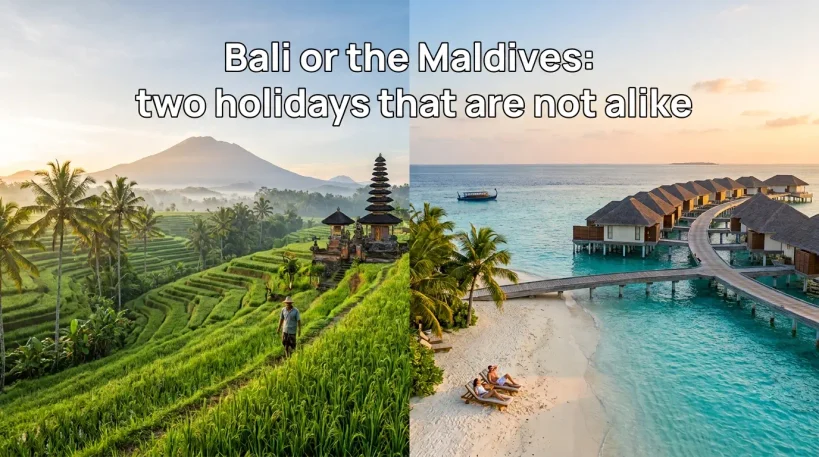
People compare the Maldives and Bali as though they were two beach holidays at different prices. They are not, and the correction is worth making before anything else.
Bali’s famous beaches are surf beaches. Grey and gold sand, waves, a shoreline that breaks rather than a lagoon that lies flat. The calm turquoise water people picture when they hear “Bali” is mostly on the offshore islands — Nusa Lembongan, Nusa Penida, and the Gilis next door in Lombok — rather than on the mainland south coast where most visitors stay.
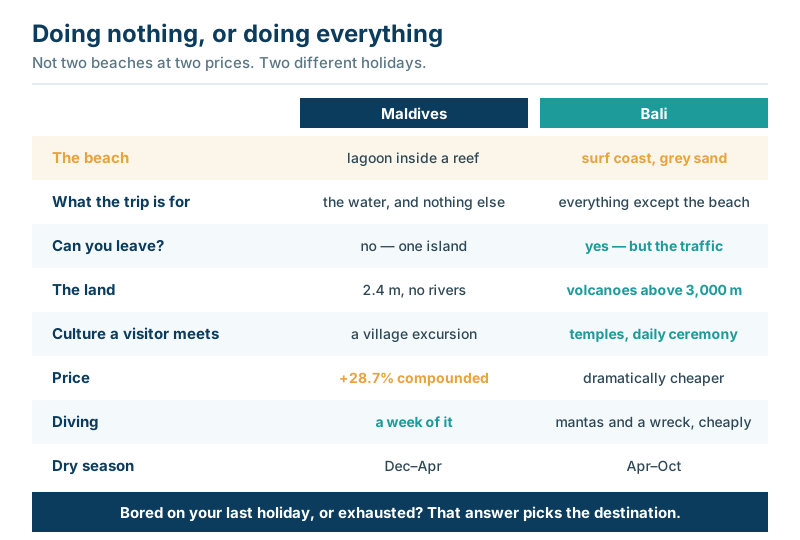
The Maldives is the opposite: a lagoon inside a reef, flat water, and nothing else at all. Which makes this the clearest contrast in the whole comparison set — one destination is about doing nothing, and the other is about everything except the beach.
1. The beach correction
Start here, because it is the most common misconception in this particular comparison.
The southern coast is a surf coast. Kuta, Seminyak, Canggu and Uluwatu are famous for waves, sunsets and beach clubs — not for wading into flat turquoise water.
The sand is not white in most of it. Volcanic geology produces grey and gold beaches, and several of the best-known ones are dark.
The calm-lagoon experience is offshore. Nusa Lembongan, Nusa Penida and the Gili islands are where the postcard water is, and reaching them is a boat trip of thirty minutes to two hours from the mainland.
Which means a beach holiday there and a beach holiday here are different products, and comparing brochure photographs will mislead you about both.
The Maldivian version has its own caveat, and it is the mirror image: “house reef” covers four different arrangements, one of which is a sandy lagoon with the reef four hundred metres out. The check is in our guide to reading a house reef and it matters more than any photograph.
Where Bali genuinely competes on water is underwater rather than at the shoreline — see below.
2. What the trip is actually for
The dimension that decides this comparison, and it is not close in either direction.
A Maldives trip is about the water and the absence of everything else. Nothing to organise, nowhere to get to, no traffic, no schedule. Our activities overview is explicit that two or three excursions across a week is the right number.
A trip there is about volume. Temples, rice terraces, volcanoes, waterfalls, markets, a serious food scene, a wellness industry, art towns, nightlife and traffic. A fortnight there can be full every day.
Which is a difference in kind, not degree. Someone choosing between them is not choosing between two beaches at two prices. They are choosing between a week of doing nothing and a week of doing a great deal.
And the failure mode runs both ways. People who wanted stimulation book the Maldives and describe it as boring by day four. People who wanted rest book Bali and spend the holiday in a car.
Answer that question honestly first and the rest of this article is confirmation rather than decision.
3. Can you leave?
The question that runs through this comparison set, with the most emphatic answer here after Thailand.
A Maldivian resort occupies its entire island. No road, no second restaurant, no shop, nowhere to walk. The alternative is a guesthouse island, a village you can cross in twenty minutes.
It is an island of roughly 5,600 square kilometres with over four million people on it. Roads everywhere, scooters, ride-hailing, and a hotel is a starting point rather than a container.
The caveat is traffic. The south is genuinely congested, and journeys that look short on a map are not. That is the practical cost of mobility there, and it surprises visitors who assumed island distances would be trivial.
Which produces an unexpected symmetry. In the Maldives you cannot go anywhere; in southern Bali you can go anywhere and it may take two hours. Neither is freedom of movement in the way a brochure implies.
The Maldivian equivalent of a bad journey is a cancelled boat, and our guide to missed connections covers what that costs.
4. What the land is
Where Bali has everything and the Maldives has nothing, and it is the source of most of Bali’s appeal.
Bali is volcanic. Mount Agung rises above 3,000 metres, there are craters, calderas, hot springs, rivers, waterfalls and rainforest.
The rice terraces are agriculture, not scenery arranged for visitors — a working landscape maintained by an irrigation system that has run for centuries.
The Maldives has none of this. A high point of about 2.4 metres. No hills, no rivers, no forest, no interior.
So the land component of a Bali trip is the trip. In the Maldives it is a beach and a path between the villa and the restaurant.
And it produces the wet-day difference. In Bali, rain sends you to a temple, a museum or a warung. In the Maldives, wind cancels the boat and you are on the island — a distinction our guide to rainy days draws carefully.
5. Culture, which is Bali’s actual product
Worth its own section, because it is what people mean when they say Bali is “more interesting”.
Bali is a Hindu island in a Muslim-majority country, with temples in every village, daily household offerings, processions, ceremonies and a religious calendar that visitors encounter constantly.
It is not curated for tourism. The ceremonies happen whether or not anybody is watching, which is what distinguishes it from a cultural attraction.
Ubud is the centre of the visitor version — art, dance performances, craft villages and the wellness industry that grew around them.
The Maldives has no equivalent a visitor can access. Non-Muslims generally do not enter mosques and there is no historic quarter to wander. The culture a tourist meets is either a resort’s presentation of it or a village on an excursion.
Which is a real asymmetry and should be said plainly. If seeing a culture is part of what you want from a holiday, Bali offers it and the Maldives structurally cannot.
The Maldivian counter is that it does not pretend to. The country sells water and isolation, and our comparison of resort and inhabited islands is honest about how little of the country a resort week contains.

The overtourism question, which applies to one of them
Worth raising because it is a real planning input rather than a moral aside.
The south is busy. Traffic, development pressure, waste management and water use are all discussed openly in Indonesia, and a visitor in the south encounters the congestion directly.
Which is a function of success, and it varies enormously by area. The north, east and the interior are a different experience from the Kuta-to-Canggu strip.
The Maldives has the opposite structure and its own version of the problem. One resort per island distributes visitors so thoroughly that crowding is invisible — but the reef pressure, the imported everything and the waste from a hundred self-contained operations are real, as our guide to reef health and our guide to what the country runs on both touch on.
Neither country is the responsible choice by default. They distribute the pressure differently, and a visitor’s behaviour matters more than the destination in both.
The practical version for planning: in one place you choose an area to avoid crowds; in the other you choose a density figure, which is measurable from a satellite map before you book.
6. What is in the water
The section where the comparison is closer than most people expect, and where Bali earns real credit.
The Maldives has the stronger reef overall. More coral, more reef fish, more species, and reliable encounters with manta rays, reef sharks and turtles — plus the year-round whale shark aggregation in South Ari, which has no Balinese counterpart.
But Bali has mantas too. Nusa Penida holds manta cleaning stations among the better-known sites in Southeast Asia. The diving there is genuinely good.
And it has a wreck. The Liberty at Tulamben is shore-accessible and heavily dived — a category the Maldives does not compete in.
Water temperature and conditions differ. Nusa Penida can be cold and current-swept in a way Maldivian sites generally are not, and it is not beginner water.
The seasonal draw is the mola mola, which appears around Nusa Penida in the middle of the year and is a genuinely unusual sight.
Which produces an honest summary: the Maldives is better for a week of diving, and Bali is better value for a few days of very good diving inside a trip that is mostly about other things.
7. What it costs
The dimension most people already assume, and the assumption is right.
Bali is dramatically cheaper across the range. Accommodation from hostel to villa to ultra-luxury, food at every price point, and transport that costs very little.
The Maldivian bill compounds. A 10% service charge and 17% goods and services tax reach roughly 28.7% on nearly every resort line. The mechanism is in our guide to money; what a package excludes is in our guide to budget and all-inclusive.
A week for two, excluding international flights. Maldivian figures from our own budget work; Bali as orientation.
| Maldives | Bali | |
|---|---|---|
| Budget | USD 1,100–1,900 guesthouse island | Well below |
| Mid-range | USD 4,500–8,000 resort | A small fraction |
| Luxury | USD 12,000+ | Substantially less |
| Transfer to the hotel | USD 200–1,640 for two | A road transfer |
| Eating outside the hotel | Impossible at a resort | The normal way to eat |
| Tax on the bill | ~28.7% compounded | Local taxes, plus a visitor levy |
Bali introduced a tourist levy payable by foreign visitors — a modest fixed amount rather than a percentage. Check the current figure and payment method before travelling, since the process has changed since introduction.
And the Maldivian bottom end competes. A guesthouse island at around USD 60 a night with meals at USD 5 to 13 is not far off Bali pricing, and almost nobody comparing the two knows it exists.
8. The rules you live under
Different in a way that matters more for the cheap version of the Maldives than for the resort one.
Bali is relaxed. Alcohol is sold normally, dress is a matter of courtesy, and temple visits ask for a sarong and covered shoulders in the same way churches ask elsewhere.
The Maldives operates two legal regimes. Alcohol is served on resort islands under licence and is unavailable on every inhabited island; swimwear is for resorts and designated tourist beaches only. Our guides to alcohol and dress codes set out the detail.
Which does not usually affect a resort week, since a Maldivian resort is licensed and behaves like anywhere else.
It affects the guesthouse-island option decisively. That format competes with Bali on price, and it is dry, modest and rule-bound in a way Bali is not.
And there is a local etiquette around temples, ceremonies and offerings on the pavement, asked of visitors constantly rather than in a defined zone.
9. Season
Similar in shape and offset in timing, which matters for anyone with fixed dates.
The Maldives runs on the monsoon. December to April is dry, clear and expensive; May to November is wetter, cheaper and better for large animals. The mechanism is in our monsoon guide and the pricing in our guide to high and low season.
The dry season runs roughly April to October, and the wet season roughly November to March.
Which means the European summer favours Bali and falls in the Maldivian wet season — a real argument for anyone tied to school holidays.
And December to March reverses it, with the Maldives at its best and Bali at its wettest.
Both are hot year-round, and neither has a cool season in any meaningful sense.
10. Who each one suits
Choose the Maldives if: the water is the whole point, you want to be unreachable, and doing nothing is the objective rather than a fallback.
Choose Bali if: you want a country, a culture, food, terrain and things to do, at a price that lets you stay longer.
Divers: the Maldives for a diving week; Bali for excellent diving inside a broader trip, at a fraction of the cost.
Surfers: Bali, comfortably. The Maldives has surf and access to two of its best waves is controlled by the resorts in front of them, which our guide to choosing a resort for surfing explains.
Honeymooners: the Maldives for seclusion; Bali if you would rather be doing something together. Our honeymoon guide covers the Maldivian case.
Families: Bali for variety and cost, the Maldives for a contained shallow lagoon and no traffic anywhere — the considerations are in our guide to choosing a resort for a family.
Long trips: Bali, and it is not close. A month there is a country; a month in the Maldives is a very long time on a small island.
Anyone who has been disappointed by a beach holiday before: work out whether the disappointment was boredom or exhaustion. The answer picks the destination.
Two weeks, and what each one does with them
The length question, because these two destinations behave very differently as trips lengthen.
A Maldives week is coherent and a Maldives fortnight needs a plan. Seven nights on one island is a complete holiday; fourteen on the same island is a long time, which is why our where to stay pillar keeps recommending a split — a few nights on an inhabited island and a few at a resort.
A fortnight there fills itself. South, then Ubud, then the east or the north, then an offshore island — and most visitors run out of days rather than ideas.
Which reverses the value calculation. Per day, the Maldives is expensive and gets no cheaper with time. Bali gets better value the longer you stay, because the fixed cost is the flight and everything after it is inexpensive.
And it changes the shape of a trip. A Maldives fortnight is two or three bases at most. A fortnight there can be five, and moving between them costs very little.
If you have three weeks or more, the comparison stops being close: Bali absorbs the time and the Maldives does not, unless you are diving daily or on a liveaboard.
11. Can you do both?
Geographically awkward, occasionally done, and worth understanding.
They are a long way apart — the Maldives sits in the Indian Ocean west of Sri Lanka, Bali in the Indonesian archipelago, with no short hop between them.
Combining them means a third long flight and usually a Southeast Asian or Gulf hub, which is a lot of flying for a fortnight.
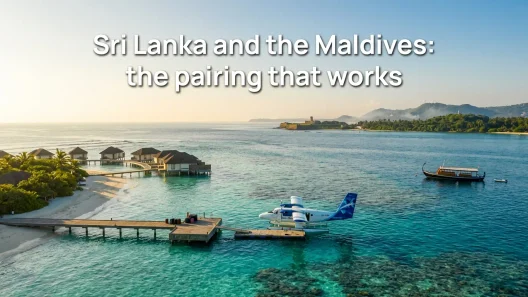
Each has a natural partner. Bali pairs with the rest of Indonesia — Java, Lombok, Flores, Komodo — reachable by short domestic flights and ferries. The Maldives pairs with Sri Lanka, a short hop and a completely different trip.
And a useful framing for a fortnight: you are frequently choosing between two pairings rather than two islands, which our comparison hub sets out for the whole set.
What we know first-hand, and what we do not
We have been to the Maldives — to Maafushi, an inhabited island, with a day visit to one resort. We have not stayed overnight at a Maldivian resort, which is why nothing on this site ranks them.
We have not been to Bali. This comparison is structural: geography, transport, cost mechanics, legal environment and season — facts that are checkable rather than felt.
Which is why this article says nothing about Balinese food, service, hotels or people. We are not in a position to, and neither is most of the comparison content that claims otherwise.
The Maldivian figures are ours, from published work on this site. The Bali figures are bands, labelled as orientation.
Three of the ten comparisons in this set were written after visiting both countries — Mauritius, Zanzibar and Thailand. This is not one of them, and the difference is stated on purpose.
Questions travellers ask
Which is better, the Maldives or Bali? Different holidays rather than different beaches. The Maldives is water, isolation and doing nothing. Bali is culture, terrain, food and volume, at a small fraction of the price. Decide which of those you actually want before comparing anything else.
Does Bali have white sand beaches like the Maldives? Mostly not on the mainland. Southern Bali is a surf coast with grey and gold sand and waves. The calm turquoise water is on the offshore islands — Nusa Lembongan, Nusa Penida and the Gilis — a boat ride away.
Which is cheaper? Bali, dramatically, across the whole range. The Maldivian exception is a guesthouse island at around USD 60 a night, which competes directly and which most comparisons never mention.
Which has better diving? The Maldives for a diving week, on coral, species and reliable large animals including year-round whale sharks. Bali has manta cleaning stations at Nusa Penida, a famous shore-accessible wreck at Tulamben, and much lower prices.
Can you leave your hotel? In Bali, constantly — though southern traffic makes short journeys long. On a Maldivian resort island, no; the property occupies the whole island.
When should I go to each? The Maldives is best December to April. Bali’s dry season runs roughly April to October, so the European summer favours Bali and falls in the Maldivian wet season.
Is alcohol available in both? In Bali, normally. In the Maldives, only on resort islands and floating bars; every inhabited island is dry.
Can I visit both in one trip? Rarely worth it — they are far apart with no short hop. Bali pairs with the rest of Indonesia; the Maldives pairs with Sri Lanka.
What to take away
- Bali’s mainland beaches are surf beaches with grey and gold sand. The calm turquoise water is on the offshore islands, and most comparisons get this wrong.
- This is a choice between doing nothing and doing a great deal, not between two beaches at two prices.
- Bali has volcanoes above 3,000 metres, rivers, rainforest and a living Hindu culture. The Maldivian high point is about 2.4 metres.
- Bali is dramatically cheaper — except against a Maldivian guesthouse island, which competes and which almost nobody knows about.
- Bali has mantas at Nusa Penida and a famous wreck. The Maldives still wins a diving week, on coral, species and year-round whale sharks.
Next step: answer one question before you look at a single hotel. Was your last disappointing holiday disappointing because you were bored, or because you came home exhausted? Boredom points at Bali and exhaustion points at the Maldives — and that single answer is more reliable than any list of beaches.